The best thermal scope for an AR-15 is the ATN ThOR 6 640×512 | 2-16x at $2,295: a 640×512 sensor at ≤15mK, 3,100 m (3,390 yd) of detection and 830 g (1.83 lb) on the rifle. Two things change that answer — how far you actually shoot, and what you can spend once the mount is in the cart.
Short answer: for most AR-15 owners, our top ATN pick is the ATN ThOR 6 640×512 | 2-16x at $2,295 (list $3,625). Under $1,000, take the ATN ThOR 6 Mini 256×192 | 2-16x at $689 (list $985). For shots past 300 yards at unknown distances, the ATN ThOR 6 LRF 640×512 | 3-24x at $2,995 (list $4,945).
Quick answer: the best thermal scope for an AR-15
- Best overall, mixed distances — ATN ThOR 6 640×512 | 2-16x — $2,295 (list $3,625): 640×512 at ≤15mK, 3,100 m (3,390 yd) detection, 830 g / 1.83 lb.
- Best value, first thermal — ATN ThOR 6 384×288 | 2.5-20x — $1,595 (list $2,195): the same ≤15mK sensitivity, 2,300 m (2,515 yd) detection, 790 g / 1.74 lb.
- Best lightweight, long carries — ATN ThOR 6 Mini 384×288 | 2.5-20x — $1,295 (list $1,975): 528 g / 1.16 lb, 384×288 at ≤18mK, 2,300 m (2,515 yd) detection — the lightest 384 scope in this guide, 262 g under the full-size 384.
- Best long-range, unknown distances — ATN ThOR 6 LRF 640×512 | 3-24x — $2,995 (list $4,945): 3,650 m (3,992 yd) detection, built-in 1,000 m rangefinder, ballistic calculator.
- Best under $1,000, first build — ATN ThOR 6 Mini 256×192 | 2-16x — $689 (list $985): 1,200 m (1,312 yd) detection, 500 g (1.10 lb), and a Picatinny quick-detach mount in the box.
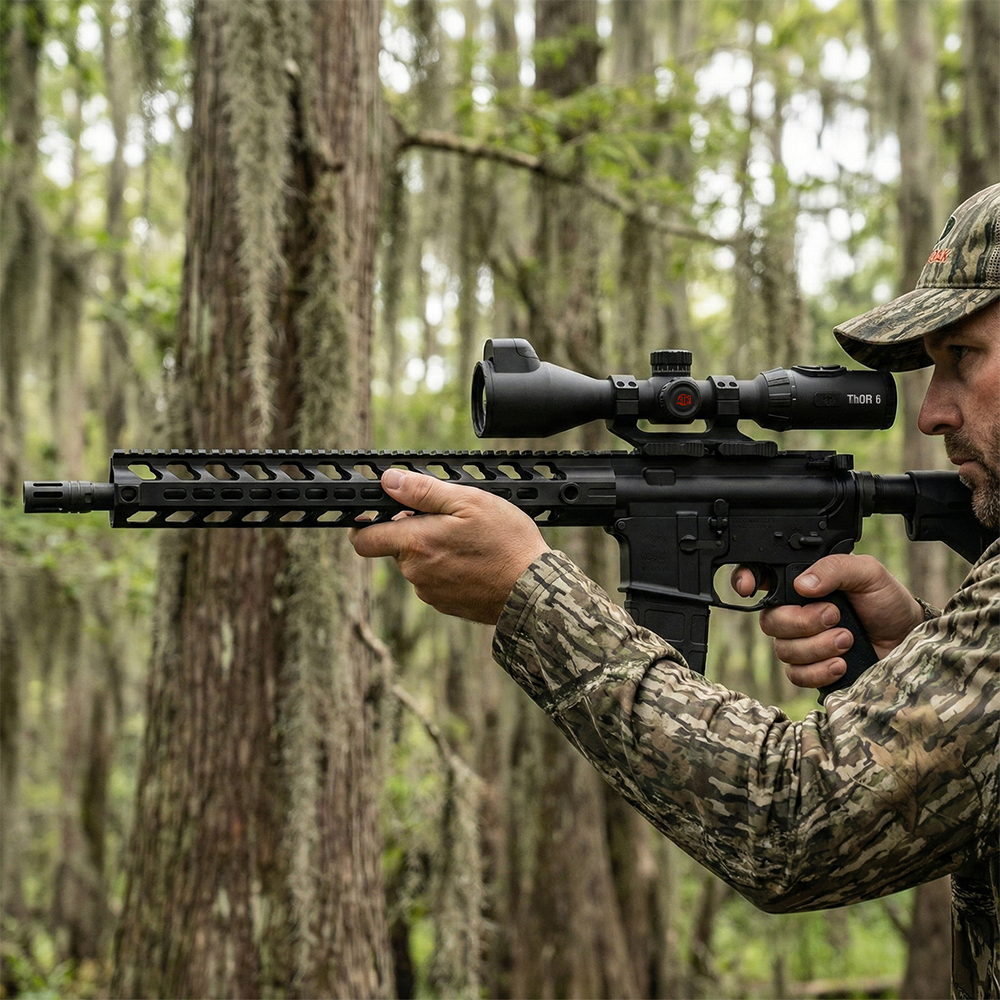
AR-15 thermal scope comparison table
| Pick | Model | Best for | Sensor | NETD | Magnification | Detection | Battery | Weight | Price (store / list) |
|---|---|---|---|---|---|---|---|---|---|
| Best overall | ATN ThOR 6 640×512 | 2-16x | Mixed distances, identifying past 150 yd | 640×512 | ≤15mK | 2× optical, 16× max (8× digital) | 3,100 m / 3,390 yd | ~9 hrs | 830 g / 1.83 lb | $2,295 / $3,625 |
| Best value | ATN ThOR 6 384×288 | 2.5-20x | A first thermal, work inside 250 yd | 384×288 | ≤15mK | 2.5× optical, 20× max (8× digital) | 2,300 m / 2,515 yd | ~9 hrs | 790 g / 1.74 lb | $1,595 / $2,195 |
| Best lightweight | ATN ThOR 6 Mini 384×288 | 2.5-20x | Carrying the carbine more than resting it | 384×288 | ≤18mK | 2.5× optical, 20× max (8× digital) | 2,300 m / 2,515 yd | ~7 hrs | 528 g / 1.16 lb | $1,295 / $1,975 |
| Best long-range | ATN ThOR 6 LRF 640×512 | 3-24x | Open ground past 300 yd at unknown distances | 640×512 | ≤15mK | 3× optical, 24× max (8× digital) | 3,650 m / 3,992 yd | ~9 hrs | 855 g / 1.89 lb | $2,995 / $4,945 |
| Best under $1,000 | ATN ThOR 6 Mini 256×192 | 2-16x | A first build, shots inside 150 yd | 256×192 | ≤20mK | 2× optical, 16× max (8× digital) | 1,200 m / 1,312 yd | ~8 hrs | 500 g / 1.10 lb | $689 / $985 |
Prices and specs: ATN product pages and price list, checked 19 November 2026. The first price is the current store price, the second is the list price; both change with the season, so check the product page before you buy. Detection range is the manufacturer's published distance at which the optic registers a heat signature — it is not a shooting distance and not the distance at which you can tell a hog from a dog. Magnification is split deliberately: the first figure is the optical magnification of the lens, and the rest of the range comes from 8× digital zoom on a thermal scope in 1×/2×/4×/8× steps, which enlarges the picture without adding detail.
How we picked
We ranked five ThOR 6 configurations against the ATN specification sheets, not against a field test we cannot show you. ATN makes every scope on this list, so read this as a guide to the ThOR 6 line rather than an independent test of the whole market. I am the founder of the company, and that is exactly why the criteria are written down instead of implied.
The criteria, in the order they change outcomes on a carbine: sensor resolution and NETD, published detection range, recoil rating, weight on the rifle, battery runtime, and price with the mount included. Every number comes from the ATN specification sheet for that specific SKU, never from a family page — the 640 and the Mini 640 are different scopes and we do not average them.
Where our own published figures disagree, the specification sheet wins over the marketing copy. Two cases in this article: the Mini 384 product page states "under 500 g" while the ThOR 6 Mini manual lists 528 g (1.16 lb), and 528 is not under 500, and the 384 product page carries a description block copied from the 640. The manual figure is the one in the table. Nothing here was independently tested, and no identification distances are published because we have not measured them.
What an AR-15 needs from a thermal scope
An AR-15 asks four things of a thermal scope: a recoil rating well above 5.56, a mount that fits a flat-top Picatinny rail, weight the carbine can carry at the muzzle end, and enough eye relief to sit behind it with your normal cheek weld. Here is what ATN publishes against each.
Recoil rating. Every ThOR 6 in this guide — full-size and Mini alike — carries a maximum recoil rating of 6,000 J, stated on the same specification line as 1,000 g of acceleration over 0.4 ms. ATN publishes both figures on the same specification line. A 5.56 carbine sits far below that figure, which is why the same optic survives being moved to a heavier rifle later.
Mount and rail fit. The three full-size models use a 30 mm tube and take 30 mm rings, which are not included. ATN's own is a dual cantilever mount — a quick-detach 30 mm cantilever made in the USA, $199 (list $219). The two Mini models ship with a Picatinny QD mount in the box, so there are no rings to buy and no ring torque to get wrong.
Weight. The lightest scope here is the ThOR 6 Mini 256×192 | 2-16x at 500 g (1.10 lb); the heaviest is the ThOR 6 LRF 640×512 | 3-24x at 855 g (1.89 lb). That 355 g gap sits forward of the receiver, where a carbine feels it most. Budget the mount with the optic: a full-size model is 830–855 g before rings.
Eye relief and mount height. Eye relief across the ThOR 6 line is 50 mm. That is short enough that fore-and-aft position on a flat-top upper deserves a few minutes of fitting before you zero. ATN does not publish a recommended ring height for AR uppers, so set it for a repeatable cheek weld with the stock you actually run rather than to a number.
Battery. The full-size models carry two 18650 cells, one internal and one swappable, for about 9 hours. The Minis run one swappable 18650 for about 7 to 8 hours. All five accept external USB-C power. If you sit from dusk to dawn, read thermal scope battery life before you choose.
Why the 6th generation matters on a carbine
Generation 6 changed the two things that decide an AR-15 build: sensitivity and weight. Every full-size ThOR 6 runs a 12μm VOx sensor at ≤15mK NETD. That number describes how faint a temperature difference the optic can separate from the background, and it is what saves you on a humid August night when a hog's body and the sun-loaded ground are nearly the same temperature. Resolution decides how far you can zoom before the picture turns to mush; NETD decides whether there is a picture worth zooming into at all.
The second change is the housing. Thirty years after I imported my first night vision units into a space barely bigger than a garage, we build optics the way phone makers build phones — one platform, several configurations, and a relentless fight over grams. The full-size ThOR 6 sits at 830 g (1.83 lb) on a magnesium alloy chassis; the Mini line starts at 500 g (1.10 lb). On a 16-inch carbine that gap is the difference between a rifle you carry all night and one you set down at midnight.
Every ThOR 6 also records. There is 64 GB of internal storage, Recoil Activated Video that automatically keeps 10 seconds before and after the shot, and Wi-Fi to the ATN Connect 6 app. Recoil Activated Video is a recording feature, not a durability rating — the two get confused because of the name. I have settled more than one argument about where a bullet went by pulling up the RAV clip before we walked up on the animal.
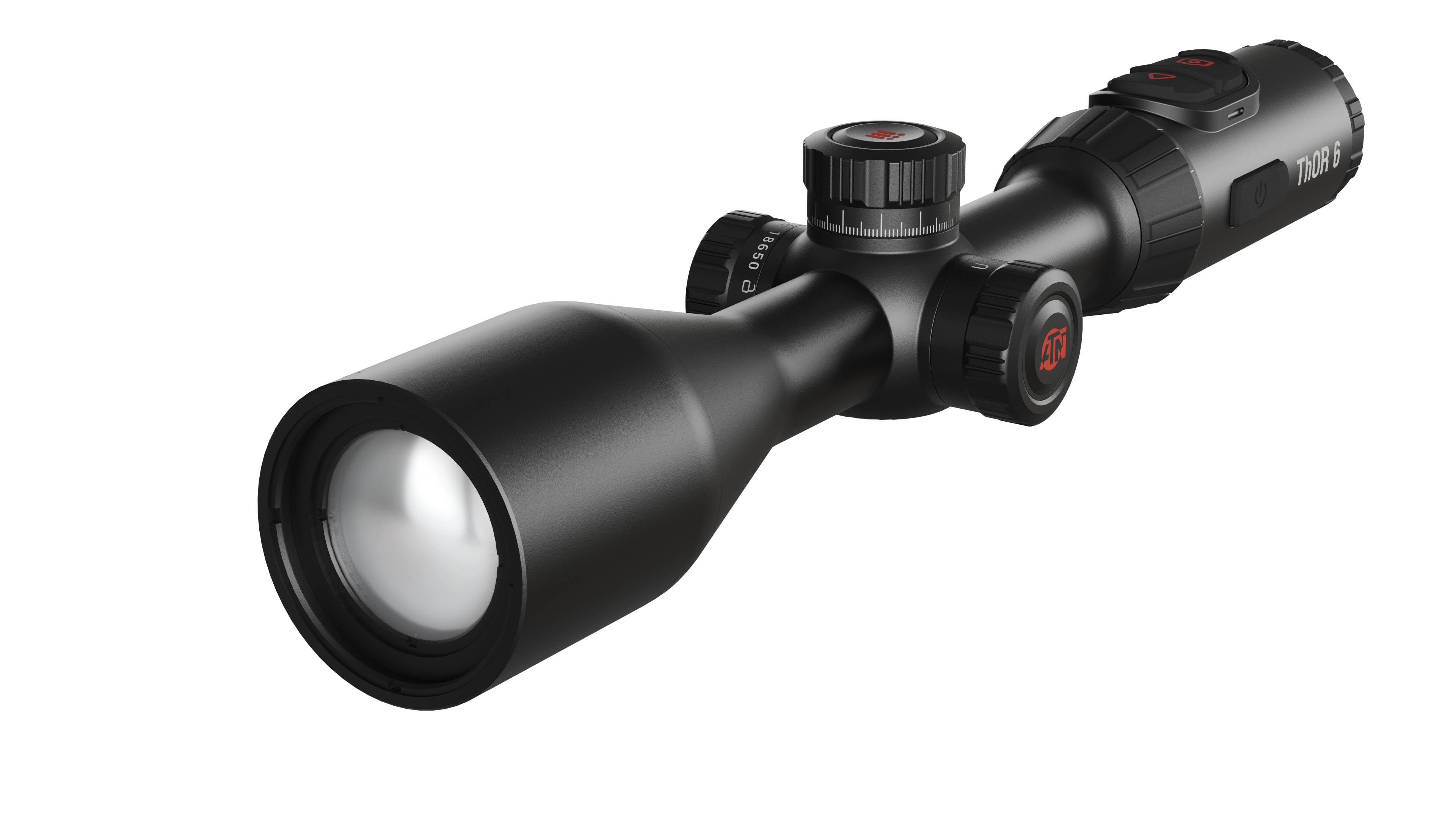
Best overall: ATN ThOR 6 640×512 | 2-16x
The ThOR 6 640 2-16x is the one I would put on my own carbine, because 640×512 at ≤15mK gives you enough pixels to identify an animal rather than just register that something warm is out there — and that gap is exactly where most AR-15 shooters get into trouble.
Image quality
The 12μm sensor runs at a 50 Hz refresh rate and feeds a 0.49-inch, 1920×1080 OLED display, and SharpIR runs edge and contrast enhancement on the live image. Six palettes are on board — White Hot, Black Hot, Iron Red, Alarm, Green Hot and Sepia — and I switch between White Hot and Black Hot more often than I expected once hot ground starts washing out contrast after a scorching day.
Range and magnification
Optical magnification is 2×; the 16× maximum comes from 8× digital zoom in 1×/2×/4×/8× steps, through a 35 mm F/1.0 germanium lens with a 12.52° × 9.41° field of view. Detection range is 3,100 m (3,390 yd). Most of the magnification range is digital, which is worth knowing before you shop on the headline number alone.
Battery and build
Two 18650 cells — one internal, one swappable — give roughly 9 hours, so a full night does not need a power bank dangling off the rifle. The chassis is magnesium alloy, IP67, rated from -30°C to 55°C, and 830 g / 1.83 lb in a 430×85×72 mm body. It mounts in 30 mm rings, which are not included; on an AR I run the ATN dual cantilever mount, a 30 mm quick-detach at $199 (list $219), so the optic comes off in seconds and goes back on without hunting for zero.
Smart features
Zeroing Freeze pauses the image at the moment of impact so you can move the reticle without a partner calling shots. Picture-in-Picture keeps a wide window live while you zoom, Hot Point Tracking flags the hottest object in the frame, and startup is under 7 seconds — instant out of standby.
Buy this if you hunt past 150 yards and want to identify what you are looking at. Skip it if your shots are inside 100 yards over a feeder — you are paying for pixels you will not use. If you are weighing resolutions rather than models, our guide to 640 thermal scopes covers that decision on its own.
Best value: ATN ThOR 6 384×288 | 2.5-20x
The ThOR 6 384 2.5-20x keeps the ≤15mK sensitivity of the flagship and trades pixel count for $700 at store prices. That is the trade I recommend to most first-time thermal buyers.
Strengths
Same ≤15mK NETD, same 0.49-inch 1920×1080 display, same 64 GB and RAV, same IP67 magnesium housing and the same 6,000 J rating as the 640 — in a 790 g / 1.74 lb body that is actually 40 g lighter. The 25 mm F/1.0 lens gives a 10.53° × 7.91° field of view and 2,300 m (2,515 yd) detection.
Limitations
Against the ThOR 6 Mini 384 at $1,295 it costs $300 more for the same 384×288 sensor and the same 2,300 m detection; what the extra buys is ≤15mK instead of ≤18mK and about 9 hours of runtime instead of 7. Push digital zoom hard at 300 yards and the 384 sensor starts showing you its pixels while a 640 still holds a readable outline.
Not ideal for
Ground that regularly opens past 300 yards, and anyone who already knows they want to identify rather than spot at that distance.
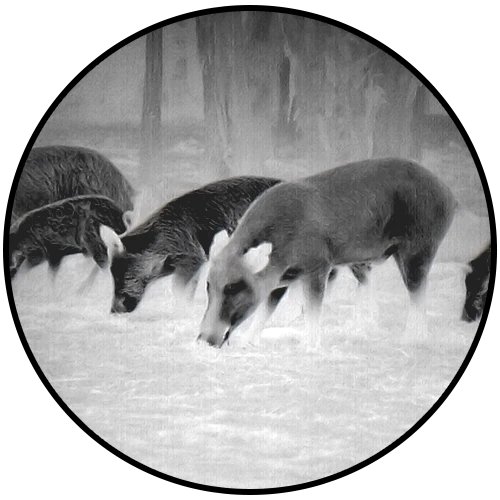
Best lightweight: ATN ThOR 6 Mini 384×288 | 2.5-20x
If balance on the rifle is what you care about, the ThOR 6 Mini 384 is the answer: 528 g / 1.16 lb with a 384×288 sensor at ≤18mK and the same 2,300 m (2,515 yd) detection range as its full-size sibling. The Mini 256 is lighter still at 500 g; this is the lightest 384 in this guide, 262 g under the full-size 384.
Strengths
The Mini line exists because of a complaint I heard for years — thermal makes a light carbine feel like someone bolted a brick to the front of it. This one runs 2.5× optical to 20× with 8× digital zoom through a 25 mm F/1.0 germanium lens with a 10.5° × 7.9° field of view, in a 180×65×65 mm magnesium body. Same 0.49-inch 1920×1080 OLED as the full-size models, 64 GB of storage with RAV, Wi-Fi to Connect 6, IP67 sealing, the 6,000 J rating, and a Picatinny mount in the box rather than on a separate line of the invoice.
Limitations
Seven hours on a single 18650 instead of nine on two, so an all-night sit means swapping cells — a second battery ships in the box. And ≤18mK instead of ≤15mK is a real difference on humid nights — small, but it is there.
Not ideal for
Sitting in one place from dusk to dawn, where the longer runtime of the full-size models matters more than the grams.
Best long-range: ATN ThOR 6 LRF 640×512 | 3-24x
Past 300 yards, misses stop coming from image quality and start coming from range estimation, and the ThOR 6 LRF 640 3-24x is the model that fixes that. Of the five picks here, it is the only one with a built-in rangefinder.
Strengths
The laser rangefinder reads to 1,000 m with ±1 m accuracy on an eye-safe Class 1 905 nm laser, and the ballistic calculator stores up to six profiles for different rifles. Behind it: 640×512 at ≤15mK, a 50 mm F/1.0 germanium lens, 8.78° × 6.59° field of view, 3× optical to 24×, and 3,650 m (3,992 yd) of detection, the longest figure ATN publishes for a ThOR 6.
Limitations
$2,995 (list $4,945) is the top of the ThOR 6 line, it weighs 855 g (1.89 lb), and the 50 mm lens narrows the field of view to under 9° — useful on open ground, slower when you are sweeping thick brush. If you are weighing sensor sizes above 640 rather than models, our guide to 1280 thermal scopes covers where that resolution sits in the ATN range.
Not ideal for
Shooters whose distances are mostly inside 200 yards — buy the 640 without the LRF and spend the difference on ammunition. If calling predators is the main job, our guide to the thermal scope for coyote hunting picks a winner for that one.
Best under $1,000: ATN ThOR 6 Mini 256×192 | 2-16x
At $689 (list $985) the ThOR 6 Mini 256 is the floor I am willing to stand on, and it is a real thermal scope rather than a compromise dressed up as one.
Strengths
The 256×192 sensor at ≤20mK sees to 1,200 m (1,312 yd) through a 15 mm F/1.0 lens with an 11.7° × 8.8° field of view. For an AR-15 build it has one detail the bigger models do not: a Picatinny quick-detach mount ships in the box, so there are no 30 mm rings to buy and no ring torque to get wrong. It weighs 500 g / 1.10 lb in a 180×65×65 mm body, runs about 8 hours on a single replaceable 18650, and keeps the 64 GB of storage, RAV, Wi-Fi, Hot Point Tracking, IP67 sealing and 6,000 J recoil rating of the rest of the line.
Limitations
The display steps down to a 0.32-inch 800×600 OLED, the sensor carries 49,152 pixels against 327,680 on the 640 — about a sixth, and 1,200 m detection is the shortest here. Where cheap thermal cuts corners is exactly in those three places; we chose to keep the sensitivity and the sealing honest and let the display be smaller. If you are shopping this tier broadly, see thermal rifle scopes under $1,000 and cheap thermal scopes.
Not ideal for
Anyone who already knows they want reach. At 300 yards you will want the 384 or the 640, and you will have bought twice.
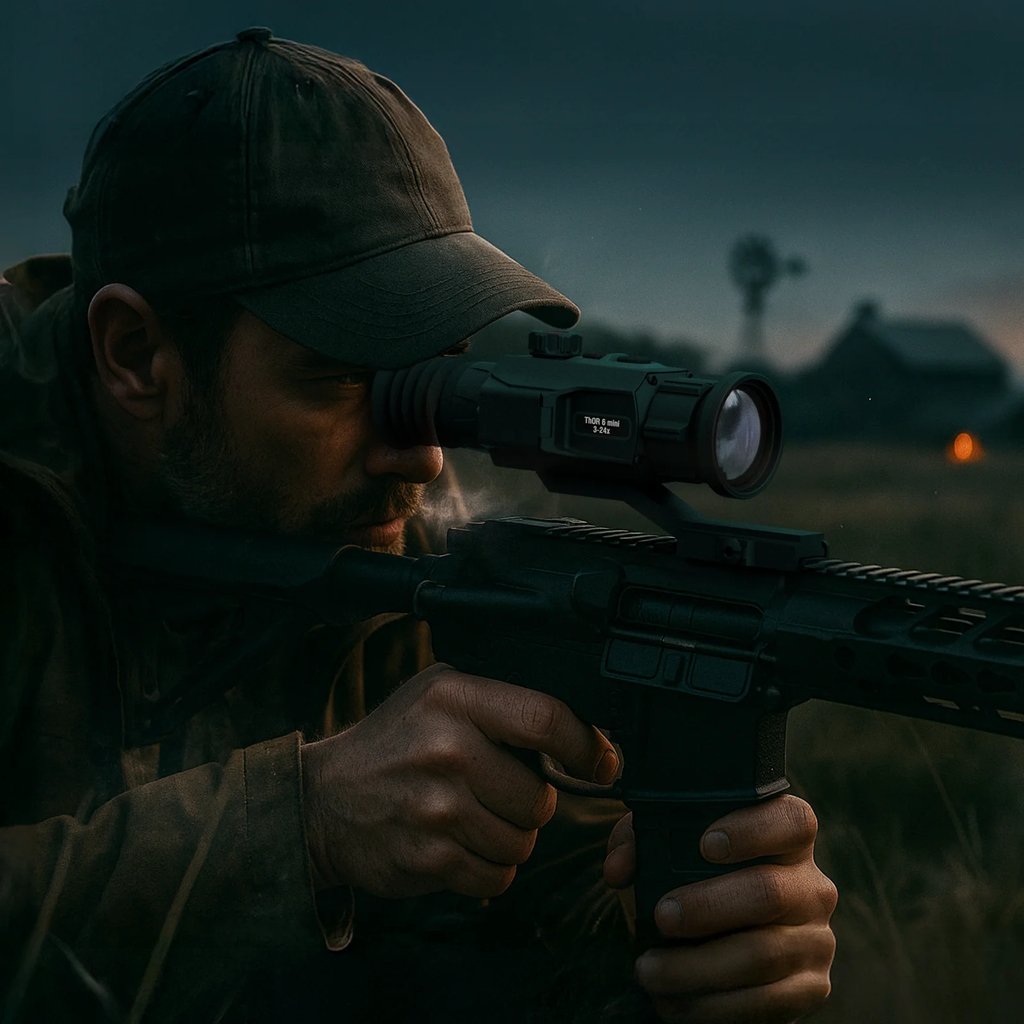
Thermal or night vision on an AR-15
On an AR-15, thermal is the better first optic for finding game, and digital night vision is the better one for identifying it. Thermal reads emitted heat, so it needs no light at all and shows an animal through grass and light brush. Digital night vision amplifies reflected light and leans on an infrared illuminator after dark, which gives you a recognizable picture — coat, markings, antlers — but an IR beam will not push through heavy foliage.
For a carbine used mostly after dark on hogs or predators, buy thermal. For a rifle that works in daylight as often as at night, and where positive identification matters more than detection distance, the digital route costs less. The full comparison is in night vision vs thermal.
Can you hunt with thermal in your state
It depends on your state, the species and the season, and we cannot answer it for your ground. Many states permit thermal on non-game animals such as hogs and coyotes, often with conditions on permits, seasons or landowner permission, while rules for deer and other big game are usually far stricter and in places prohibit night optics outright. Some counties add rules of their own, and the rules change.
Check the current regulations with your state wildlife agency before you plan a hunt. This is thermal optics advice, not legal advice.
How to choose for your AR-15
Answer four questions in this order and the model picks itself. If you want the longer version of this reasoning without model names attached, start with our thermal scope guide.
- How far do you actually shoot? Inside 150 yards the Mini 256 is enough. Out to 250, the 384. Past 300, the 640 — and past 300 at unknown distances, the LRF version.
- What does your ground look like? Thick brush and short lanes reward a wider field of view and lower optical magnification, which is where the 2× models sit. Open pasture rewards the 50 mm lens on the LRF 640.
- How much weight will you carry? A full-size ThOR 6 is 830–855 g / 1.83–1.89 lb before rings; the Minis are 500–528 g with a mount included. If you walk more than you sit, the Mini line is the honest choice.
- What is your budget, including the mount? The full-size models need 30 mm rings; our quick-detach dual cantilever mount is $199 (list $219). The Mini 256 and Mini 384 ship with a mount.
One more path worth knowing: if you like your day optic and do not want to give it up, a TICO 6 clip-on ($995 for the 256×192, list $1,205) mounts in front of it and leaves your day zero alone. Choose a dedicated scope if the rifle is a night rifle, and a clip-on if the same rifle works in daylight. You can compare the whole line on our thermal scopes page; if hogs are the whole reason for the build, see our thermal scope for hog hunting guide, and if you hunt more than hogs, the best thermal scope for hunting takes a wider view.
FAQ
What is the best thermal scope for an AR-15?
For most AR-15 owners, the ATN ThOR 6 640×512 | 2-16x at $2,295 (list $3,625): a 640×512 sensor at ≤15mK, 3,100 m (3,390 yd) of detection and 830 g (1.83 lb) on the rifle. Under $1,000, the ThOR 6 Mini 256×192 at $689. Past 300 yards at unknown distances, the ThOR 6 LRF 640×512 | 3-24x.
Will a thermal scope handle 5.56 recoil?
Yes. Every ThOR 6 in this guide, full-size and Mini alike, carries a maximum recoil rating of 6,000 J, published on the same specification line as 1,000 g of acceleration over 0.4 ms. A 5.56 carbine sits far below that figure, which is why the same optic survives being moved to a heavier rifle later.
Do I need 384 or 640 resolution for an AR-15?
384×288 is enough for confident work inside roughly 250 yards; 640×512 is what you want past 300. Resolution controls how far you can zoom before the image breaks down, so it matters most when you need to identify an animal rather than simply spot it.
How much does a thermal scope cost for an AR-15?
A ThOR 6 for an AR-15 runs from $689 for the Mini 256×192 to $2,995 for the LRF 640×512 at store prices, with the 640×512 | 2-16x at $2,295. List prices run $985 to $4,945. Checked 19 November 2026. Budget a mount too unless you choose a Mini, which ships with one.
Which is better for an AR-15, thermal or infrared night vision?
Thermal, for finding game. It reads emitted heat, works in complete darkness and shows animals in cover that night vision will not. Infrared night vision amplifies reflected light, needs an IR illuminator after dark, and shows more recognizable detail on a lit target. Full comparison: night vision vs thermal.
What mount do I need for a thermal scope on an AR-15?
Full-size ThOR 6 models use a 30 mm tube and take 30 mm rings, sold separately; our dual cantilever mount, a quick-detach 30 mm at $199 (list $219), is built for flat-top uppers. The ThOR 6 Mini 256 and Mini 384 both ship with a Picatinny quick-detach mount, so neither needs rings.
How do you zero a thermal scope on an AR-15?
Use a heat source as the target and the Zeroing Freeze function, which pauses the image at the moment of impact so you can move the reticle onto the hit without a spotter. A heating target ships in the box with every ThOR 6. Step by step, including zero distance: how to sight in a thermal scope.
Can you use a thermal scope during the day?
Yes. Thermal reads heat, not visible light, so daylight will not damage the sensor. In daytime, sun-warmed ground and rocks cut contrast, which is why dawn, dusk and shade work best. Full guide: can you use a thermal scope during the day.
Are thermal scopes legal for hunting?
It depends on your state, the species and the season. Many states allow thermal on non-game animals such as hogs and coyotes, often with conditions on permits or landowner permission, while rules for deer and other big game are usually far stricter. Check the current regulations with your state wildlife agency before you hunt.
Which ATN thermal scope has the clearest image?
The 640×512 models at ≤15mK: the ATN ThOR 6 640×512 | 2-16x and the ThOR 6 LRF 640×512 | 3-24x. NETD is the smallest temperature difference the sensor can separate from the background, so a lower figure means more usable contrast, and 640×512 holds that detail further into the zoom range.
How long does a thermal scope battery last on an AR-15?
Between 7 and 9 hours depending on the model. The three full-size ThOR 6 models run about 9 hours on two 18650 cells, one internal and one swappable; the Mini 256 runs about 8 hours and the Mini 384 about 7, each on a single swappable cell. All five accept external USB-C power. More in thermal scope battery life.
What is the lightest ATN thermal scope for an AR-15?
The ATN ThOR 6 Mini 256×192 | 2-16x at 500 g (1.10 lb), with a Picatinny quick-detach mount in the box. The lightest 384 here is the ThOR 6 Mini 384×288 | 2.5-20x at 528 g (1.16 lb). The heaviest here is the LRF 640 at 855 g (1.89 lb), before rings.
Related guides
Five articles that go deeper than this page has room for.
- Thermal scope battery life — what actually drains a ThOR 6 on a long sit, and how to plan a full night.
- Digital zoom on a thermal scope — what happens to the picture at 2×, 4× and 8×, and why optical magnification is the number to shop on.
- How to sight in a thermal scope — zero distance, the heated target and the Zeroing Freeze procedure, step by step.
- Can you use a thermal scope during the day — why daylight does not damage the sensor and what hot ground does to contrast.
- Best 640 thermal scopes and best 1280 thermal scopes — the resolution decision on its own, without model names attached.
Where to start
If you want one recommendation and no hedging: put the ThOR 6 640×512 2-16x on a quick-detach mount and go hunting. The short list behind it is just as simple — the ThOR 6 640 for most builds, the Mini 256 if $1,000 is the ceiling, the LRF 640 if your ground opens past 300 yards, and the Mini 384 if every gram counts. If $2,295 is not this year's number, the Mini 256 at $689 will still show you hogs you did not know were on your property, and it will make the case for the 640 better than I can. Compare the full lineup on our thermal scopes page, then zero it properly before opening night.