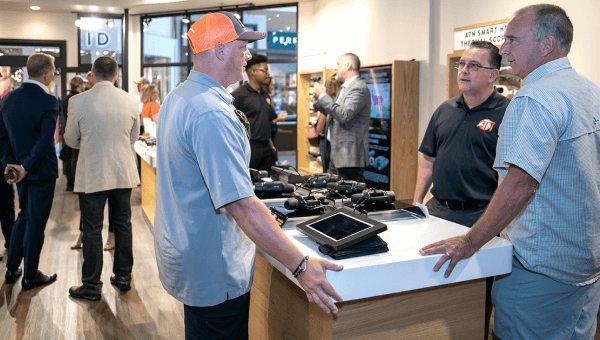
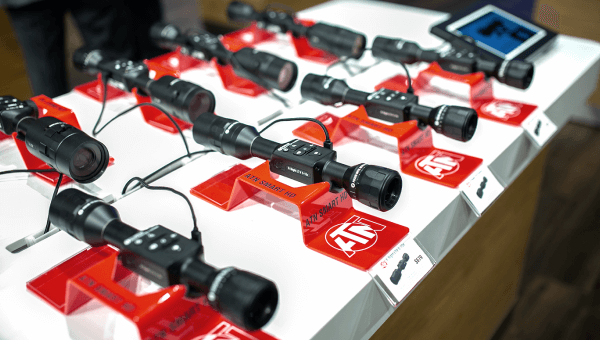
The best thermal monocular is the one that matches the distance you actually scan, not the one with the biggest number on the box. A handheld thermal is a finding tool: you use it to sweep a field edge, count a sounder, or confirm what is standing in the brush before you commit. Below are seven ATN monoculars, one for each job a handheld gets asked to do, with the specifications, the prices and the honest limits of each.
The best thermal monocular in 2027 is the ATN BlazeHunter 650 LRF ($2,195): a 640×512 sensor at <18mK, 2,377 m of published detection and a built-in 1,000-yard rangefinder. On a budget the BlazeSeeker 6 207 ($429) is the cheapest way into a real 12µm sensor, and the BlazeTrek 6 319 ($795) is the best value for hunting.
On this page
- Quick picks: all seven at a glance
- How we picked
- ATN BlazeHunter 650 LRF: best overall
- ATN BlazeSeeker 6 207: best budget
- ATN BlazeHunter 635 LRF: best for hunting
- ATN BlazeTrek 6 625: best compact premium
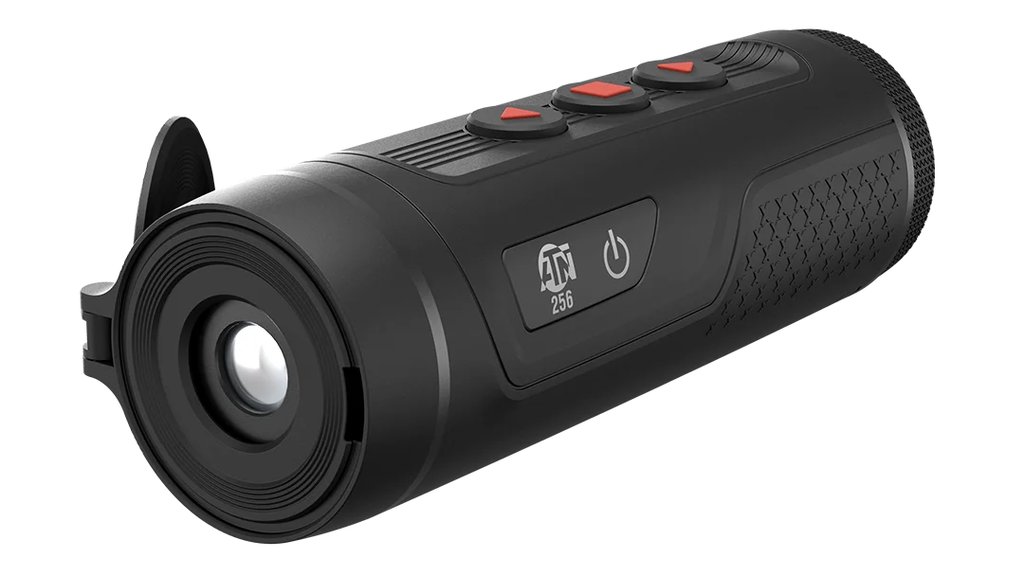
- ATN BlazeSeeker 6 210: best compact
- ATN BlazeHunter XD LRF: best long-range
- ATN BlazeTrek 6 319: best handheld value
- Best thermal monoculars with a rangefinder
- Thermal monocular prices by range
- Are cheap thermal monoculars worth it?
- Thermal monoculars for hunting
- How ATN compares to other thermal monocular brands
- Thermal monocular, binocular or scope: which do you need?
- How to choose a thermal monocular
- The three ATN monocular series
- FAQ
- Where to start
Quick picks: all seven at a glance
| Pick | Model | Sensor | NETD | Detection range | Rangefinder | Weight | Battery | Price | Why it wins |
|---|---|---|---|---|---|---|---|---|---|
| Best overall | ATN BlazeHunter 650 LRF | 640×512 | <18mK | 2,600 yd / 2,377 m | Yes, 1,000 yd | 360 g / 12.7 oz | 14 h (two batteries) | $2,195 | Longest reach of the 640 models, with ranging built in |
| Best budget | ATN BlazeSeeker 6 207 | 256×192 | ≤20mK | 377 yd / 345 m | No | 270 g / 9.5 oz | ~8 h internal | $429 | Lowest price for a real 12µm thermal sensor |
| Best for hunting | ATN BlazeHunter 635 LRF | 640×512 | <18mK | 2,000 yd / 1,829 m | Yes, 1,000 yd | 360 g / 12.7 oz | 14 h (two batteries) | $1,895 | Wider field of view than the 650 for sweeping cover |
| Best compact premium | ATN BlazeTrek 6 625 | 640×512 | ≤18mK | 1,422 yd / 1,300 m | No | 320 g / 11.3 oz | ~6.5 h internal | $1,499 | 640 sensor in the small body, no batteries to carry |
| Best compact | ATN BlazeSeeker 6 210 | 256×192 | ≤20mK | 503 yd / 460 m | No | 270 g / 9.5 oz | ~8 h internal | $489 | Same pocket size as the 207 with a longer 10 mm lens |
| Best long-range | ATN BlazeHunter XD LRF | 1280×1024 | ≤15mK | 3,718 yd / 3,400 m | Yes, 1,000 m | 495 g / 17.5 oz | 10+ h (two batteries) | $3,995 | Highest resolution and lowest NETD of the seven here |
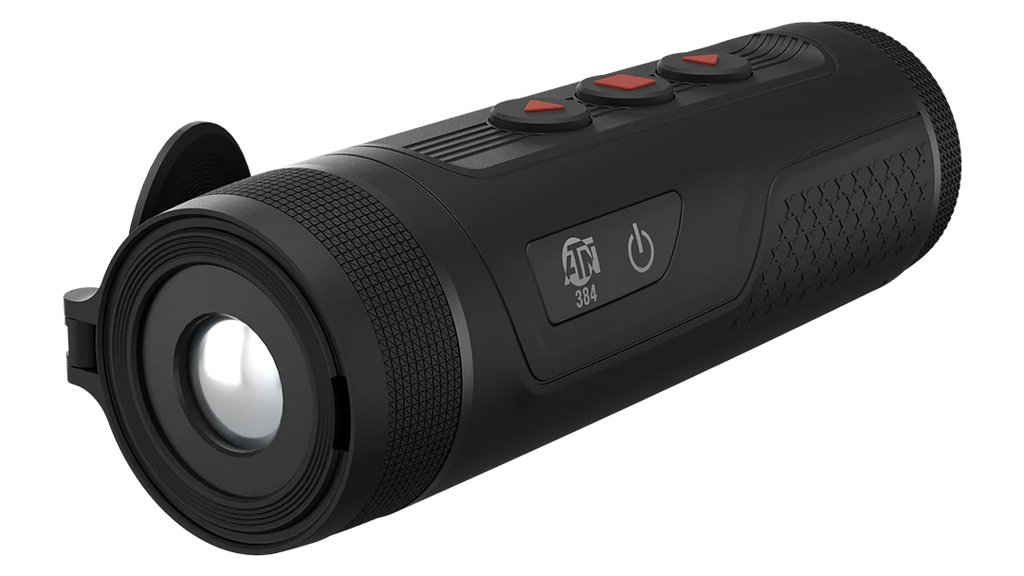
| Best handheld value | ATN BlazeTrek 6 319 | 384×288 | ≤18mK | 1,094 yd / 1,000 m | No | 320 g / 11.3 oz | ~8 h internal | $795 | 384 sensor and 1,000 m detection for under $800 |
Notes on the table. Prices checked November 23, 2026 on atncorp.com; these are the current store prices, and the list price on each product page is higher. Detection range is the distance at which the optic registers a heat signature — it is not the distance at which you can tell a hog from a dog, and identification happens at a fraction of it. ATN publishes detection for the two BlazeHunter LRF models in yards and for the Gen 6 models in meters; the second unit in each cell is converted, not published. Rangefinder limits follow the same split: 1,000 yd on the BlazeHunter 650 and 635 LRF, 1,000 m on the XD.
Watch the three series side by side. Our walkthrough video ATN BlazeSeries: BlazeHunter XD, BlazeTrek 6, BlazeSeeker 6 shows the same bodies in hand, which answers the size-and-weight question faster than a specification table can.
How we picked
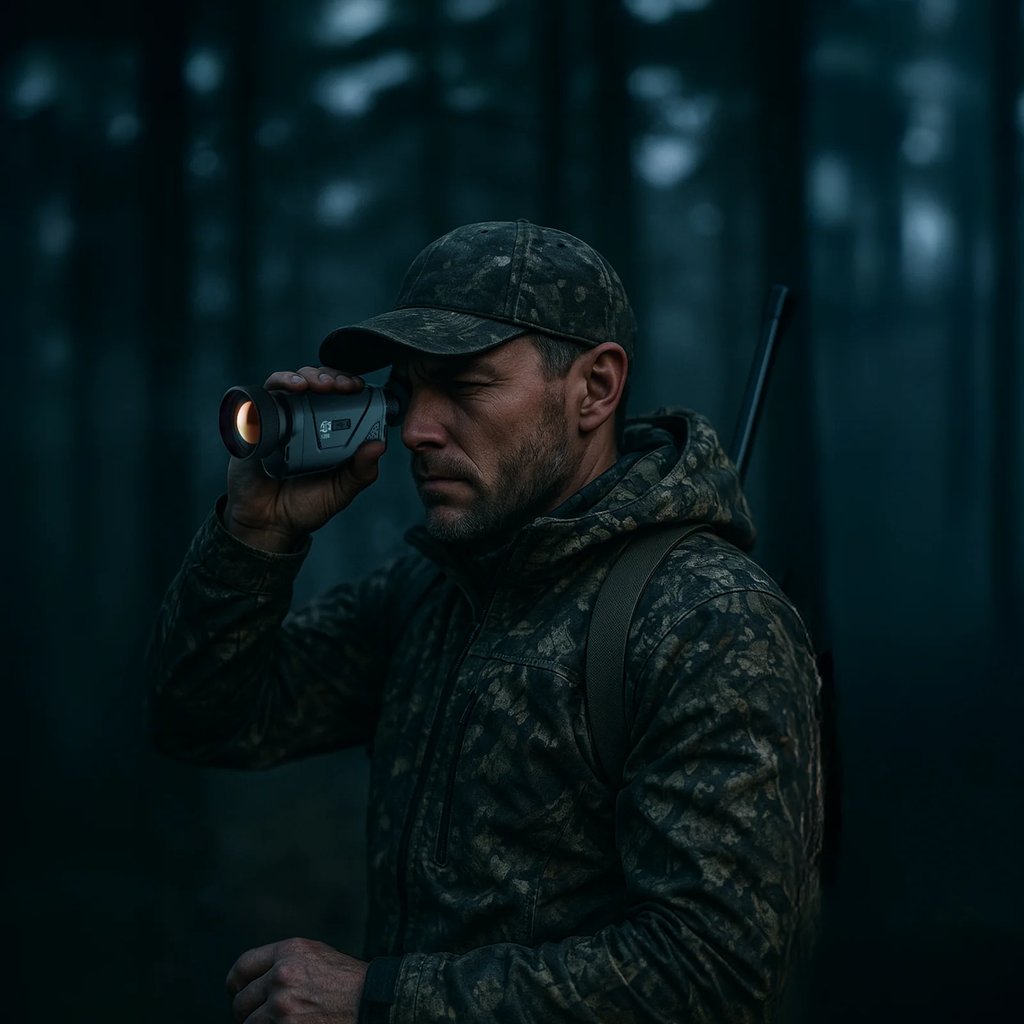
ATN builds every monocular on this list, so this is a guide to the ATN line and not an independent test of the whole market. That is worth saying plainly, because it also explains the one advantage we have: the numbers below come from our own specification sheets and manuals rather than from a retailer listing.
We compared the seven on the things that change what you see and what you carry: sensor resolution, NETD, published detection range, whether a rangefinder is built in, weight, battery runtime and price. Where our own sources disagreed we used the series manual rather than the product page — that is how the BlazeTrek 6 625 ended up listed with a 25 mm lens and 1,300 m of detection instead of the 19 mm figures that had been copied onto its page. Prices were checked on the ATN store on November 23, 2026 and will drift; the product page is always the live number. We have not run a controlled field test of all seven against each other, so you will not find claims about one of them outperforming the others in conditions we did not measure.
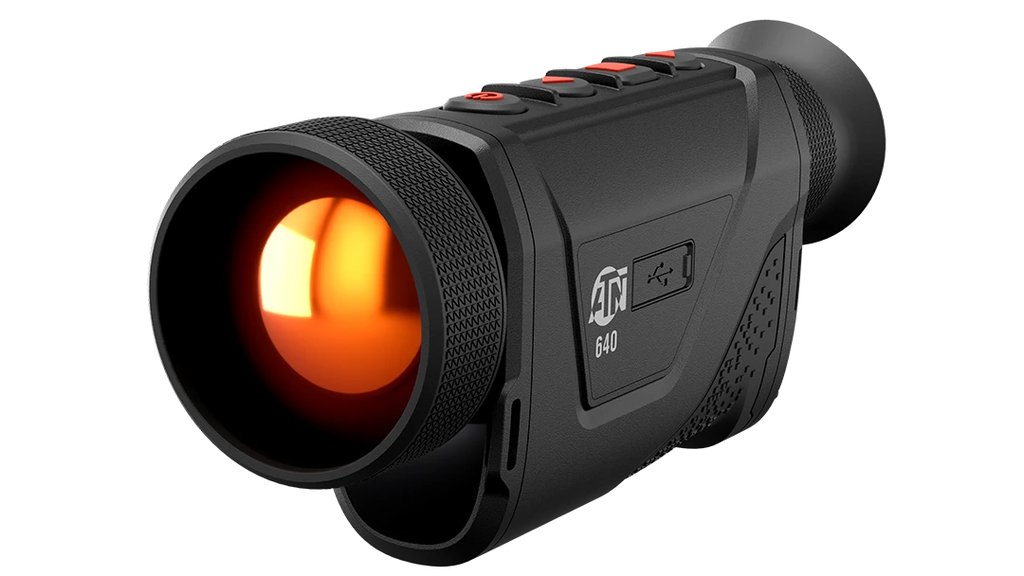
ATN BlazeHunter 650 LRF: best overall
The BlazeHunter 650 LRF is the pick for someone who scans open country and wants the distance read for them. A 640×512 sensor at <18mK behind a 50 mm lens gives the longest published detection in the 640-class line, and the rangefinder means you stop guessing at the gap between you and the treeline.
Specifications: 640×512 sensor, 12µm, 50 Hz, <18mK NETD; 50 mm lens; 3.5-28× magnification; field of view 8.7° × 6.9°; detection 2,600 yd (2,377 m); built-in laser rangefinder to 1,000 yd; 0.41-inch 1440×1080 OLED display; two replaceable 18650 batteries, 14 hours total at about 7 hours per battery; 360 g / 12.7 oz without battery; IP67; $2,195.
Strengths
The 50 mm lens is what separates it from the 635 LRF: 600 yards more published detection for $300. Two swappable 18650 cells with a charger in the box mean a full night without a power bank, and the 1440×1080 display holds detail when you push the digital zoom.
Limitations
The same 50 mm lens narrows the field of view to 8.7° horizontally, so sweeping a brushy field edge takes longer than it does with the 635. Both BlazeHunter LRF models weigh the same 360 g without batteries, so the 50 mm lens buys you reach rather than a lighter package.
Not ideal for
Close, cluttered ground where you are scanning more than ranging — take the 635 LRF for the wider view, or the BlazeTrek 6 625 if you want to drop the weight.
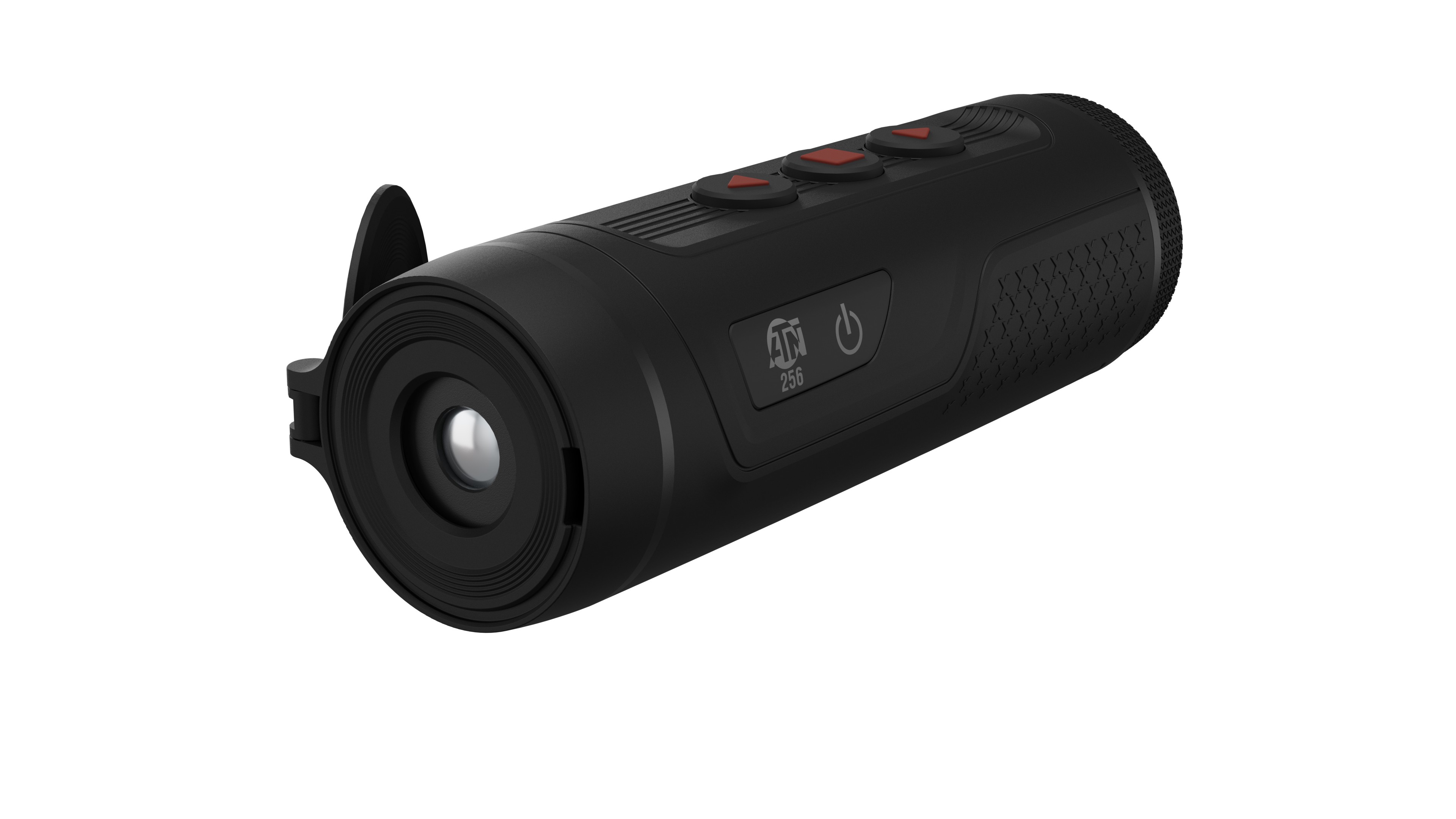
ATN BlazeSeeker 6 207: best budget
The BlazeSeeker 6 207 at $429 is the entry point into the line, and it is a real 12µm thermal rather than a toy. The 7 mm lens gives the widest field of view of all seven, which is exactly what you want when the job is finding something at the edge of a food plot.
Specifications: 256×192 sensor, 12µm, 50 Hz, ≤20mK NETD; 7 mm lens, F/1.0, focus-free; 1.2-9.6× magnification; field of view 24° × 18°; detection 377 yd (345 m); no rangefinder; 800×600 OLED display; internal rechargeable battery, about 8 hours; 270 g / 9.5 oz; IP67; 32 GB storage; $429.
Strengths
The widest view here at 24° horizontally, so you cover a field faster than with any other model on this list. Focus-free optics mean nothing to adjust in the dark, and at 270 g it rides in a jacket pocket. Video and audio recording, Wi-Fi and 32 GB of storage are the same as on the BlazeTrek 6 625 at $1,499.
Limitations
256×192 carries 49,152 pixels against 327,680 on a 640 sensor — about a sixth — so detail collapses sooner when you zoom. Published detection is 377 yd (345 m), and the internal battery is not swappable — a USB-C power bank is the only way to extend the night.
Not ideal for
Open country where you need to work past a few hundred yards. If that is your ground, the BlazeTrek 6 319 gives nearly three times the published detection for $366 more. For a wider look at this price tier, see cheap thermal scopes.
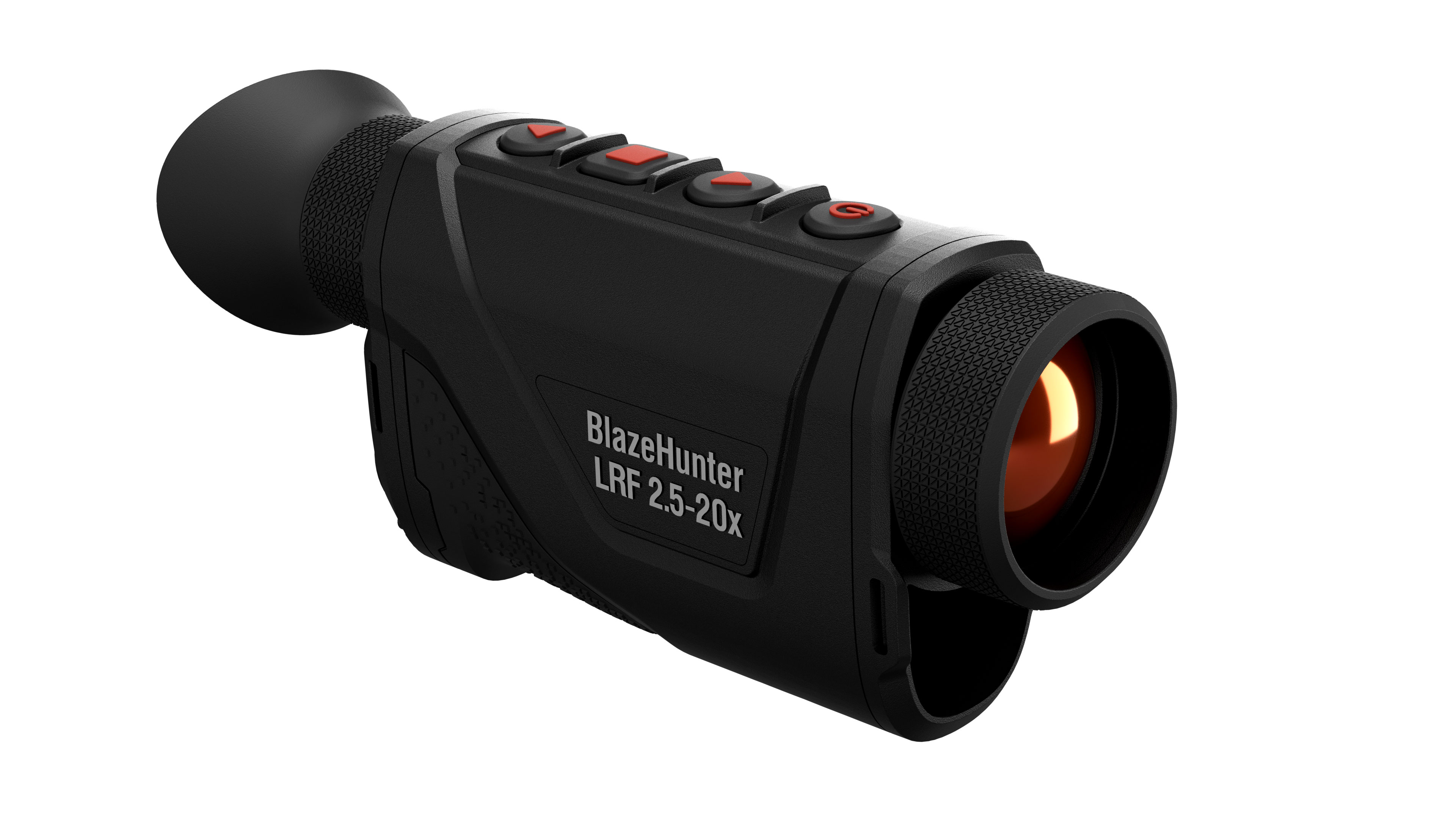
ATN BlazeHunter 635 LRF: best for hunting
The BlazeHunter 635 LRF is the hunting pick because hunting is mostly scanning. It shares the 650's sensor, display, battery system and rangefinder, but the 35 mm lens opens the field of view to 12.4° against 8.7° — about 43 percent wider — and costs $300 less.
Specifications: 640×512 sensor, 12µm, 50 Hz, <18mK NETD; 35 mm lens; 2.5-20× magnification; field of view 12.4° × 10°; detection 2,000 yd (1,829 m); built-in laser rangefinder to 1,000 yd; 0.41-inch 1440×1080 OLED display; two replaceable 18650 batteries, 14 hours total; 360 g / 12.7 oz without battery; IP67; $1,895.
Strengths
The wide view is the point: at 12.4° you sweep a fence line in fewer passes and pick up movement at the edge of the frame. Ranging to 1,000 yd settles the one argument that costs more shots than optics do. Same two-battery system and 14-hour runtime as the 650.
Limitations
600 yd less published detection than the 650 LRF, and a lower top magnification at 20×. If you regularly glass past a mile of open pasture, that gap is real.
Not ideal for
Long open country — take the 650 LRF for the 50 mm lens, or the XD LRF if you need to identify rather than detect out there. If you want the same 640 sensor in a scope rather than a handheld, start with 640 thermal scopes.
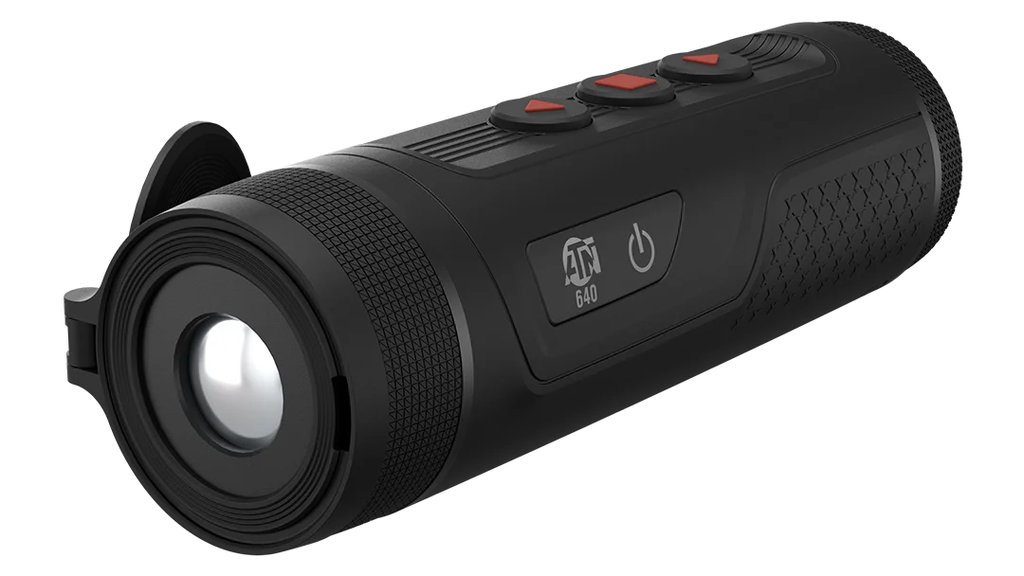
ATN BlazeTrek 6 625: best compact premium
The BlazeTrek 6 625 puts a 640×512 sensor into the small Gen 6 body. It weighs 320 g with its battery in it, against 360 g for a BlazeHunter before you add two 18650 cells, and there is nothing to swap in the dark. That is the trade: you give up removable batteries and a rangefinder, and you keep the sensor.
Specifications: 640×512 sensor, 12µm, 50 Hz, ≤18mK NETD; 25 mm lens, F/1.0; 1.75-14× magnification; field of view 17.5° × 14°; detection 1,422 yd (1,300 m); no rangefinder; 800×600 OLED display; internal rechargeable battery, about 6.5 hours; 320 g / 11.3 oz with battery; IP67; 32 GB storage; $1,499.
Strengths
A 640 sensor and a 17.5° field of view in a 158 mm body — this is the combination the smaller models cannot offer. SharpIR image processing, Wi-Fi to the ATN Connect 6 app and 32 GB of onboard recording come standard, and USB-C takes a power bank directly.
Limitations
About 6.5 hours on an internal battery is the shortest runtime of the seven, and you cannot swap a cell at 2 a.m. The 800×600 display is a step down from the 1440×1080 panels in the BlazeHunter models, and there is no rangefinder.
Not ideal for
All-night sits and anyone who needs distance readings — the BlazeHunter 635 LRF adds both for $396 more.
ATN BlazeSeeker 6 210: best compact
The BlazeSeeker 6 210 is the 207 with a longer lens. Same body, same sensor, same 270 g, same 8-hour battery — the 10 mm optic trades field of view for reach, and costs $60 more.
Specifications: 256×192 sensor, 12µm, 50 Hz, ≤20mK NETD; 10 mm lens, F/1.0, focus-free; 1.7-13.6× magnification; field of view 17.3° × 13.1°; detection 503 yd (460 m); no rangefinder; 800×600 OLED display; internal rechargeable battery, about 8 hours; 270 g / 9.5 oz; IP67; 32 GB storage; $489.
Strengths
Pocket size with 126 yd more published detection than the 207 and higher magnification at 13.6×. For walking ground where the lanes are longer than a food plot but shorter than a pasture, this is the better of the two BlazeSeekers.
Limitations
The narrower 17.3° view means more passes to cover the same ground than the 207's 24°. Same 256×192 sensor, so the zoom limit has not moved, and the battery is still internal.
Not ideal for
Scanning wide and close, where the 207 is both cheaper and faster. Past 500 yd neither BlazeSeeker is the right tool — step up to the BlazeTrek 6 319.
ATN BlazeHunter XD LRF: best long-range
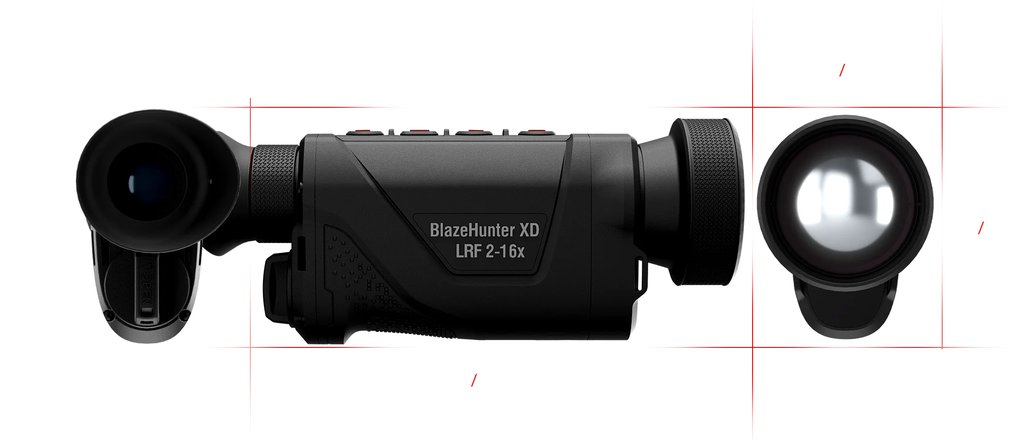
The BlazeHunter XD LRF is the only ATN monocular with a 1280×1024 sensor, and the resolution is what you are paying for: more pixels on the animal at the far end means you can identify rather than just detect. Detection is published at 3,400 m, the longest in the line.
Specifications: 1280×1024 sensor, 12µm VOx, 50 Hz, ≤15mK NETD; 50 mm germanium lens, F/1.0; 2-16× magnification; field of view 17.46° × 14.01°; detection 3,400 m (3,718 yd); built-in rangefinder to 1,000 m, ±1 m, eye-safe Class 1 905 nm; 0.49-inch 1920×1080 OLED display; two replaceable 18650 batteries, 10+ hours total; 495 g / 17.5 oz without battery; magnesium alloy, IP67; 32 GB storage; $3,995.
Strengths
1280×1024 carries 1,310,720 pixels against 327,680 on a 640×512 sensor — four times as many — and ≤15mK is the lowest NETD in the ATN monocular line — the number that decides whether a warm animal separates from warm ground on a humid night. The 1920×1080 display puts about four times the pixels of an 800×600 panel behind your eye, and the rangefinder reads to 1,000 m with ±1 m accuracy.
Limitations
495 g without batteries makes it the heaviest here, and $3,995 is the top of the line. The 17.46° field of view is wide for a 50 mm lens, but detection figures measured in kilometers have little to do with the distance at which you will actually identify an animal.
Not ideal for
Anyone whose scanning happens inside 1,000 yards — the BlazeHunter 650 LRF covers that for $1,800 less. If you want this resolution class in a rifle scope instead, read 1280 thermal scopes first, because the answer there is different.
ATN BlazeTrek 6 319: best handheld value
If you want the best thermal monocular for the money, the BlazeTrek 6 319 gives you a 384×288 sensor and 1,000 m of detection for $795. It is the cheapest way into that sensor class, and the model to buy when the BlazeSeekers are too short-ranged and the 640 models are too expensive.
Specifications: 384×288 sensor, 12µm, 50 Hz, ≤18mK NETD; 19 mm lens, F/1.0; 2.25-18× magnification; field of view 14.4° × 10.8°; detection 1,094 yd (1,000 m); no rangefinder; 800×600 OLED display; internal rechargeable battery, about 8 hours; 320 g / 11.3 oz with battery; IP67; 32 GB storage; $795.
Strengths
More than double the published detection of the BlazeSeeker 6 210 for $306 more, and ≤18mK instead of ≤20mK, which matters more than the pixel count on damp nights. Eight hours of runtime beats the 640-sensor BlazeTrek 6 625, and the recording, Wi-Fi and SharpIR processing are identical.
Limitations
384×288 runs out of detail before a 640 does when you zoom, and the internal battery is not replaceable. No rangefinder.
Not ideal for
Anyone who already knows they want to identify animals past 1,000 yards — that is the 650 LRF or the XD, and buying here first means buying twice.
Best thermal monoculars with a rangefinder
The best thermal monocular with a rangefinder is the ATN BlazeHunter 650 LRF at $2,195, which ranges to 1,000 yd behind a 640×512 sensor. Three of the seven models here carry a laser rangefinder; the four Gen 6 BlazeSeeker and BlazeTrek models do not.
| Model | Rangefinder | Sensor | Detection range | Price |
|---|---|---|---|---|
| ATN BlazeHunter 635 LRF | 1,000 yd | 640×512, <18mK | 2,000 yd / 1,829 m | $1,895 |
| ATN BlazeHunter 650 LRF | 1,000 yd | 640×512, <18mK | 2,600 yd / 2,377 m | $2,195 |
| ATN BlazeHunter XD LRF | 1,000 m, ±1 m, Class 1 905 nm | 1280×1024, ≤15mK | 3,718 yd / 3,400 m | $3,995 |
A rangefinder matters when the animal is far enough that holdover is a guess rather than a reflex, and when the terrain gives you nothing to measure against — open pasture, a cut field, a canyon edge. In thick cover inside 150 yards it does almost nothing for you, because the drop is flat and the ranges are obvious. It also matters because the alternative is carrying a second device: a standalone unit like the ABL 1500 works, but it means a second thing to find in the dark and a second battery to charge.
Note what the two numbers mean. The rangefinder figure is how far the laser will return a distance from a normal target. The detection figure is how far the thermal sensor registers heat. They are not the same measurement and on all three models the sensor reaches much further than the laser, so past about 1,000 yards you are back to estimating.
Thermal monocular prices by range
Three price bands cover the line. Prices are the ATN store prices checked November 23, 2026; list prices on the product pages are higher.
| Budget | Models | Sensor and reach | What you give up |
|---|---|---|---|
| Under $500 | BlazeSeeker 6 207 ($429), BlazeSeeker 6 210 ($489) | 256×192, 345–460 m detection | Zoom headroom, removable battery, rangefinder |
| $500 to $2,000 | BlazeTrek 6 319 ($795), BlazeTrek 6 625 ($1,499), BlazeHunter 635 LRF ($1,895) | 384×288 to 640×512, 1,000–1,829 m detection | The BlazeTreks have no rangefinder and fixed batteries |
| Above $2,000 | BlazeHunter 650 LRF ($2,195), BlazeHunter XD LRF ($3,995) | 640×512 and 1280×1024, 2,377–3,400 m detection | Weight and money |
Every model under $1,000 here is a BlazeSeeker or the BlazeTrek 6 319. If your ceiling is $1,000 and you want a rifle optic rather than a handheld, the equivalent list is thermal rifle scopes under $1,000, and the narrower monocular version of this page is best thermal monocular under $1,000.
Are cheap thermal monoculars worth it?
A cheap thermal monocular is worth it if your problem is finding warm bodies at a few hundred yards, and a waste of money if you expected to identify them at distance. Under $500 the two BlazeSeeker models here give you a genuine 256×192 sensor at 12µm with ≤20mK NETD, 50 Hz, recording, Wi-Fi and IP67 sealing. What you give up is listed in the price table above: zoom headroom, a removable battery and a rangefinder. That is a real tool for walking a property line, checking a feeder or finding a downed animal in cover.
Below that price the market fills with unbranded units, and there the questions are different. Check the sensor resolution and the pixel pitch, because a 256×192 sensor at 17µm sees less than the same count at 12µm. Check whether NETD is published at all — many listings leave it out, and a sensor with no stated sensitivity usually has nothing good to state. Check the refresh rate: anything below about 25 Hz smears when you pan, which is most of what a handheld does. Check that there is a named warranty with a term in years and somewhere to send the unit. And check whether the app still exists; a thermal device whose firmware was abandoned is a device that will never get a bug fixed.
The verdict: a cheap thermal from a company that publishes its specifications and honors a warranty is a sound buy for scanning work; a cheap thermal with no NETD figure, no refresh rate and no support address is not a bargain but a lottery ticket. If $429 is your ceiling, the BlazeSeeker 6 207 is the honest version of that purchase.
Thermal monoculars for hunting
The best thermal monocular for hunting is the ATN BlazeHunter 635 LRF at $1,895, because hunting is mostly scanning and its 35 mm lens gives a 12.4° field of view with a 640×512 sensor behind it. Which model is right for you depends on the game, and the four subsections below name a pick for each.
Coyotes and predators
For coyote hunting the pick is the BlazeHunter 650 LRF at $2,195. Predator work happens on open ground, the scanning sessions are long, and a dog that hangs up at 300 yards and circles downwind is a ranging problem before it is a resolution problem. The 650's 50 mm lens publishes 2,600 yd of detection and its rangefinder reads to 1,000 yd, which settles the one argument that costs more shots than optics do. Two swappable 18650 cells cover a full night of calling. If $2,195 is beyond this year's budget, the 635 LRF keeps the sensor and the rangefinder and trades 600 yd of detection for a wider sweep. For the rifle side of the same night, see our best thermal scope for coyote hunting guide.
Hogs
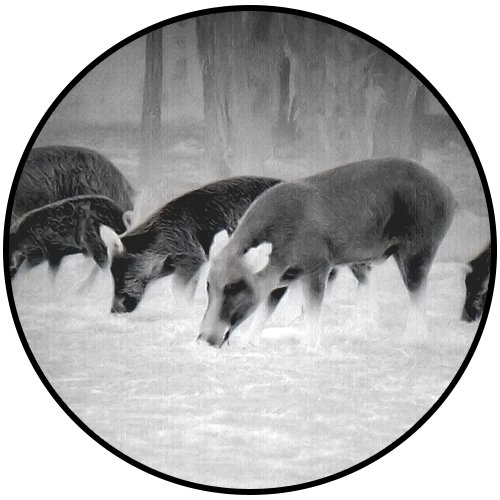
For hog hunting the pick is the BlazeSeeker 6 207 at $429, with the BlazeHunter 635 LRF as the upgrade. You are counting a sounder and watching which way it is drifting, usually inside 300 yards over a feeder or a field edge, so field of view matters more than reach: the 207's 7 mm lens covers 24° horizontally, the widest here, and at 270 g it lives in a jacket pocket all night. Its published detection of 377 yd is enough for that distance. Move up to the 635 LRF when you need to tell a boar from a sow at the far end of the field rather than just count heads. The rifle guide is thermal scope for hog hunting.
Deer: scouting and blood-trail recovery
For deer the pick is the BlazeTrek 6 319 at $795. Night hunting of deer with thermal is restricted in most states, so the real uses are pre-season scouting and recovering an animal after the shot, both of which reward a light body and a sensor good enough to pick a warm deer out of cooling ground. The 319's 384×288 sensor at ≤18mK and 1,000 m of published detection cover both jobs at 320 g, and eight hours of runtime outlasts a recovery that goes badly. Check your state wildlife agency before you carry a thermal into the deer woods at all — in some states possession afield during certain seasons is itself regulated.
Stand and blind work versus spot-and-stalk
Sitting still favors the BlazeHunter models; covering ground on foot favors the Gen 6 bodies. From a stand you are not carrying weight anywhere, so the 360 g BlazeHunter 635 LRF with two swappable cells and a 1440×1080 display is the better instrument, and the 15 mm eye relief means you can keep glasses on through a long sit. Spot-and-stalk is the opposite case: the 270 g BlazeSeeker 6 210 or the 320 g BlazeTrek 6 319 ride in a pocket, switch on in under a second and have no loose batteries to drop in the dark. The trade is runtime — the internal-battery models need a USB-C power bank to pass about eight hours, while the BlazeHunters take a fresh cell instead.
How ATN compares to other thermal monocular brands
No single company makes the best thermal optic at every price, and the honest answer to "who makes the best thermal optics" is that it depends on which number you are buying. We build the seven monoculars above, so treat this section as context rather than as a verdict: every figure in the table below comes from the manufacturer's own US product page, not from a retailer or a review.
| Model | Sensor | NETD | Detection range | Rangefinder | Price | Warranty |
|---|---|---|---|---|---|---|
| ATN BlazeSeeker 6 207 | 256×192, 12µm | ≤20mK | 345 m | No | $429 store / $549 list | See the ATN warranty page |
| ATN BlazeTrek 6 319 | 384×288, 12µm | ≤18mK | 1,000 m | No | $795 store / $1,095 list | See the ATN warranty page |
| ATN BlazeHunter 650 LRF | 640×512, 12µm | <18mK | 2,600 yd / 2,377 m | 1,000 yd | $2,195 store / $3,185 list | 3 years |
| ATN BlazeHunter XD LRF | 1280×1024, 12µm | ≤15mK | 3,400 m | 1,000 m | $3,995 store / $5,495 list | See the ATN warranty page |
| AGM Taipan V2 25-384 | 384×288, 12µm | <35mK | 1,200 m/yd | No | $1,445 (out of stock) | 5 years, transferable |
| Pulsar Axion 2 LRF XG35 | 640×480, 12µm | <40mK | 1,750 m | Yes | $2,999.97 | 3 years, 5 with registration |
| Vortex Veil 400 | 400×300, 12µm | Not published | 1,100 yd | No | $2,299.99 MSRP | Unlimited lifetime |
Checked November 23, 2026 on agmglobalvision.com, pulsarnv.com and vortexoptics.com. Two models from Google's product grid for this query are missing on purpose: the FLIR Scout TKx is marked discontinued on FLIR's own site, and RIX did not serve a specification page for the Stride when we checked, so there was nothing to quote. The AGM figure is the price shown while the item is out of stock. Competitor prices are single published figures; ATN figures are given as store price and list price because our store price is the one you actually pay.
Where the others are stronger. Warranty is the clearest case. Vortex backs the Veil 400 with an unlimited lifetime warranty and AGM gives the Taipan V2 five years and makes it transferable, both of which are better terms than the three years published on our BlazeHunter 650 LRF. Vortex also sells a 400×300 sensor at $2,299.99 MSRP against our $3,185 list for a 640, and if you buy at list rather than at store price that is a real difference. AGM puts a 384 sensor with a removable battery at $1,445, which is a crowded price point where nobody has a decisive advantage.
Where we win. Sensitivity, in every class we can compare: ≤18mK on the $795 BlazeTrek 6 319 against <35mK on the $1,445 AGM 384, and <18mK on the BlazeHunter 650 LRF against <40mK on the $2,999.97 Pulsar 640. NETD is the figure that decides whether a warm animal separates from warm ground on a humid night, and on these published numbers a cheaper ATN sensor is the more sensitive one. Reach follows: 2,600 yd published on the 650 LRF against 1,750 m on the Axion 2 LRF XG35, for $800 less at our store price. Runtime too — 14 hours on the BlazeHunter's two cells against 6.5 hours on the Taipan V2 and 4.5 hours per battery on the Veil 400. One number we cannot settle from published specifications is image processing: how a sensor is read out and filtered changes the picture as much as its NETD does, and no manufacturer publishes a figure for that, ours included.
Thermal monocular, binocular or scope: which do you need?
Buy a monocular to find animals, a binocular to watch them for hours, and a scope to shoot. Most hunters end up with a monocular and a scope, because the handheld does the searching and the rifle optic does the aiming, and neither one does the other job well.
| Type | What it is for | Weight | Price range | Best for |
|---|---|---|---|---|
| Monocular | Scanning and finding, handheld | 270–495 g | $429–$3,995 | Walking ground, counting a sounder, recovery |
| Binocular | Sustained observation with both eyes | Heavier than a monocular | Higher than a comparable monocular | Sitting and watching, long glassing sessions |
| Rifle scope | Aiming and the shot | Mounted, not carried | Varies by sensor class | Taking the animal once it is found and identified |
A monocular is lighter and cheaper than a binocular and leaves one eye dark-adapted, which is why it is the standard scanning tool. A binocular is far less tiring over hours of glassing because both eyes work, so it earns its weight from a stand rather than on foot — our picks are in best thermal binoculars. A thermal rifle scope is a different purchase again: it has to survive recoil, hold zero and give you a reticle, none of which a handheld does. Those are in best thermal scope. If you already own a day scope you are happy with, a TICO 6 clip-on puts thermal in front of it instead of replacing it.
How to choose a thermal monocular
Start with how far you scan and how wide your ground is, then work down the list below. If the terms are new, our thermal scope guide defines them properly. As a shortcut: inside 400 yards a BlazeSeeker, out to 1,000 m the BlazeTrek 6 319, out to 1,300 m the 625, and past that a BlazeHunter.
Sensor resolution: 256, 384, 640 or 1280
Resolution decides how far you can zoom before the image falls apart, not how far the sensor sees. A 256×192 sensor carries 49,152 pixels, a 384×288 carries 110,592, a 640×512 carries 327,680 and a 1280×1024 carries 1,310,720 — four times the 640. Put plainly: 256 finds animals, 384 follows them, 640 lets you tell what they are at distance, and 1280 extends that judgement further out. Buy the class that matches the distance at which you need to make a decision, not the biggest one you can afford.
NETD: the number buyers skip
NETD is the faintest temperature difference the sensor can separate from its background, measured in millikelvin, and a lower figure is better. It decides whether there is a usable picture on a humid night when the ground and the animal are nearly the same temperature — the condition that ruins more hunts than darkness does. Across these seven it runs from ≤15mK on the BlazeHunter XD LRF to ≤20mK on the two BlazeSeekers. If a listing does not publish NETD at all, treat that as the answer.
Lens size and field of view
A short lens sees wide and near; a long lens sees narrow and far, and you cannot have both at once. The 7 mm BlazeSeeker 6 207 covers 24° horizontally and the 50 mm BlazeHunter 650 LRF covers 8.7° — the 207 sweeps a field in a third of the passes, and the 650 reaches nearly seven times further. Thick cover and close work reward the wide lens; open pasture rewards the long one. Field of view is set by the lens and the sensor size together, so the same lens on a different sensor gives a different angle.
Detection, recognition and identification are three different distances
Published detection range is the distance at which the optic registers that something warm is there — a blob, nothing more. Recognition is telling an animal from a fence post, and identification is telling a boar from a sow or a coyote from a dog. Each step costs you a large fraction of the distance, which is why a monocular that publishes 2,377 m of detection is not a device you identify game with at 2,377 m. ATN publishes detection figures only; we do not publish identification distances, because they depend on the animal, the weather and the operator. Use detection to compare models against each other, never as a working range.
Refresh rate
Every monocular here runs at 50 Hz, which is what you want in a device whose whole job is panning. Below about 25 Hz the image smears as you sweep and lags behind a moving animal, so a low refresh rate undoes whatever the sensor resolution gained you. This is one of the first corners cut on very cheap units, and one of the easiest to check.
Battery: internal or swappable, and what the cold does
Swappable cells beat a long internal battery once your nights run past eight hours. The three BlazeHunter models take two replaceable 18650 cells and publish 10 to 14 hours total; the BlazeSeekers and BlazeTreks carry an internal battery good for about 6.5 to 8 hours and take a USB-C power bank to go further. Lithium cells lose capacity in the cold, so a published runtime is a warm-weather figure in every brand's catalog, ours included — plan on less when it is below freezing and keep the spare in an inside pocket.
Rangefinder
A built-in rangefinder earns its place when the terrain gives you nothing to measure against and the shot is far enough that holdover is a guess. Three of these seven have one: the BlazeHunter 635 LRF and 650 LRF read to 1,000 yd, and the XD LRF reads to 1,000 m with ±1 m accuracy on an eye-safe Class 1 905 nm laser. Inside 150 yards in cover it adds nothing you cannot estimate. The alternative is carrying a separate rangefinder, which works but is a second device and a second battery.
Recording, app and Wi-Fi
Recording matters more than buyers expect, because reviewing a night afterwards is how you learn where animals actually cross. All seven record video and connect to a phone over built-in Wi-Fi. The Gen 6 models and the XD add audio recording, 32 GB of internal storage and SharpIR image processing and run on the ATN Connect 6 app; the BlazeHunter 635 LRF and 650 LRF use the ATN BLAZe app instead. Check which app a device uses before you buy a second one, so you are not running two.
Weatherproofing
All seven are rated IP67, which means dust-tight and able to survive immersion in a meter of water for half an hour — enough for rain, fog, dew and a drop in a creek, and not a license to go diving. Operating temperature on the models that publish it runs from about −30 °C to 50–55 °C. IP67 is the floor we would accept on any handheld meant to live outdoors; a unit that only claims to be "water resistant" with no IP figure is telling you something.
Warranty
Check the term before you buy, because it varies across our own line and we would rather you read it than assume it. ATN publishes a three-year warranty on the BlazeHunter 650 LRF specification sheet. The Gen 6 BlazeSeeker and BlazeTrek models and the BlazeHunter XD LRF do not carry a warranty line in the specifications we publish, so the warranty page on atncorp.com and the card in the box are the authority for those, not this article. Whoever you buy from, the questions are the same: how many years, what is covered, whether it transfers, and where the unit goes for service.
The three ATN monocular series
The names map to three different jobs, and knowing which series you are in narrows the choice before you compare individual models.
- BlazeSeeker 6 — pocket scanners. 256×192, 7 or 10 mm lenses, 270 g, internal battery, no rangefinder. For finding warm bodies at close and medium range without carrying anything.
- BlazeTrek 6 — the all-rounders. 384×288 or 640×512, 19 or 25 mm lenses, 320 g, internal battery, no rangefinder. More sensor and more reach in a body that is still small.
- BlazeHunter — the long-range and professional tools. 640×512 or 1280×1024, 35 or 50 mm lenses, swappable 18650 cells, 1440×1080 or 1920×1080 displays, and a built-in rangefinder on every model listed here.
What all seven share is narrower than the marketing suggests: video recording, built-in Wi-Fi to a phone app, six color palettes and IP67 sealing. The Gen 6 models and the XD add SharpIR image processing, 32 GB of internal storage and audio recording, and they run on the ATN Connect 6 app; the BlazeHunter 635 LRF and 650 LRF use the ATN BLAZe app instead. You can compare the whole range, including configurations outside this seven, on our thermal monoculars page.
FAQ
What is a thermal monocular, and how does it work?
A thermal monocular is a handheld device that shows heat instead of light. An uncooled microbolometer sensor reads the infrared energy every object emits, and the processor turns those temperature differences into an image, so it works in complete darkness, light fog and smoke without any illumination at all.
What is the best thermal monocular in 2027?
For most buyers the ATN BlazeHunter 650 LRF at $2,195: a 640×512 sensor at <18mK, 2,600 yd (2,377 m) of published detection, a rangefinder to 1,000 yd and 14 hours on two swappable batteries. If your budget is under $500, the BlazeSeeker 6 207 at $429 does the finding job honestly.
What is the best thermal monocular for the money?
The ATN BlazeTrek 6 319 at $795. It is the cheapest model here with a 384×288 sensor and 1,000 m of published detection, which is roughly three times the reach of the $429 BlazeSeeker 6 207 for $366 more. Above it the price climbs faster than the capability does.
What is the best handheld thermal monocular under $1,000?
Three of the seven here fall under $1,000 at current store prices: the BlazeSeeker 6 207 ($429), the BlazeSeeker 6 210 ($489) and the BlazeTrek 6 319 ($795). Of those three the BlazeTrek 6 319 is the one to buy if you can stretch to it, because it is the only one of them with a 384×288 sensor. The wider ATN monocular range has more models in this bracket — check the thermal monoculars page for the full list.
Are thermal monoculars worth it?
Yes, if your problem is finding animals rather than shooting them. A thermal monocular shows you what is in the brush before you move, which saves walks that spook game and nights spent looking at nothing. If you only need to see at night and your distances are short, digital night vision costs less.
Should I choose a 384 or 640 thermal monocular?
384×288 is enough to find and follow animals inside roughly 1,000 m; 640×512 is what you want past that, or whenever you need to tell what the animal is rather than that it is there. Resolution controls how far you can zoom before the image breaks down, so it matters most at distance.
What is the best thermal monocular for hunting?
The ATN BlazeHunter 635 LRF at $1,895. Hunting is mostly scanning, and its 35 mm lens gives a 12.4° field of view — much wider than the 650 LRF's 8.7° — while keeping the same 640×512 sensor and a rangefinder to 1,000 yd. For hogs at feeder distance a BlazeSeeker 6 207 is enough.
Can I get a thermal monocular with a rangefinder?
Yes. Three of the seven here have one built in: the BlazeHunter 635 LRF and 650 LRF range to 1,000 yd, and the BlazeHunter XD LRF ranges to 1,000 m with ±1 m accuracy on an eye-safe Class 1 905 nm laser. The Gen 6 BlazeSeeker and BlazeTrek models on this list do not.
Which is better for hunting, thermal or infrared night vision?
Thermal reads emitted heat and finds animals in cover that night vision will not, in total darkness and light fog. Infrared night vision amplifies reflected light, needs an IR illuminator in the dark, and shows more recognizable detail on a lit target. For finding game first, thermal wins. The full comparison is in night vision vs thermal.
Thermal monocular or thermal binocular: which is better?
A monocular is lighter, cheaper and leaves one eye dark-adapted, which is why it is the standard scanning tool. A binocular such as the ATN Binox-6 Dual is heavier but far less tiring over hours of glassing, because both eyes work. Scan on foot with a monocular; sit and watch with a binocular.
Can you use a thermal monocular with a rifle scope?
Yes, and that is the normal setup: you find the animal with the handheld, then move to the rifle optic such as the ATN ThOR 6 640×512 to make the shot. If you would rather keep your day scope on the rifle, a TICO 6 clip-on mounts in front of it instead.
What is the best helmet-mounted thermal monocular?
None of the seven here: the BlazeSeeker, BlazeTrek and BlazeHunter lines are handheld scanners, not head-worn devices. For hands-free use ATN's multi-functional thermal line, Odin MFT, is the right category, and a thermal helmet mount is sold as a separate accessory.
Are cheap thermal monoculars worth it?
Yes for finding animals, no for identifying them at distance. Under $500 the BlazeSeeker 6 207 at $429 gives a real 256×192 sensor at 12µm, ≤20mK, 50 Hz and IP67 sealing. On unbranded units, check pixel pitch, NETD, refresh rate and whether the warranty names a term in years before you buy.
Who makes the best thermal optics?
No one company leads on every figure. On published specifications ATN wins on sensitivity and reach per dollar — ≤18mK at $795 against <35mK at $1,445 from AGM — while Vortex offers an unlimited lifetime warranty and AGM a transferable five-year term, both better than our published three years. The full comparison is in the brands section above.
How far can a thermal monocular see?
Published detection runs from 345 m on the BlazeSeeker 6 207 to 3,400 m on the BlazeHunter XD LRF. Detection means the sensor registers something warm, not that you can tell what it is — identification happens at a fraction of that distance and depends on the animal, the weather and your eyes, so no manufacturer publishes it honestly.
What is the best thermal monocular for coyote hunting?
The ATN BlazeHunter 650 LRF at $2,195. Coyote work is open-ground scanning with a ranging problem at the end of it, and the 650 pairs 2,600 yd of published detection with a rangefinder to 1,000 yd and 14 hours on two swappable cells. On a tighter budget the 635 LRF keeps both and trades 600 yd for a wider sweep.
Can you use a thermal monocular to find a deer after the shot?
Yes, and recovery is one of the strongest arguments for owning one. A deer holds enough body heat to show clearly for hours, and a thermal picks it out of cover that a flashlight cannot search. The BlazeTrek 6 319 at $795 is enough. Check your state rules: possession afield during some seasons is regulated.
Can a thermal monocular see through glass or fog?
Not through glass, and only partly through fog. Glass blocks long-wave infrared almost completely, so a window shows you the glass temperature, not what is behind it. Light fog, haze and smoke pass well because their droplets are small relative to the wavelength; dense fog and heavy rain scatter enough to cut your working range sharply.
Can you use a thermal monocular during the day?
Yes. Thermal reads emitted heat rather than reflected light, so daylight neither helps nor hinders it, and all seven here work at noon. Contrast is usually worse in the afternoon because sun-warmed ground, rocks and tree trunks sit close to animal body temperature. Early morning, when the ground has cooled overnight, gives the cleanest daytime picture.
Is it legal to hunt with a thermal monocular?
It depends on your state and the species. Many states allow thermal for hogs and non-game predators year-round, restrict it during deer seasons, and set separate rules for public land and for night hunting. Some regulate possession afield rather than use. Check your state wildlife agency before the season; we cannot give legal advice.
Where to start
If you want one answer: the BlazeHunter 650 LRF at $2,195 covers almost every job a handheld thermal is asked to do. If $2,195 is not this year's number, the BlazeHunter 635 LRF at $1,895 trades 600 yards of detection for a wider view and is arguably the better hunting tool. If you are starting from zero, the BlazeSeeker 6 207 at $429 will show you animals you did not know were on your property, and it will make the case for the next one better than I can. Compare all seven on our thermal monoculars page, and check the product page for the current price before you buy.