Two hunts, same week, same rifle, different world. Monday night I am glassing a cut cornfield for hogs — flat ground, half a mile of open sightline. Thursday I am forty feet up a ridge in second-growth timber with thirty yards of visibility if I am lucky, waiting on whitetail moving through the brush line. Same scope both nights. That is the test behind this guide: the best thermal scope for hunting is not the one that wins a single spec sheet, it is the one that does not care what species or terrain you put in front of it.
Most hunters do not stick to one type of ground or one type of game, and a scope should not force them to. Below are five ATN ThOR 6 configurations from $689 to $2,595, with the honest limits of each and a comparison against two 640-class scopes from other makers.
Short answer: for mixed ground and mixed game, the ATN ThOR 6 640 2-16x at $2,295 is the pick — a 640×512 sensor at ≤15mK with the widest horizontal field of view of the five here at 12.52°, and 3,100 m of detection. For open country where range matters, the LRF 640 ($2,595). For long carries, the Mini 384 ($1,295). To start out, the Mini 256 ($689).
Quick answer: best thermal scopes for hunting
- Best overall — ATN ThOR 6 640 2-16x ($2,295): the all-around pick for mixed game and mixed terrain.
- Best for the money — ATN ThOR 6 384 2.5-20x ($1,595): same ≤15mK sensitivity, smaller sensor, lower price.
- Best lightweight — ATN ThOR 6 Mini 384 2.5-20x ($1,295): 528 g for still hunters and long carries.
- Best long-range — ATN ThOR 6 LRF 640 2-16x ($2,595): built-in rangefinder and ballistic calculator for open country.
- Budget pick — ATN ThOR 6 Mini 256 2-16x ($689): a real thermal scope for hunters starting out or adding a backup rig.
Disclosure: ATN designs and manufactures every scope in this guide, and I founded the company. That is a reason to read the cons as carefully as the pros, so I have listed real limits for each model rather than marketing ones, put our numbers next to two competitors' published figures further down, and said plainly in How we picked what this guide is based on and what it is not.
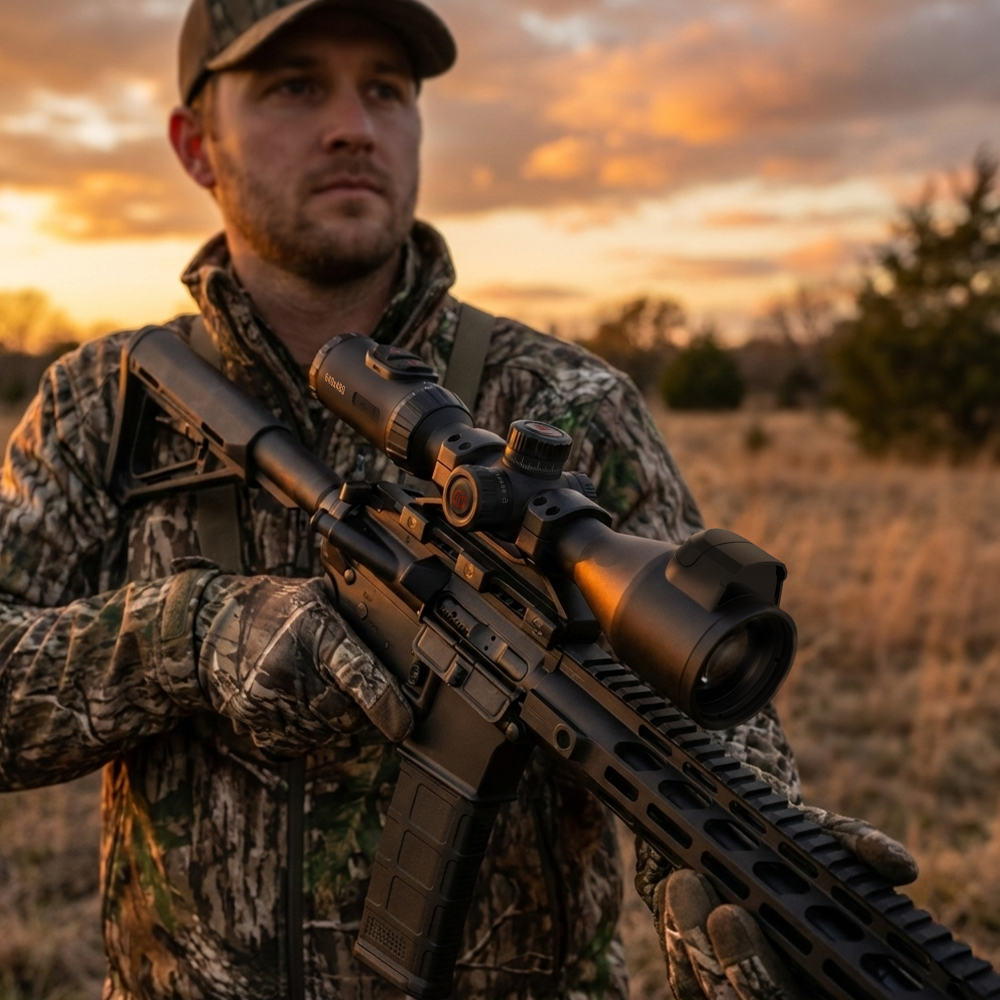
Compare the ThOR 6 lineup
| Best for | Model | Sensor / NETD | Magnification | Field of view | Detection | Rangefinder | Weight / battery | Price |
|---|---|---|---|---|---|---|---|---|
| Mixed terrain | ThOR 6 640 2-16x | 640×512, ≤15mK | 2-16× | 12.52° × 9.41° | 3,100 m / 3,390 yd | No | 830 g / 29.3 oz, ~9 hrs | $2,295 (MSRP $3,625) |
| Value | ThOR 6 384 2.5-20x | 384×288, ≤15mK | 2.5-20× | 10.53° × 7.91° | 2,300 m / 2,515 yd | No | 790 g / 27.9 oz, ~9 hrs | $1,595 (MSRP $2,195) |
| Spot-and-stalk | ThOR 6 Mini 384 2.5-20x | 384×288, ≤18mK | 2.5-20× | 10.5° × 7.9° | 2,300 m / 2,515 yd | No | 528 g / 18.6 oz, ~7 hrs | $1,295 (MSRP $1,975) |
| Open country | ThOR 6 LRF 640 2-16x | 640×512, ≤15mK | 2-16× | 12.52° × 9.41° | 3,100 m / 3,390 yd | Yes, 1,000 m | 855 g / 30.2 oz, ~9 hrs | $2,595 (MSRP $4,175) |
| Budget | ThOR 6 Mini 256 2-16x | 256×192, ≤20mK | 2-16× | 11.7° × 8.8° | 1,200 m / 1,312 yd | No | 500 g / 17.6 oz, ~8 hrs | $689 (MSRP $985) |
Prices and specs: ATN product pages, checked 11 November 2026. The first price is the current store price, MSRP is the list price; yards and ounces are converted from the published meters and grams. Detection is where the sensor registers a heat signature — not where you can identify an animal, and not a shooting distance. The three full-size models take 30 mm rings, sold separately; both Minis ship with a Picatinny mount. All carry a 5-year warranty.
How we picked
This is a guide to the ATN ThOR 6 line, written by the company that builds it. We have not run a controlled head-to-head test of these five under measured conditions, so there are no claims here about one outperforming another in weather we did not instrument. Every published number is traced to our own product pages and specification sheets, with the date we checked them, and every competitor figure to that manufacturer's own site.
The ranking criterion is how well each configuration covers mixed ground and mixed game. That puts field of view and sensor sensitivity first, detection range and magnification second, then weight, battery and price. Where our own sources disagreed, the specification table won over marketing copy — which is why the Mini 384 is listed at 528 g rather than the "under 500 grams" on its product page.
Best overall: ATN ThOR 6 640 2-16x
The ThOR 6 640 2-16x does not ask what you are hunting or where. A 640×512 sensor at ≤15mK behind a 35 mm lens gives a 12.52° × 9.41° field of view — the widest of the five here — and 3,100 m of detection.
Specifications: 640×512, 12µm VOx, 50 Hz, ≤15mK NETD; 35 mm F/1.0 germanium lens; 2-16× with 8× digital zoom; field of view 12.52° × 9.41°; detection 3,100 m (3,390 yd); no rangefinder; 0.49-inch 1920×1080 OLED; two 18650 cells, about 9 hours; 830 g / 29.3 oz; 430×85×72 mm; 6,000 J recoil rating; IP67; 64 GB storage; 5-year warranty; $2,295.
Pros
- Widest horizontal field of view of the five here at 12.52°, which is what finds an animal before you magnify it.
- ≤15mK NETD holds detail through fog and thick cover where less sensitive sensors flatten into noise.
- Two 18650 cells, one internal and one swappable, with a charger in the box: about 9 hours, the longest runtime of the five.
Cons
- At 830 g / 29.3 oz it is 302 g heavier than the Mini 384, which you feel on a long carry.
- No rangefinder or ballistic calculator — those are the LRF version's job, for $300 more.
- 3,100 m of detection is more reach than dense timber will ever use; in tight cover you are paying for range you cannot see through.
Buy this if you hunt more than one species or more than one type of ground. Skip it if you only ever hunt tight cover where a smaller sensor already does the job.
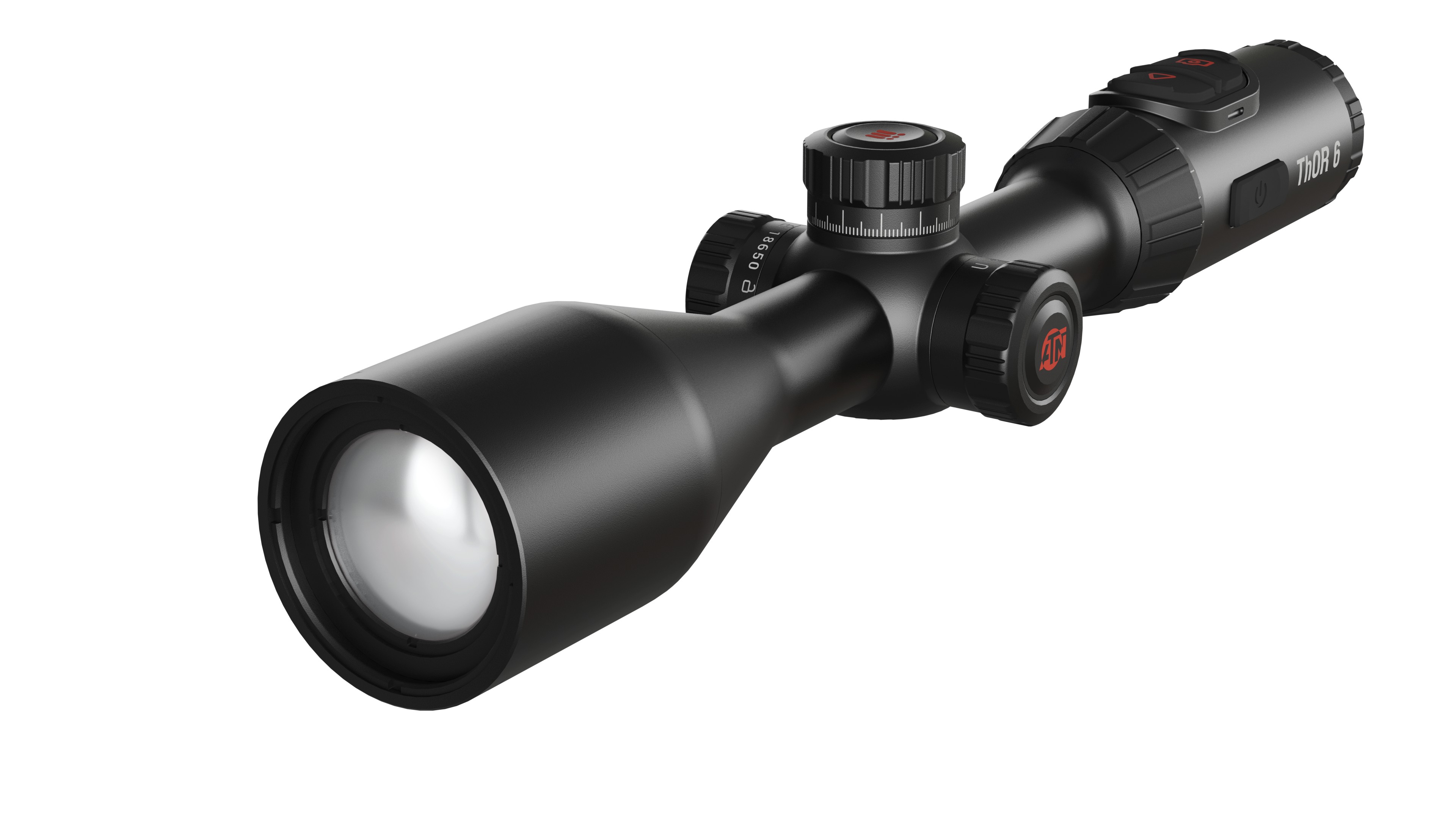
Best for the money: ATN ThOR 6 384 2.5-20x
The ThOR 6 384 2.5-20x keeps the flagship's ≤15mK NETD, battery life and feature set on a 384×288 sensor and a 25 mm lens — $700 less for pixel count you will not miss inside a few hundred yards.
Specifications: 384×288, 12µm VOx, 50 Hz, ≤15mK NETD; 25 mm F/1.0 germanium lens; 2.5-20×; field of view 10.53° × 7.91°; detection 2,300 m (2,515 yd); no rangefinder; 0.49-inch 1920×1080 OLED; two 18650 cells, about 9 hours; 790 g / 27.9 oz; 410×85×66 mm; 6,000 J recoil rating; IP67; 5-year warranty; $1,595.
Pros
- Identical ≤15mK sensitivity to the 640 models — the number that decides whether a bedded animal separates from warm grass.
- 40 g lighter than the flagship while keeping the two-battery, nine-hour setup.
- Highest top magnification of the three full-size models here at 20×.
Cons
- 384×288 is 110,592 pixels against 327,680 on a 640 sensor, so the image softens sooner as you push the digital zoom.
- Narrower field of view than the 640 at 10.53° against 12.52°, which costs you time on a moving animal in cover.
- 800 m less published detection than the 640 models.
Buy this if you want flagship sensitivity without the flagship price. Skip it if you identify game at the far end of open country, where the 640 sensor's resolution is what tells you what you are looking at. Sensor sizes compared: 640 thermal scopes.
Best lightweight: ATN ThOR 6 Mini 384 2.5-20x
The ThOR 6 Mini 384 is the pick when weight matters more than reach. At 528 g it is 262 g lighter than the full-size 384 with the same sensor size and the same 2,300 m of detection, mount included.
Specifications: 384×288, 12µm, 50 Hz, ≤18mK NETD; 25 mm F/1.0 germanium lens; 2.5-20× with 8× digital zoom; field of view 10.5° × 7.9°; detection 2,300 m (2,515 yd); no rangefinder; 0.49-inch 1920×1080 OLED; one 18650 cell, about 7 hours; 528 g / 18.6 oz; 180×65×65 mm; IP67; Picatinny mount included; 64 GB storage; $1,295.
Pros
- 262 g lighter than the full-size 384 and 302 g lighter than the flagship, which is the difference between carrying gear and being carried down by it on a mountain hunt.
- Same 0.49-inch 1920×1080 display as the full-size models, so the picture on the glass does not step down with the body.
- Clamps straight to a Picatinny rail with the mount included — no rings to buy, no ring torque to get wrong.
Cons
- ≤18mK instead of ≤15mK: a real difference on humid nights, small but present.
- About 7 hours on one cell is the shortest runtime of the five; a second 18650 ships in the box, but you have to stop and swap it mid-hunt.
- No rangefinder, and the short 180 mm body gives less rail real estate to play with on a long receiver.
Buy this if weight matters more than maximum detection range. Skip it if you sit a stand all night and want the nine-hour dual-battery runtime of a full-size body.
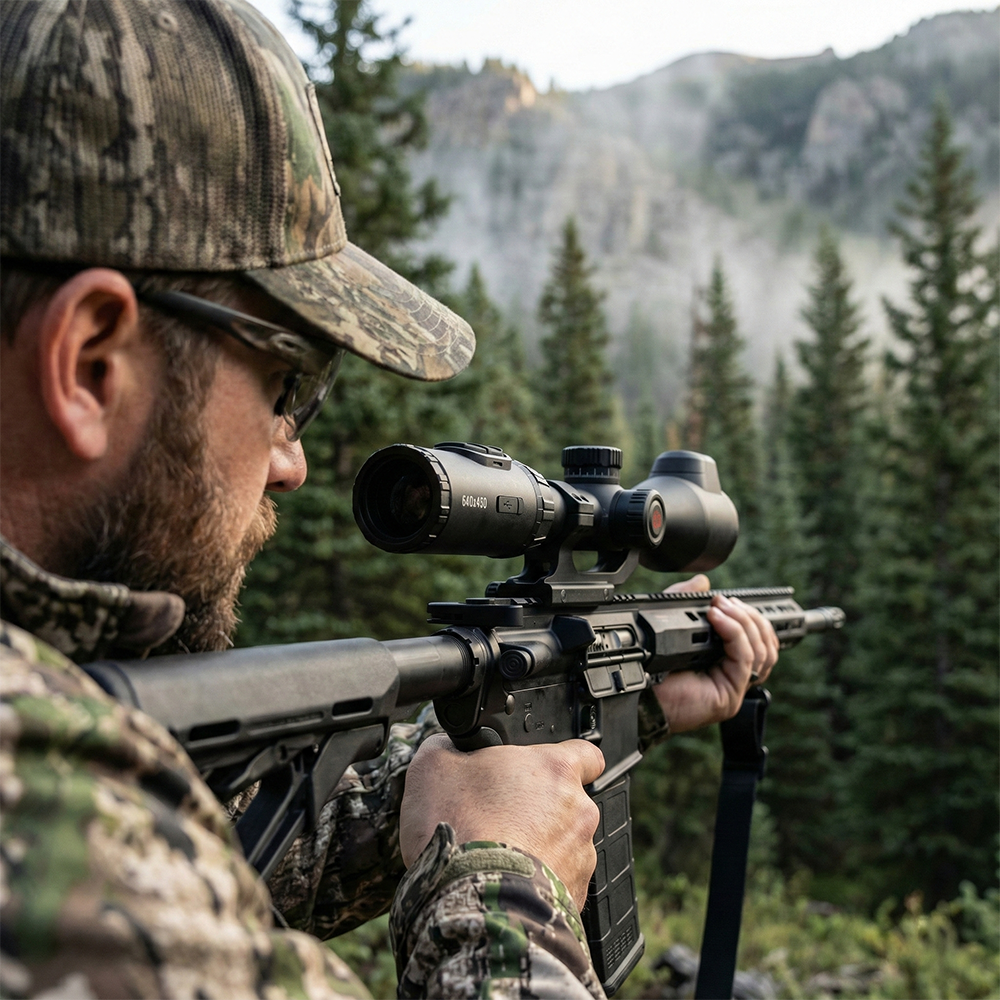
Best long-range: ATN ThOR 6 LRF 640 2-16x
The ThOR 6 LRF 640 2-16x is the flagship with a laser rangefinder in the objective bell. In open country your shot might be 100 yards or 500, and past a couple of hundred misses stop coming from image quality and start coming from range estimation.
Specifications: identical optical core to the 640 2-16x — 640×512 at ≤15mK, 35 mm F/1.0 lens, 12.52° × 9.41° field of view, 3,100 m detection, 0.49-inch 1920×1080 OLED, about 9 hours on two 18650 cells. Adds a built-in rangefinder to 1,000 m (1,094 yd) at ±1 m accuracy on an eye-safe Class 1 905 nm laser, plus a ballistic calculator storing six profiles. 855 g / 30.2 oz; 430×85×80 mm; 6,000 J; IP67; 5-year warranty; $2,595.
Pros
- Range the animal and get a corrected aiming point without taking your eye off him.
- Six ballistic profiles cover more than one rifle or more than one load.
- Everything the flagship does — same sensor, same field of view, same nine-hour runtime — with nothing given up except weight and price.
Cons
- The most expensive scope here at $2,595, $300 over the standard 640.
- 855 g / 30.2 oz makes it the heaviest of the five.
- The rangefinder module adds 8 mm of body height, which can matter for ring clearance, and in close cover you will rarely use it.
Buy this if you hunt open terrain where range estimation is part of the shot. Skip it if your ground is close cover inside a hundred yards — buy the standard 640 and spend the difference on a mount.
Budget pick: ATN ThOR 6 Mini 256 2-16x
At $689 the ThOR 6 Mini 256 is the cheapest and lightest ThOR 6 at 500 g, and its 11.7° field of view is wider than either 384 model here.
Specifications: 256×192, 12µm, 50 Hz, ≤20mK NETD; 15 mm F/1.0 germanium lens; 2-16×; field of view 11.7° × 8.8°; detection 1,200 m (1,312 yd); no rangefinder; 0.32-inch 800×600 OLED; one 18650 cell, about 8 hours; 500 g / 17.6 oz; 180×65×65 mm; 6,000 J recoil rating; IP67; Picatinny mount included; 64 GB storage; $689.
Pros
- Lowest price and lightest body of the five, 28 g under the Mini 384.
- Wider field of view than either 384 configuration at 11.7°, which suits close cover.
- Keeps the 6,000 J recoil rating, IP67 sealing, 64 GB of storage and Recoil Activated Video of the rest of the line.
Cons
- 256×192 carries 49,152 pixels against 327,680 on a 640 — about 15 per cent — so identification falls off much sooner as you zoom.
- ≤20mK is the least sensitive sensor here, which shows on warm, humid nights.
- The display steps down to 0.32-inch 800×600, and 1,200 m is the shortest detection range of the five.
Buy this if you are getting into thermal or want a second scope for close terrain. Skip it if you already know you want to identify game at distance — you will buy twice. See also thermal rifle scopes under $1,000.
Already have a day scope? Consider a thermal clip-on
If your rifle already wears a day scope you trust and is zeroed the way you like it, a clip-on is often the better buy than a second dedicated optic. An ATN TICO 6 mounts on the rail ahead of your existing scope at 1× optical magnification, so your day zero and your reticle stay exactly where they are, and you pull it off in daylight.
Three configurations, all with a quick-detach mount in the box: the 256×192 1-8x at $995 (MSRP $1,205), the 384×288 1-12x at $1,795 (MSRP $2,415) and the 640×512 1-15x at $2,995 (MSRP $4,285). The 640 pairs a ≤18mK sensor with a 50 mm lens for 3,500 m of detection in a 564 g body and runs about 7 hours; the 256 is 511 g and runs about 8. The number after the dash is the day-scope magnification each is built to work behind.
Where a clip-on is the wrong call: you need rail space ahead of the day scope, your day optic's magnification has to fall inside the clip-on's range, and a dedicated scope gives more magnification and a purpose-built reticle for the same money. The longer version is in our guide to clip-on thermal scopes.
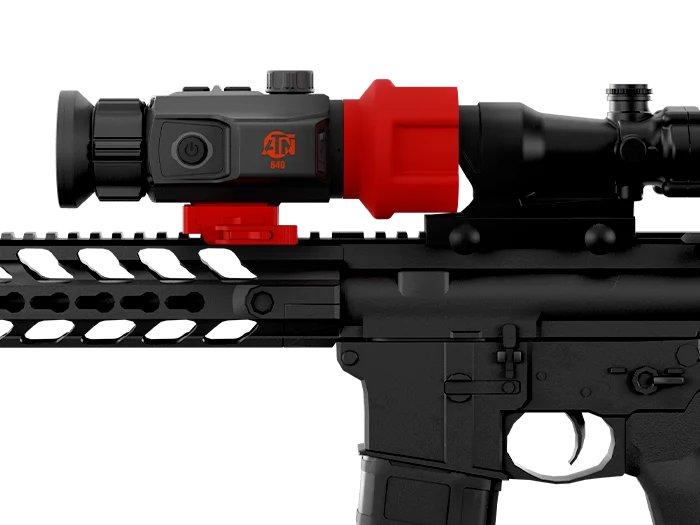
How the ThOR 6 compares with other 640-class scopes
Every other scope on this page is ours, so here is the ThOR 6 640 next to two 640-class riflescopes from other manufacturers, using each company's own published figures. Where they are ahead of us, the table says so.
| Model | Sensor | NETD | Magnification | Rangefinder | Battery | Weight | Warranty | Price |
|---|---|---|---|---|---|---|---|---|
| ATN ThOR 6 640 2-16x | 640×512, 12µm | ≤15mK | 2-16× | No (LRF version, 1,000 m) | 2 × 18650, ~9 hrs | 830 g | 5 years | $2,295 |
| Pulsar Thermion 2 LRF XP60 | 640×480, 17µm | <25mK (sNETD <18mK) | 3-24× | Yes, 800 m | Built-in + APS3, 7 hrs | 1,160 g | 3 years, 5 with registration | $4,499.97 |
| AGM Varmint V2 LRF 35-640 | 640×512, 12µm | <20mK | 2-16× | Yes, range not published | 1 × 18650, over 5 hrs | 517 g | 5 years, transferable | $2,995 |
Competitor specifications from the manufacturers' own product pages, checked 11 November 2026. Read it honestly. The AGM is 313 g lighter than our flagship and has ranging built in, though at $2,995 it costs more than either of our 640 configurations; if light weight with a rangefinder is your priority, that is still a real argument. The Pulsar has a longer top magnification, though its sensor is 640×480 on a 17µm pitch against our 640×512 on 12µm. Where our line is ahead: ≤15mK is the lowest published NETD of the three, the price is the lowest, and the warranty term is 5 years without conditions attached to its length. None of this comes from a side-by-side test — these are published specifications, and different companies measure them differently.
How to choose the right thermal scope for your hunt
Terrain and shot distance
Start with terrain, not price. Open fields, pasture or high desert where shots stretch past 300 yards reward detection range and an LRF model, because knowing the distance changes whether you take the shot. In timber and brush at 50 to 150 yards, a smaller sensor with strong NETD identifies game just as fast, and the savings go to ammunition or a mount.
Sensor resolution: 256 vs 384 vs 640
Resolution sets how far you can zoom before the image breaks down. 256×192 is 49,152 pixels and works inside roughly 150 yards; 384×288 is 110,592 and covers most hunting out to a few hundred; 640×512 is 327,680 and is what tells you what the animal is rather than that something warm is standing there.
NETD, or thermal sensitivity
NETD is the faintest temperature difference the sensor can separate from the background, and lower is better. The step from ≤20mK to ≤15mK is what picks a bedded animal out of warm grass instead of a blur, and it matters most on humid nights. Here it runs ≤15mK on the full-size models, ≤18mK on the Mini 384, ≤20mK on the Mini 256.
Pixel pitch and magnification
Pixel pitch is the size of each sensor cell — 12µm across this line. Base magnification and field of view travel together: the 35 mm lens at 2× sees 12.52°, the 25 mm lens at 2.5× sees 10.53°. Buy the base magnification that frames your ground; the 8× digital zoom is for afterwards. More: lens size and field of view.
Battery life and cold weather
Plan for less runtime than the sheet promises, because lithium cells lose capacity in the cold. Full-size models run about 9 hours on two 18650 cells with one swappable; the Mini 384 runs about 7 and the Mini 256 about 8 on a single cell. For all-night sits in freezing weather, carry a spare — every model takes USB-C external power.
Mounting and rail space
Measure the rail before you buy. The three full-size models use 30 mm rings and run 410 to 430 mm long, which an AR flat-top handles but a short bolt-action receiver may not. Both Minis are 180 mm and clamp straight to a Picatinny rail, mount included. Ring height matters too: a 35 mm objective sits higher than a 15 mm one.
Laser rangefinder and ballistic calculator
A built-in rangefinder earns its price at unknown distances past a couple of hundred yards. On the LRF 640 it reads to 1,000 m at ±1 m on an eye-safe Class 1 905 nm laser and feeds a ballistic calculator holding six profiles, so the corrected aiming point appears without leaving the eyepiece. Inside 150 yards it is $300 you do not need to spend.
App, recording and streaming
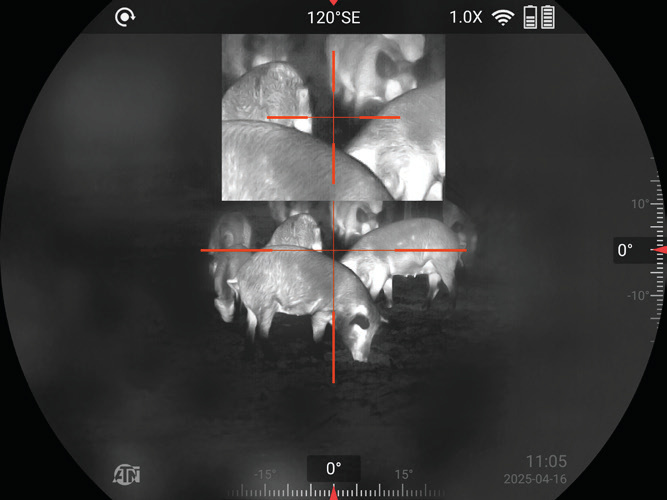
Every ThOR 6 here records to 64 GB of internal storage with Recoil Activated Video, which keeps ten seconds either side of the shot, and connects over Wi-Fi to the ATN Connect 6 app. The practical value is settling where the bullet went before you walk up.
Warranty and support
Warranty is part of the price. Every ThOR 6 configuration here carries a 5-year warranty, which matters more on an electro-optic than on a glass scope because there is firmware and a battery system behind the lens. Check what coverage requires: some manufacturers ask you to register to get the full term.
Hunting laws
Rules for hunting with thermal at night vary by state, by species and sometimes by county, and they change. Thermal is commonly allowed on non-game species such as hogs and coyotes and restricted or prohibited for deer in many places. We cannot answer this for your ground: confirm the current rules with your state wildlife agency before you plan the hunt.
Frequently asked questions
What is the best thermal scope for hunting?
The ATN ThOR 6 640 2-16x at $2,295 for most hunters. It pairs a 640×512 sensor at ≤15mK with the widest field of view of the five here, 12.52° × 9.41°, and 3,100 m of detection, so it handles open fields and tight timber without being rebuilt for either.
Do I need a 640 sensor or is 384 enough for hunting?
384×288 is enough for most hunting inside a few hundred yards, especially with a ≤15mK sensor like the ThOR 6 384 2.5-20x. Step up to 640×512 when you need to identify an animal rather than spot it at distance: 327,680 pixels against 110,592 is what holds the outline together as you zoom.
How far can a thermal scope detect game?
From 1,200 m on the ThOR 6 Mini 256 to 3,100 m on both 640 models, as published. Detection and identification are not the same thing: telling a deer from a dog happens at a fraction of that, and your cartridge sets the real limit. More in thermal scope detection range.
What yardage should you zero a thermal scope at?
Zero at the distance where most of your shots actually happen, which for thermal hunting is usually inside 200 yards. ATN does not publish one recommended distance, because it depends on your cartridge and ground. Use a heat source and the Zeroing Freeze function: how to sight in a thermal scope.
Is a thermal scope good for deer hunting?
Technically yes — thermal finds a bedded deer in grass that your eye and a day scope will not. Legally it is a different question: many states restrict or prohibit thermal for deer while allowing it on hogs and coyotes. Check with your state wildlife agency before you plan around it.
What is the best thermal rifle scope under $1,000?
The ATN ThOR 6 Mini 256 2-16x at $689, list price $985 — the only ThOR 6 under $1,000 on both numbers. You get a 12µm 256×192 sensor, an 11.7° field of view, IP67 sealing and a Picatinny mount in the box. What you give up is resolution, sensitivity and reach.
What are the best thermal scopes in 2027?
Across the ATN line: the ThOR 6 640 2-16x for mixed ground, the LRF 640 for open country, the 384 2.5-20x for value, the Mini 384 for weight and the Mini 256 for a first thermal. They share the same 12µm core and 5-year warranty, and differ in sensor size, field of view, reach and price.
Thermal scope vs night vision: which is better for hunting?
Thermal is better for finding, night vision for identifying under light. Thermal reads emitted heat and works in complete darkness, fog and grass; digital night vision amplifies reflected light and shows coat and antler detail. For most night hunting, thermal wins. Full comparison: night vision vs thermal.
Thermal clip-on vs dedicated thermal scope: which should I buy?
Buy a clip-on if your rifle already has a day scope you trust and you want one rifle for day and night: a TICO 6 mounts ahead of it at 1× and leaves your day zero alone. Buy a dedicated scope if the rifle is a night rifle, rail space is tight, or you want more magnification for the money.
Is it legal to hunt with a thermal scope?
It depends entirely on where you are and what you are hunting. Many states permit thermal on non-game species like hogs and coyotes, often with conditions on licences or landowner permission; rules for game animals are usually stricter. Confirm with your state wildlife agency before the hunt.
What warranty comes with ATN thermal scopes?
Every ThOR 6 configuration in this guide carries a 5-year warranty, as published in the specifications for each model. That covers the whole platform — sensor, electronics and housing — which matters more on a thermal optic than on a glass scope because there is firmware and a battery system behind the lens.
Can I use a thermal scope for hunting during the day?
Yes. Thermal reads heat rather than visible light, so daylight will not damage the sensor. Contrast drops once the ground has absorbed the sun's heat, which is why dawn, dusk and shaded cover read best. Full guide: can you use a thermal scope during the day.
What is the difference between the ThOR 6 and the ThOR 6 Mini?
Size, battery and sensitivity. The full-size ThOR 6 is a 410 to 430 mm body on 30 mm rings with two 18650 cells for about 9 hours; the Mini is 180 mm, clamps to a Picatinny rail with the mount included, and runs one cell for 7 to 8 hours. The Minis sit at ≤18mK and ≤20mK rather than ≤15mK.
Is a built-in laser rangefinder worth it for hunting?
It is worth it when you hunt open ground at unknown distances. On the ThOR 6 LRF 640 it reads to 1,000 m at ±1 m and feeds a ballistic calculator with six storable profiles, so the corrected aiming point appears without leaving the eyepiece. Inside 150 yards the standard 640 does the job for $300 less.
How long does a thermal scope battery last in the field?
About 9 hours on the full-size ThOR 6 models, which run two 18650 cells with one swappable, and about 7 to 8 hours on the Mini models on a single cell. Cold shortens all of those figures, so carry a spare cell or a USB-C power bank for an all-night sit.
Find your ThOR 6
If you want one answer and no hedging: the ThOR 6 640 2-16x at $2,295 covers more hunting situations than anything else here, and the wide 12.52° view is what makes it work in cover as well as across a field. Open ground at unknown distances is worth the extra $300 for the LRF version. If you walk more than you sit, the Mini 384 at $1,295 saves 302 g. And for a first thermal, the Mini 256 at $689 will show you animals you have been walking past for years. Compare the range on our ThOR thermal scope page, or start with the best thermal scope for an AR-15 and the thermal scope guide.