The question people type is some version of «how far can it see», and the answer is that a thermal scope detection range figure is not a seeing distance at all. It is the distance at which the device still puts enough thermal pixels on a standard target for that target to register as something rather than nothing. Our spec sheet says 3100 m for the ATN ThOR 6 640x512 | 2-16x. The number is real and measured, and it does not mean you will tell a hog from a calf at three kilometres. Here is what it measures and which specifications move it.
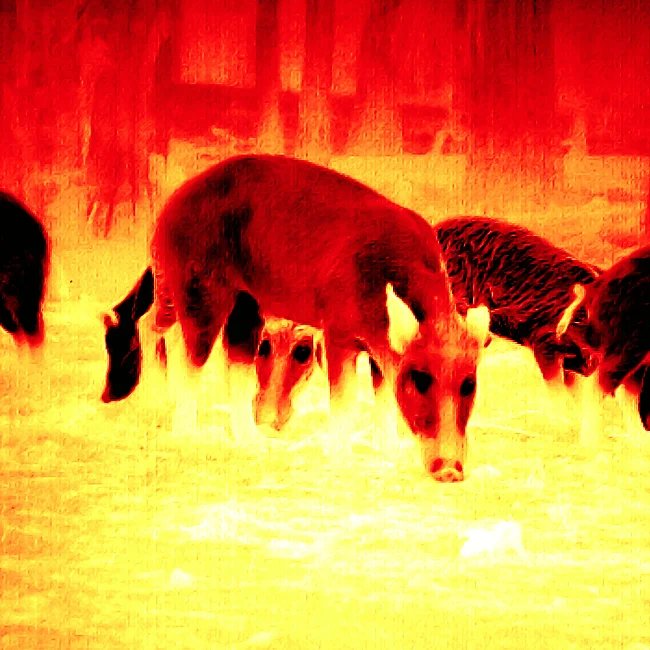
Detection means «there is a heat source there». Recognition means «that is an animal». Identification means «that is a sow with piglets». A published detection range is the first and by far the longest of the three, and ATN publishes only that one.
What a detection range figure measures
It measures how far away a target of defined size still produces a usable thermal signal. Two things must be true at once. The optics and detector have to resolve the target: the angle it subtends must fall across enough pixels. And the target has to be thermally distinguishable from its background: the temperature difference must exceed the detector's own noise. Lose either condition and the range collapses, which is why the same scope behaves differently on a frozen pasture and on sun-baked ground an hour after sunset.
How the DRI model works
DRI stands for detection, recognition and identification. It comes from work done by John Johnson in the 1950s on how many resolvable cycles — line pairs — an imaging system must lay across a target before an observer can perform a given task. The convention still runs like this:
- Reduce the target to a critical dimension, usually the square root of height times width. A 2.3 × 2.3 m NATO target is the common reference; a human is taken as 1.8 × 0.5 m.
- Detection: about 1 line pair. Two pixels across that dimension — enough to say something is there, at roughly 50 percent probability.
- Recognition: about 4 line pairs. Eight pixels, enough to sort the target into a class: animal, vehicle, person.
- Identification: roughly 6 to 8 line pairs. Twelve to sixteen pixels, enough to say which animal.
- Apply the atmosphere. The model assumes a clear path and a stated temperature difference; humidity, fog, dust and rain absorb in the long-wave infrared band and pull every distance in.
Because recognition needs roughly four times the resolution of detection, the detection distance is several times the recognition distance on the same device. That ratio belongs to the model, not to any manufacturer, and it is why a four-digit detection figure is never a shooting distance.
What the number is good for
Comparing devices on one scale, and little else. Every manufacturer publishes detection against its own chosen target under its own assumed conditions, so the figure is most useful inside a single product family, where test conditions are held constant. Across our Gen 6 line the comparison is informative because the detector technology is shared — a 12µm VOx uncooled array at 50 Hz. What changes is the objective, the sensitivity and the sensor format, and the published range tracks those changes.
Published detection ranges across the ATN Gen 6 line
| Model | SKU | Sensor | NETD | Objective | Field of view | Detection |
|---|---|---|---|---|---|---|
| ThOR 6 640x512 | 2-16x | TIWST6635A | 640×512 | ≤15mK | 35 mm | 12.52° × 9.41° | 3100 m |
| ThOR 6 640x512 | 3-24x | TIWST6650A | 640×512 | ≤15mK | 50 mm | 8.78° × 6.59° | 3650 m |
| ThOR 6 384x288 | 2.5-20x | TIWST6325A | 384×288 | ≤15mK | 25 mm | 10.53° × 7.91° | 2300 m |
| ThOR 6 Mini 640x512 | 2-16x | TIWST6M635 | 640×512 | ≤18mK | 35 mm | 12.5° × 10.0° | 3000 m |
| BlazeTrek 6 640x512 | 1.5-12x | TIMNBLT619G6 | 640×512 | ≤18mK | 19 mm | 22.8° × 18.3° | 1000 m |
| BlazeTrek 6 384x288 | 2.25-18x | TIMNBLT319G6 | 384×288 | ≤18mK | 19 mm | 14.4° × 10.8° | 1000 m |
Detection, recognition, identification: the practical difference
They are three distances for the same animal on the same night. At detection range the animal is a bright patch with no edges you would trust. At recognition range the shape resolves: four legs, a body axis, a gait. At identification range you are counting what is in front of you: sow or boar, mature or young, one animal or two overlapping. Each step costs roughly four times the pixels on target, which is why it costs so much distance. ATN publishes the detection figure only; treat any recognition or identification number for these models found elsewhere as an estimate, not a specification.
The specifications that actually move the number
- Objective and focal length — the dominant term. Same sensor and sensitivity, two lenses: the ThOR 6 640x512 | 2-16x on 35 mm germanium is rated at 3100 m, the 3-24x on 50 mm at 3650 m.
- Pixel pitch — every Gen 6 thermal sensor above uses a 12µm pitch. Pitch divided by focal length gives the angle one pixel covers, and both numbers are published for every model, so you can work it out yourself.
- Sensor format — resolution sets how many pixels exist, which is why it governs recognition and identification more than detection. On the same 19 mm objective the BlazeTrek 6 640x512 and 384x288 are both rated at 1000 m; only one turns that patch into an animal.
- NETD — thermal sensitivity in millikelvin, the smallest temperature step the detector separates from its own noise floor, lower being better. Change only this: ≤15mK on the full-size 2-16x gives 3100 m, ≤18mK on the ThOR 6 Mini 640x512 | 2-16x with the same 35 mm objective gives 3000 m.
- Field of view — the cost side of the trade. Going from 35 mm to 50 mm takes you from 12.52° × 9.41° to 8.78° × 6.59°. Matching magnifications do not guarantee matching frames: the ThOR 6 Mini 640x512 | 2-16x shows 12.5° × 10.0°, taller vertically than the full-size 2-16x.
- Magnification — moves nothing. Zoom steps of 1×, 2×, 4× and 8× enlarge data the sensor already captured; past a handful of pixels on target you get a larger blur, not more information.
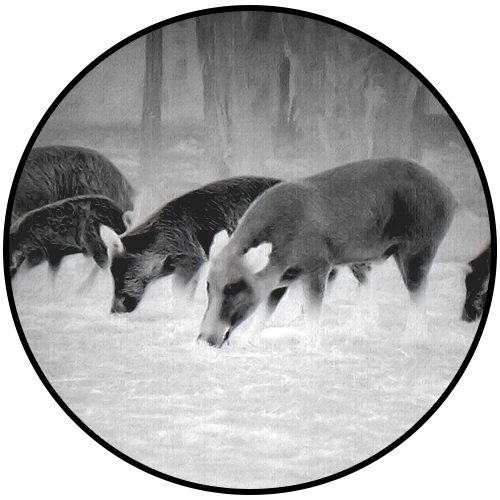
What to check on a spec sheet before you buy
Read the four numbers that produce the range, not the range alone. Objective and focal length tell you how much reach the optics deliver. Sensor format and pixel pitch tell you how much detail arrives at the far end of it. NETD tells you how the device behaves when scene contrast collapses. Field of view tells you what you paid for that reach, and it is the specification people regret ignoring, because a narrow frame is slow to search and slow to follow a moving animal. Similar detection figures with very different frames mean you are choosing between finding things and reaching things — the optical reasons sit in our piece on germanium optics and thermal lenses.
Common mistakes reading range numbers
The first is treating detection as a shooting distance; it measures whether a signal exists, and nothing in the definition implies a shot is appropriate or legal. The second is comparing figures across manufacturers as though they were measured identically — target size, assumed temperature difference and atmospheric model all vary, and are rarely printed. The third is expecting the figure to hold in bad air, when water vapour absorbs long-wave infrared. The fourth is ignoring thermal crossover, when ground and animal reach similar temperatures and contrast falls toward zero. The fifth is assuming magnification extends range; the processing that keeps enlarged frames readable is covered in how SharpIR AI actually works.
A worked example: the ATN ThOR 6 640x512 | 2-16x
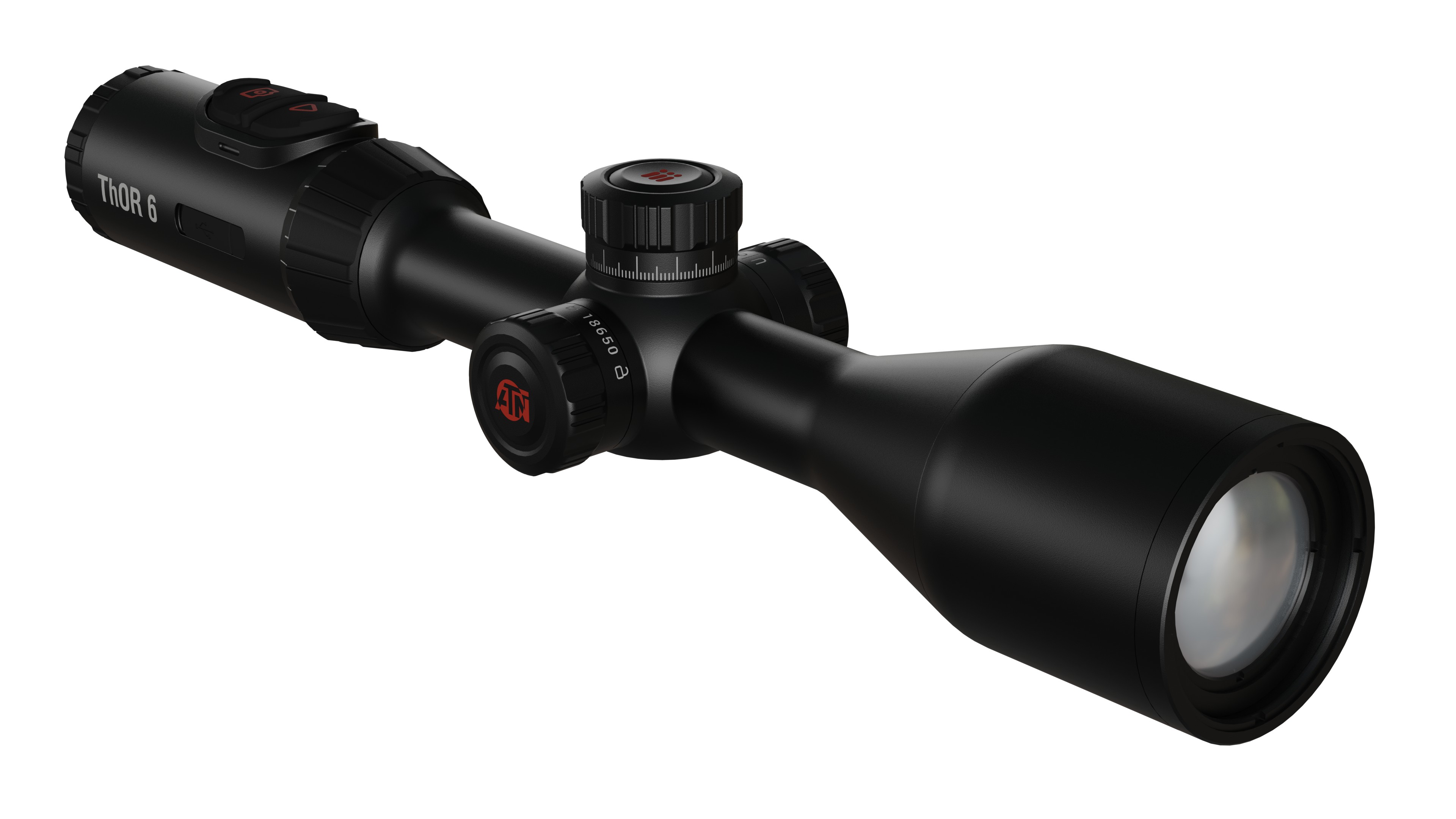
Take the ATN ThOR 6 640x512 | 2-16x apart and 3100 m stops being mysterious. The detector is a 12µm VOx uncooled focal plane array at 640×512, 50 Hz, ≤15mK; the optics are a 35 mm germanium objective at F/1.0 giving 12.52° × 9.41° at 2-16x. Those four values are the whole input to the number. Everything else on the sheet changes what you do with the image rather than how far it reaches: a 0.49-inch 1920×1080 OLED, ten reticle styles, Zeroing Freeze, Picture-in-Picture, Hot Point Tracking, Recoil Activated Video, 64 GB of storage, magnesium alloy, IP67, 6000 Joules, 830 g / 1.83 lbs, around nine hours on one internal and one replaceable 18650. It lists at $3,625 with a published promotional price of $2,295.
Is a bigger detection figure worth paying for?
Only if your ground is big enough to use it. Moving from 35 mm to 50 mm buys 550 m of rated detection and costs nearly four degrees of horizontal frame — excellent on open country, poor in timber. Sensitivity is the quieter upgrade: ≤15mK against ≤18mK adds little to the published range, but does its work on nights when contrast is thin. Buy the lens for your terrain and the NETD for your climate. For where 640×512 is enough, see our rundown of the best 640 thermal scopes.
Thermal scope range: common questions
How far can a thermal scope really see?
It depends on the task. ATN publishes 3100 m of detection for the ThOR 6 640x512 | 2-16x: a heat signature registers on the sensor at that distance under test conditions. Recognising and identifying the animal both happen far closer.
What does DRI stand for?
Detection, recognition and identification — the three tasks in the Johnson criteria. Each needs roughly four times the resolution on target of the one before it, so each is achieved at a substantially shorter distance.
Does higher magnification increase detection range?
No. Magnification enlarges the image the sensor already produced. Detection range is set by the objective, the pixel pitch, the sensor format and the thermal sensitivity.
Why do a 640 and a 384 model show the same detection range?
Because they share the optics. Both use a 19 mm germanium objective and both are rated at 1000 m. Extra resolution pays off in recognition and identification, where pixel count on target is the limit.
What is NETD and how much does it matter?
NETD is thermal sensitivity in millikelvin: the smallest temperature difference the detector separates from its own noise, lower being better. On published range it is a modest term — ≤15mK versus ≤18mK on the same lens is 3100 m versus 3000 m — but it matters most in humid air.
Does ATN publish recognition and identification distances?
No. The specification sheets carry a single detection range per model. Any recognition or identification figure for these scopes found elsewhere was estimated by applying the Johnson ratios, not measured by us.
The short version
A detection range is one measurement of one task under stated conditions: a heat signature registering on a sensor. It is set by the objective, the pixel pitch, the sensor format and the thermal sensitivity, and it is several times longer than the distance at which you can tell what you are looking at. Read the four inputs and let terrain choose the lens. The current ATN thermal scopes publish all four on every model, so you can check the claim yourself.
Quick spec reference
- Featured optic: ATN ThOR 6 640x512 | 2-16x, SKU TIWST6635A — $3,625 list / $2,295 promotional
- Sensor and optics: 640×512, 12µm VOx uncooled, 50 Hz, ≤15mK; 35 mm (Ge) F/1.0; 12.52° × 9.41°; 3100 m detection
- Longest and shortest above: ThOR 6 640x512 | 3-24x (TIWST6650A), 50 mm, 3650 m; BlazeTrek 6 monoculars (TIMNBLT619G6, TIMNBLT319G6), 19 mm, 1000 m