No. Can thermal see through glass is the question we are asked most often, and the answer is a clean no — point a thermal imager at a window and you will see the temperature of the window, with your own reflection sometimes mixed in. That single fact is also the reason the objective lens on every ATN thermal device is germanium rather than glass, and once you understand why, every other question on this list answers itself.
Thermal imagers work in long-wave infrared, roughly the 8 to 14 micrometre band, and that band is blocked by glass, water, walls and foliage — you see the surface temperature of those things, not what is behind them. It passes well through smoke and thin plastic, and it penetrates light haze better than your eyes do. Heavy fog and rain degrade it, because water in the air absorbs the same wavelengths.
What a Thermal Imager Is Actually Detecting
A thermal imager detects long-wave infrared radiation, the band from roughly 8 to 14 micrometres that every object above absolute zero emits as a function of its temperature. It does not detect light, which is why darkness costs it nothing, and it does not detect objects — it detects the radiation leaving the surfaces facing it.
That last distinction is the whole article. A thermal sensor builds its picture from the outermost surface in its line of sight. If something opaque at those wavelengths sits between you and your subject, the picture you get is of that something, at whatever temperature it happens to be.
Why the Lens Is Germanium and the Window Is Not
Ordinary glass is effectively opaque to long-wave infrared, which is precisely why thermal optics are built around germanium. Every objective in the current ATN thermal line is specified as germanium — 15 mm, 25 mm, 35 mm and 50 mm, all at F/1.0 — because germanium transmits the 8 to 14 micrometre band that glass stops.
Turn that around and you have your answer about windows. The reason a manufacturer pays for germanium instead of using cheap glass is the same reason your scope cannot look into a lit room from the garden: glass is a wall at these wavelengths. A window viewed in thermal reads as a flat panel at roughly ambient temperature, often with a mirror-like reflection of whatever warm object is on your side of it. The piece on germanium optics covers why that material is the expensive part of a thermal optic.
The Short Table
| Medium | Does thermal see through it? | What you actually see |
|---|---|---|
| Glass, windows, vehicle windscreens | No | The surface temperature of the glass, plus reflections |
| Walls, doors, roofs | No | The wall's own temperature; heat conducted from inside only over hours |
| Water, ponds, rivers | No | The temperature of the water's surface film |
| Dense foliage, brush, tree trunks | No | The vegetation; animals appear only through gaps |
| Smoke, dust | Largely yes | The scene behind it, with some loss of contrast |
| Light haze, thin mist | Better than your eyes | A usable but softer image |
| Heavy fog, hard rain | Degraded | Reduced range and contrast; the air itself is absorbing |
| Thin plastic sheeting, bin bags | Often yes | Warm objects behind the plastic, dimmed |
| Space blankets, foil | No | A mirror; often a reflection of you |
Water, Fog and Rain Are Three Different Problems
All three involve water, and they fail in different ways. Standing water is a surface: a pond reads as one flat temperature, and a fish a foot down is invisible because the water above it is opaque at these wavelengths. People expect thermal to work like sonar here, and it does not.
Fog and mist are suspended droplets, so the question becomes how much water sits in the path and how large the droplets are. In light haze, thermal comfortably outperforms the naked eye, because it is not relying on visible light scattering off the subject. In thick fog the same droplets absorb and scatter long-wave infrared, your effective range shortens, and the scene flattens. The device has not failed; the atmosphere has become part of the optical path.
Rain does both at once. Falling water absorbs infrared, and it also cools and wets surfaces, which drains the temperature difference the sensor depends on. A soaked animal against soaked ground is a genuinely harder target than the same animal on a dry, cold night — and this is where sensitivity earns its price. ≤15mK on the full-size ThOR 6 bodies and ≤18mK on the Mini line is the specification that decides how small a temperature difference still produces a picture. The piece on performance below freezing covers the cold end of the same problem.
Foliage: the Honest Answer
Thermal does not see through leaves, branches or grass — it sees through the gaps between them. A hundred-yard screen of brush with ten per cent open area will show you an animal behind it, because one in ten of your pixels is looking at a warm body rather than a cool leaf. Thicken the screen and the animal disappears entirely.
This is why thermal feels like it penetrates cover. It does not penetrate anything; it is simply very good at noticing a warm fragment in a cold frame, and a hunter's eye is bad at that in the dark. Resolution decides how small a gap still produces a recognisable shape, which is a practical argument for a 640×512 sensor in timber rather than a longer detection figure.
Where Thermal Genuinely Wins: Smoke
Smoke and dust particles are small compared with an 8 to 14 micrometre wavelength, so long-wave infrared passes through them far better than visible light does. This is why thermal imaging became standard equipment for firefighting long before it reached hunting, and it is the one "see through" claim in this article that holds up without qualification.
Thermal Against the Digital Night Channel
Worth separating, because the two technologies answer this question differently. A digital day/night channel is a visible and near-infrared camera: it needs light, and on a dark night it needs an infrared illuminator to supply it. The Binox-6 Dual pairs a thermal channel with a 4K day sensor and an 850 or 940 nm illuminator rated to an effective 400 m at night.
Near-infrared at those wavelengths passes through glass, which is exactly the opposite of the thermal channel. A digital night channel can look through a window; it cannot find a warm animal in brush. The thermal channel can do the second and not the first. Neither is better — they answer different questions, and a device with both lets you pick.
Myths Worth Retiring
Myth: thermal sees through walls. It does not, and no civilian or military thermal imager does. What it can show is a warm patch on a wall where something hot has been resting against the other side long enough to conduct heat through — a radiator, a chimney flue, a vehicle engine. That is reading the wall, not seeing past it.
Myth: a thicker lens sees through more. Objective diameter changes how much radiation you collect and therefore detection range and base magnification. It does not change what the band can pass through. A 50 mm germanium objective looks at a window exactly as blankly as a 15 mm one.
Myth: more magnification helps in fog. Zoom enlarges the image you already have. If fog has removed the contrast, magnifying the result enlarges the fog — the digital zoom explainer covers why.
The Optic I Would Point at This
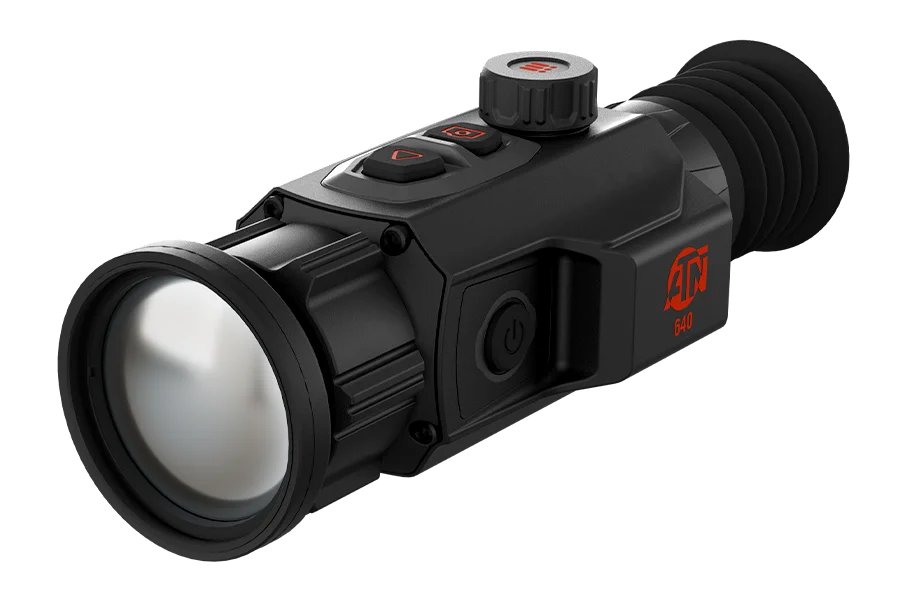
For working in conditions that fight you, I would take the ATN ThOR 6 Mini 640 3-24x at $2,495, because resolution and sensitivity are what survive bad air. The specifics: 640×512 at ≤18mK on a 12μm core, a 50 mm germanium objective at F/1.0, 3,500 m detection range, 50 Hz refresh, six palettes, about seven hours on a replaceable 18650, 580 g in a magnesium alloy housing with IP67 sealing.
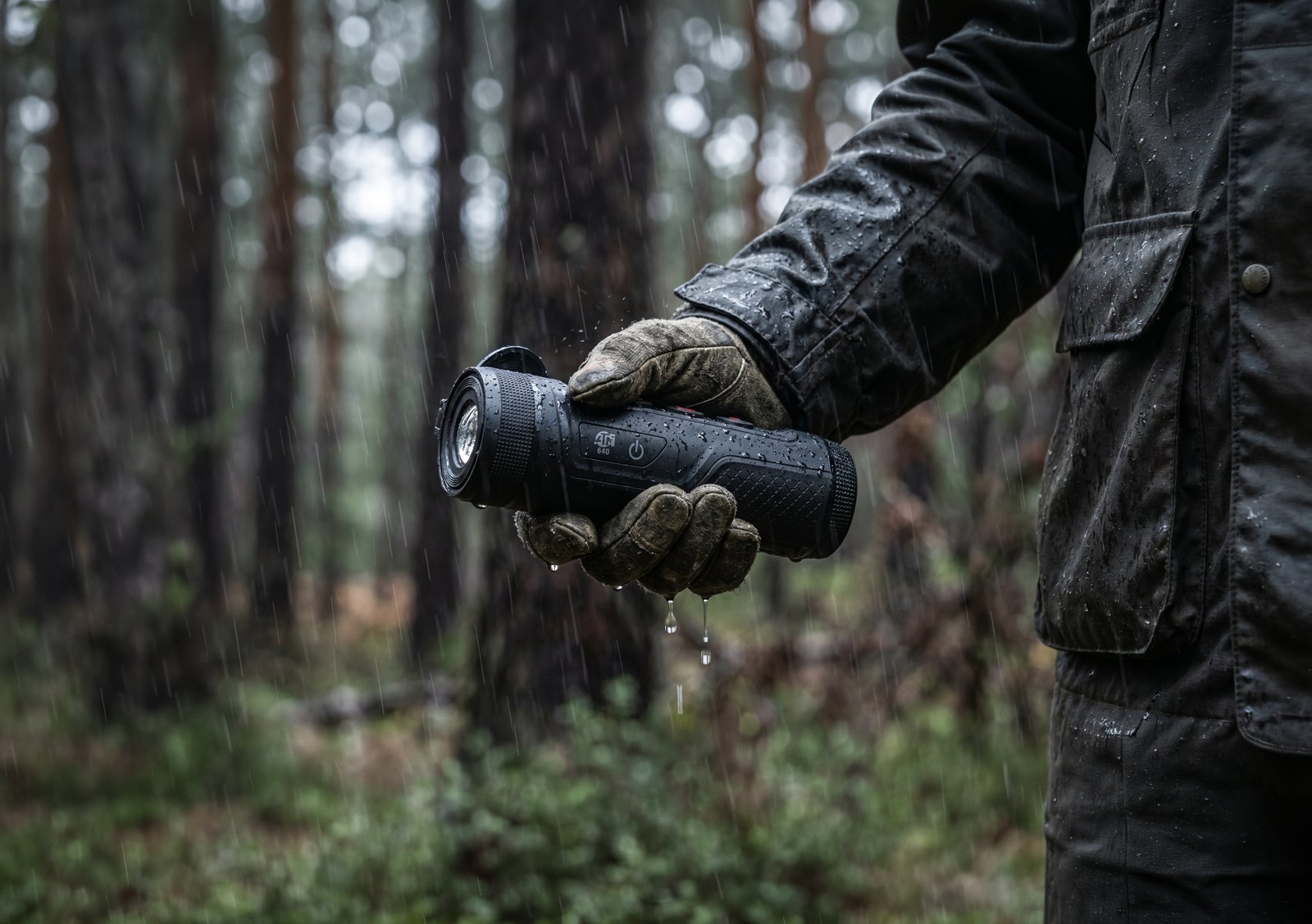
That IP67 rating matters in this context: the device is sealed against the rain that degrades its image. You will lose range on a wet night regardless of what you are carrying, and the honest expectation is a shorter working distance rather than a failed one.
Frequently Asked Questions
Can thermal imaging see through glass?
No. Glass is effectively opaque to the 8 to 14 micrometre band thermal sensors use, so a window reads as a flat surface at its own temperature, often with a mirror-like reflection. This is the same property that makes germanium, not glass, the material used for thermal objective lenses.
Can thermal see through walls?
No. A thermal imager reads the surface of the wall. If something hot has been pressed against the far side for a long time, conducted heat can show as a warm patch, but that is the wall's own temperature rather than a view of the room behind it.
Can thermal see through water?
No. Water is opaque at these wavelengths, so you see the temperature of the surface film. A pond reads as one flat plane, and an animal or fish below the surface is not visible.
Does thermal work in fog and rain?
It works, with reduced range. Light haze is where thermal clearly beats the naked eye. Heavy fog and hard rain put water in the optical path that absorbs the same wavelengths the sensor needs, and wet surfaces lose the temperature difference that makes a target stand out, so expect a shorter working distance.
Can thermal see through trees and brush?
Only through the gaps. Leaves and branches are opaque, but a partial screen still leaves open area, and a warm body behind it registers in whatever pixels are looking through those openings. Higher sensor resolution means a smaller gap still produces a recognisable shape.
Why can thermal see through smoke but not glass?
Because smoke particles are small relative to an 8 to 14 micrometre wavelength, so the radiation largely passes around them, while glass absorbs that band outright. Particle size and material transparency are two different physical properties, and thermal happens to be lucky with one and unlucky with the other.
What to Take From This
Remember one sentence and the rest follows: a thermal imager shows the temperature of the nearest opaque surface in its line of sight. Glass, water, walls and leaves are all opaque at these wavelengths, so you read them rather than through them; smoke is not, so you read past it; and fog is a partial case that costs you range rather than the image. If you want the numbers behind sensitivity and distance, the detection range explainer and the current lineup breakdown both take it further, and the full range is on the ATN thermal scopes page.
Quick Spec Reference
- ATN ThOR 6 Mini 640x512 | 3-24x: $2,495 · 640×512, 12μm · ≤18mK · 50 mm germanium, F/1.0 · detection 3,500 m · 50 Hz · ~7 hrs · 580 g / 1.28 lbs · 64 GB · IP67 · magnesium alloy
- ATN Binox-6 Dual 640x512 | 3-24x: $2,895 · thermal 640×512 at ≤15mK plus a 4K day channel with an 850 / 940 nm illuminator effective to 400 m at night · built-in rangefinder to 1,000 m