How to hunt coyotes at night comes down to the calendar more than the catalog. I get the same email every August asking which scope to buy, and every August I stop the sender before they spend anything, because the optic is not the variable that beats them. A coyote you call in January behaves nothing like the one you called in October, and if you plan a season around a single mental image of "a coyote at night," you will be disappointed with whatever you put on the rifle.
If you came here for a ranked list of models, that is not this article — we already built that one, and it is worth your time: best thermal scope for coyote hunting breaks down specific picks by detection range, price and use case. What you are reading now is the tactical layer underneath that list: how the season changes the hunt, and how to run a thermal scope like the ATN ThOR 6 640 2-16x as a tool that adapts with you.
Quick answer: to hunt coyotes at night with thermal, set up downwind of where coyotes travel, scan at low magnification, call in short sequences, confirm the animal at full magnification before the shot, and let the season set your expectations — early-season dogs commit from 300+ yards, deep-winter dogs give you about six seconds.
Quick answer: how to hunt coyotes at night with thermal
- Plan the stand around the wind first. A coyote's nose finds you long before its eyes or ears do. Pick the stand for the wind, then let the scope do its job.
- Early season, September to November: animals are dispersing and under little pressure. They commit fast from 300+ yards of open stubble. Run the scope at the low end of the zoom and watch the open middle.
- Deep winter, December to February: breeding stress and hunting pressure make coyotes hang at the tree line and circle downwind. Expect six seconds instead of sixty, and lean on detection range and digital zoom.
- Scan wide, confirm tight. Find the animal at low magnification, then zoom to identify before the trigger. Detection range and identification range are not the same number.
- Match the palette to the ground. White Hot for most conditions, Black Hot when snow cover makes white-on-white hard to read.
- Looking for a scope? See our best thermal scope for coyote hunting picks.
Why the month decides more than the scope
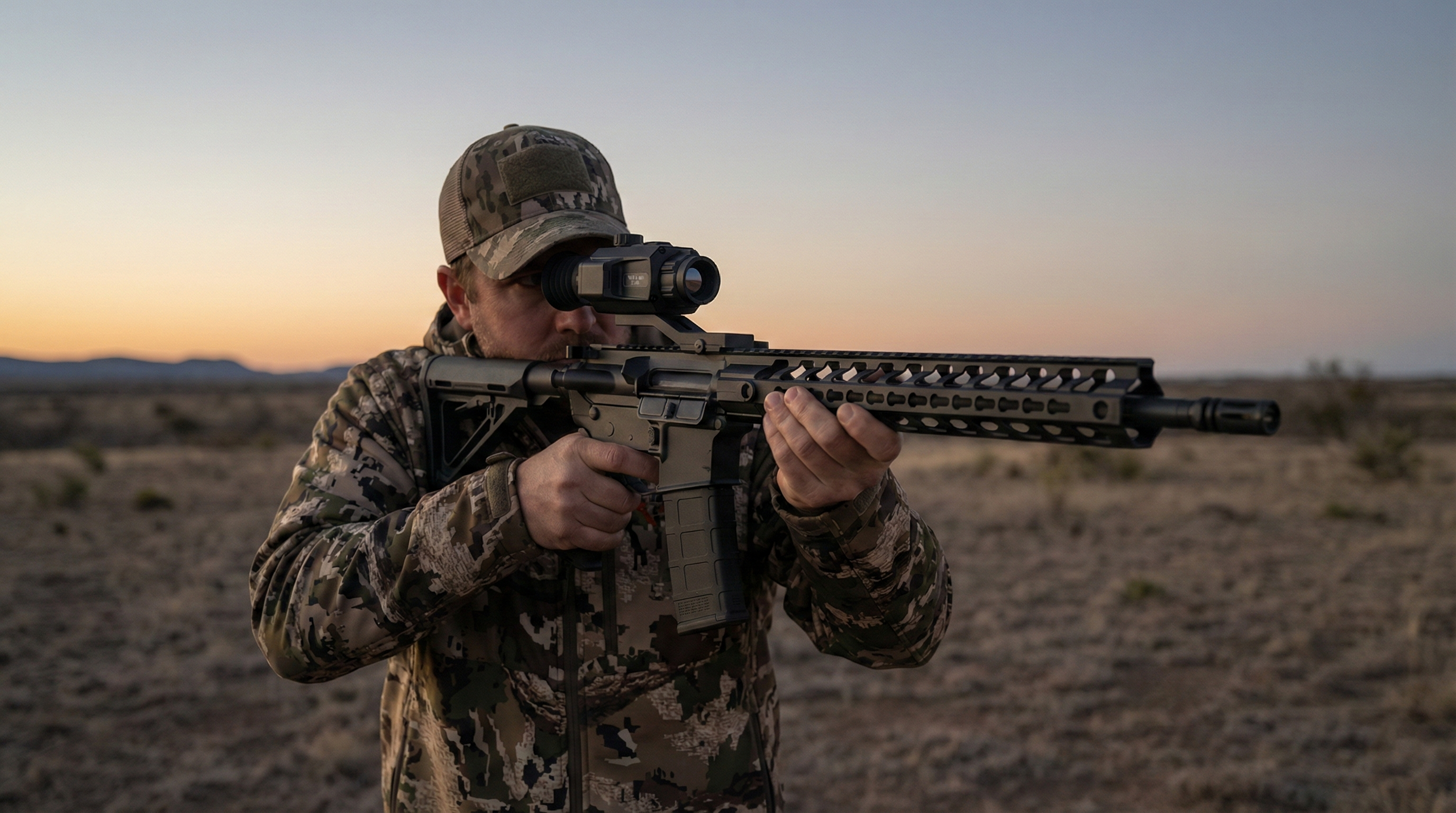
A thermal sensor does not know the month; the coyote in front of it does. Early-season animals are naive and will commit to a call from 300+ yards of open stubble. Deep-winter animals have been called at, shot at and missed by every hunter in the county — they hang at the tree line, circle downwind and give you six seconds instead of sixty. Same species, different animal.
January coyote vs. October coyote: what actually changes
Split the season into two rough phases and plan your tactics around each one.
- Early season (September–November): coyotes are dispersing, young animals are pushed out of home territory, and pressure from other hunters is low. They respond fast and close the distance. Wider fields of view and quicker target acquisition matter more than raw magnification — you need to find the dog and get on it before it changes its mind.
- Deep winter (December–February): breeding season stress and hunting pressure make coyotes cautious and quick to bust. They hang at range, use terrain to approach from your flank, and often present only for a few seconds. This is where detection range and digital zoom each do their own job — detection tells you a dog is working the edge before it commits, and the zoom is what lets you identify it once it is close enough to judge, instead of scrambling to find it at the last second.
The ThOR 6 640 2-16x carries a 3,100 m detection range and 2-16× optical magnification, so it is built for the winter scenario without giving anything up in the early season — you simply run it at the low end of the zoom range when animals are close and pushing in fast.
Wind and the approach: the part gear cannot fix
No sensor resolution compensates for hunting downwind of your own stand. A coyote's nose finds you long before its eyes or ears do, in January or October. What changes is the terrain's forgiveness: early-season cover and warm ground add thermal clutter, but the animals push in on an imperfect wind. Cold, snow-covered ground gives a cleaner picture — and coyotes that test the wind before every step. Plan the stand around the wind, then let the scope do its job.
What is a thermal scope, and what does it actually solve for a coyote hunter
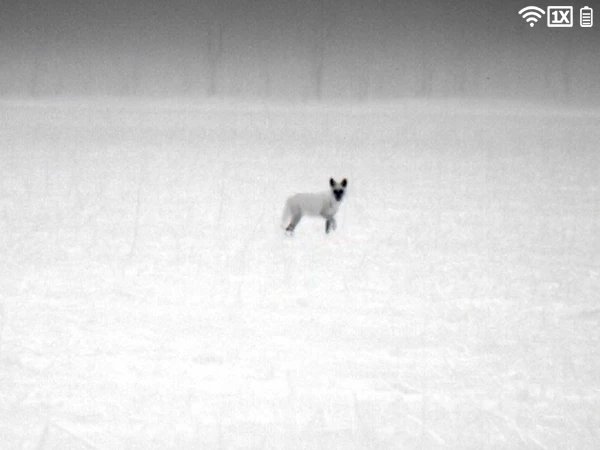
A thermal scope reads emitted heat rather than reflected light, so it works in complete darkness with no illuminator at all. For a coyote hunter that solves two problems at once: finding an animal that is moving through cover you cannot see into, and confirming what it is before you commit. Neither job is about brightness; both are about the contrast between a warm body and the ground behind it.
How a thermal scope changes what you do at each stage of the season
- Scouting and stand selection: early in the season, use wider fields of view to scan large open ground quickly and confirm coyote activity before you commit a full night to a spot.
- The call sequence: as coyotes get call-shy later in the season, you will spend more time watching the field edges and less time watching the open middle — set your magnification low enough to catch movement at the margins.
- Target confirmation: identify the animal before you touch the trigger. Resolution plus real NETD sensitivity is what separates a coyote from a neighbor's dog at distance.
- The shot: winter coyotes often give you a narrow window as they hang up at range; digital zoom lets you get a tighter look at the vitals without breaking position to close distance.
- After the shot: Recoil Activated Video lets you review exactly where you connected — useful for follow-up if the animal does not drop in place, which happens more in winter cover than open fall stubble.
What you can use it for beyond the coyote stand
The same scope covers hogs, general predator work and night scouting, because the core requirement does not change: read a heat signature clearly enough to identify it and place a shot in the dark. Check your state's rules before you plan around any species other than the one you bought the scope for — what is legal for coyotes is often not legal for game animals.
Key features to understand before you buy
- Sensor resolution: 640×512 on a 12µm pitch — enough detail to read a coyote's outline against brush, not just a blob of heat.
- NETD: ≤15mK. Lower means finer temperature differences, which is what keeps a winter animal crisp instead of smeared.
- Detection range: 3,100 m — that is the distance at which the sensor registers a heat signature, which in winter means knowing a dog is out there while it still hangs outside your shot window. Confirming what it is comes from resolution and zoom, far closer in.
- Digital zoom: 1×/2×/4×/8× on top of 2-16× optical, so you tighten on a wary animal without moving.
- Battery runtime: ~9 hours on two 18650 cells — a full winter night, with one spare in your pocket.
- Zeroing Freeze: pauses the image at impact so you move the reticle without rushing, including mid-season touch-ups. The full procedure is in how to sight in a thermal scope.
- Weight: 830 g / 1.83 lbs — light enough for a night of carrying the rifle, not just shouldering it.
What to look for before buying
Match the scope to how you hunt, not to a spec sheet. Open ground with long sight lines rewards detection range and digital zoom. Brushy edges, where coyotes appear and vanish, reward a wider field of view and fast acquisition. And size battery life to your longest sit, not your average one. If you want that decision made model by model, it is in our best thermal scope for coyote hunting roundup.
Common mistakes hunters make
- Buying for one season and expecting it to cover both. A wide-field, low-magnification setup bought for close early-season work leaves you short when winter coyotes hang at distance.
- Treating detection range as identification range. Telling a coyote from a neighbor's dog takes magnification and resolution together, and it happens much closer in. We unpack how that published figure is produced in thermal scope detection range.
- Not practicing with the zoom and reticle in daylight. The night you first hunt a new scope is the wrong night to learn which button does what.
The scope built to cover the whole season: ATN ThOR 6 640 2-16x
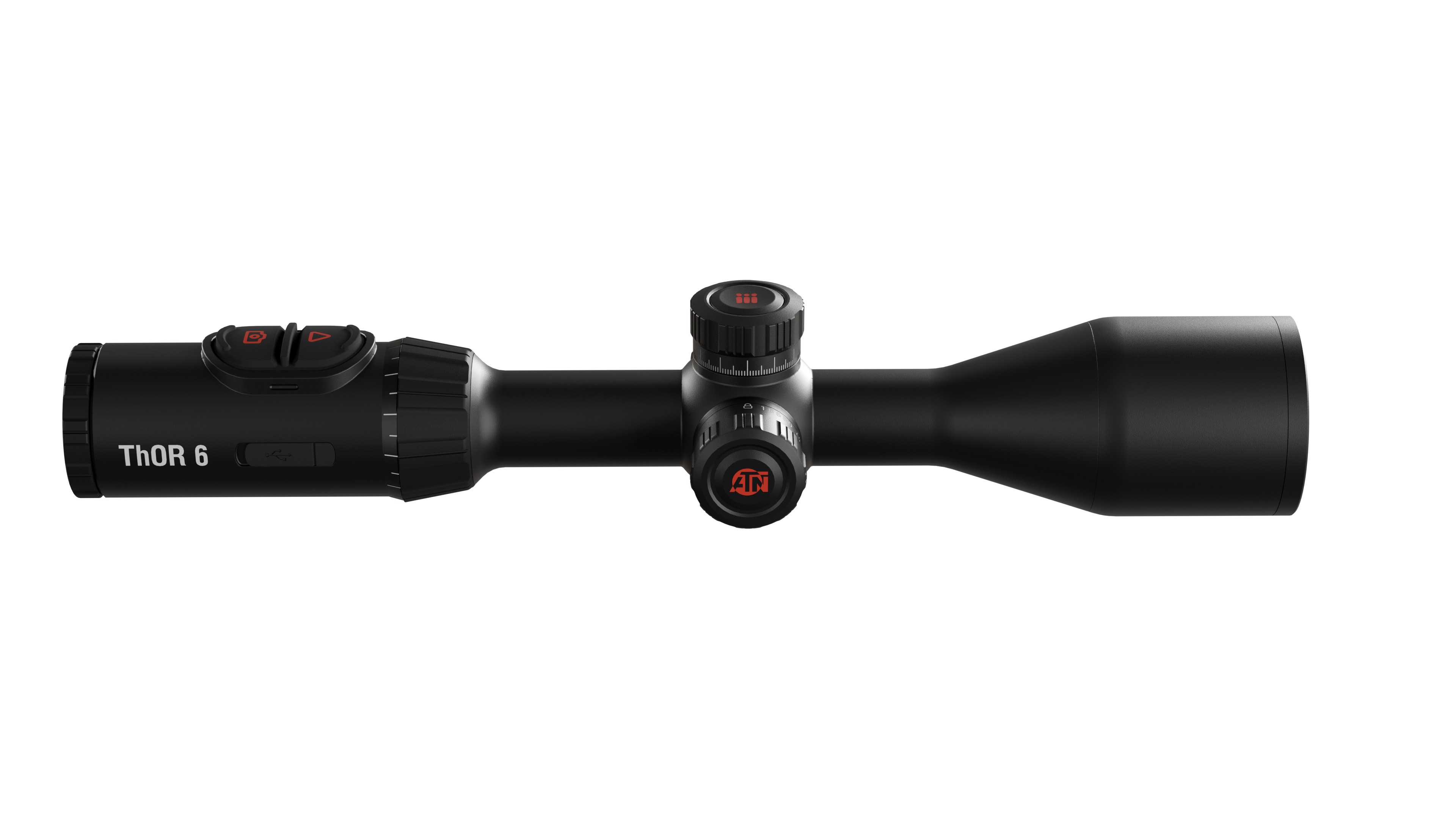
The reason I keep coming back to the ThOR 6 640 2-16x for coyote work across the season is that it does not force you to pick a lane. The 2-16× optical range with 8× digital zoom on top covers close, fast early-season encounters and the long, patient winter stare-down without swapping equipment. SharpIR image enhancement keeps edges defined instead of smeared, which is the difference between confidently identifying a coyote at the far end of your ground on a cold night and second-guessing yourself. ATN does not publish an identification distance for the sensor, and neither will I. It sells for $2,295, list price $3,625, checked on the product page on 12 November 2026.
Pros
- 2-16× optical plus 8× digital covers both halves of the season on one rifle, with no second optic to zero.
- ≤15mK NETD and a 640×512 sensor hold a coyote's outline against brush and sun-warmed ground.
- About 9 hours on two 18650 cells, one internal and one swappable — a full winter night.
- Six palettes including White Hot and Black Hot, so you match the display to snow or stubble.
- 5-year warranty: the scope you buy for this January is still the scope you run next October.
Cons
- 830 g / 1.83 lbs before you add 30 mm rings, which are sold separately — it is a full-size optic on a walking hunt.
- No built-in rangefinder; if you want the distance read for you, that is the LRF version at $2,595.
- At $2,295 it is not an entry-level purchase, and a first-season hunter may not use everything it offers.
Other ThOR 6 options for coyotes
If the 640 2-16x is more scope than your ground needs, three other configurations cover the same season differently. Full specifications and the reasoning behind each are in the roundup.
| Model | Sensor | Best for coyotes | Price |
|---|---|---|---|
| ThOR 6 LRF 640 2-16x | 640×512, ≤15mK | Open country where dogs hang up and the distance is a guess | $2,595 |
| ThOR 6 384 2.5-20x | 384×288, ≤15mK | Same sensitivity for less money, if your stands are shorter | $1,595 |
| ThOR 6 Mini 256 2-16x | 256×192, ≤20mK | A first thermal, or a light rifle you carry between stands | $689 |
Prices are current ATN store prices checked on 12 November 2026; the list price on each product page is higher.
Is it worth it?
If you hunt coyotes more than a handful of nights a year, yes. The scope does not make a careless stand work, and it will not fix a bad wind. What it does is remove the part of the night you used to spend guessing — whether something is out there, whether it is the animal you called, and where it went after the shot. That is the difference between a season of maybes and a season of counted animals.
FAQ
How do you hunt coyotes at night with a thermal scope?
Set up downwind of where coyotes travel, scan at low magnification to cover ground quickly, call in short sequences, and confirm the animal at higher magnification before the shot. Then adjust by season: early-season dogs commit fast from long range, winter dogs hang at the tree line and give you seconds.
What is the best thermal scope for coyote hunting?
A 640×512 sensor with ≤15mK NETD covers both early-season close work and deep-winter identification without compromise. For a ranked comparison with prices, see our best thermal scope for coyote hunting roundup.
Do I need a different thermal scope for winter coyote hunting than fall?
Not a different scope, but a different technique. Winter coyotes hang up at range and demand more detection distance and digital zoom, while fall coyotes commit fast and reward a wider field of view. A versatile scope like the ThOR 6 640 handles both without swapping gear.
What is the best thermal for coyote hunting on a budget?
Budget models trade off sensor resolution and detection range, which matters most in winter when coyotes hang up at distance. The ThOR 6 Mini 256 2-16x at $689 is the entry point in this line; the full budget comparison is in our roundup.
Does wind matter more than gear when calling coyotes?
Yes. No amount of sensor resolution compensates for a coyote winding you before it is in range. Position your stand with the wind in mind first, then let the scope handle target identification and shot placement once the animal is committed.
Can I use the same thermal scope for coyote hunting and hog hunting?
Yes. The core requirement — reading a heat signature clearly enough to identify and place a shot in total darkness — is the same across species. A scope built for winter coyote distances handles hog hunting and general predator work without modification.
How far can a thermal scope detect a coyote?
Detection range depends on the scope and sensor; the ATN ThOR 6 640 2-16x is rated at 3,100 m. Positively identifying the animal at that distance is another matter entirely — that takes magnification and resolution together, and it happens far closer in.
Bottom line
Buy for the hardest night of your season, not the easiest one. The January coyote that hangs at the tree line is the animal that decides whether your optic was the right call, and the October coyote will forgive almost anything. Plan the stand around the wind, scan wide and confirm tight, and let the calendar set your expectations. If you are ready to choose a model, start with the best thermal scope for coyote hunting roundup, compare the full range on our thermal scope page, or read the wider tactical picture in our guide to thermal coyote hunting.
Quick spec reference: ATN ThOR 6 640 2-16x (TIWST6635A)
- Sensor: 640×512, 12µm pixel pitch, ≤15mK NETD
- Magnification: 2-16× optical, plus 1×/2×/4×/8× digital zoom
- Detection range: 3,100 m
- Display: 0.49-inch OLED, 1920×1080
- Battery: ~9 hrs on two 18650 cells, one internal and one swappable
- Weight: 830 g / 1.83 lbs
- Warranty: 5 years
- Price: $2,295, list $3,625, checked 12 November 2026