You have probably seen the spec sheets and come away more confused than when you started. Resolution, NETD, refresh rate, detection range — every listing shouts a different number, and none of them tell you plainly whether the thing will work at 1 a.m. in the rain. This guide fixes that. It walks through what actually separates a good thermal scope from a bad one, in plain hunter's English, and uses the ATN ThOR 6 640 as the worked example so the numbers connect to something real. By the end you will know which specs matter, which are marketing filler, and how to read a scope before you spend a dime.
What is a good thermal scope?
A good thermal scope is a rifle optic that turns heat into a picture clear enough to identify and shoot an animal in total darkness, and that keeps doing it when the weather turns. Every thermal scope 'sees' heat instead of light, so all of them work in the dark — but a good one does three things a poor one cannot: it shows enough detail to tell a hog from a stray dog before you shoot, it stays readable in fog, humidity, and drizzle instead of going milky, and it keeps a running animal smooth rather than smearing it across the frame. The specs on the box are just proxies for those three abilities. Learn to read them that way and the whole category stops being confusing.
How does a thermal scope work?
- The lens gathers heat. A germanium objective (glass is opaque to thermal energy) focuses infrared radiation — heat — from everything in front of you onto the sensor.
- The sensor reads temperature differences. A microbolometer measures how warm each point in the scene is. A warm animal against cool ground shows up as a bright shape.
- The processor builds and cleans the image. This is where AI processing like ATN's SharpIR sharpens edges and detail in real time, turning raw heat data into a picture you can actually identify.
- The display shows it to you. The finished image lands on an internal screen — on the ThOR 6 640 that's a Full-HD 1920x1080 OLED — refreshed fast enough (50Hz) that motion stays smooth.
- The reticle overlays for the shot. A digital reticle sits on top of the thermal image, and you zero it to your rifle just like a day scope.
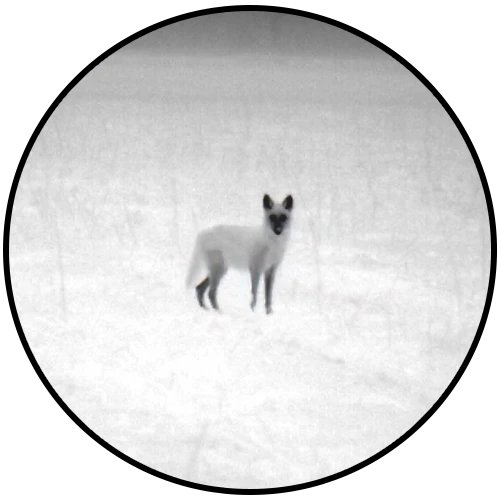
What can you use a thermal scope for?
- Predator control — coyotes, foxes, and other predators move at night, which is exactly when a thermal scope has the advantage over a day optic.
- Hog hunting — feral hogs are nocturnal and destructive; thermal lets you spot a sounder in a field long before you could with the naked eye.
- Property and livestock protection — scanning fence lines and pastures after dark to catch what is threatening your animals.
- Recovery and scanning — a warm body stands out against cool ground, which helps locate downed game and read a landscape at night.
Key features to understand
- Sensor resolution — the number of dots that build the picture. A 640x512 sensor has far more dots than a 384x288, so detail survives longer as you zoom in; think of it like the jump from standard definition to HD.
- NETD (thermal sensitivity) — how small a temperature difference the sensor can see. A low NETD of 15mK or better keeps the image sharp in fog, humidity, and light rain, when a less sensitive sensor washes out.
- Refresh rate — how many times per second the picture updates. A 50Hz refresh keeps a running animal smooth instead of smeared, which matters the second something bolts.
- Magnification — base magnification sets your field of view; a lower base like 2x gives a wide view for scanning, while higher zoom reaches farther but narrows what you see.
- Detection range — how far the scope can pick up a heat signature. The ThOR 6 640 reaches 3,100m, though real shots are taken far closer.
- AI image enhancement — processing like SharpIR that sharpens the picture in real time, so an animal reads as a recognizable shape instead of a warm blur.
What to look for before buying
- A sensor that matches your ranges — 640 for detail at distance, 384 if most shots are moderate and you want versatility.
- A low NETD — 15mK or better if you ever hunt in humid or wet conditions, which is most places.
- A fast refresh — 50Hz or higher so moving targets stay clean.
- Replaceable batteries and a waterproof rating — so the scope finishes the night; the ThOR 6 640 uses swappable 18650 cells and is IP67 rated.
- Recording and app features — onboard storage and phone streaming are genuinely useful for reviewing shots and dialing in.
Common mistakes when picking a thermal scope
- Buying on magnification alone. A big zoom number on a weak sensor just gives you a bigger blur. Resolution and NETD decide clarity, not magnification.
- Ignoring NETD. Two scopes can share a resolution and behave completely differently in fog — the lower-NETD one wins on the nights that matter.
- Overlooking refresh rate. A slow refresh smears anything that moves, which is precisely when you need the picture to be clear.
- Chasing detection-range numbers. Detection range is how far heat is picked up, not how far you can cleanly identify and shoot. Focus on the image quality at your real ranges.
- Forgetting the build. A scope that isn't waterproof or runs out of battery early is a scope that quits on you mid-hunt.
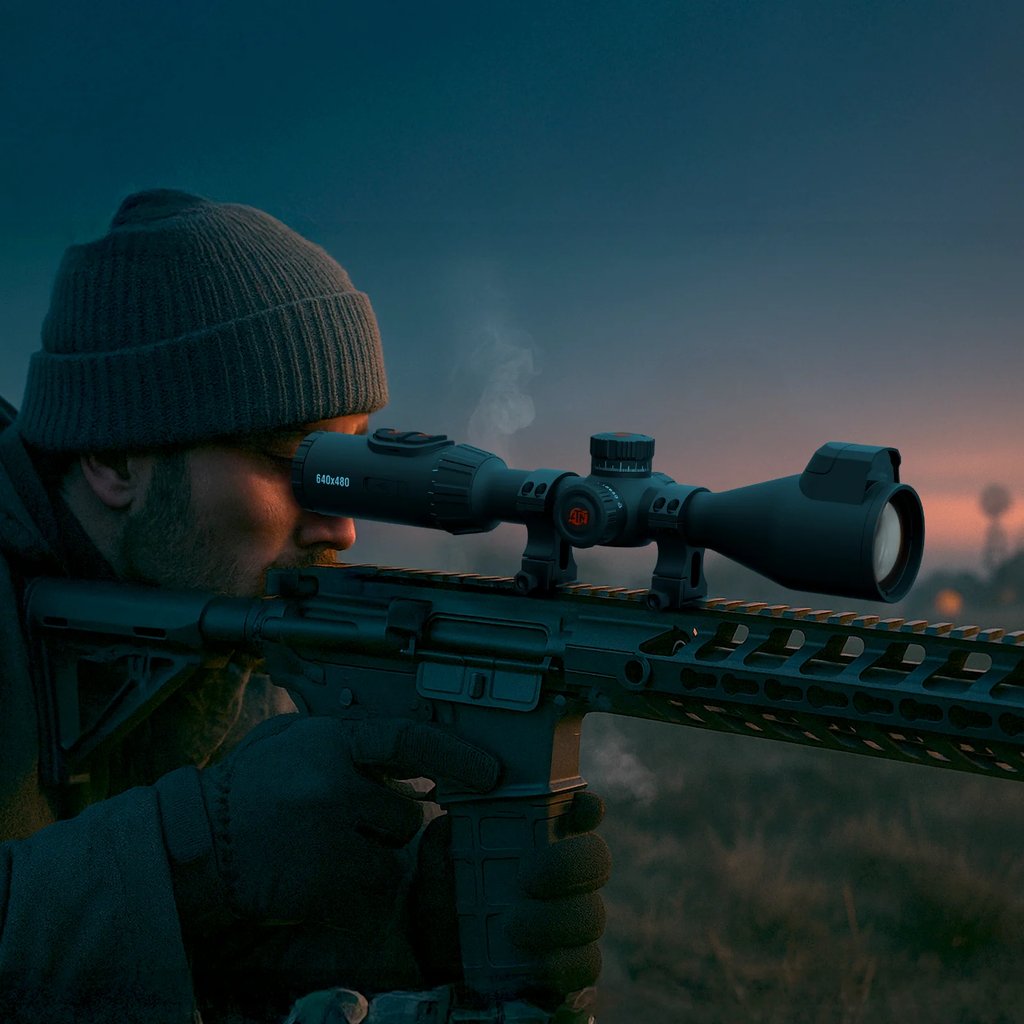
Example: the ATN ThOR 6 640
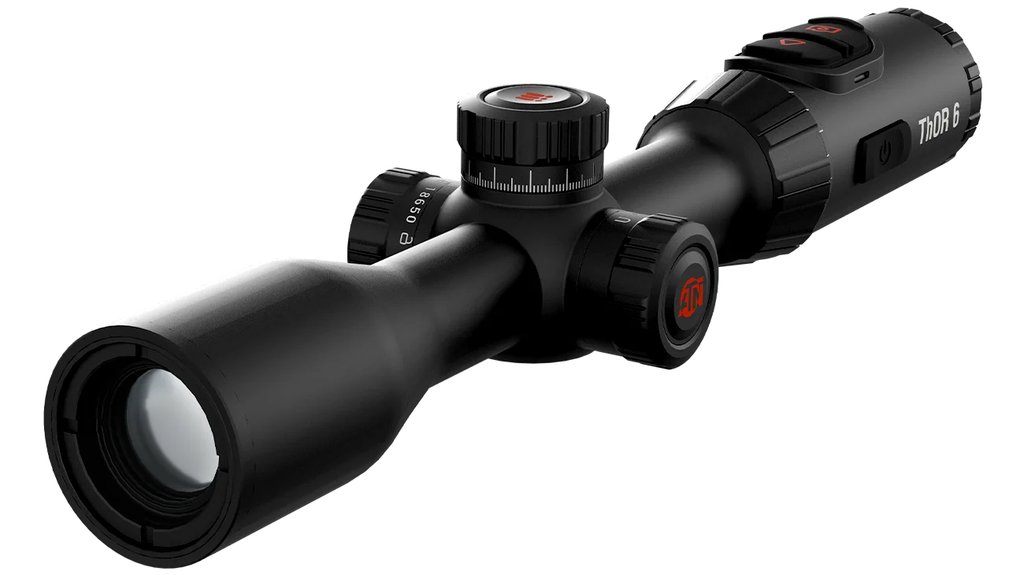
The ATN ThOR 6 640 is a clean example of what all of that looks like in one scope. Its 640x512 sensor packs the most dots in ATN's current line, so detail holds up when you zoom — an animal at the edge of a field stays a recognizable shape. The NETD of 15mK or better keeps that picture readable when the air turns humid or foggy. A 50Hz refresh keeps a running hog smooth, and SharpIR AI processing sharpens the whole frame in real time. The 2-16x magnification gives you a wide 2x base for scanning and pulls in to 16x (up to 8x digital) when you need to reach, backed by a 3,100m detection range and a 35mm F/1.0 objective. It runs about 9 hours on replaceable 18650 batteries, stores footage on 64GB internally, streams through the ATN Connect 6 app, and is IP67 waterproof — the whole checklist above, in one unit. It is the flagship-tier choice in the family, which is reflected in where it sits on price.
Is a good thermal scope worth it?
For anyone who hunts predators or hogs after dark, a good thermal scope is worth it because it does something no day optic or light can: it shows you a warm animal against cool ground in total darkness, at distance, and in weather that would blind other gear. The value is not in the spec sheet — it is in the nights you actually connect instead of going home empty. A capable scope like the ThOR 6 640 pays for itself in the animals you spot early, the shots you take with confidence, and the seasons the gear survives. If you only hunt in daylight, you don't need one; if you hunt the dark, a good one changes the game entirely.
Frequently Asked Questions
What is a good thermal scope?
A good thermal scope produces a clean, detailed image at the range you actually hunt, holds it in bad weather, and keeps moving animals smooth. In specs, that means a high-resolution sensor (640 or 384), a low NETD of 15mK or better, a 50Hz refresh rate, and a rugged waterproof build. The ATN ThOR 6 640 is a strong example of all of those together.
What resolution should a good thermal scope have?
For most hunting, a 384x288 sensor is the versatile minimum and a 640x512 sensor is the high-detail choice for longer ranges. Higher resolution means more dots in the picture, so detail survives as you zoom in. The ATN ThOR 6 640 uses a 640x512 sensor for exactly that reason.
What does NETD mean on a thermal scope?
NETD measures how small a temperature difference the sensor can detect, and it is written in millikelvin (mK). A low NETD like 15mK means the scope keeps a clear picture in fog, humidity, and light rain, when a less sensitive sensor would wash out. It is one of the most important specs a good scope gets right.
Does a thermal scope work in daylight?
Yes. Thermal scopes read heat rather than light, so they work in full daylight as well as total darkness. That said, they are most valuable at night, when predators and hogs move and when no day optic can compete.
How is refresh rate different from resolution?
Resolution is how detailed the picture is; refresh rate is how many times per second it updates. A 50Hz refresh keeps a running animal smooth instead of smeared, while resolution decides how sharp the shape looks. A good thermal scope needs both.
How far can a good thermal scope see?
Detection range varies by model; the ATN ThOR 6 640 detects heat out to 3,100 meters. Keep in mind that detection range is how far a heat signature is picked up, not how far you can cleanly identify and shoot — real shots are taken much closer.
Is a more expensive thermal scope always better?
Not automatically. What matters is whether the resolution, NETD, refresh, and build match how you actually hunt. A well-matched mid-tier scope can outperform an expensive one used for the wrong job, so buy for your ranges and conditions rather than the price tag.
Sensor: 640x512, NETD <=15mK
Magnification: 2-16x (up to 8x digital zoom)
Detection range: 3,100m
Refresh: 50Hz · Display: Full-HD 1920x1080 OLED
Battery: ~9 hrs, replaceable dual 18650 · Build: IP67 waterproof, 1.83 lbs
Now that you know what actually separates a good thermal scope from a mediocre one, put the checklist to work. The ATN ThOR 6 640 hits every point — high-resolution sensor, low NETD, fast refresh, and a build that finishes the night — and you can line it up against the rest of the family on the ATN thermal scopes page. Match the specs to your own ranges and conditions, and you'll know exactly what you're buying before you spend a cent.
Created: July 7, 2026 · 19:23:13 UTC