You do most of your work before the trigger ever moves. You scan a field edge, catch a warm smudge in the dark, and decide if it is a hog or a stump. That first job, finding the heat, is exactly what a good thermal spotting scope is for. The interesting part is that a modern thermal rifle scope now spots almost as well as it shoots, so you can run one optic for both. This roundup looks at three current ATN ThOR 6 models and organizes them around the features that actually make a scope a strong spotter: sensor detail, reach on the magnification dial, and the smart tracking that keeps a moving animal from getting lost in the frame.
Best all-around: ATN ThOR 6 640x512 2-16x. Same crisp 640 sensor, a wider low end for close scanning, a lighter reach up top. A great everyday do-everything pick.
Best value: ATN ThOR 6 384x288 2.5-20x. The 384 sensor still spots game well and it sits in the value tier, so it is the easy entry point into ThOR 6.
Why ATN's 6th-gen ThOR 6 line spots so well
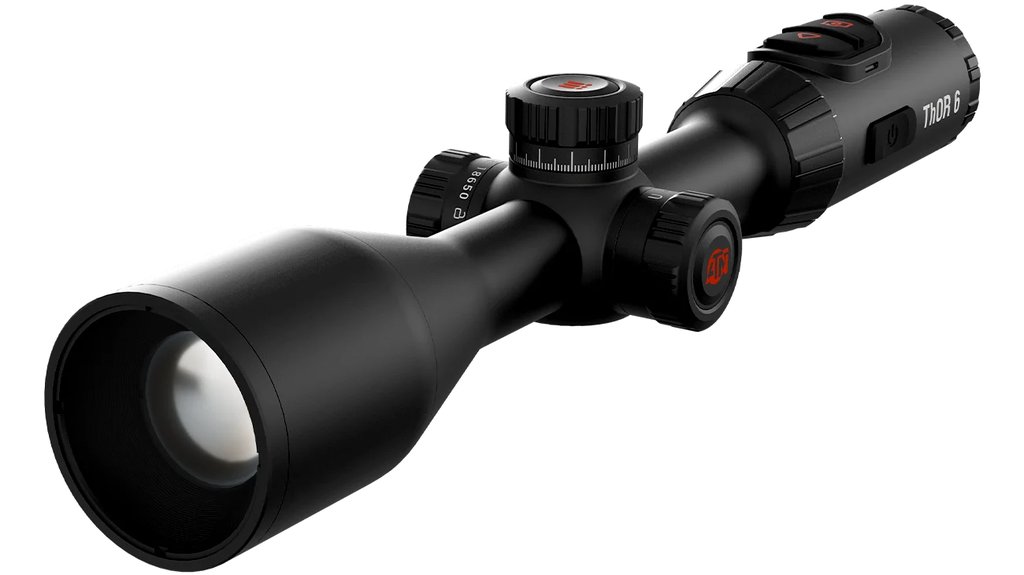
A spotting scope's whole job is to turn faint heat into something you can read. The ThOR 6 line does that with a low NETD sensor and a fast image. NETD (millikelvin) is the smallest temperature difference the sensor can see, and lower mK means a cleaner, higher-contrast picture; every ThOR 6 here sits at 15 mK or better, so a bedded deer stands out from cool ground instead of smearing into it. Pair that with SharpIR AI image processing, a smooth 50Hz-class refresh that keeps motion crisp as you pan, and Hot Point Tracking that locks onto the warmest object in view, and you have an optic that finds game fast. All three models below are part of ATN's ThOR 6 thermal scope lineup, so they share the same core smarts and differ mostly in sensor size and zoom range.
ATN ThOR 6 640x512 3-24x - best thermal spotting scope overall
This is the model to reach for if spotting at distance matters to you. The ATN ThOR 6 640x512 3-24x pairs the biggest sensor in this group with the longest zoom, so you can sweep a field wide open at 3x, then wind up to 24x to read whether that heat blob 400 yards out is a coyote or a barn cat before you commit.
The 640 sensor picks targets out of clutter
Think of the 640x512 sensor like stepping from SD to HD: more pixels means finer detail, so you can identify targets farther out. When you are spotting, that detail is the difference between 'something is out there' and 'that is a hog quartering left.' The image holds its shape as you push the zoom, which is where a lower-res sensor starts to fall apart into a blur.
High magnification doubles as your spotter
The 3-24x range spans the optical base up through the max digital zoom, plus 8x digital on top. The low end is your scan setting, wide field, easy to catch movement. The high end is your confirm-and-shoot setting. Because it is one optic, you are not setting a handheld spotter down to grab your rifle, which is exactly when animals slip away.
Hot Point Tracking and PiP keep the target in view
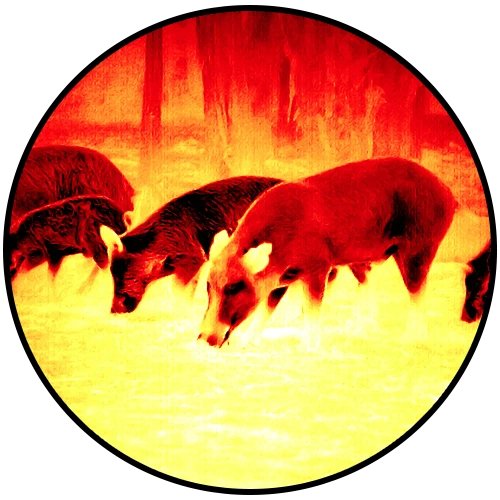
Hot Point Tracking marks the warmest object so a moving animal stays flagged as you pan. Picture-in-Picture floats a magnified aiming window over the wide view, so you keep the whole scene while you hold on a small target. SharpIR AI cleans the image, and Zeroing Freeze plus RAV mean your zero and your recordings are handled without fuss.
Who it is for: hunters who spot and shoot at longer distances and want the most reach. Who it is not for: if all your shots are inside 100 yards in thick cover, the top-end magnification is more than you will use.
ATN ThOR 6 640x512 2-16x - the everyday high-res spotter
If you spend more time scanning close-to-mid ground than reaching way out, the 2-16x is the smarter buy. It keeps the same 640x512 sensor, so your image is just as detailed, but the wider 2x low end gives you a bigger scan window for sweeping brushy edges and field corners quickly.
Same 640 detail, friendlier scan view
The 640 sensor still gives you that HD-grade detail for pulling targets out of background clutter. Starting at 2x means a wider field of view when you first scan, which makes catching movement easier. Detection reaches out to 3100 m, so spotting is not the limitation here; this is simply a more balanced everyday tool.
Light enough to carry and scan for hours
At 830 g it runs about nine hours on two swappable 18650 cells, so a long night of walking and glassing does not leave you nursing the battery. The 50Hz-class refresh keeps motion smooth while you pan, less lag when a hog trots across the frame, so you do not lose it mid-scan.
Who it is for: the hunter who wants one crisp, do-everything scope for spotting and shooting at normal ranges. Who it is not for: long-range spotters who really want that extra top-end zoom the 3-24x delivers.
ATN ThOR 6 384x288 2.5-20x - the value spotter
The 384x288 model is where you get into ThOR 6 without stretching. The sensor has fewer pixels than the 640s, but it still resolves a warm animal against cool ground plenty well for spotting, and the 2.5-20x range gives you real reach. It sits in the value tier while keeping the family's smart features intact.
384 sensor still finds and flags game
Fewer pixels than the 640 is like fewer dots making up the picture, so you will not read fine detail quite as far out, but for spotting, catching the heat, the 384 does the job. Six color palettes let you switch between White Hot, Black Hot and Iron to whatever gives you the best contrast in the conditions you are hunting.
Full smart-feature set at a lower tier
You still get SharpIR AI, Hot Point Tracking, PiP, Zeroing Freeze, RAV recording, Wi-Fi and ATN Connect 6, and the Full-HD OLED display. Nothing about the workflow feels stripped down; you are trading some sensor resolution and reach for a lower entry point, and that is an honest trade.
Who it is for: new thermal hunters and anyone who wants a capable spotter without paying flagship money. Who it is not for: hunters who need to positively ID targets at the far edge of detection, where the 640 sensors pull ahead.
How to choose a thermal spotting scope
Start with the range you actually hunt, not the range you dream about. That decides how much sensor and zoom you need. Then weigh these features, because on a spotting scope they matter more than the marketing does:
- Sensor resolution - more pixels means finer detail, so you can ID targets farther out. Step up to a 640 sensor if you spot at distance; a 384 is fine for closer work.
- NETD (thermal sensitivity) - the smallest temperature difference the sensor sees, in millikelvin. Lower mK gives a cleaner, higher-contrast image, so faint heat pops out of cool ground.
- Detection range - the farthest distance the optic picks up a heat signature. This is spotting distance, not full-ID distance; you will ID much closer than you detect.
- Magnification range - a low end for a wide scan view and a high end to confirm targets. The range spans the optical base up to the max digital zoom.
- Refresh rate - a smooth 50Hz-class image means less lag and smearing when you track a moving animal across the frame.
- Weight and battery - if you walk and glass for hours, a lighter body and swappable cells keep you in the field instead of headed back to the truck.
How we picked these ATN thermal scopes
Full disclosure: this is an in-house comparison of ATN's own current range, not an independent lab test. We only considered the 6th-generation ThOR 6 line, and we judged each model against the real job of a thermal spotting scope, finding and confirming game, rather than against a spec sheet in the abstract.
- Sensor resolution - how much detail each model resolves for pulling targets out of clutter and spotting at range.
- NETD / thermal sensitivity - how cleanly faint heat separates from cool background, which is where spotting lives or dies.
- Detection range - how far each optic first picks up a heat signature.
- Refresh rate - how smoothly the image tracks a moving animal without lag.
- Weight and battery life - how comfortably you can carry and scan through a full night.
The honest trade-offs: the flagship 3-24x steps up in price and its top-end zoom is overkill for close, thick-cover hunting. The 384 value model gives up sensor detail at long range. And a rifle scope used as a spotter is still mounted on a firearm, so it is not the right tool if you want a standalone handheld to pass around camp. Who these are NOT for: anyone wanting a non-weapon-mounted observation device should look at ATN's monoculars or binoculars instead. Check these specs against your own ranges and habits before you buy.
Frequently Asked Questions
Can a thermal rifle scope really work as a spotting scope?
Yes. A high-resolution thermal scope like the ThOR 6 640 lets you scan wide at low magnification to find heat, then zoom in to confirm the target. The main difference from a handheld spotter is that it is mounted on your rifle, which is actually handy since you spot and shoot with one optic.
What sensor resolution do I need to spot game reliably?
A 384 sensor detects and spots warm animals against cool ground just fine. A 640 sensor gives you finer detail, so you can identify what you are looking at farther out. If you hunt at distance the 640 is worth the step up; for closer work the 384 is plenty.
Why does NETD matter for spotting?
NETD is the smallest temperature difference the sensor can see, measured in millikelvin. A lower mK number means a cleaner, higher-contrast image, so a faint heat signature separates from the background instead of blending in. Every ThOR 6 here sits at 15 mK or better.
How far can these thermal scopes detect an animal?
Detection range runs from about 2300 m on the 384 model up to 3650 m on the flagship 640 3-24x. Remember detection is not identification; you will spot heat much farther than you can confirm what it is. Real ID happens well inside those numbers.
Does the refresh rate really change how spotting feels?
It does. A smooth 50Hz-class refresh means less lag and smearing when you pan across a field or track a moving animal. A choppy image makes it easy to lose a running hog; a smooth one keeps it locked in the frame while you decide.
What is Hot Point Tracking and does it help you spot?
Hot Point Tracking flags the warmest object in your view. When you are scanning, it helps draw your eye to a heat source you might otherwise pan right past, and it keeps a moving animal marked. It is a genuine help when game is on the move.
If spotting and shooting with one optic sounds like your kind of setup, the ATN ThOR 6 640x512 3-24x is the flagship that does both best. Want to weigh the whole family side by side before you decide? Browse ATN's ThOR 6 thermal scope lineup and match the sensor and zoom to the ranges you actually hunt. Whichever you pick, you get the same low-NETD image, smart tracking, and long battery life that make a thermal scope a real spotter. Get out there and find them before they find you.
Created: August 5, 2026 · 19:53:47 UTC