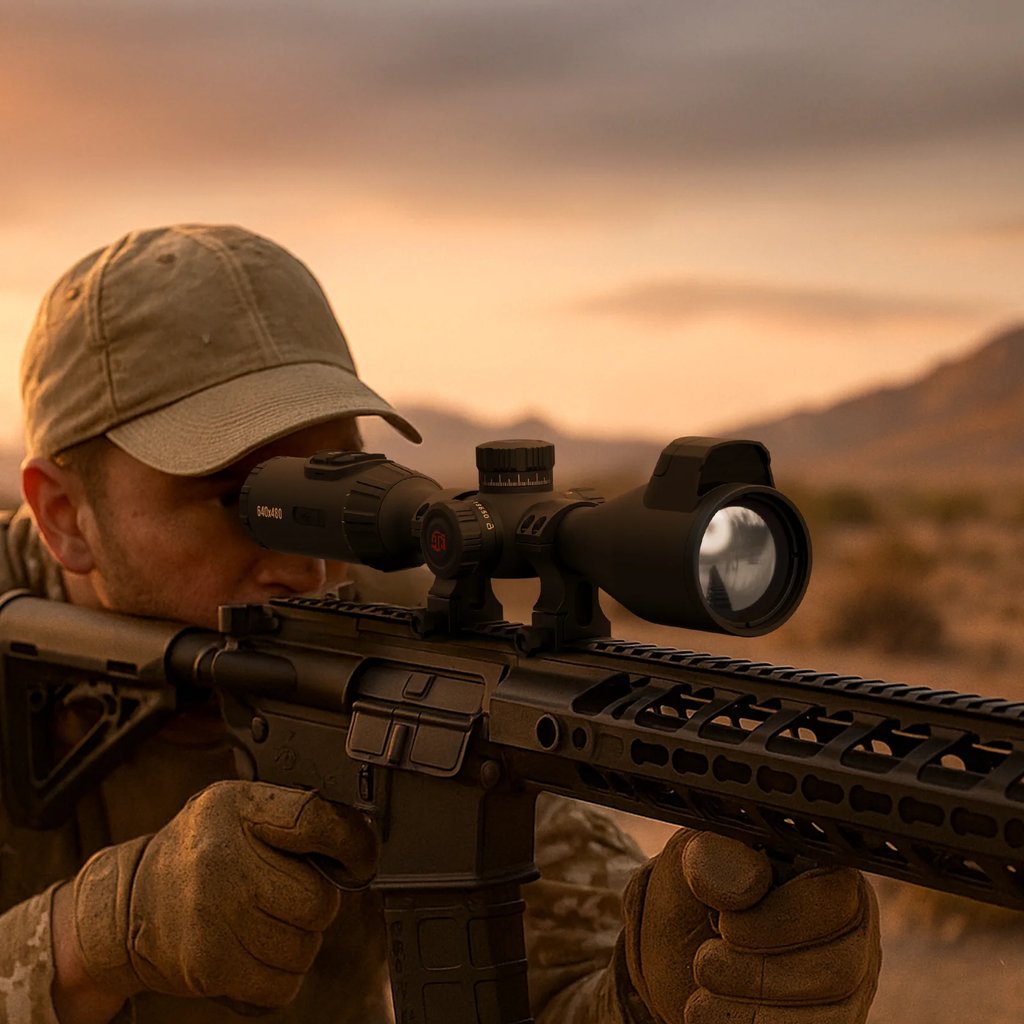
A thermal scope with LRF puts a laser rangefinder inside the optic, so the moment you spot a warm animal you can range it with a button press instead of guessing the distance. On a long shot in the dark, that number is the difference between a clean hit and a miss — and the ATN ThOR 6 LRF 640x512 3-24x takes it one step further by feeding that range straight into a built-in ballistic calculator that adjusts your aim for you. No lasering with a separate handheld, no dialing dope off a chart with cold fingers. This roundup covers our ATN picks for a thermal scope with LRF, how they stack up, and how to choose the one that fits the way you hunt.
Best for precision long range: the same ThOR 6 LRF — the ranging plus ballistics combo is built for reaching out with confidence.
Best value without ranging: ATN ThOR 6 384x288 2.5-20x — a capable mid-range thermal scope for hunters who range by other means.
Why ATN's 6th-gen LRF scope changes long-range hunting
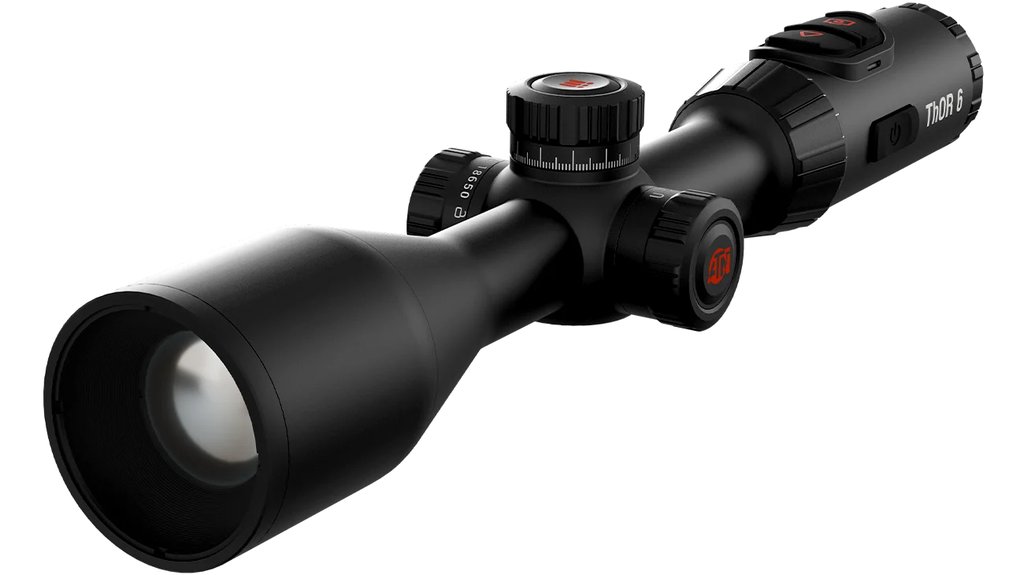
An LRF — laser rangefinder — bounces an invisible, eye-safe laser off your target and reads back the exact distance. Guessing range in the dark is where most long thermal shots go wrong, and ATN's 6th-generation ThOR 6 LRF removes the guess. Its rangefinder reads out to 1000m with about a meter of accuracy using a 905nm Class 1 eye-safe laser, and here's the part that matters: that distance drops straight into an onboard ballistic calculator that holds up to six rifle-and-load profiles. Range the animal, and the reticle shows you where to hold — no dope card, no separate handheld unit, no fumbling in the cold. Layer that on top of a 640x512 sensor, <=15mK thermal sensitivity, SharpIR AI enhancement, a full-HD OLED display, and IP67 waterproofing, and you have a single optic that spots, ranges, and solves the shot. We only consider the current 6th-gen line here, from ATN's thermal scope range; older models are out.
Best overall thermal scope with LRF: ATN ThOR 6 LRF 640x512
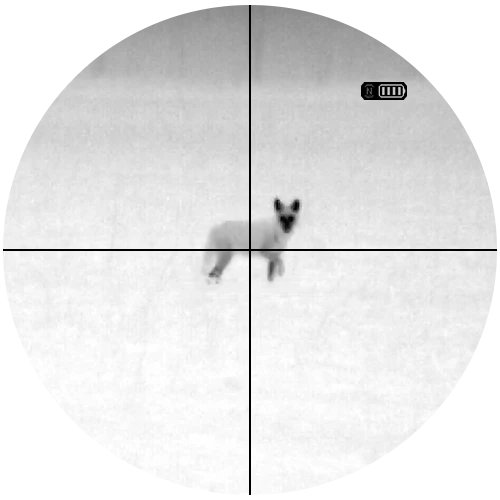
The ATN ThOR 6 LRF 640x512 3-24x is the pick when the shot distance is the hard part. Its built-in laser rangefinder reads out to 1000m within roughly a meter, and the onboard ballistic calculator turns that number into an aim point across up to six profiles for different rifles or loads. On a 240-yard coyote across a cut field, you range, the reticle corrects, and you send it — no chart, no math, no second device.
Why the resolution and range pair so well with ranging
The 640x512 sensor gives you far more dots in the picture — HD versus standard definition — so at the distances the rangefinder is meant for, the animal is still a clear, identifiable shape rather than a warm smudge. Detection stretches to about 3,650m, and the 3-24x magnification lets you reach out and confirm before the shot. Ranging is only useful if you can also see clearly that far, and this sensor delivers that.
How the workflow speeds up a shot
The real win of integrated ranging is speed and simplicity when it counts. Picture a hog stepping out at last light: with a separate handheld rangefinder you'd have to lower the rifle, find the unit, range, remember the number, do the holdover math, then re-shoulder and hope the pig hasn't moved. With the ThOR 6 LRF you stay on the gun, press to range, and the reticle updates — one motion, no lost time, no cold-fingered arithmetic. Fewer steps means fewer chances to fumble and fewer chances for the animal to disappear back into cover. On a long shot in the dark, that streamlined workflow is often the difference between a filled tag and a story about the one that got away.
Six profiles for a shared rifle rack
The ballistic calculator holding up to six profiles matters more than it sounds if you hunt with more than one rifle or load. You set each rifle's data once, then pick the right profile before you head out, and the scope corrects for that specific gun. Move the scope between a bolt gun and an AR, or switch between two loads, and you're not re-entering numbers in the field — you just select the profile. That flexibility keeps one flagship optic useful across a whole rack instead of being locked to a single setup.
Who it's for and who it's not
It's for the precision-minded hunter taking longer shots who wants ranging and ballistics handled inside one optic. It's not for someone who only shoots inside a hundred yards or already ranges reliably another way — that hunter can save weight and money with the non-LRF model.
Best value without ranging: ATN ThOR 6 384x288
The ATN ThOR 6 384x288 2.5-20x is the pick if you like the ThOR 6 platform but don't need a rangefinder built in. It shares the same <=15mK sensitivity, SharpIR AI enhancement, full-HD display, and IP67 build, just with a 384x288 sensor and no LRF or ballistic calculator. Detection runs to about 2,300m, which covers the majority of real mid-range hog and predator work.
What you give up and what you keep
You lose the one-button ranging and the automatic aim correction, so you'll range with a handheld or hold over from experience. In exchange you get a lighter scope at 790 grams and a lower price tier, while keeping the ThOR 6's core image quality and features. For a lot of hunters who mostly shoot inside a few hundred yards, that's a sensible trade.
Why some hunters skip the LRF
Not every hunter needs ranging baked in, and there's no shame in the simpler tool. If your stands and blinds cover known distances — you've walked the field and you know the far fence is 180 yards — you already have the number before the animal shows. If you're comfortable holding over from experience at your typical range, the extra hardware is weight you carry for nothing. The 384 rewards that hunter with a lighter scope, a lower price tier, and the same clean image and shooting tools. It's the honest pick for close-to-mid-range work where the shot distance is rarely a mystery.
Who it's for and who it's not
It's for the value-minded mid-range hunter who ranges another way or doesn't take shots long enough to need it. It's not for the long-range shooter who wants ranging and ballistics integrated — that's squarely the LRF model's job.
How to choose a thermal scope with LRF
Decide first whether integrated ranging genuinely earns its place for you, then match the sensor and magnification to your real shot distances. An LRF is worth the extra weight and cost only if you take shots long enough that guessing range is a real risk.
- Rangefinder accuracy and reach — the ThOR 6 LRF reads to 1000m within about a meter; make sure the reach covers your longest realistic shot.
- Ballistic calculator — an onboard solver that turns range into an aim point saves you dialing dope in the dark; the ThOR 6 LRF holds up to six profiles.
- Sensor resolution — 640x512 puts more dots in the picture so a ranged animal stays clear at distance; 384x288 is lighter and fine for mid-range.
- Thermal sensitivity (NETD) — <=15mK on both means a cleaner picture in humid, foggy, or damp air.
- Detection range — 3,650m on the LRF versus 2,300m on the 384; detection is spotting distance, not shooting distance, so leave margin.
- Weight — the LRF adds a little heft (855 g vs 790 g) for the hardware, worth it if you use the ranging.
A quick word on how to read the distance numbers, because they trip people up. Detection range is how far the scope can pick up that a warm object exists — a heat signature far out in the dark. That is not the same as the distance at which you can identify what it is, and neither is the same as the distance at which you can ethically shoot. The rangefinder's 1000m reach sits comfortably inside the realistic shooting window for almost all hunting, while the 3,650m detection number on the flagship just means you'll spot heat well before it's in range. Match the rangefinder's reach to your longest genuine shot and let the big detection number be headroom for spotting, not a shooting target.
Finally, remember that an LRF scope is still first and foremost a thermal scope, so the fundamentals matter just as much as the ranging. A rangefinder doesn't help if the picture is too coarse to identify what you're aiming at, and a great sensor doesn't help if you can't nail the distance. The ThOR 6 LRF works because it pairs both — a high-resolution 640 sensor and integrated ranging — so neither half lets the other down. When you compare options, weigh the whole package rather than fixating on the rangefinder spec alone; the best long-range results come from the sensor and the ranging pulling together.
How we picked these ATN thermal scopes with LRF
We judged these scopes on what a long-range thermal hunter actually needs: accurate ranging to the target, a fast way to turn that range into an aim point, and a sensor sharp enough to identify what you're ranging. We weighed rangefinder reach and accuracy, the ballistic calculator, sensor resolution, thermal sensitivity (NETD), detection range, and weight against real hunting distances, and we only considered ATN's current 6th-gen line. The honest trade-off: the LRF model carries a little extra weight and costs more for the ranging and ballistics hardware, so it's overkill for a hunter who only takes short shots. This is an in-house comparison of ATN's own range, not an independent lab test, so weigh the ranging feature against how far you actually shoot before you buy.
Frequently Asked Questions
What does LRF mean on a thermal scope?
LRF stands for laser rangefinder. It is a rangefinder built into the scope that bounces an eye-safe laser off your target and reads back the exact distance. On the ATN ThOR 6 LRF it reads to 1000m within about a meter, which removes the guesswork on long shots.
Do I really need a rangefinder built into my thermal scope?
You need one if you take shots long enough that misjudging distance would cause a miss or a poor hit. Guessing range in the dark is one of the biggest causes of missed long thermal shots. If you mostly shoot inside a hundred yards or already range reliably another way, a non-LRF scope like the ATN ThOR 6 384 may serve you fine.
What is a ballistic calculator and how does it help?
A ballistic calculator takes the ranged distance and your rifle-and-load data, then tells you where to hold for that shot. On the ATN ThOR 6 LRF it stores up to six profiles and adjusts the aim point automatically after you range the target. That means no dope card and no mental math in the field.
Is the laser rangefinder on the ThOR 6 LRF safe for the eyes?
Yes. The ATN ThOR 6 LRF uses a 905nm Class 1 eye-safe laser, which is designed to be safe under normal use. It ranges to 1000m with about a meter of accuracy. As with any laser device, you should still avoid deliberately aiming it at people's eyes.
How far can the ATN ThOR 6 LRF detect and range?
The ThOR 6 LRF 640 detects heat out to about 3,650m and ranges targets with its laser to 1000m within roughly a meter. Detection distance is how far it can pick up a warm body, which is farther than the distance at which you can identify or ethically shoot. The ranging reach covers the realistic long-shot window for most hunting.
What is the difference between the ThOR 6 LRF 640 and the ThOR 6 384?
The ThOR 6 LRF 640 adds a built-in laser rangefinder and ballistic calculator and uses a higher-resolution 640x512 sensor for a sharper, longer-reaching picture. The ThOR 6 384x288 has no rangefinder, a smaller sensor, detects to about 2,300m, and weighs a bit less. Choose the LRF for precision long-range work and the 384 for lighter mid-range hunting.
If your shots stretch past the point where guessing distance is safe, ranging built into the optic is worth every gram. The ATN ThOR 6 LRF 640x512 3-24x reads distance to 1000m and hands it to a ballistic calculator that corrects your hold automatically, all on a high-resolution 640 sensor. Browse the full ATN thermal scope lineup to compare the LRF model against the non-ranging ThOR 6 and match the sensor and reach to how far you hunt.
Created: July 7, 2026 · 19:23:13 UTC