Straight answer first: as of 2026 there is no ATN thermal scope under $500, and there is no genuine, hunt-ready thermal rifle scope from anyone at that number. The physics of a real thermal core, the germanium optics, and the processing behind a stable reticle simply cost more than $500. So instead of pretending, this roundup does something more useful: it takes the money you'd actually spend and matches an ATN ThOR thermal scope to how far you really shoot.
Here's the framing that actually helps you choose: don't shop by a headline price you can't hit anyway. Shop by range band. The single biggest question is how far your shots really land. A backyard hog problem inside 100 yards asks for a completely different scope than 300-yard coyote work across an open pasture. Once you honestly plot your typical shot distance, the right ATN ThOR almost picks itself — and you stop overpaying for reach you'll never use or, worse, under-buying and missing the far ones.
First, reset the price expectation
It's worth being blunt because a lot of listings are not. A working thermal scope has a microbolometer sensor, a full germanium lens stack, a fast image pipeline, and a display good enough to hold a reticle steady while you breathe and squeeze. None of that lives under $500. When you see a $500 "thermal," you're usually looking at a toy-grade sensor, a phone clip-on, or a used unit with a spent core. For a scope you'll trust on live game at night, plan on spending real money — and spend it where it matches your shooting.
That's why this guide is organized by range band rather than by a tier ladder. The most affordable current ATN, the ThOR 6 Mini, is a serious 6th-gen scope at $1,975.00 (promo $1,795.00) — not a bargain-bin gadget. It just happens to be the entry point into a line that scales up as your distances grow.
Close-in band: shots inside ~100 yards
This is where most first-time thermal buyers actually live: hogs rooting near the treeline, raccoons on the fence, foxes in the yard, dispatch work at short distance. Inside about 100 yards you don't need enormous magnification or the longest detection number on the box — you need a light scope that comes up fast, holds a clean picture, and doesn't fatigue your arms on a walk-and-stalk.
Best for close-in work: ATN ThOR 6 Mini 384x288 2.5-20x
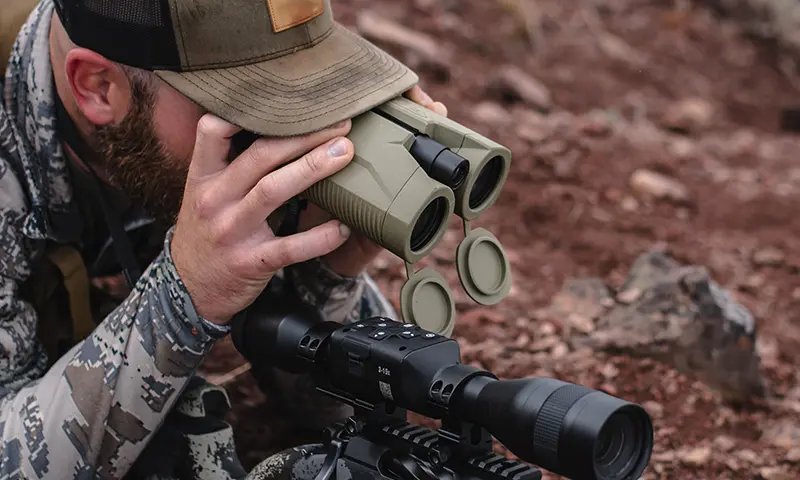
The ATN ThOR 6 Mini 384x288 2.5-20x is our close-in pick and the most affordable current ATN thermal scope. At under 500 g in a compact magnesium-alloy body it handles like a red dot with a brain — you can swing it fast on a moving hog at 40 yards without wrestling a heavy tube. Its 384x288 sensor with a NETD of 18 mK or better gives crisp heat edges at short range, and the 2.5x low end keeps your field of view wide so a close target never fills the whole screen. Detection reaches out to 2300 m for scanning, but its sweet spot is the close and lower-mid band where its light weight and quick handling matter most.
Handy extras earn their keep up close too: One-Shot Zero with Zeroing Freeze so you sight in fast, Picture-in-Picture for a magnified aiming window without losing the wider view, Hot Point Tracking to flag heat signatures, and RAV recoil-activated video to save the shot. Battery runs about 7 hours on a single 18650, plenty for a yard-and-treeline evening. Full-HD OLED and built-in Wi-Fi round it out.
Mid-range band: shots from ~100 to 250 yards
Step out onto the edge of a field or a power-line cut and your shots stretch. In the mid band you want more resolution to tell a coyote from a dog at distance, a touch more glass to reach, and a magnification range that still lets you find the animal before you zoom in. This is the band where a lot of hunting genuinely happens.
Mini still covers the lower mid — and the ThOR 6 640 2-16x owns the upper mid
The ThOR 6 Mini stretches comfortably into the lower mid band, so if most of your shots land inside ~150 yards it may still be all the scope you need. When your typical distance creeps toward 200-250 yards, the ATN ThOR 6 640x512 2-16x takes over. Its 640x512 sensor and tighter NETD (15 mK or better) resolve heat detail far better at distance, so a mid-field coyote reads as a coyote, not a warm smudge. The 35 mm F/1.0 lens and 2x low-end magnification keep acquisition easy while giving you room to zoom for the shot, and detection out to 3100 m means the animal is on screen long before it's in range. It costs more than the Mini — that's the trade for the bigger sensor and reach.
You also get ATN Connect 6, SharpIR image sharpening, RAV, a Full-HD OLED display, and about 9 hours of runtime from a replaceable dual-18650 system at 830 g — heavier than the Mini, but a fair carry for the extra capability.
Long-range band: shots past ~250 yards
Wide agricultural fields, prairie, and dedicated predator setups push shots well past 250 yards. Out here you need the most resolution, the longest reach, and enough top-end magnification to positively identify and place a shot at distance. This is the band where you buy for capability, not compactness.
Best for long range: ATN ThOR 6 640x512 3-24x
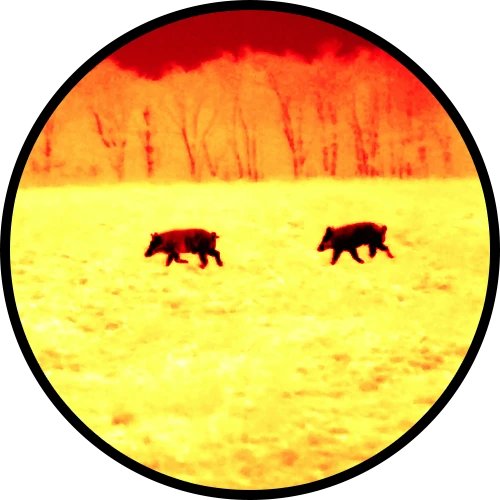
The flagship ATN ThOR 6 640x512 3-24x is the long-range pick. It pairs the 640x512 sensor and 15 mK-or-better NETD with a 50 mm F/1.0 objective and a 3-24x magnification range, so you can crank in and hold detail on a target that's a speck to the naked eye. Detection reaches 3650 m — the longest in this trio — and an 8x digital zoom stacks on top of the optical range for far identification. It carries ATN Connect 6, SharpIR, RAV, and a Full-HD OLED, runs about 9 hours on two 18650s, and weighs the same 830 g as the 2-16x. It's the most expensive of the three, and that price buys the reach; it's overkill for a backyard hog inside 60 yards.
Range-band comparison at a glance
Read the table by finding your row, not by chasing the biggest numbers. If your shots live inside 100 yards, the Mini's light weight and quick handling beat a heavier long-range scope every night. If you routinely reach past 250 yards, the 3-24x flagship earns its extra size and price. The 2-16x sits in the middle for the shooter who mixes field edges and open ground.
How to plot your own range band
- Log your last 10-20 shots (or best honest estimate) and note the distance of each.
- Find where most of them cluster — that cluster, not your longest single shot, is your true range band.
- Match the band: close-in leans Mini, mid leans Mini-to-640 2-16x, long leans 640 3-24x.
- Weight the tie-breakers: how far you walk (favor the lighter Mini), how long you sit (favor the 9-hour dual-battery 640s), and how often you must positively ID at distance (favor 640 resolution).
- Buy one band up only if your distances are genuinely growing — not to chase a spec you'll never shoot.
Common mistakes when shopping by price alone
- Chasing a "$500 thermal scope" and landing on a toy-grade sensor that can't hold a reticle on live game.
- Buying maximum detection range for backyard shots you'll never take past 80 yards.
- Under-buying resolution for open-field work, then squinting at a warm blob you can't identify.
- Ignoring weight — a heavy long-range scope punishes a walk-and-stalk hunter every single outing.
- Forgetting battery life for long sits; a single-cell close-in scope isn't built for an all-nighter.
How we picked these ATN thermal scopes
Because the honest budget question — a thermal scope under $500 — has no real product to answer it, we built this roundup around the next most useful decision: matching a current ATN ThOR to your shooting distance. We weighed each scope on sensor resolution (384x288 versus 640x512), thermal sensitivity (NETD, where 15 mK resolves finer heat detail than 18 mK), detection range, display refresh and processing, weight, and battery runtime — and we judged those against a plain affordability-and-distance lens rather than a lab bench. The Mini wins close-in on light weight and price; the 640 models win as distances grow because resolution and reach start to matter more than grams. We considered only the 6th-generation line, so nothing here is an older or discontinued model dressed up as new. Being upfront: this is an in-house comparison of ATN's own range, not an independent lab review, and no scope here is under $500. It's also not for someone who genuinely only wants a sub-$500 gadget — that budget simply won't buy a scope worth trusting after dark, and we'd rather say so than sell you a disappointment. Check these specs against your real shot distances before you decide.
Frequently Asked Questions
Is there a thermal scope under $500?
No — not a real, hunt-ready one. There is no ATN thermal scope under $500, and no trustworthy thermal rifle scope from anyone at that price. The most affordable current ATN model is the ATN ThOR 6 Mini 384x288 2.5-20x at $1,975.00, with a promo price of $1,795.00. Anything advertised at $500 is typically a toy-grade sensor, a phone clip-on, or a used unit with a worn core.
Why do thermal scopes cost so much more than $500?
A real thermal scope needs a microbolometer sensor, a germanium lens stack, a fast image pipeline, and a display steady enough to hold a reticle. Those components are expensive to make, which is why a dependable scope for live game at night starts well above $500.
Which ATN ThOR is best for close-range hunting?
The ATN ThOR 6 Mini 384x288 2.5-20x. Under 500 g and compact, it comes up fast and handles well for shots inside about 100 yards — hogs near the treeline, foxes in the yard, and short dispatch work.
Which ATN ThOR is best for long range?
The ATN ThOR 6 640x512 3-24x. Its 640x512 sensor, 50 mm F/1.0 lens, 3-24x magnification, 8x digital zoom, and 3650 m detection make it the strongest of the three for shots past roughly 250 yards. It costs more than the Mini and the 2-16x.
What about mid-range shots around 150 to 250 yards?
The ATN ThOR 6 640x512 2-16x is the mid-band pick. Its 640x512 sensor and 35 mm F/1.0 lens resolve a coyote at distance far better than a 384 sensor, with 3100 m detection and easy 2x acquisition. The Mini can still cover the lower mid band if most shots land inside about 150 yards.
Is the cheapest ATN scope still good enough to hunt with?
Yes. The ThOR 6 Mini is a full 6th-gen scope with an 18 mK-or-better sensor, One-Shot Zero, Picture-in-Picture, Hot Point Tracking, RAV, and built-in Wi-Fi. It's affordable relative to the line, not a downgrade in capability for close and mid work.
How do I know which range band I'm in?
Log your typical shot distances and find where most of them cluster — not your single longest shot. Inside 100 yards points to the Mini; a cluster around 150-250 yards points to the Mini or the 640 2-16x; regular shots past 250 yards point to the 640 3-24x.
Ready to pick by distance instead of a price you can't hit? Compare the full 6th-gen line at the ATN ThOR thermal scope category, or start with the most affordable option, the ATN ThOR 6 Mini 384x288 2.5-20x.
Created: August 5, 2026 · 19:53:47 UTC