The right thermal optic scope is the one that matches the nights you actually hunt — a January stand on frozen open ground asks different things of an optic than a muggy August sit over a bean field. This roundup sorts ATN's current 6th-generation ATN thermal scopes by the season each one suits best. Our lead pick is the ATN ThOR 6 640x512 3-24x, and every option below is an ATN ThOR 6 model, judged on how it holds up across the calendar rather than on a spec sheet alone.
Best for changeable shoulder seasons: ATN ThOR 6 640x512 2-16x — the same 640 clarity in a swappable-battery build, with a wider low end for spring and fall ground that runs from timber to open.
Best for warm summer close work: ATN ThOR 6 384x288 2.5-20x — the lightest carry, with six palettes to pull targets out of heat-soaked summer ground on shorter sits.
Why ATN's 6th-gen ThOR 6 line works across the seasons
The ThOR 6 line earns a spot in this roundup because the same core hardware holds up whether the ground is frozen or baking. Every model runs a low sub-15 mK NETD, and that number is what keeps the picture honest when the weather turns against you — a lower NETD means the scope reads finer temperature gaps, so a deer still stands out from cold winter stubble and a hog still separates from ground that soaked up sun all day. On top of the sensor sits SharpIR, ATN's on-board AI enhancement, which cleans edges in real time so a target reads like what it is instead of a fuzzy warm patch. A 50 Hz refresh keeps a moving animal smooth rather than smeared, and user-replaceable batteries good for roughly 9 hours mean a long winter sit does not end early. Below, the three ThOR 6 options are sorted by the season each one fits best.
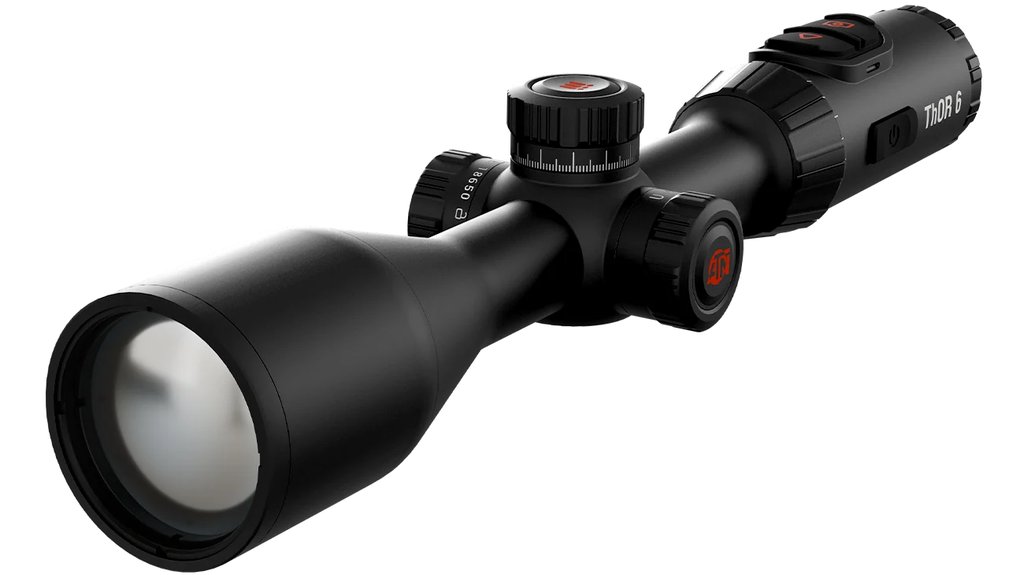
Best for cold winter open ground: ATN ThOR 6 640x512 3-24x
The ATN ThOR 6 640x512 3-24x is the pick when the nights are long, the ground is frozen, and the animals show up small and far off across open country. Winter is when a thermal optic scope is at its easiest and its most demanding at the same time — a warm body against cold stubble lights up beautifully, but the ranges stretch out. This is where the 50 mm objective, the 640x512 sensor and the 3650 m detection range earn their keep, pushing a clean image out to the edge of what the ground allows and giving you a 3-24x zoom band (up to 8x digital) to confirm before anything is in range.
What you notice on a frozen field
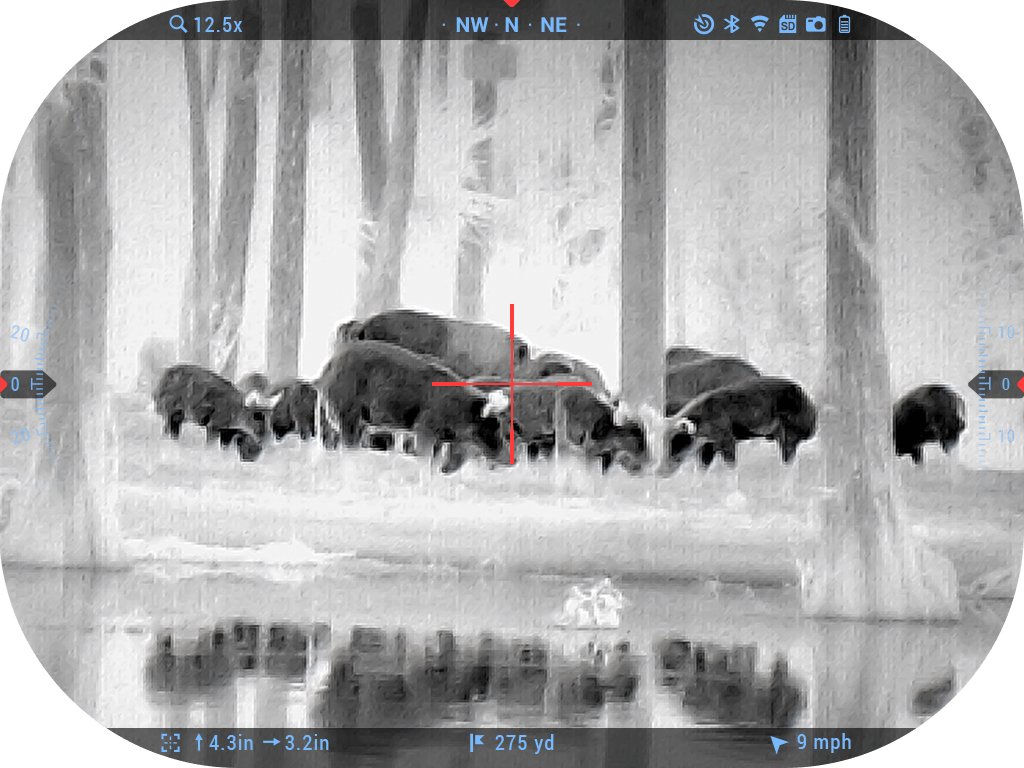
Cold air is kind to thermal, and this scope makes the most of it. Against frost-covered stubble the contrast is stark, and the 640x512 sensor packs enough pixels on the target that you can read shape and gait at ranges where a smaller sensor shows only a bright dot. Think of it like the jump from a grainy old broadcast to a sharp HD feed — the extra pixels are what turn a far-off glow into a recognizable animal. The 50 Hz refresh keeps a walking deer or trotting coyote crisp, and Hot Point Tracking flags the warmest object on screen, which is a real help when you are sweeping a wide, empty tree line in the dark.
Who it is for — and who it is not
It is for the hunter whose season leans on winter and open ground, who needs maximum reach and identification and will pay the flagship outlay for it. It is not the pick if most of your sits are short, warm-weather stands over a small field, where the extra reach of the 3-24x is range you rarely use and the lighter 384 saves weight without leaving detection on the table.
Best for changeable spring and fall: ATN ThOR 6 640x512 2-16x
The ATN ThOR 6 640x512 2-16x is the pick for the shoulder seasons, when one night is cool and open and the next is warm and tight in the timber. It keeps the full 640 sensor but drops to a 35 mm lens and a 2-16x zoom band, which widens the low end for scanning close ground while still reaching a 3100 m detection range when the country opens up. Its standout is the replaceable 18650 battery system — hot-swap a fresh set and a spring turkey-plot sit or a fall predator night simply keeps going.
What you notice across mixed ground
Spring and fall throw variety at you, and the wider bottom end of the 2-16x handles it. The lower magnification gives you a broader field of view to pick up movement across a green field or a cut cornfield before you zoom in to confirm. You keep the same 640 clarity and sub-15 mK sensitivity as the winter flagship, so up close the image quality is identical — you simply trade a little top-end reach for a friendlier package and swappable power that suits nights of unpredictable length.
Who it is for — and who it is not
It is for the hunter whose calendar is built around spring and fall — mixed ranges, changing cover, and sits that can run long. It is not the pick if you almost always shoot at the outer edge of open winter country, where the longer-reaching 3-24x is worth its extra glass.
Best for warm summer close work: ATN ThOR 6 384x288 2.5-20x
For hot summer nights and short, mobile sits, the ATN ThOR 6 384x288 2.5-20x is the one you want on the rifle. It steps the sensor down to 384x288 and the weight down to 790 g / 1.74 lbs, which matters on a July stalk when you are moving between fields rather than settling in for the night. Detection lands at 2300 m — plenty for the closer ranges summer usually gives you — and you gain six colour palettes to dial in contrast, which is exactly what warm ground demands.
What you notice on a summer night
Summer is the season thermal has to work hardest, because ground that baked in the sun stays warm and the temperature gap between an animal and its background shrinks. That is where the sub-15 mK sensitivity and the palette options do their job — flick between White Hot, Black Hot and the iron tones until a hog separates cleanly from a heat-soaked field edge. The 384 sensor is not a 640, but at the shorter ranges summer close work actually involves, the difference on screen is small, and the lighter unit is the one you notice least on a long walk in.
Who it is for — and who it is not
It is for the hunter who lives in warm-weather close work and prizes a light, easy-carry rig. It is not the pick if you specifically came for a 640 sensor and long winter reach — this is the value-tier step-down for people whose season simply does not demand the bigger sensor.
How to choose a thermal optic scope for your season
Start with the nights you actually hunt most, not the longest shot you can imagine. The season you spend the most time in should drive the buy, because a scope that suits your dominant conditions will feel right far more often than one bought for a rare edge case.
- Match reach to your season's ground — cold open winters reward the 3-24x and its 3650 m detection; mixed spring and fall cover does fine on the 2-16x; close summer work rarely needs either.
- Weigh the power system against sit length — long winter and shoulder-season sits favour the swappable 18650 build so a fresh set keeps the night alive.
- Be honest about resolution — a 640 earns its keep for long winter identification; for shorter warm-weather ranges the 384 saves weight.
- Mind the palettes for heat — more colour options matter most in summer, when heat-soaked ground fights your contrast.
- Plan for the whole calendar — Recoil Activated Video and the ATN Connect 6 app let you review every season's stands and learn from them.
What a winter night looks like behind the 3-24x
Picture the coldest stand of your year: a rise at the edge of a frozen bean field, the wind dead still, the ground crusted with frost. You settle behind the ATN ThOR 6 640x512 3-24x at its wide 3x setting and sweep the far treeline, where a warm smudge peels away from the shadow and starts working across the open. Because the 640 sensor and the 3650 m detection range give you that contact early, you have time — you watch the animal commit, read its line, and thumb the zoom up only when it slows inside range. SharpIR sharpens the outline so you confirm the animal and not a stray, Hot Point Tracking keeps it flagged as it crosses the open, and the 50 Hz refresh keeps it smooth. On a still winter night with cold ground behind it, this is the scope doing exactly what the season built it for.
Getting the most from a thermal optic scope in each season
A season-matched scope still needs season-matched habits. In winter, zero carefully at the longer ranges you engage on open ground and lean on Zeroing Freeze so your point of impact locks while you fire your confirming shots in the cold. In spring and fall, when your ground changes week to week, set Picture-in-Picture so a zoomed aiming window rides above your wide scanning view and you can read close cover and open lanes at once. In summer, spend the first few sits learning the palettes — White Hot reads fine on a cool evening, but Black Hot or an iron tone often pulls a hog off warm ground more cleanly. Let Recoil Activated Video roll all year so each season's stands are reviewable in the ATN Connect 6 app, and carry the batteries to see a long night through rather than cutting a good sit short.
A note on detection range versus what you can identify
The detection ranges in the table — 3650 m, 3100 m, 2300 m — are the distance at which the scope first picks up heat, not the distance at which you can safely tell a coyote from a stray dog. In cold weather those numbers stretch because the contrast is high; in warm weather they pull in because the ground fights you. Treat detection as your early-warning line and identification as the closer, more honest distance where SharpIR and the 640 sensor actually resolve enough detail to commit. Knowing that gap keeps you patient — you let the animal close instead of forcing a shot at the edge of what the optic can see.
Building a year-round setup instead of a one-season rig
If you hunt hard across the whole calendar and can own only one thermal optic scope, buy for your hardest season, not your easiest. Cold-weather open-ground work is the demanding problem — it punishes an optic that cannot reach — while warm close work forgives a scope that reaches farther than it needs. That tips a single-scope decision toward the ATN ThOR 6 640x512 3-24x, and you simply accept carrying a touch more reach than the summer nights strictly ask for. Flip it — mostly warm, close, mobile hunting with the odd cold stand — and the wider, swappable-battery 2-16x becomes the smarter single buy.
If the budget stretches to a two-scope kit, a hunter who truly lives in every season pairs the long-reach 3-24x for cold open winters with the lighter 384x288 2.5-20x for warm summer close work, and leaves each optic doing the job it is best at instead of asking one to be everything. Whichever route you take, the honest step is to log a few weeks across seasons, note the range at which you actually identified and shot, and buy for that reality rather than for the longest shot on the calendar.
Common mistakes when picking by season
- Buying for the rare season — kitting out for one dream long-range winter night when most of your calendar is close summer work leaves you carrying reach you never use.
- Over-zooming to search — cranking straight to the top of the band throws away the wide view that finds animals; scan low, then zoom to confirm.
- One palette all year — leaving White Hot on through summer wastes the contrast the other palettes give you on heat-soaked ground.
- Skipping a season-right zero — a scope zeroed for close summer ranges is not confirmed for long winter shots; re-check it with Zeroing Freeze at the distance the season actually calls for.
- Treating detection as identification — a warm blob at the edge of detection is a contact, not a confirmed target; let it close or zoom in before you commit.
How we picked these ATN thermal scopes
This is an in-house comparison of ATN's own ThOR 6 thermal scopes, not an independent lab review, so use it as a starting point and check the specs against the seasons you actually hunt. We sorted the line by the conditions each model handles best, then weighed the things that decide a night in that season: sensor resolution and thermal sensitivity (NETD) for identifying targets, detection range for reach, refresh rate for tracking moving animals, and weight and battery life for how long and how far you carry the rig. Only the current 6th-generation ThOR 6 line was considered. The honest trade-off is plain — the flagship reaches farthest and reads cleanest but weighs and costs the most, while the 384 gives up range and pixels to stay light for warm-weather work. Who it is not for: anyone wanting a cheap novelty rather than a tool that carries season after season.
Frequently Asked Questions
Does a thermal optic scope work better in winter or summer?
Winter is generally easier for thermal because the cold ground contrasts sharply with a warm animal, which stretches your effective range. Summer is harder: sun-soaked ground stays warm and shrinks the temperature gap, which is where the ThOR 6's low sub-15 mK sensitivity and its palette options do the most work.
Which ATN ThOR 6 is best for cold-weather open ground?
The ATN ThOR 6 640x512 3-24x. Its 640 sensor and 3650 m detection range let you pick up and identify animals far across frozen open country, and the 3-24x zoom band gives you room to confirm before anything is in range.
Can one thermal optic scope cover every season?
Yes, if you buy for your hardest season. Cold open-ground work is the demanding case, so a scope built for it, like the 3-24x, forgives easier warm-weather nights. Buy for your dominant conditions and it will feel right far more often than a one-season pick.
Why does detection range change with the weather?
Detection is the distance at which the scope first picks up heat, and that depends on contrast. Cold air widens the gap between an animal and its background, so the listed ranges stretch in winter and pull in during warm summer nights when the ground is nearly as warm as the target.
How long will the battery last on a long seasonal sit?
Plan on roughly 9 hours per charge across the line. The 2-16x uses a replaceable 18650 system, so a spare set in a pocket keeps a long winter or shoulder-season sit going with no downtime.
Is the 384 model good enough, or do I need a 640?
For close, warm-weather work at shorter ranges the ATN ThOR 6 384x288 2.5-20x holds its own and saves real weight. Step up to a 640 sensor when your season leans on long winter identification, where the extra pixels turn a distant glow into a recognizable animal.
Ready to match a thermal optic scope to your season? Start with the ATN ThOR 6 640x512 3-24x — our top pick for cold open winters and the most capable all-year choice — or browse the full range of ATN thermal scopes to line up sensors, reach and weight side by side. Every ThOR 6 runs SharpIR AI and the Connect 6 app, so whichever season you buy for, you are ready to learn fast and hunt hard from the first night out.
Created: August 5, 2026 · 19:53:45 UTC