Most thermal imaging scope reviews throw numbers at you — resolution, NETD, refresh rate — without telling you which ones actually change what you see through the glass. This guide fixes that. Instead of another star rating, it teaches you how to read the key specs so you can judge any review on your own, using ATN's 6th-gen ThOR 6 line and its flagship, the ThOR 6 640x512 3-24x, as a worked example.
What is a thermal imaging scope review actually rating?
A thermal imaging scope review is rating how well a scope turns invisible heat into a usable picture on your rifle. A thermal scope has no relationship to visible light: it reads the heat every object gives off and paints warmer things brighter than cooler ones, so a review is really judging four things — how much detail the picture holds, how sensitive the sensor is, how far it reaches, and how smoothly it handles motion. Everything else is comfort and features around that core.
How does a thermal scope work?
- The lens (germanium, not regular glass) gathers infrared heat energy from the scene instead of visible light.
- The thermal sensor — a grid of tiny heat-reading pixels — measures the temperature at each point in the frame.
- Software like ATN's SharpIR AI enhancement cleans up and sharpens that raw heat map in real time.
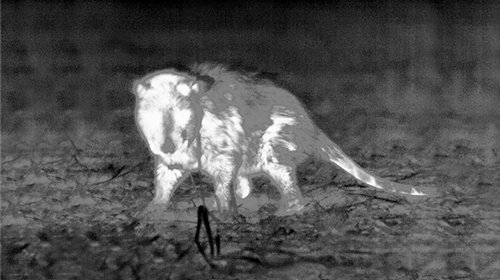
- The display shows the result, with warm targets standing out against a cooler background in your chosen color palette.
- The whole loop repeats many times a second — that repeat rate is the refresh rate, and it's why a running hog stays crisp.
What can you use it for?
- Night hog hunting — hogs are nocturnal and give off strong heat, so they light up clearly against cool ground.
- Predator control — coyotes and other predators are easy to spot and identify at range in total darkness.
- Locating downed game — a fallen animal holds heat, so a thermal scope helps you recover it after a shot.
- Property and stock checks — scan a field or pasture in the dark without spooking anything with a light.
Key features to understand when reading reviews
- Sensor resolution — the pixel count of the heat sensor. More pixels means finer detail; a 640x512 like the ThOR 6 flagship is like HD compared with a 384's standard definition, and it holds detail as you zoom.
- NETD — how small a temperature difference the sensor can detect, in millikelvin. A lower number (the ThOR 6's ≤15 mK) means a more sensitive sensor and a cleaner, higher-contrast image.
- Detection range — the farthest distance the scope can pick up a heat signature. The ThOR 6 640x512 3-24x reaches about 3650 m; detection means spotting something is there, not fully identifying it.
- Refresh rate — how many times per second the picture updates. A higher rate gives smoother motion and less lag when tracking a moving animal.
- Magnification — how much closer the target appears. The 3-24x range spans base optical zoom up through digital zoom.
What to look for before buying
- Match resolution to your range — long shots need a 640 sensor; close brush is fine with a 384.
- Check NETD, not just resolution — a sensitive sensor gives contrast that helps you tell a hog from a stump.
- Confirm the refresh rate — for moving targets you want a high refresh, not a laggy 25 Hz.
- Look at battery and swap-ability — the ThOR 6's ~9 hr swappable 18650 pack keeps you out all night.
- Weigh the extras honestly — Recoil Activated Video and Wi-Fi are useful, but they don't fix a weak sensor.
Common mistakes when reading thermal scope reviews
- Chasing magnification numbers — high zoom on a low-res sensor just enlarges a blurry image.
- Ignoring NETD — two scopes with the same resolution can look very different if their sensitivity differs.
- Trusting daytime demo images — thermal performance is about heat contrast, best judged in real field conditions.
- Overlooking refresh rate — a smooth picture on static targets can smear badly on a running animal.
Example: the ATN ThOR 6 640x512 3-24x
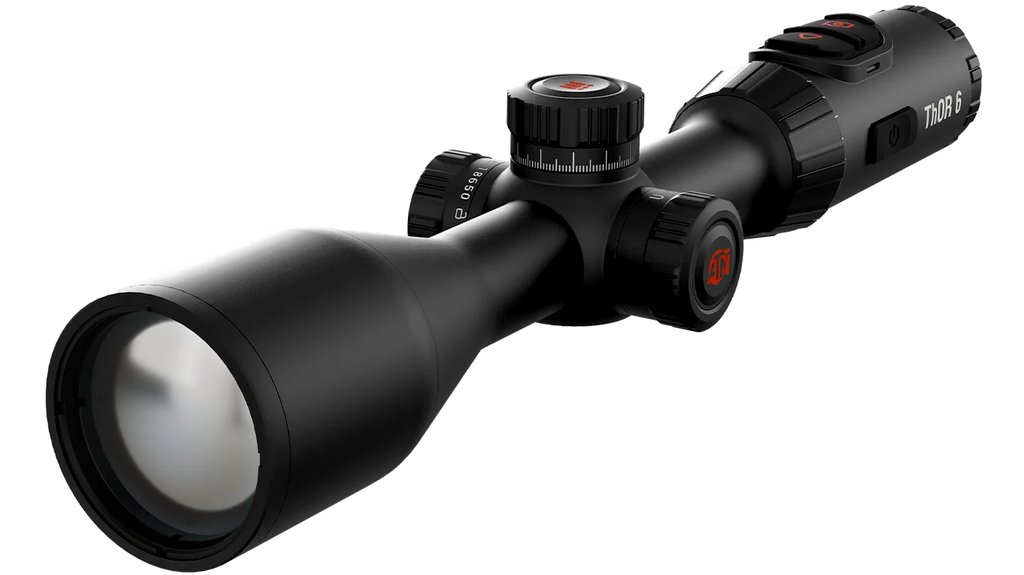
The ATN ThOR 6 640x512 3-24x is a clean worked example of what strong specs look like on paper and why they matter in the field. Its 640x512 sensor holds detail as you dial toward 24x, the ≤15 mK sensitivity gives high-contrast images that make identification easier, and detection reaches roughly 3650 m. Add SharpIR AI enhancement, a high refresh rate for tracking movement, Recoil Activated Video and a ~9 hr swappable battery, and you can see how each spec a review lists translates into something you actually notice through the scope.
Is a thermal imaging scope worth it?
A thermal imaging scope is worth it if you hunt or manage land after dark and need to detect and identify warm animals no light can reveal. Once you can read the specs, you stop paying for numbers that don't help you and start buying reach, contrast and smoothness that do. A 640-class ThOR 6 is worth the flagship tier for long-range work; a 384 model is the honest value choice for closer ground.
How this guide was put together
This guide was built to make thermal imaging scope reviews readable rather than to rank one product, so we focused on the specs that change what you see: sensor resolution, NETD, detection range, magnification and refresh rate, judged against real hunting distances. We used only ATN's current 6th-gen ThOR 6 line as the example — no older or discontinued models — and this is an in-house explanation from a brand that makes these scopes, not an independent lab test. Weigh the numbers against your own ground. The honest trade-off: no single spec tells the whole story, and the flagship's reach is wasted at close range. Who this guide is NOT for: someone who just wants a one-line 'buy this' with no interest in why.
Frequently Asked Questions
What makes a good thermal imaging scope review?
A good review explains the four specs that matter — resolution, NETD, detection range and refresh rate — and ties each to real field performance rather than just listing numbers or a star score. If a review only quotes magnification, it's not telling you how the scope actually sees.
Which spec matters most in a thermal scope?
It depends on your use, but sensor resolution and NETD together decide image quality: resolution sets detail, NETD sets contrast and sensitivity. Detection range and refresh rate then determine reach and how well the scope tracks moving animals.
What does NETD mean in thermal scope reviews?
NETD is the smallest temperature difference the sensor can detect, measured in millikelvin. A lower number, like the ThOR 6's ≤15 mK, means a more sensitive sensor and a cleaner, higher-contrast picture that makes targets easier to identify.
Is higher magnification always better?
No. Magnification only helps if the sensor has the resolution to support it. Zooming a low-resolution sensor just enlarges a blurry image, which is why reviews should pair magnification with resolution before you trust the reach.
How far can a thermal scope detect an animal?
Detection range depends on the sensor and lens. The ATN ThOR 6 640x512 3-24x reaches about 3650 m for detection, but detection means spotting a heat signature, not fully identifying it — identification happens at shorter range.
Do thermal scopes work in daylight?
Yes. Thermal scopes read heat, not visible light, so they work day or night. They're most useful in the dark, but they'll still detect a warm animal against cooler surroundings during the day.
Now that you can read the specs, put them to work. Look over the ATN ThOR 6 640x512 3-24x to see a full 6th-gen spec sheet in context, then compare it against the mid and value models in the ATN thermal scope lineup. When your next review lands, you'll know exactly which numbers to trust and which are just marketing — and you'll buy the scope that fits your ground, not the one with the biggest headline.
Created: August 10, 2026 · 09:39:32 UTC