Set two hunting rigs side by side and the question answers itself. There is no true thermal binoculars under 1000 hog hunting setup on the market — so instead of comparing a fantasy budget model against a real one, this piece compares the two genuine ATN Binox-6 setups from the current 6th-generation thermal binoculars line, and tells you exactly where the price honestly begins.
First, the honest part about $1,000
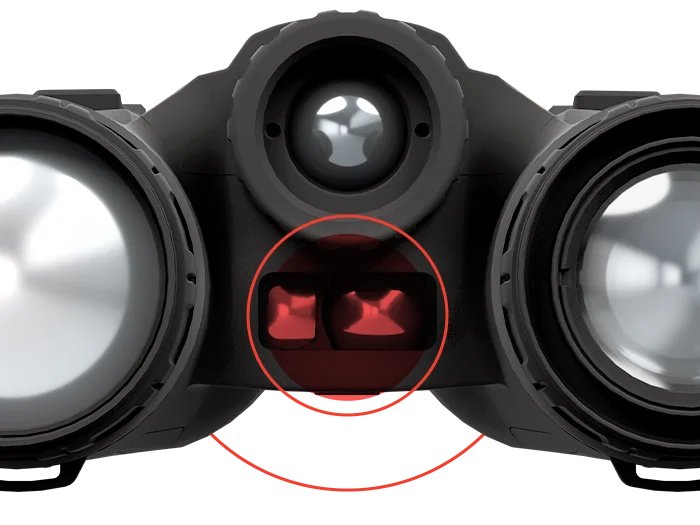
Comparisons are only useful if both sides are real. A thermal binocular under $1,000 is not — a true two-eyecup thermal instrument costs more than that because of the germanium optics and the sensor behind each eye. Listings under $1,000 are monoculars, not binoculars. So the meaningful comparison for a hog hunter is not 'cheap binocular vs good binocular'; it is which of the two real Binox-6 setups fits your ground and your budget.
The two setups head to head
Setup one: Binox-6 Dual 384x288 — the higher-zoom entry
The Binox-6 Dual 384x288 is the least costly real thermal binocular ATN makes, at a promo $2,895.00 (regular $3,185.00). Its headline for hog work is reach-through-zoom: a 5.5-44x thermal channel lets you push in hard on a distant heat blob to count a sounder before you decide anything. Detection sits at 2750 m and the 384x288 sensor is plenty for the mid-range fields most hog hunters actually work.
This is the setup for the hunter whose priority is 'get me the lowest real entry into thermal binoculars, and give me plenty of top-end magnification to identify targets.'
Setup two: Binox-6 Dual 640x512 — the longer-reach rig
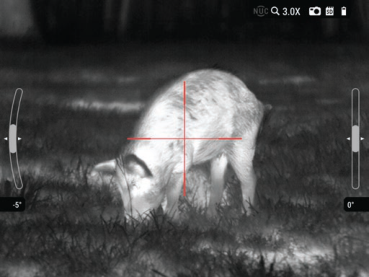
The Binox-6 Dual 640x512 at a promo $3,595.00 (regular $3,955.00) trades some top-end zoom for a sharper, longer-range picture. The 640x512 sensor resolves a hog as a clean animal shape, and detection to 3100 m gives the earliest warning on pressured pigs. Its 3-24x range starts wider, which suits scanning a big property over glassing a single lane.
This is the setup for the hunter running wide, open country who wants maximum detection distance and image clarity, and is willing to pay the step-up from the entry model.
Which setup wins for you
- Lowest real entry + high zoom to ID targets → Binox-6 Dual 384x288.
- Widest scanning field + longest detection + cleanest image → Binox-6 Dual 640x512.
- Hard $1,000 ceiling → neither; a thermal monocular is your realistic starting point, not a binocular.
- Both share the same ≤15 mK NETD, 4-in-1 vision, built-in rangefinder and near-identical weight, so comfort and features are a wash.
A real hog night with each setup
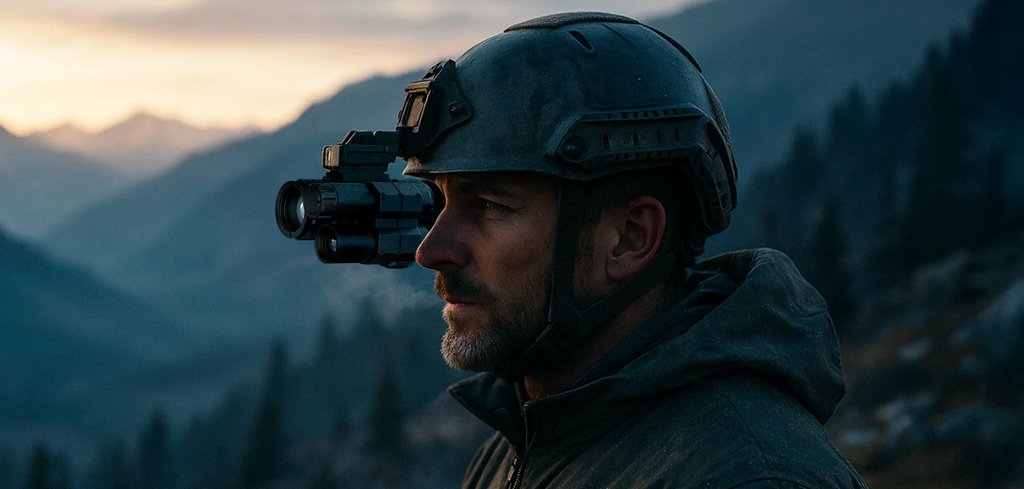
Picture a warm July night over a picked cornfield. With the 384x288 you sweep the tree line at the base of its zoom, catch a hot body pushing out of the timber, then crank toward 44x to count the sounder and pick the boar — the top-end magnification doing the identification work. With the 640x512 the same scene reads sharper at the base 3-24x range: the pigs resolve as clean, separate animals across the field without needing to zoom in as hard, and the extra 350 m of detection means you saw them enter before the 384 would have. Both range with the built-in laser and both hold two eyes on glass — the difference is whether you prefer to reach in with zoom or start with a wider, sharper picture.
Neither of those workflows is possible on a sub-$1,000 single-tube monocular held to one eye, and that gap in comfort and capability over a long night is exactly what the price of a true binocular pays for.
The $1,000 myth, laid to rest
- The badge trap — a listing can say 'binoculars' and still be a single-sensor monocular; check for two independent eyecups and a full thermal channel.
- The image tell — a genuinely cheap 'binocular' usually shows a coarse, low-resolution picture that falls apart at the distances hog hunting demands.
- The honest floor — for a real ATN thermal binocular, the entry is the Binox-6 Dual 384x288 at a promo $2,895.00, not anywhere near $1,000.
- The smart alternative — if $1,000 is truly fixed, a thermal monocular gives you real capability at that number without pretending to be a binocular.
How we compared them
This is an in-house, ATN-vs-ATN comparison of our own current 6th-generation Binox-6 line, not an independent review, so measure the numbers against your own hog ground. We compared the two setups on the specs that decide a real night: sensor resolution and NETD for image quality, detection range for early warning, magnification for target ID, and weight for comfort over long glassing.
On price we stayed honest — because the keyword asks about $1,000, we used ATN's real figures instead of inventing a budget model, and the plain finding is that no true thermal binocular meets that threshold. Who this is not for: if your budget genuinely stops at $1,000, neither Binox-6 fits, and a monocular is the honest recommendation.
Frequently Asked Questions
So which is better under $1,000 for hogs — 384 or 640?
Neither is under $1,000; no true thermal binocular is. Between the two real options, the 384x288 (promo $2,895.00) is the entry with more top-end zoom, and the 640x512 (promo $3,595.00) is the longer-reach, higher-resolution rig.
Is the 640x512 worth the step up from the 384x288?
If you hunt wide, open country and want the longest detection range and the cleanest image, yes. If you work mid-range fields and value the extra top-end magnification for target ID, the 384x288 covers you at a lower entry price.
Why does the 384x288 zoom higher than the 640x512?
The 384x288 model is tuned as a high-magnification observation optic at 5.5-44x, while the 640x512 starts wider at 3-24x to favour a broader scanning field. It is a design trade, not a quality gap.
Do both range hogs the same way?
Yes. Both carry the same built-in laser rangefinder, accurate to about 1 m out to 1000 m, so ranging a hog before the move is identical on either setup.
Can I really not find a thermal binocular under $1,000?
Not a genuine one. Anything advertised at that price is a single-sensor monocular, not a two-eyecup binocular. For a true thermal binocular, the honest entry is the Binox-6 Dual 384x288 at a promo $2,895.00.
Are both setups a similar weight to carry?
Yes, almost identical — 1.59 lbs for the 384x288 and 1.61 lbs for the 640x512. Carry comfort on a chest harness is not a deciding factor between them.
Compare them yourself: the entry Binox-6 Dual 384x288 against the longer-reach Dual 640x512, or browse all ATN thermal binoculars. Real gear, real prices — no sub-$1,000 make-believe.
Created: August 5, 2026 · 19:53:44 UTC