A budget of a thousand budget is a fair starting point for a lot of hunting gear, but for thermal binoculars under 1000 hog hunting it runs into a hard wall: no real thermal binocular is built at that price. This roundup takes a different angle from the usual price hunt — it sorts ATN's actual options by the hog-hunting jobs they do, so you can see what your money buys once you accept the real floor. The value entry is the Binox-6 Dual 384x288 5.5-44x at $2,895.
Step-up for range: ATN Binox-6 Dual 640x512 3-24x — sharper sensor, longer detection.
The truth: a $1,000 budget will not buy a genuine hog-capable thermal binocular; the $2,895 Binox-6 384 is where real ATN thermal glass starts.
What a $1,000 budget actually buys in thermal
A $1,000 budget does not buy a genuine hog-hunting thermal binocular, and it helps to know why before you spend. The sensor that reliably separates a pig from cool soil, the germanium optics that focus infrared, and the processing that renders it all in real time cost real money — and a binocular needs that quality across a full optical path. ATN's most affordable, the Binox-6 Dual 384x288 5.5-44x, lands at $2,895 and includes a 1000 m rangefinder, GPS and a 4K day sensor. A thousand-budget listing, by contrast, is either a low-grade single sensor or a mislabeled night-vision device, and it will fail you on the first distant hog.
Value pick: ATN Binox-6 Dual 384x288 5.5-44x
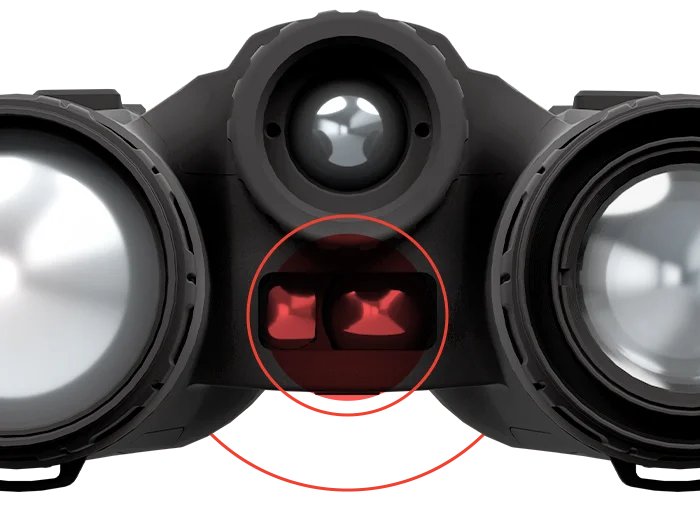
The ATN Binox-6 Dual 384x288 5.5-44x, at $2,895, is the cheapest real ATN thermal binocular and the sensible target once the under-$1,000 idea is off the table. Sorted by the job it does best, it is a scanner and confirmer.
The job: scan and confirm
Most hog work is sweeping a field for warm shapes, then pushing zoom to confirm the shape is a pig. The 384's <=15 mK sensor finds the shapes and its 44x top-end zoom confirms them, while the built-in rangefinder tells you how far off they are. For that core job it wants for nothing at $2,895.
Who it is for: the hunter who wants a genuine thermal binocular at the lowest honest price and mostly scans and confirms. Who it is not for: anyone clinging to a sub-$1,000 budget, which buys nothing real in this category.
The job: check a known crossing or feeder
There is a second job the 384 handles cleanly, and it is the one most hog hunters actually do the most: parking on a spot you already know. You have a trail crossing, a feeder, or a gap in the fence where the pigs come through every few nights. You are not sweeping wide open country. You are watching one patch of ground at moderate range and waiting. That plays right into the 384's hands. Its 5.5x low end gives you a wide enough field to keep the whole crossing in view, and when heat shows up you roll the zoom in to read it. The <=15 mK sensor pulls a warm pig off cool dirt long before your eyes would catch a shape in the dark, so you get seconds of warning instead of a startle.
This is where the built-in rangefinder earns its keep. You range the feeder once, note the number, and now every pig that steps into that spot is already ranged for you. No guessing. No holdover math in your head while a sounder mills around. At $2,895 the 384 does this job as well as anything in the ATN line, because at moderate range you simply do not need the sharper 640 sensor to know a hog is a hog. If your hunting is mostly sitting on known ground and waiting for the crossing to fill, the value pick is not a compromise — it is the right tool.
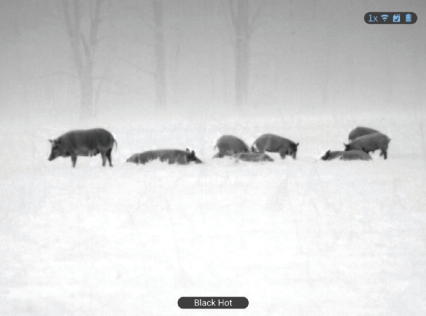
Step-up: ATN Binox-6 Dual 640x512 3-24x
The ATN Binox-6 Dual 640x512 3-24x, at $3,595, takes on the harder job: identifying pigs at long range. Its 640x512 sensor holds detail out where the 384 blurs, and 3100 m detection catches heat far out. It costs more, but there is no cheaper path to that clarity — certainly not under $1,000.
The job: identify at distance
On big open ground, telling a sounder from cattle at the far fence line is a job the sharper sensor does confidently. If that is your reality, the step-up is money well spent.
The job: pick a sounder out of the cattle
Here is the scenario that sells the 640 to a lot of hunters. You are working a big lease with a cattle herd on it, and a sounder likes to feed near the far fence line at night. In thermal, a cow and a hog are both just warm blobs at first glance, and a mistaken shot near livestock is a nightmare you never want. This is exactly the call the sharper sensor makes easier. At 640x512 the pigs keep their shape at distance — the low ground clearance, the long snout, the way a sounder clusters tight and moves as one — while cattle read taller and stand apart. The 384 blurs those tells at the far fence; the 640 holds them.
Detection range is the other half of it. The 640 catches heat out to 3100 m versus the 384's 2750 m, so you see the group form up at the fence before it drifts into your setup, giving you time to count heads and confirm they are pigs and not calves. At $3,595 you are paying for that extra certainty at distance, and on ground where livestock and hogs share the same field, that certainty is not a luxury. It is the difference between a clean cull and a mistake you cannot take back.
Who it is for: the long-range hunter who needs to identify at distance, especially anywhere livestock share the ground. Who it is not for: the mid-range scanner, well covered by the $2,895 384.
What real thermal money buys you
It helps to know what the price tag is actually paying for, because that is why nothing genuine lands under $1,000. Four things drive both the performance and the cost, and a real thermal binocular has to nail all of them at once.
Start with sensor resolution. Think of it like the jump from an old standard-definition TV to HD. The 384x288 sensor is a solid SD-grade picture — plenty to find and confirm a hog at moderate range. The 640x512 is the HD upgrade: more pixels on the same target means the pig stays crisp when it is far away, which is the whole point of the step-up. Neither is cheap to build, because a thermal sensor is a delicate array that reads tiny differences in infrared heat, and that manufacturing is where a chunk of the price lives.
Next is NETD — thermal sensitivity, written as a number in millikelvin. Both Binox-6 models sit at <=15 mK, and lower is better. It measures the smallest temperature difference the sensor can see. A tight <=15 mK figure is why a pig lying still in wet grass on a cool night still glows clearly instead of washing into the background. Cheap sensors run much higher numbers and give you a mushy, low-contrast image right when you need detail most. That sensitivity is a real cost, and it is one the sub-$1,000 listings quietly skip.
Then there is detection range — 2750 m on the 384, 3100 m on the 640. That is not how far you shoot; it is how far the optic can pick up a heat signature at all. More range means you spot the sounder forming up long before it reaches you, which turns a rushed reaction into a planned setup. Longer detection takes a better sensor and better germanium optics working together, and again, that is money.
Finally, you are not buying a bare sensor — you are buying the full 4-in-1 toolkit. Both models fold in a 1000 m laser rangefinder, GPS, a 4K day camera for recording your hunts, and roughly 8 hours of battery on swappable 18650 cells. That is four devices in one housing. Add up a real thermal core, <=15 mK sensitivity, long detection, and a full toolkit, and you land at $2,895 for the 384 and $3,595 for the 640. That stack is exactly why a genuine hog-capable thermal binocular cannot exist at $1,000 — the parts alone cost more than that. Anything advertised under the line is missing one or more of these, and it will show the first time a pig is farther than the porch light.
How to spend your thermal budget wisely
Once you accept the floor, spend on the job you actually do rather than on a fantasy price.
- Reset the budget — plan around $2,895 as the real entry, not under $1,000.
- Buy for the job — scanning and confirming favours the 384; long-range identifying favours the 640.
- Skip the fakes — sub-$1,000 'thermal binoculars' will not perform on a hog field.
- Count the toolkit — both bring the 1000 m rangefinder, GPS and ~8-hour battery, so you are buying a full system, not just a sensor.
How we picked these ATN thermal binoculars
We began from the honest fact that no real ATN thermal binocular sells under $1,000, then sorted the actual options by the hog jobs they do — scanning and confirming versus identifying at distance — weighing sensor resolution, NETD, detection range, magnification, weight and battery, and only within ATN's current 6th-gen Binox-6 line. We quote the real ATN prices ($2,895 and $3,595) rather than invent a sub-threshold number. The honest trade-off: even the value pick is a real investment, and the 384 trades sensor sharpness for a lower cost. This is an in-house comparison of ATN's own range, not an independent lab test, so weigh it against your ground. Who neither is for: a buyer whose budget truly caps at $1,000, since no genuine thermal binocular exists there from any maker.
Frequently Asked Questions
Can I hog hunt with a thermal binocular under $1,000?
Not with a real one. Genuine thermal binoculars start well above $1,000 because the sensor and optics are costly. ATN's most affordable, the Binox-6 384x288, is $2,895.
What will a $1,000 budget get me instead?
For thermal, nothing hog-capable. You would be better off saving toward the $2,895 Binox-6 384, or looking at a lower-cost device class entirely, rather than buying a fake-thermal listing that fails at range.
Is the $2,895 Binox-6 384 worth it for hogs?
Yes. It scans, ranges and confirms pigs with a <=15 mK sensor, 44x zoom and a 1000 m rangefinder — a complete 4-in-1 system, which is what the price reflects.
Why is the 640 more expensive?
Its 640x512 sensor is sharper and its detection reaches 3100 m, which costs more to build. At $3,595 it is the pick for identifying pigs at long range.
Are online 'thermal binoculars' under $1,000 scams?
Not always scams, but they are the wrong tool — usually low-grade sensors or mislabeled night vision that cannot separate a hog from the background at hunting range.
How long will these run in the field?
About 8 hours each on two 18650 cells, and because the cells swap out, spares cover an all-night hog sit on either model.
Ready to plan around the real numbers? Set your sights on the most affordable genuine option, the ATN Binox-6 Dual 384x288 5.5-44x at $2,895, or compare it with the long-range 640 across ATN's thermal binoculars range. Skipping the under-$1,000 dead end and buying real thermal glass is the choice that actually puts pigs on the ground.
Created: August 5, 2026 · 19:53:44 UTC