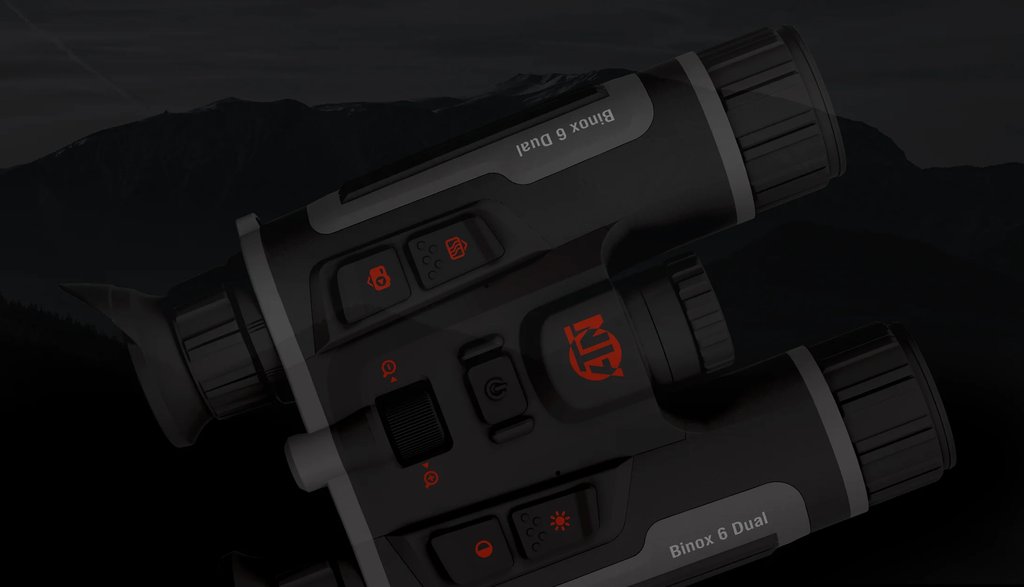
Search "thermal binoculars under 1000 hog hunting" and you are asking a fair question: can you get real thermal binoculars for night hogs without spending big? Here is the honest answer up front, because you deserve it before a wall of marketing. In ATN's current 6th-generation thermal binoculars line, there is no model priced under $1,000. The most affordable one, the ATN Binox-6 Dual 384x288, lists at $3,185.00 and runs $2,895.00 on promo. That is above the $1,000 mark, and we are not going to pretend otherwise.
The straight answerIs there an ATN thermal binocular under $1,000? No. The line's entry point is the ATN Binox-6 Dual 384x288 at $3,185.00 ($2,895.00 on promo). Why the gap? A true 4-in-1 binocular with a laser rangefinder, a 4K day sensor and a thermal core is a different tool from a bare thermal viewer — and for hog hunting, that difference is exactly what earns the money back.
We could have buried a fake "under $1,000" pick in this article to catch your click. We did not, because that is not how you buy a tool you will bet a season on. Instead, this piece explains where the Binox-6 line really starts, what the extra spend buys for hog work specifically, and how to decide whether the jump is worth it for you. Every price here is the real ATN figure — nothing invented, nothing rounded to look better.
Where the ATN thermal binocular line actually starts
The entry point into ATN's thermal binoculars is the Binox-6 Dual 384x288 5.5-44x at $3,185.00, or $2,895.00 on promo. It is well over the $1,000 you searched for, so if your ceiling is firm at a grand, an ATN thermal binocular is not the tool that fits today — and it is better you hear that plainly than get talked into the wrong buy. What you get for the real price is not a stripped viewer but a full 4-in-1 platform: thermal, day, night and twilight in one housing, a 384x288 thermal sensor with an ≤15 mK NETD, a laser rangefinder good to 1000 m, and a 5.5-44x zoom range that is the widest in the family.
- Real entry price: Binox-6 Dual 384x288 — $3,185.00 list, $2,895.00 promo. Not under $1,000.
- 384x288 thermal sensor, ≤15 mK NETD — enough resolution and sensitivity to separate a hog from cool ground on a real night.
- 5.5-44x magnification — scan wide, then zoom hard to confirm a sounder before you move.
- Laser rangefinder to 1000 m — range a pig to within a meter without a second device.
- Detection out to 2750 m — you pick up heat long before hogs are anywhere near you.
Why nothing lands under $1,000 (and why that is honest, not a dodge)
A binocular is two optical channels, not one, and doing thermal in both eyes with a rangefinder, a 4K day sensor, GPS, a compass and ATN's SharpIR AI processing costs real money to build. The sub-$1,000 "thermal" gear you will find elsewhere is almost always a single-eye viewer with a tiny sensor, no ranging and no day mode — a different class of tool entirely. For casually spotting warmth in the yard, that can be fine. For hunting hogs, where you scan for hours, identify a target and range it before a shot, the cheaper class runs out of capability fast. The Binox-6 costs more because it does the whole job; that is the trade the price reflects.
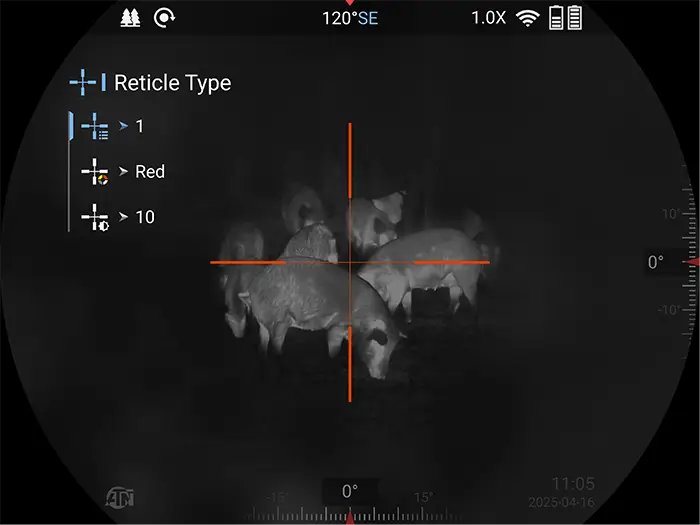
What the real spend buys for hog hunting
If you can stretch past the $1,000 line to where the Binox-6 actually lives, here is what the money is doing on a hog night, feature by feature. None of this is fluff — each item changes how a real hunt goes.
- Two-eyed scanning — both eyes open for hours cuts fatigue and gives you depth sense as a sounder moves through cover, which a one-eyed viewer cannot.
- Built-in rangefinder — ranging a hog to within a meter before a shot is the difference between a clean result and a guess in the dark.
- 4-in-1 modes — the same unit scouts sign in daylight and hunts pigs after dark, so you are not buying two devices.
- ≤15 mK NETD — low sensitivity keeps a hog readable when warm ground shrinks the contrast on a muggy night.
- Swappable 18650 batteries — roughly 8 hours per set, and a spare pair turns dusk-to-dawn into a battery change, not a dead unit.
Entry model vs the step-up: which real price makes sense
If the Binox-6 fits your budget once you accept it is above $1,000, you then choose between the entry 384x288 and the flagship Binox-6 Dual 640x512 3-24x. The table below lays out the real prices and the specs side by side so you can see exactly what stepping up costs and buys.
The entry 384x288 at $2,895.00 promo is the smart-money start for most hog hunters: it magnifies further than the flagship and leans on winter contrast. Step up to the 640x512 at $3,595.00 promo only if you hunt heat-soaked summer ground where the extra resolution earns its keep. Both are real prices, and both are above $1,000 — there is no honest shortcut under that number in this line.

How to think about a thermal budget for hogs
If the $1,000 target came from a first guess rather than a hard ceiling, it is worth reframing what you are actually buying. A thermal binocular for hog hunting is not a seasonal accessory you replace every couple of years — it is a long-life tool that changes what is possible after dark, and the good ones hold their usefulness for many seasons. Spread the entry Binox-6 384x288 at $2,895.00 promo across the nights you will hunt over its life and the per-outing cost drops fast, especially when you consider it also replaces a separate rangefinder and a daytime scouting optic. That is the honest math behind why the real price sits where it does, and why chasing an under-$1,000 sticker often means buying twice.
- It is one tool doing three jobs — thermal hunting, laser ranging and 4K daytime scouting, so you are not paying for three separate devices.
- It lasts — an IP67-sealed 6th-generation unit is built for many seasons of dew, frost and hard field use, not a season or two.
- Buying cheap can cost more — a sub-$1,000 single-eye viewer that runs out of capability often gets replaced, and the second purchase erases the saving.
If $1,000 is a hard ceiling, here is the honest advice
We will not pretend the Binox-6 fits a firm $1,000 budget, because it does not — the line starts at $2,895.00 on promo. If a grand is truly all you can spend right now, the honest move is to wait and save toward the real entry price rather than buy a cheap viewer that will disappoint you on the first serious hog night. Watch for ATN promotions, which is how the 384x288 reaches $2,895.00 from its $3,185.00 list, and plan your purchase around them. When you can meet the real number, you will own a tool that finds, identifies and ranges hogs in the dark — something no under-$1,000 option in this class genuinely does. That is the straight answer to "thermal binoculars under 1000 hog hunting": the capability you want lives above the line, and it is worth reaching.
How we picked these ATN thermal binoculars
This is an in-house look at ATN's own current range, not an independent lab review, so weigh it against your own budget and the way you hunt. We answered the "under $1,000" question with the real listed and promo prices ATN charges rather than a made-up figure, because a false pick helps no one. We judged the two Binox-6 variants on what decides a hog night — sensor resolution and NETD for separating an animal from warm ground, magnification and detection range for real distances, and battery and weight for a long scan — and we only consider the 6th-generation line. The honest trade-off is simple: if your absolute ceiling is $1,000, this is not your tool right now, and we would rather tell you that than sell you the wrong thing. Who it is not for: the buyer whose budget cannot move past a grand, or anyone who only needs a rare, casual look in the dark.
Frequently Asked Questions
Are there ATN thermal binoculars under $1,000 for hog hunting?
No. The most affordable model in ATN's current line, the Binox-6 Dual 384x288, lists at $3,185.00 and runs $2,895.00 on promo. That is above $1,000, and there is no ATN thermal binocular priced under that mark.
What is the cheapest ATN thermal binocular right now?
The Binox-6 Dual 384x288 5.5-44x, at $3,185.00 list or $2,895.00 on promo. It is the entry point into the line and the smart-money start for most hog hunters, even though it sits well above $1,000.
Why do real thermal binoculars cost so much more than $1,000?
A binocular runs thermal in both eyes and adds a laser rangefinder, a 4K day sensor, GPS and AI image processing. That is a full 4-in-1 tool, not a single-eye viewer, and doing the whole job for hog hunting is what the price reflects.
Can I hog hunt with a cheaper single-eye thermal viewer instead?
You can spot heat with one, but for hours of scanning, identifying a target and ranging it before a shot, a bare viewer runs out of capability fast. The Binox-6's two-eyed view and built-in rangefinder are what the extra spend delivers.
Is the entry 384x288 enough for hogs, or should I get the 640?
The 384x288 at $2,895.00 promo is plenty for most hog work and actually zooms further, to 44x. Step up to the 640x512 at $3,595.00 promo only if you hunt warm summer ground where extra resolution helps most.
How long does the battery last for a full night of hog hunting?
About 8 hours on two 18650 cells, and the cells are user-swappable. Carry a charged spare pair and you can cover dusk-to-dawn without the binocular going dark.
Is it worth waiting and saving instead of buying a cheaper viewer under $1,000?
For serious hog hunting, usually yes. A sub-$1,000 single-eye viewer often gets replaced once its limits show, and the second purchase erases the saving. Saving toward the Binox-6 Dual 384x288 at $2,895.00 promo gets you a tool that finds, identifies and ranges hogs the first night out.
If you are ready to buy the right tool rather than the cheapest one, see the entry ATN Binox-6 Dual 384x288 or compare the full thermal binoculars line. There is nothing under $1,000 here — but there is glass that will actually find, identify and range your hogs after dark.
Created: August 5, 2026 · 19:53:44 UTC