If you are searching for thermal binoculars under 1000 hog hunting, here is the honest answer up front: ATN does not make a true thermal binocular that sells under $1,000, and any listing claiming a real 4-in-1 thermal binocular at that price is not describing the same category of tool. Hog hunting across dark, seasonal fields demands a sensor and glass that simply cost more to build. The value entry into ATN's line is the Binox-6 Dual 384x288 5.5-44x, and this roundup explains where that money goes and why it holds up season to season.
Step-up: ATN Binox-6 Dual 640x512 3-24x — sharper 640 sensor and longer detection.
Reality check: a real thermal binocular for hogs costs more than $1,000; the $2,895 Binox-6 384 is where genuine ATN thermal glass begins.
Why there is no real thermal binocular under $1,000
There is no real thermal binocular under $1,000 because a thermal sensor sensitive enough to separate a hog from cool ground — and paired with quality germanium optics — is expensive to manufacture, and doubling it into a binocular costs more again. The most affordable ATN option, the Binox-6 Dual 384x288 5.5-44x, comes in at $2,895. That figure buys a 4-in-1 day/night/thermal/twilight optic with a 1000 m rangefinder, GPS and a 4K day sensor — not a stripped single-tube gadget. Anything advertised as a thermal binocular for a few hundred budget is either a toy-grade sensor or mislabeled, and it will not reliably identify a pig at hog-hunting range.
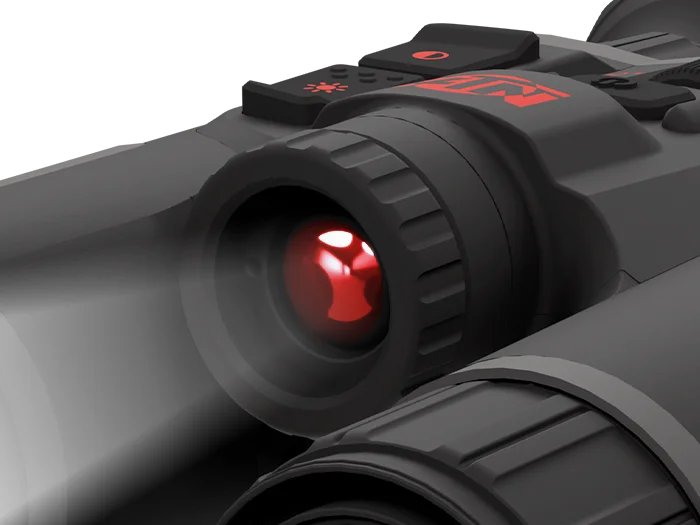
Value pick: ATN Binox-6 Dual 384x288 5.5-44x
The ATN Binox-6 Dual 384x288 5.5-44x, at $2,895, is the most affordable genuine thermal binocular ATN builds and the honest starting point once you accept the under-$1,000 hunt is a dead end. Its 384x288 sensor reads down to <=15 mK — a low millikelvin figure meaning it catches tiny heat differences — so a warm hog jumps off cool ground.
Why it holds up season to season
Hogs run year-round, and conditions swing from humid summer nights to frozen winter fields. The 384's sensitivity and 4-in-1 vision handle both, and its 44x zoom lets you dwell on a distant sounder across a bare winter field or a summer-green plot alike. The built-in rangefinder then confirms the distance before you commit.
Summer humid nights vs frozen winter fields
Picture a July night. The air is thick, the ground is still warm from the day, and the temperature gap between a hog and the dirt behind it shrinks to almost nothing. That is the hardest job a thermal sensor faces, and it is where a cheap sensor turns your pig into a gray smudge. The 384's <=15 mK NETD is what pulls that shrinking heat gap back apart, so a rooting sounder still reads as a cluster of warm bodies instead of a blur. Flip to a February morning — frozen stubble, a hard cold field — and now the contrast is easy but the range is long, because bare winter ground lets you glass a lot farther. Same optic, opposite problems, and the 384 handles both without you touching a setting.
The 4-in-1 vision earns its keep across those seasons too. On a black summer night you lean on pure thermal to find the group. When the moon is up over open snow you can drop to the day or twilight channel to confirm you are looking at pigs and not a neighbor's stock, then range them and settle. One tool covers finding, identifying and ranging, which is exactly what a season-long hog rig has to do.
Who it is for: the hunter who wants real thermal glass at the lowest honest ATN price and hunts hogs through the year. Who it is not for: anyone still hoping for a sub-$1,000 unit — that product does not exist in this category.
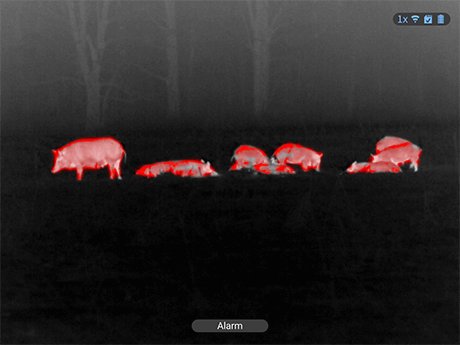
Step-up: ATN Binox-6 Dual 640x512 3-24x
The ATN Binox-6 Dual 640x512 3-24x, at $3,595, steps up from the value pick with a 640x512 sensor — more pixels per hog, the standard-definition-to-HD jump — and 3100 m detection. It costs more than the 384 but still nowhere near the mythical under-$1,000 line, because there is no shortcut to a sharper thermal sensor.
When the step-up earns it
If you hunt big open ground and need to identify pigs at the far edge in any season, the 640's sharper sensor and wider scanning low end are worth the jump. It holds detail where the 384 softens at extreme range.
Long-range seasonal work
Long range is really a winter problem. Once the crops are cut and the fields go bare, you can see a hog from a long way off — and the question stops being can I spot it and becomes can I tell what it is. That is where the 640 pulls ahead. More pixels on the target means a distant blob resolves into a body shape, ears and a snout, so you know it is a pig before you close the distance. Its 3100 m detection gives you the reach, and the 3x low end lets you sweep a whole field fast instead of hunting through a narrow keyhole. In summer, when heavy cover pulls your shots in close, that extra sensor is less critical — which is exactly why the 384 is enough for most nights.
Think of it this way. The 384 finds and identifies pigs at the ranges most hog hunting actually happens. The 640 does the same, then keeps working when the ground opens up and the shots stretch out. If your season includes a lot of that wide winter glassing, the sharper sensor pays you back; if it does not, you are buying reach you rarely use.
Who it is for: the hunter working long, open fields who wants the sharpest ATN binocular. Who it is not for: the budget-first buyer, for whom the $2,895 384 already covers most hog nights.
Why the price floor exists
It helps to know where the money actually goes, because once you do, the under-$1,000 dream stops looking like a bargain you missed and starts looking like what it is. Four things set the floor, and none of them is optional on a real hog optic.
First, the thermal sensor. A hog does not glow — it just runs a few degrees warmer than the field, and on a warm summer night that gap is tiny. Reading it takes a microbolometer array built in a clean room, and those cost real money to make. Second, the glass. Thermal light does not pass through ordinary lenses, so the optics are cut from germanium, a specialty material that is expensive on its own and harder to grind. A cheap gadget skips the good sensor and the good germanium, and that is why it cannot tell a pig from a warm rock.
Third, resolution. Think of it like the old jump from standard definition to HD. A 384x288 sensor gives you a solid, usable picture; the 640x512 packs in far more pixels, so the same hog fills more of the screen and holds its shape farther out. You cannot fake those pixels — a smaller array is simply cheaper because it is a smaller, easier-to-make chip. Fourth, sensitivity, measured as NETD. Both Binox-6 variants read down to <=15 mK, meaning they catch heat differences smaller than a hundredth of a degree. That low number is the whole game on humid nights, and it is engineered in, not bolted on.
Stack those up and the detection range follows — 2750 m on the 384, 3100 m on the 640. That reach is the payoff of every bit above the mark. Add a doubled optic for two eyes, a 1000 m laser rangefinder, GPS and a 4K day sensor, and you can see why real thermal binoculars start at $2,895 and step to $3,595, not under $1,000. The price floor is not a markup — it is the cost of parts that actually work on a hog.
How to shop honestly for hog thermal binoculars
Shop by accepting the real floor and matching the variant to your ground, rather than chasing a price point that does not exist. The good news is that the choice is simple once you stop shopping by price alone. Both real ATN options do the core job — find, identify, range — so the decision comes down to how far and how open your ground is, and how much winter glassing your season really involves.
- Accept the real floor — genuine ATN thermal binoculars start at $2,895, not under $1,000.
- Ignore too-cheap listings — a real thermal binocular cannot be built for a few hundred budget.
- Match sensor to range — 384x288 for typical fields, 640x512 for extreme distance.
- Value the toolkit — both include the 1000 m rangefinder, GPS, IR illuminator and ~8-hour battery, which is part of why real thermal costs what it does.
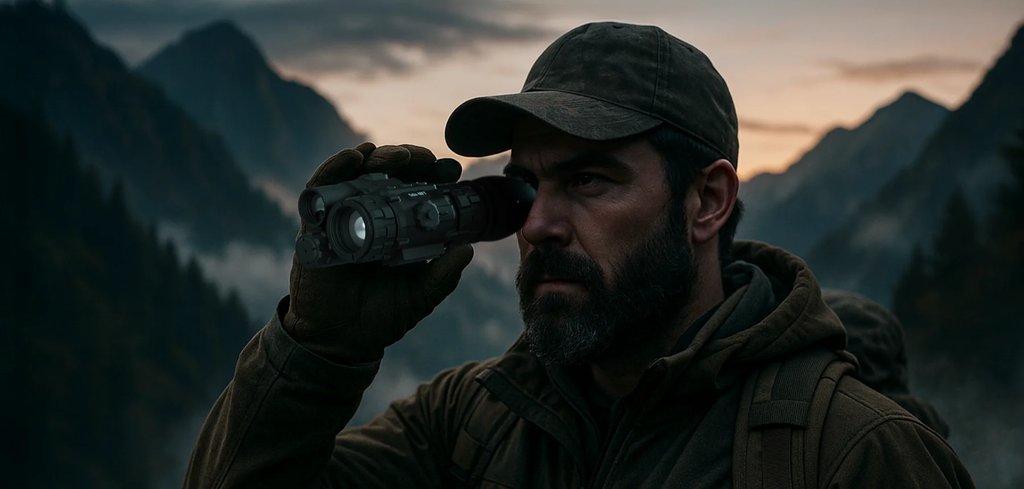
How we picked these ATN thermal binoculars
We started from an honest premise — no true ATN thermal binocular sells under $1,000 — and then weighed the real options on the specs that decide a hog night: sensor resolution, NETD, detection range, magnification band, weight and battery, judged against year-round pig hunting and only within ATN's current 6th-gen Binox-6 line. We cite the real ATN prices ($2,895 for the value 384, $3,595 for the 640) rather than invent a sub-threshold figure. The honest trade-off: even the cheapest option is a serious investment, and the 384 gives up sensor sharpness to the 640 to keep its cost down. This is an in-house comparison of ATN's own range, not an independent lab test. Who neither is for: a shopper unwilling to spend above $1,000, for whom no real thermal binocular exists at any brand.
Frequently Asked Questions
Is there a real thermal binocular under $1,000 for hog hunting?
No. A genuine thermal binocular with a sensor sensitive enough to identify hogs costs well above $1,000. The most affordable ATN model, the Binox-6 384x288, is $2,895 — anything cheaper is not the same category of tool.
Why can't thermal binoculars be cheaper?
The thermal sensor and germanium optics are expensive to make, and a binocular needs the sensitivity for two eyes and long range. That cost floor is why real thermal glass sits above $1,000.
What is the cheapest ATN thermal binocular?
The Binox-6 Dual 384x288 5.5-44x at $2,895. It is a full 4-in-1 optic with a 1000 m rangefinder, GPS and 4K day sensor — the honest entry point into ATN thermal binoculars.
Are cheap thermal binoculars online worth it for hogs?
No. Listings advertising thermal binoculars for a few hundred budget use toy-grade sensors that cannot reliably separate a pig from the background at range. For hog hunting they are a waste of money.
What does the extra money over the 384 buy on the 640?
A sharper 640x512 sensor and longer 3100 m detection, at $3,595. That helps at extreme range on open ground; for typical hog distances the 384 is already enough.
How long do these run on a hunt?
About 8 hours each on two 18650 cells, and the cells swap out, so charged spares get you through an all-night sit on either model.
Does thermal work in summer heat as well as winter cold?
It works in both, but summer is harder. On a humid warm night the gap between a hog and the ground is small, so a sensitive sensor matters most. The Binox-6's <=15 mK NETD is what keeps a pig readable in the heat; in cold winter conditions the contrast is easier and the main gain is longer glassing range across bare fields.
Do I need the 640 or is the 384 enough for hogs?
For most hog hunting the $2,895 384x288 is enough — it finds, identifies and ranges pigs at the distances hunting actually happens. Step up to the $3,595 640x512 only if you work big open ground and need to identify pigs at the far edge, mostly in cut winter fields where shots stretch long.
Ready to shop with clear eyes? Skip the under-$1,000 dead end and start with the most affordable real option, the ATN Binox-6 Dual 384x288 5.5-44x at $2,895, or compare it with the sharper 640 across ATN's thermal binoculars range. Both put scanning, ranging and day glassing in one unit — which is exactly why genuine thermal glass earns its price.
Created: August 5, 2026 · 19:53:44 UTC