The best scope thermal setup isn't the one with the biggest number on the box. It's the one that fits the job you do after dark. A guy chasing sounders across cut cornfields at 300 yards needs something very different from someone calling coyotes at the edge of a pasture or slipping through creek bottoms after a lone boar. So this roundup skips the raw ranking and sorts the ATN ThOR 6 line by the work in front of you. Nail the use case first, and picking the right scope stops being a guessing game.
Best all-around: ATN ThOR 6 640x512 2-16x — the same 640 sensor with a wider low end that feels natural at everyday hunting distances.
Best value: ATN ThOR 6 384x288 2.5-20x — every 6th-gen feature at the most approachable tier, with a 384 sensor that stays plenty sharp inside a few hundred yards.
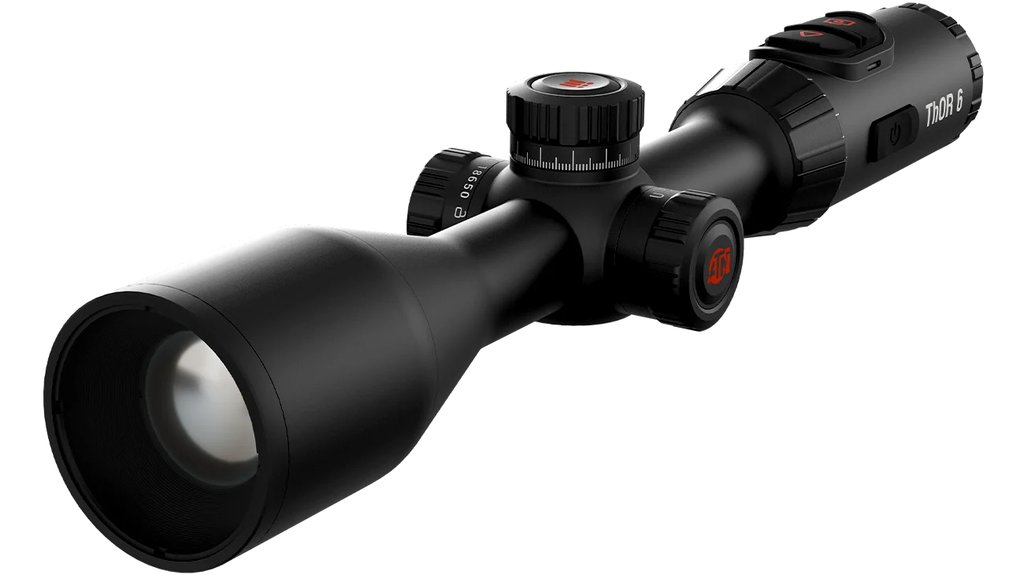
Why ATN's 6th-gen ThOR 6 fits so many jobs
The 6th-generation ThOR 6 line spreads across use cases because ATN kept one strong core and then varied the parts that decide a specific task. The shared core is what you'd expect from a current design: a low-noise sensor rated 15 mK or better for NETD, SharpIR AI smoothing the frame, and a Full-HD OLED display that keeps a boar's outline crisp against cool dirt. NETD, by the way, is the smallest temperature difference the sensor can register in millikelvin — the lower it goes, the more subtle the heat it can pull out of a scene. Bolted around that core is the gear a working hunter leans on shot to shot: Recoil Activated Video, Zeroing Freeze to lock the reticle while you dial, Hot Point Tracking, Picture-in-Picture, 8x digital zoom, and ATN Connect 6 Wi-Fi. Then the variants pull apart on the three things that decide a job — sensor resolution, magnification band, and how far the optic reaches. Sort by the task and those differences line up neatly behind your use case.
ATN ThOR 6 640x512 3-24x — best overall
The ATN ThOR 6 640x512 3-24x earns best overall because it covers the widest spread of jobs without asking you to give anything up. The 640x512 sensor is the heart of it. Picture the leap from a low-megapixel phone to a modern one: pack in more pixels and a hog at 250 yards resolves as a hog, not a warm blob you squint at and hope. That surplus detail is what lets you positively identify an animal before your finger ever finds the trigger.
Reach that fills a field
Reach is where this scope stakes its claim as best overall. A detection range out to 3650 meters paired with a 3-24x magnification band lets you sweep a wide cornfield for heat, then zoom in tight to confirm what you found. Detection range is only how far off you can pick up a heat source in the first place, so treat that top number as a spotting figure and not a shooting distance. Even so, the point holds: this scope sees a long way, and the 50mm F/1.0 lens gathers enough thermal energy to keep that far-off image worth looking at.
Detail you can actually shoot on
The 640 sensor working with SharpIR AI is the gap you feel every time the rifle comes up. Edges stay defined, small animals keep their shape, and the image holds together when a warm coyote lopes across cooler ground. The 8x digital zoom stacks onto the optical band for the moments you need one more push, and Picture-in-Picture floats a magnified aiming window while your wide view stays put — so you never trade situational awareness for a tight hold.
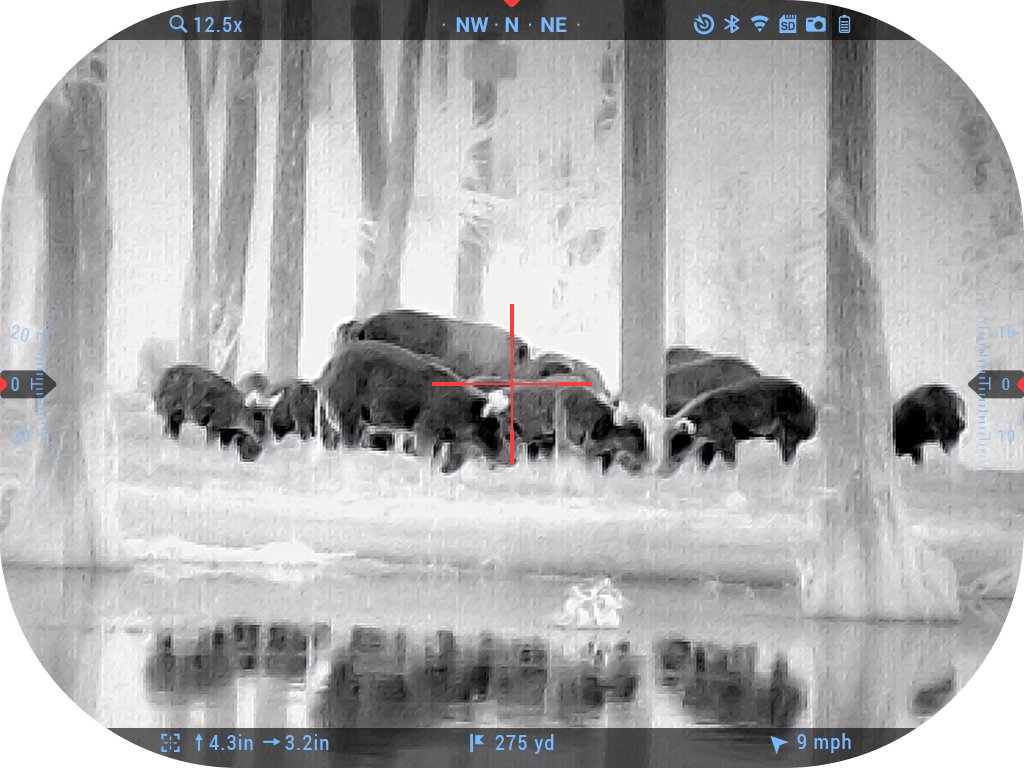
A real depredation call
Put those numbers to work on a job hunters see all the time. A landowner rings you about hogs shredding a cornfield that runs 400 yards to a treeline. You set up on a terrace at last light and start glassing at 3x, wide enough to sweep the whole field edge without constantly panning. A knot of heat blooms in the far corner. Because the 640 sensor resolves genuine shape at that range, you can tell it's a sounder and not a bedded doe, so you plan the stalk instead of gambling on a guess. You slip into a shooting lane, roll up to 12x to count the group and single out the lead sow, and the SharpIR image keeps her outline crisp against the cool ground while you settle the crosshair. Spot wide, identify at distance, confirm on the zoom — that whole chain is exactly what the 640 sensor and the 3-24x band were built for, and it's why open-country hunters bolt this one on and leave it there.
Who it's for: hunters working open ground, ag land, or anywhere a shot can stretch and identification at distance matters. Who it's not for: someone who only slips through tight timber at 75 yards and wants the lightest, cheapest rig — the extra reach and top-end zoom just sit idle there. Grab it on the ATN ThOR 6 640 3-24x product page, or see how it sits against its siblings in the ATN thermal scope collection.
ATN ThOR 6 640x512 2-16x — best all-around
The ATN ThOR 6 640x512 2-16x is the best all-around pick because it holds onto the flagship's 640 sensor while swapping some top-end zoom for a wider, more natural view. That 2x low end pulls more weight than people expect. When a sounder busts loose at 60 yards, a wide field of view keeps you glued to the group instead of losing them in a narrow tunnel — and you can still crank to 16x to verify an animal hanging back.
The same sharp image, an easier band
You keep the full 640x512 detail here, so identification stays every bit as clean as the flagship. What shifts is the 35mm lens and 3100-meter detection figure, both a modest step down from the 50mm flagship. Across the vast majority of real hunting distances that gap never surfaces. What you gain instead is a magnification band that spends more of its time in the range you actually shoot, which makes the scope quicker to point and less fussy to run on a busy night.
Built to outlast the sit
This model carries the replaceable 18650 battery system, a quiet feature that saves whole evenings. Around nine hours of runtime covers most sits, but when a cell finally sags you drop in a fresh one and keep hunting rather than packing it in. Recoil Activated Video logs every shot on its own, so the footage is there without you fumbling for a button in the dark.
Who it's for: the hunter who does a little of everything — timber edges, open pastures, calling dogs, chasing hogs — and wants one scope that never feels like the wrong tool. Who it's not for: the specialist who only takes long pokes across huge ground and wants every last yard of reach; that job belongs to the 3-24x flagship.
ATN ThOR 6 384x288 2.5-20x — best value
The ATN ThOR 6 384x288 2.5-20x is the best value because it hands you the entire 6th-gen feature set at the most approachable tier. The 384x288 sensor carries fewer pixels than the 640 models, so think of it as a lower-resolution camera: the image is still genuinely good and more than enough to identify game inside a few hundred yards — it just won't cling to as much fine detail way out at the ragged edge of its range.
Nothing important on the cutting-room floor
The value here doesn't come from stripping features. This scope keeps SharpIR, Zeroing Freeze, Hot Point Tracking, Wi-Fi, and RAV, and it even adds six color palettes so you can dial in the look that reads best for your eyes and the night's conditions. The 15 mK sensitivity sits in the same class as its bigger siblings, so the picture stays high-contrast and clean even with a lower pixel count behind it.
Light and easy to live with
At 1.74 lbs this is the lightest of the three, and the 2.5-20x range paired with a 25mm lens suits mid-range work nicely. Detection out to 2300 meters is far more than enough to catch game long before a shot ever enters the picture. Who it's for: the hunter stepping into thermal for the first time, or anyone whose shots stay inside a few hundred yards and who'd rather bank the difference toward more nights afield. Who it's not for: the long-range shooter who needs to identify a small animal at the far end of a big field — that's where the 640 sensor pays you back.
How to choose your scope thermal setup
Choosing your scope thermal setup comes down to matching the sensor and magnification to how far and where you hunt. Start with distance: if you routinely identify and shoot past 200 yards, the 640 sensor is worth every bit of it. If your shots stay tighter, the 384 saves you money without costing you a thing in the field. Then weigh your terrain and how many shots a night tends to hand you. Here's the short version:
- Resolution — 640x512 for detail and long-range ID; 384x288 when your distances are moderate and value carries the day.
- Magnification range — a low 2x base saves you in brush and on running animals; a tall 20-24x top end confirms distant game.
- Detection range — a bigger figure means more spotting room, but keep in mind it's a detection number, not a shooting distance.
- Refresh and processing — all three push smooth video and SharpIR, so moving targets stay clean right across the lineup.
- Battery and weight — roughly nine hours and under two pounds on all three; the replaceable-cell 2-16x is the easiest to keep alive on marathon sits.
- Shots per outing — on a busy hog night, RAV plus the swappable cell on the 2-16x mean you can review every encounter and never run dry mid-sit.
One more thing worth an honest look: count how often you truly shoot at your longest distances versus how often you just tell yourself you might. Most hunters overbuy magnification and shortchange field of view. If nine nights in ten your animals show up inside 150 yards and only the tenth stretches past 250, the all-around 2-16x will feel right far more often than the flagship's towering top end. Buy for your typical night rather than your rare one, and the scope stays a joy to run.
How we picked these ATN thermal scopes
Every pick above was slotted to a job first, then scored on the specs that decide whether it does that job well: sensor resolution for detail at range, NETD for how cleanly faint heat separates out, detection distance for how far the optic realistically works, plus refresh smoothness, weight, and runtime. Because the frame was the task, resolution and magnification band carried the most weight — they settle whether you can call an animal at your usual distance. We stayed inside the current 6th-gen ThOR 6 line and left older ATN models out of it entirely. We'll be blunt about the compromises the picks carry: the flagship's top-end reach is dead weight for a close-cover shooter, and the value 384 banks its savings by trading away the finest long-range detail. This is ATN comparing its own ThOR 6 range in-house, not an independent lab test, so line these numbers up against the way you actually hunt before you spend.
Frequently Asked Questions
What is the best all-around scope thermal option in the ATN ThOR 6 line?
For most hunters the ATN ThOR 6 640x512 2-16x is the best all-around choice. It runs the same 640 sensor as the flagship but with a wider low-end magnification, so it stays quick and natural at everyday hunting distances while still zooming in to confirm distant game.
Do I need a 640 sensor or is 384 enough?
If you routinely identify and shoot past roughly 200 yards, the 640x512 sensor is worth it for the extra detail. If your shots stay inside a few hundred yards, the 384x288 model gives you the same feature set and a clean image at a more approachable tier.
What does NETD 15 mK mean for image quality?
NETD measures the smallest temperature difference a sensor can detect. A rating of 15 mK or better means the scope reacts to tiny heat differences, which produces a high-contrast image where an animal's outline stands out sharply against cooler ground.
How far can these thermal scopes see?
Detection ranges run from 2300 meters on the 384 model up to 3650 meters on the 640 3-24x flagship. That figure is how far you can spot a heat signature, not how far you should shoot — ethical identification and shot distances are much closer.
How long does the battery last on the ATN ThOR 6?
All three scopes run roughly nine hours on their internal cells. The 640 2-16x adds a replaceable 18650 battery system, so on long sits you can swap in a fresh cell and keep hunting instead of stopping to recharge.
Can I record my hunts with these scopes?
Yes. Every ThOR 6 here includes Recoil Activated Video, which starts recording on the shot automatically, along with Wi-Fi and ATN Connect 6 so you can stream to your phone and pull footage off the scope afterward.
Which ATN ThOR 6 is best for long-range hunting?
The ATN ThOR 6 640x512 3-24x is the best long-range pick. Its 640 sensor, 3-24x magnification, 50mm lens, and 3650-meter detection range give you the reach and detail to spot and identify game across wide-open country.
Ready to match a scope thermal setup to the way you actually hunt? The ATN ThOR 6 lineup spans everything from long-range open country to lighter, value-minded mid-range work, all built on the same 6th-gen sensor and SharpIR processing. Start with the best-overall ATN ThOR 6 640 3-24x, or browse the full range on the ATN thermal scope collection page to line up sensors, magnification, and detection ranges side by side. Pick by use case first, and the rest of the choice falls into place.
Created: August 5, 2026 · 19:53:43 UTC