It is 1:40 a.m. in the second week of December, nineteen degrees, and I am in the corner of a picked cornfield with my back against a round bale. Wind northwest at six, steady. My caller sits ninety yards downwind and I started quiet. Right now a pair is working the fence line at 210 yards, and I have been watching them four minutes — long before they were close enough to shoot. That is what makes late-fall coyote hunting at night different work than September: the animals behave differently, the ground is open, and a thermal optic lets you manage the whole approach instead of reacting to whatever walks into a light beam.
Late fall is the best calling of the year because coyotes are hungrier, pairing up ahead of the breeding season, and this year’s pups are dispersed and inexperienced. Run a handheld thermal monocular to find and watch them, and a rifle-mounted thermal scope to make the shot. Set up so they come from downwind into open ground.
What makes late-fall coyote hunting different
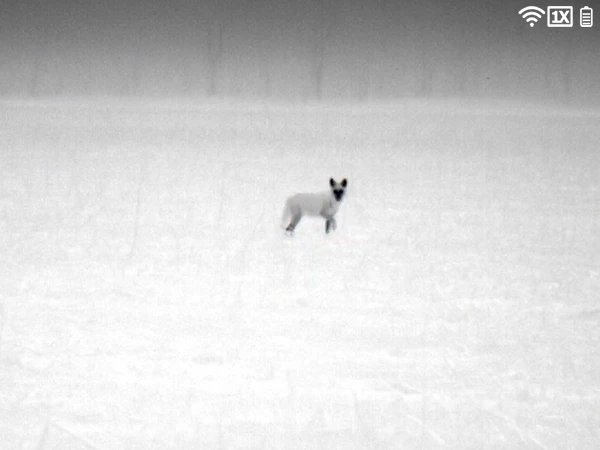
Late fall changes four things at once, and each works in your favor. Food gets scarce — rodent activity drops, fawns are grown, crops are off — so prey distress carries more weight than it did in warm weather. Coyotes begin pairing ahead of breeding season, so they answer territorial and social sounds, not just food. This year’s pups have dispersed onto unfamiliar ground; hungry, unattached, they commit faster than any adult. And you get fifteen hours of darkness instead of eight, so one night holds four or five real stands. Add harvested fields and bare timber, and you can finally see across the ground you hunt.
How a late-fall night stand actually runs
Every stand follows the same order. Wind first, position second, sound third.
- Read the wind before you leave the truck. Coyotes circle downwind to verify a sound before showing themselves. Sit so the downwind side of your caller is open, visible ground. If it is cover, move the stand.
- Park far and walk in dark. Four hundred yards minimum, no white light — pick your footing off the handheld’s screen.
- Set the caller crosswind, 80–100 yards out. That pulls attention off your position and leaves a lane between you and the sound.
- Start quiet, then pause. Two minutes of low-volume prey distress, then three minutes silent. A close coyote heard the first note and is already moving; loud openings push it out.
- Add vocalizations as the season moves on. By December, challenge howls, female invitations and lone howls bring pairs. If prey sounds get nothing in two sequences, switch to vocals rather than getting louder.
- Sit 25 to 30 minutes. Late-fall animals come slow and from a long way off.
- Move at least a mile. Anything less and you are calling to coyotes that already heard you and declined.
Predator calling gear checklist
- Rifle-mounted thermal scope — zeroed at your working distance, not the shop’s.
- Handheld thermal monocular — finding and watching without moving the rifle.
- Electronic caller with a remote, plus a hand call for when batteries quit.
- A spare 18650 cell, kept warm in an inside jacket pocket.
- Shooting sticks or a tripod — you will shoot seated at 150 to 250 yards.
- Insulated pad and one more layer than you think you need.
- Rangefinder or pre-walked reference marks, so distance is a fact, not a guess.
- Lens cloth — frost forms on objectives at the worst moment.
Two devices, two jobs: scanner in hand, scope on the rifle
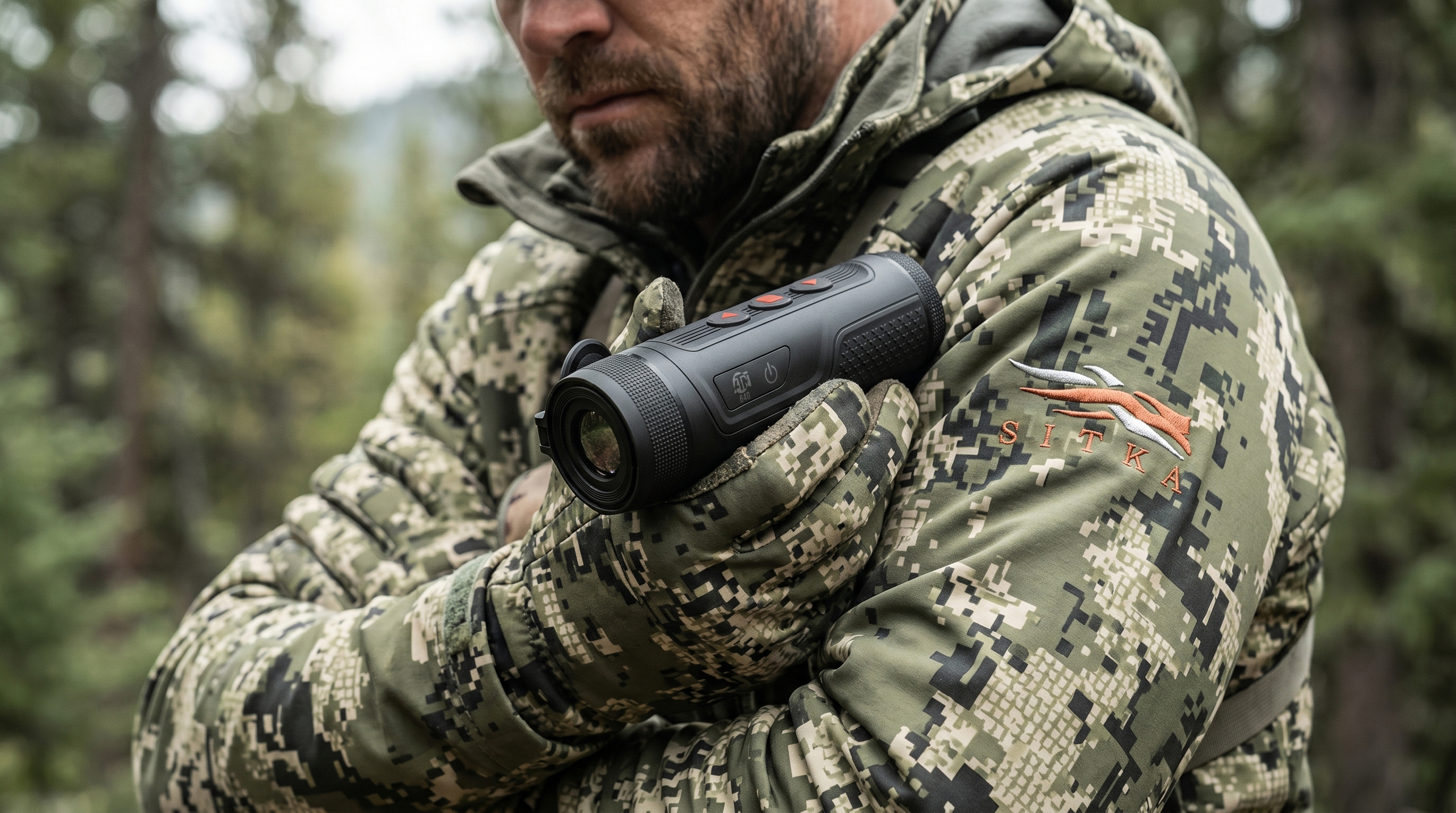
Do not do both jobs with one optic. A rifle scope is a poor search tool, and swinging a rifle to check a noise is movement a coyote will catch. The monocular does the wide, fast work — broader field of view, a 180-degree sweep in seconds, no need to lift the gun. The scope does the narrow, precise work — magnification, a reticle, a hold you confirmed on paper. Scan, identify, set the rifle, confirm through the scope. That order keeps you from being caught mid-swing at 90 yards.
Key features to understand in a night predator hunting setup
- Sensor resolution. The ThOR 6 640 uses a 640×512 sensor. Extra pixels let you tell a coyote from a house cat at 200 yards instead of just seeing something warm.
- NETD. The scope is rated ≤15mK, the BlazeTrek 6 640 monocular ≤18mK. Lower numbers separate small temperature differences — what you need when the whole field is cold.
- Field of view. The scope gives 12.52° × 9.41°, narrow and detailed. The monocular gives 17.5° × 14°, wide enough to search. That gap is the argument for carrying both.
- Detection range. Rated 3,100 m for the scope, 1,300 m for the monocular. Detection is not identification, but it means spotting movement across a picked section is realistic.
- Refresh rate. Both run 50 Hz, so a coyote trotting across your lane stays smooth instead of smearing.
- Color palettes. Six on each: White Hot, Black Hot, Iron Red, Alarm, Green Hot, Sepia. I run Black Hot over snow, White Hot over bare stubble.
- Battery format. One internal plus one replaceable 18650 for about 9 hours on the scope; an internal pack good for about 6.5 hours on the monocular. Cold shortens both.
Why thermal optics change night calling
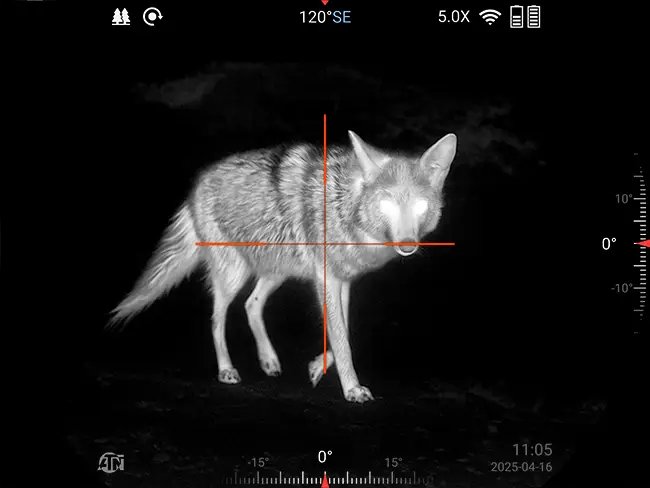
With a light and a red lens, you learn a coyote exists the moment it enters the beam — usually at 80 yards, usually already suspicious. With thermal you watch the whole approach: it breaks the tree line at 400 yards, swings downwind at 250, and you choose whether to let it keep coming or take the shot it is offering. You also see the second animal, which in late fall there very often is. Those extra minutes matter more in December than any other month, because that is when coyotes come in pairs and take their time.
What to look for before you buy
Match the optic to your ground. For cut fields and pasture with shots from 150 to 300 yards, a 640 sensor behind a 35 mm lens balances magnification against field of view well. If every shot is inside 100 yards of thick country, you are paying for reach you will not use. Check the mounting standard — the ThOR 6 640 takes 30 mm rings, not included. Confirm the recoil rating suits your rifle; this one is rated to 6,000 joules. And decide honestly whether you will carry two devices. If not, buy the scanner first: finding coyotes is the harder half.
Common mistakes on late-fall stands
- Sitting where the downwind side is cover. They circle into it, wind you, and leave unseen.
- Opening loud. The closest coyote is the one you blow out.
- Leaving too early. Twelve-minute stands work in September; in December, give it 25 to 30.
- Staying on prey distress into breeding season. By December, vocalizations often outperform food sounds.
- Cold batteries. A dead optic 40 minutes into a five-hour night ends the night.
- Shooting at heat instead of an identified animal. Zoom in and confirm the shape first. Every time.
The setup I run: ATN ThOR 6 640x512 | 2-16x
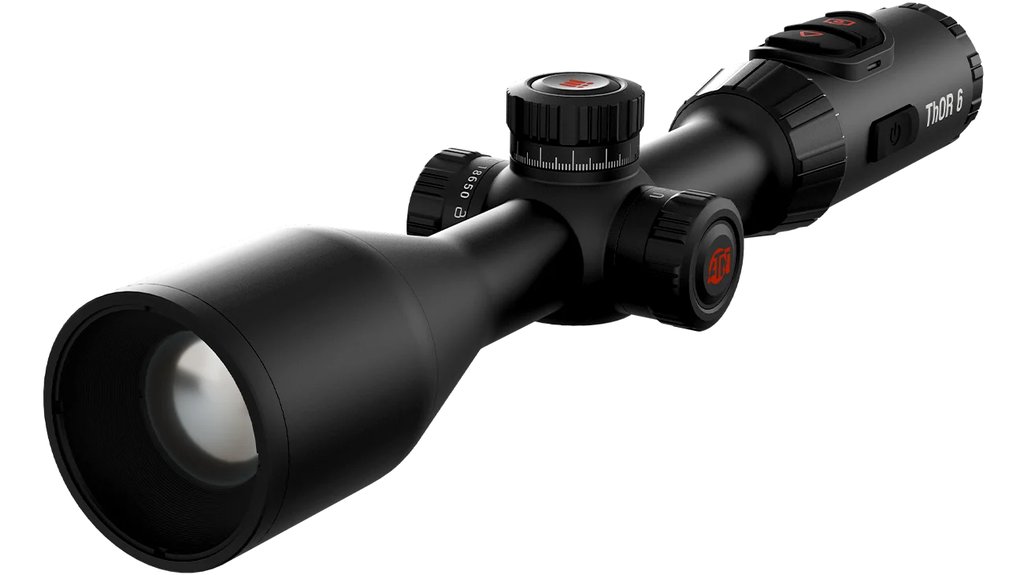
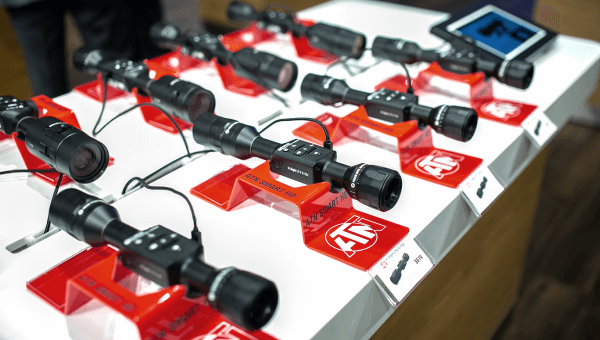
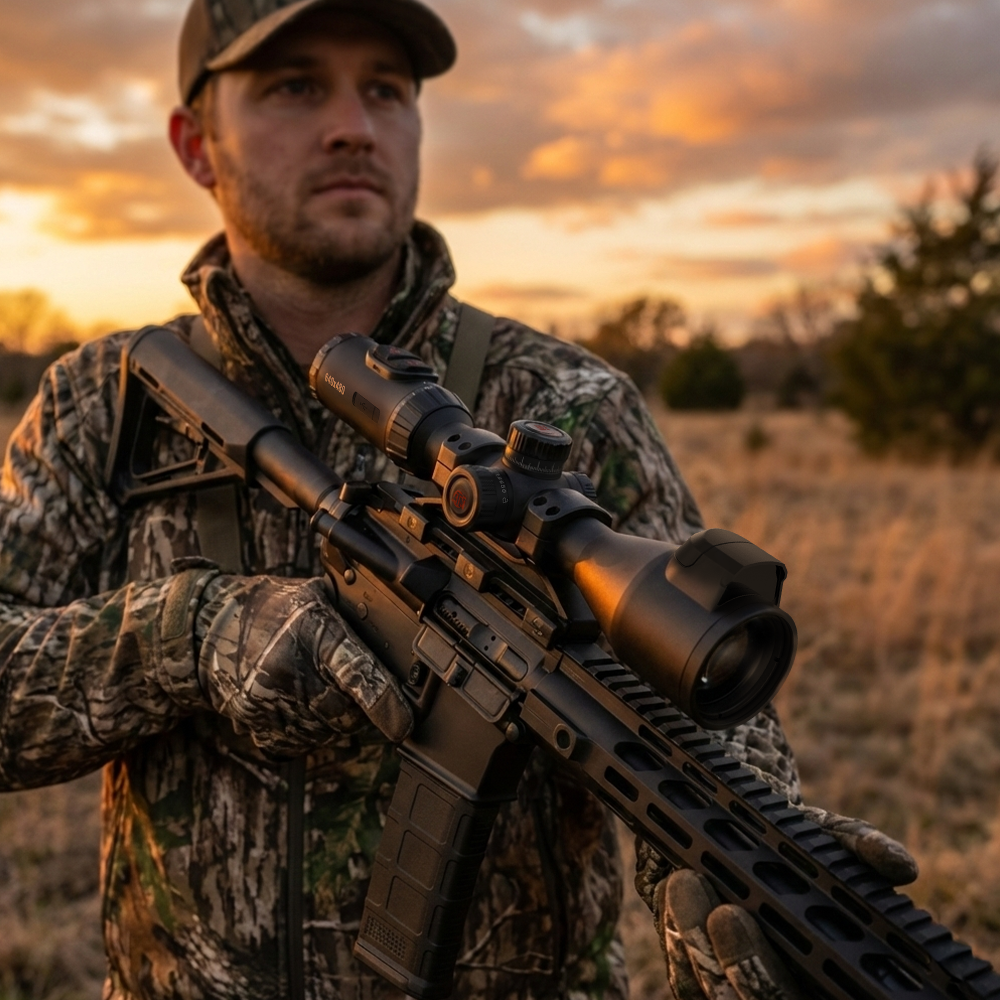
The ATN ThOR 6 640x512 | 2-16x (SKU TIWST6635A, $2,295.00) is what I keep on the rifle. The 640×512 sensor at ≤15mK gives identification at calling distance rather than a warm blob, and 2-16× covers a 60-yard surprise and a 250-yard fence line without changing anything on the gun. Three features earn their keep in the cold: Zeroing Freeze holds the image at the moment of impact so you can dial the reticle without rushing, Hot Point Tracking flags the hottest object in view while you sweep stubble, and Recoil Activated Video saves ten seconds either side of the shot to 64 GB of internal storage. It runs about 9 hours on one internal plus one replaceable 18650, weighs 830 g / 1.83 lbs in magnesium alloy, is rated IP67, and works to -30°C. No built-in rangefinder on this model, so bring one.
In my off hand is the ATN BlazeTrek 6 640x512 | 1.75-14x thermal monocular, listed as the BlazeTrek 625 (SKU TIMNBLT625G6, $2,085.00) — 640×512 at ≤18mK, 25 mm lens, 17.5° × 14° field of view, 1.75-14×, 320 g / 0.7 lb in a jacket pocket. Both connect to the ATN Connect 6 app over Wi-Fi. For more on picking a handheld, see our guide to the best thermal scanner for coyote hunting.
Is this late-fall coyote hunting setup worth it?
If you hunt coyotes more than a handful of nights a season on open ground, yes. Two 640 devices is real money, and it pays back in stands that produce instead of stands where something circled you unseen. It is not for you if you go out three nights a year, if every shot is inside 75 yards of timber, or if you will not carry and charge two devices. For December pairs on picked fields, this is the pairing I would build again.
Frequently asked questions
What is the best time of night to call coyotes in late fall?
The first three hours after full dark and the last two before dawn are most productive in November and December. Cold, clear nights keep animals moving throughout, so mid-night stands are worth running when temperatures drop hard.
Should I use prey sounds or coyote vocalizations in November and December?
Use prey distress early in the period and shift toward coyote vocalizations as breeding season approaches. By December, challenge howls and female invitation sounds pull pairs that ignore rabbit distress entirely. Run prey sounds first, then switch rather than raising volume.
How long should I stay on one stand?
Twenty-five to thirty minutes in late fall. Cold-weather coyotes frequently come from several hundred yards out and approach slowly, so short stands leave animals still on the way in. Then move at least a mile before setting up again.
Do I need both a thermal monocular and a thermal scope?
Not strictly, but the pair works far better. A monocular scans wide and fast without moving your rifle, while the scope supplies magnification and a reticle for the shot. If you buy one first, buy the handheld — finding coyotes is the harder task.
Does cold weather hurt thermal performance?
Cold generally helps image contrast, since a warm animal stands out more against frozen ground. What cold does hurt is battery runtime. Keep a spare 18650 inside your jacket and expect shorter sessions than the rated 9 hours.
Late-fall nights are the ones worth planning a season around: long, cold, and full of coyotes that answer if you set up correctly. Get the wind right, start quiet, sit longer than feels comfortable, and let the thermal show you the approach instead of the arrival. If you are building that setup, look at the ATN ThOR 6 640x512 | 2-16x or browse the full ATN thermal rifle scope lineup, and see our broader guide to thermal coyote hunting.
Quick reference: ATN ThOR 6 640x512 | 2-16x
- SKU: TIWST6635A
- Sensor: 640×512, 12μm VOx, ≤15mK NETD, 50 Hz
- Lens and field of view: 35 mm (Ge) F/1.0, 12.52° × 9.41°
- Magnification: 2-16×, plus 8× digital zoom
- Detection range: 3,100 m
- Battery: 1 internal + 1 replaceable 18650, ~9 hrs
- Weight: 830 g / 1.83 lbs, magnesium alloy, IP67
- Price: $2,295.00