Which job you are doing outdoors decides how you should set up thermal binoculars, so this guide is organized by use case rather than by brand or price. If you are scanning wide ground for predators, glassing a distant hillside for big game, watching over a property line, or observing wildlife after dark, each task rewards a different balance of field of view, magnification, and ranging. Throughout, the recommended tool is the ATN Binox-6 Dual 640x512 3-24x, a 6th-generation multispectral unit flexible enough to cover all of these jobs from one housing.
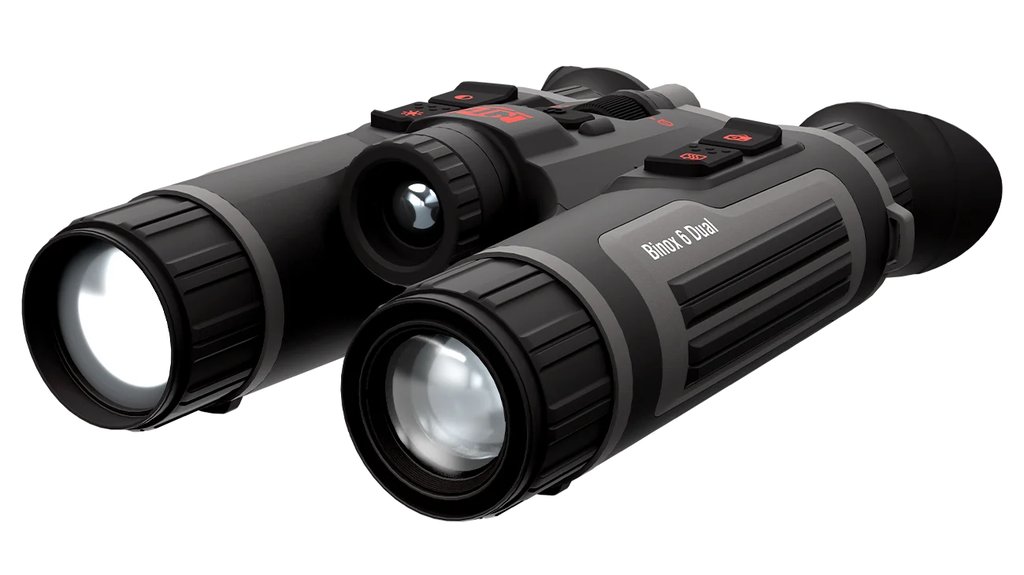
Outdoor thermal binoculars are handheld, two-eyed optics that build an image from the heat objects give off instead of from visible light, so warm bodies stand out against cooler ground in total darkness, light haze, or brush. Unlike a rifle-mounted thermal, they are made for two-handed observation and long comfortable scanning, and modern units like the ATN Binox-6 add a full-color day sensor and a laser rangefinder so one device answers both what is out there and how far away.
How thermal binoculars work
Every object above absolute zero radiates infrared energy, and a thermal sensor reads that energy rather than reflected light. The sensor's grid of tiny detectors measures small temperature differences across the scene and paints them as a live picture, which is why a warm animal glows clearly against colder grass or timber even on a moonless night. Two numbers describe how sharp and how sensitive that picture is: the sensor resolution, given as a pixel count such as 640x512, and the thermal sensitivity or NETD, measured in millikelvin, where a lower figure means the optic can separate faint heat differences instead of washing them into one flat blur.
The Binox-6 pairs a 640x512 thermal core with an NETD of 15 mK or better, so subtle edges — the line between an animal's body and the ground, or a person half-hidden by brush — stay visible. It layers a 4K day sensor on top of the thermal channel, giving four viewing modes in one unit: full-color day, low-light twilight, night with an infrared illuminator, and thermal. Because it is binocular rather than monocular, both eyes share the load and you can glass for long stretches without the eye strain a single-tube device causes.
Thermal binoculars by outdoor use case
The same pair of binoculars behaves very differently depending on the task, mainly in how much you zoom, how wide you keep the view, and how often you range. Below are the four outdoor jobs these optics get used for most, and how to run the Binox-6 for each.
Predator and coyote hunting
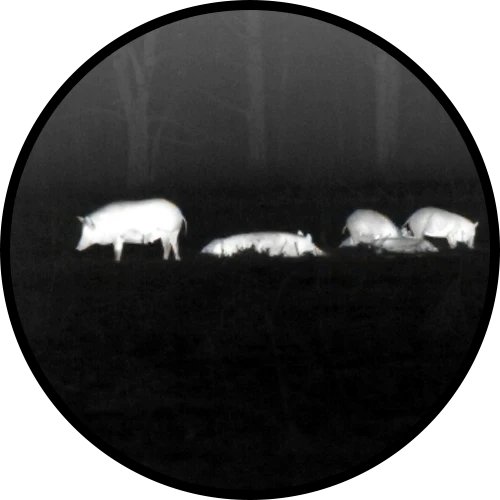
Calling predators is a scanning game. Coyotes and hogs approach from unpredictable angles and rarely give you long, so you want the widest thermal view you can hold and only zoom once you have located a heat signature. Stay near the base 3x setting on the Binox-6 Dual 640 3-24x to keep the largest slice of ground under watch, then push magnification up to confirm what you are seeing. Its detection reach of roughly 3100 meters means a body's heat registers as a bright dot long before it is in range, and the built-in laser rangefinder lets you check distance without dropping the glass. For this job the wide-then-zoom rhythm matters more than raw power.
Big-game glassing and deer observation
Glassing a far ridge or field edge at first and last light is where magnification earns its keep. Here you are not sweeping fast; you are studying one area, picking a warm shape out of the timber and judging whether it is worth the walk. Zoom the Binox-6 up toward the top of its 3-24x range once you have a target area, and lean on the day sensor when there is enough light to read antlers or body detail that a pure thermal cannot resolve. If your typical glassing distances are long and you almost never scan close cover, the support option — the Binox-6 Dual 384x288 5.5-44x — trades some scanning width for a taller 44x magnification ceiling that suits patient, far-off study.
Property watch and security
For keeping an eye on a property line, a barn, or livestock after dark, thermal binoculars beat a light or a day camera because heat gives away movement no floodlight would catch, and nothing you do announces that you are watching. Run the Binox-6 wide so a fence line or field stays in frame, and use the GPS and compass to note exactly where activity appeared so you can describe or return to a spot. The rangefinder turns a vague far corner into a precise distance, and the roughly eight-hour runtime on replaceable 18650 cells covers a full night, with spares letting you keep going indefinitely.
Wildlife watching and search
For nature observation, night surveys, or helping locate a person or a downed animal, the priority is picking faint or partly hidden heat out of a busy background — exactly what a low NETD is for. Keep magnification modest so you cover ground quickly, then zoom to identify. The Binox-6's SharpIR image enhancement, DeFog mode, and Wide Dynamic Range help hold a usable picture through mist, dew, and mixed-temperature scenery where a lesser sensor would smear. Because both eyes are engaged, long observation sessions stay comfortable, which matters when a search runs for hours.
Key features that shape each job
- Sensor resolution: a 640x512 core, as on the lead Binox-6, gives more detail per frame than a lower-count sensor, so distant shapes are easier to identify rather than merely detect.
- Thermal sensitivity (NETD): 15 mK or better lets the optic pull faint heat differences out of clutter — vital for search and for wildlife half-buried in brush.
- Magnification range: a wide base (3x) favors scanning for predators and security; a tall ceiling (up to 24x here, 44x on the support model) favors patient long-range glassing.
- Laser rangefinder: the 1000 m, plus or minus 1 m unit removes distance guesswork on the spot, useful for every use case that involves judging a shot or a location.
- Multi-mode 4-in-1 viewing: day, twilight, night with IR, and thermal in one housing means the same tool works across changing light instead of forcing a swap.
- Runtime and power: roughly eight hours on two replaceable 18650 batteries covers long sits, and swappable cells keep an all-night watch alive.
What to look for when choosing
Start from the job, not the spec sheet. If most of your time is spent sweeping wide ground for moving animals, prioritize a wide field of view and a strong NETD over a huge zoom number. If you mostly study distant, static targets, weight the magnification ceiling more heavily. Detection range tells you how far a heat source first appears, but identification range — how far you can actually tell what it is — is always shorter and rises with sensor resolution, which is why the 640 core is the more versatile all-rounder. Finally, check power: replaceable batteries and a realistic runtime decide whether the optic lasts your outing.
Common mistakes to avoid
- Scanning at high zoom. Cranking magnification narrows the view so much that animals slip past unseen; scan wide and zoom only to identify.
- Chasing detection numbers alone. A big detection figure means little if resolution is too low to identify what you found — match resolution to how far you truly need to recognize targets.
- Ignoring thermal sensitivity. In mist, dew, or thick brush a poor NETD flattens the scene; a lower-mK sensor is what keeps faint heat readable.
- Forgetting to range. Guessing distance undoes a good sighting; use the built-in rangefinder so location and shot decisions are based on a real number.
- Running dead batteries. Head out without charged spare 18650 cells and a long sit ends early — carry backups.
A worked example
Say you are watching a cut field for coyotes coming to a call, then plan to glass the far tree line for deer at last light. Start on the Binox-6 at its base 3x, sweeping the whole field in thermal so any warm body shows as a bright mark against the cool stubble. A signature appears at the field's edge; you ping it with the laser rangefinder and read a real distance instead of guessing, then zoom in to confirm it is a coyote and not a stray dog. Later, as light fades toward the timber, you switch to the twilight or day mode to read antler detail on a distant buck the pure thermal channel would only show as a warm blob, using the higher end of the zoom range to study it. One device, one outing, several jobs — handled by changing how you run it, not by carrying three optics.
Is a thermal binocular worth it?
If your outdoor life involves finding warm targets in the dark — hunting, security, wildlife work, or search — a capable thermal binocular changes what is possible more than almost any other piece of gear, because it works where lights and day optics simply cannot. The flagship-tier Binox-6 Dual 640 3-24x justifies its place by being a genuine all-rounder: wide enough to scan, sharp enough to identify, and equipped with ranging, day vision, and navigation so it replaces several single-purpose tools. It is a real investment, so the honest test is whether you spend enough time in low light across varied jobs to use its breadth; for occasional, single-task use a narrower device may be plenty. Browse the full thermal binoculars range to compare where each fits.
How this guide was put together
This is an in-house explainer from ATN, not an independent laboratory review, so read it as a plain walk-through of how our own current optics map to real outdoor jobs. We judged each unit against the use cases above using the specifications that actually decide performance in the field: sensor resolution for identification, NETD for pulling faint heat out of clutter, detection range against realistic distances, the everyday usefulness of the laser rangefinder and the 4-in-1 multi-mode viewing, and battery runtime for long sessions. Only the current 6th-generation Binox-6 line was considered — no older or discontinued models. Honestly, these optics are not for everyone: if you only ever glass in daylight, want the lightest pocket monocular, or need a rifle-mounted sight rather than a two-handed observation tool, this class is the wrong pick. Treat the recommendations as a starting point and check the numbers against the specific ground and distances you hunt or watch.
Frequently Asked Questions
What is the difference between thermal binoculars and a thermal monocular?
Binoculars use both eyes, which cuts strain during long scanning and observation, while a monocular is lighter and more pocketable but tires one eye faster. For extended outdoor watching — glassing, security, search — the two-eyed comfort of a binocular like the Binox-6 is the practical advantage.
Do thermal binoculars work in daylight?
Yes. Thermal reads heat, not light, so it works day or night. The ATN Binox-6 goes further with a 4-in-1 design that adds a 4K day sensor and a twilight mode, so you get full-color detail in daylight and heat detection after dark from the same unit.
How far can the ATN Binox-6 detect a target?
The Dual 640 3-24x has a detection range of roughly 3100 meters, meaning a warm body first registers as a bright signature around that distance. Identification — actually telling what it is — happens closer, and improves with the higher-resolution 640 sensor.
Which Binox-6 is best for scanning versus long-range glassing?
For wide scanning during predator hunting or security, the Dual 640 3-24x is the better all-rounder thanks to its wide base view and 640 resolution. For patient, far-off study the Dual 384 5.5-44x trades scanning width for a taller 44x magnification ceiling.
Does a lower NETD number really matter outdoors?
It does, especially in mist, dew, or brush where heat differences are subtle. An NETD of 15 mK or better, as on the Binox-6, lets the optic separate a faint body from a busy background instead of smearing everything into one flat gray image.
How long does the battery last on a night out?
The Binox-6 runs about eight hours on two 18650 cells, which covers most nights. Because the batteries are replaceable, carrying charged spares lets you keep an all-night property watch or search going without interruption.
Can I range a target without lowering the binoculars?
Yes. The Binox-6 has a built-in laser rangefinder good to 1000 meters at plus or minus one meter, so you read an exact distance while still looking through the optic — no guessing and no swapping to a separate rangefinder.
Quick reference specs: ATN Binox-6 Dual 640 3-24xThermal sensor 640x512 with a 4K day CMOS; NETD 15 mK or better; magnification 3-24x; detection range about 3100 m; thermal lens 35 mm F/1.0 and day lens 55 mm F/2.0; built-in laser rangefinder to 1000 m at plus or minus 1 m; 4-in-1 day, twilight, night-with-IR and thermal viewing; GPS, compass, SharpIR, DeFog and Wide Dynamic Range; roughly 8 hours on two replaceable 18650 cells; weight about 730 g (1.61 lbs).
Ready to match the optic to the job? Explore the ATN Binox-6 Dual 640 3-24x or compare the full thermal binoculars lineup to find the right fit for how you hunt, watch, or search.
Created: August 5, 2026 · 19:53:43 UTC