The ground you glass decides what the cheapest thermal binoculars actually need to be. Wide-open plains punish a pair with no reach — you're straining to inspect a signature a long way off. Wooded edges do the opposite, throwing warm trunks and cool shade at you in a cluttered mess. Hilly draws hide heat behind folds of terrain and demand you range across changing distances. A truly affordable pair has to hold up on all three without you paying for the flagship. That's why this roundup leads with the most affordable of the two Binox-6 variants, the ATN Binox-6 Dual 384x288 5.5-44x, and walks through how it handles each kind of country. The ATN Binox-6 Dual 384x288 5.5-44x is the featured pick.
Best for sharpest detail everywhere: ATN Binox-6 Dual 640x512 3-24x — the higher-resolution 640 sensor when you want the finest picture on every kind of ground.
Why ATN's 6th-gen thermal binoculars adapt to any terrain
A pair of thermal binoculars adapts to terrain when its picture stays honest whether the ground is bare, cluttered or broken. Both Binox-6 variants are built for that. A NETD rated at 15 mK or lower — the smallest temperature difference the sensor can resolve — is what lets you peel a warm animal out of warm woods or off a cold plain; the lower that number, the less the terrain can hide from you. SharpIR AI sharpens edges so a signature keeps its shape as the background changes, and a wide magnification range lets you go from a broad wooded scan to a tight look at a distant plain. A built-in laser rangefinder good to 1000 m handles the shifting distances of hilly country, and the 4-in-1 day/night/thermal/twilight design means the same pair works from a bright plain to a shaded draw.
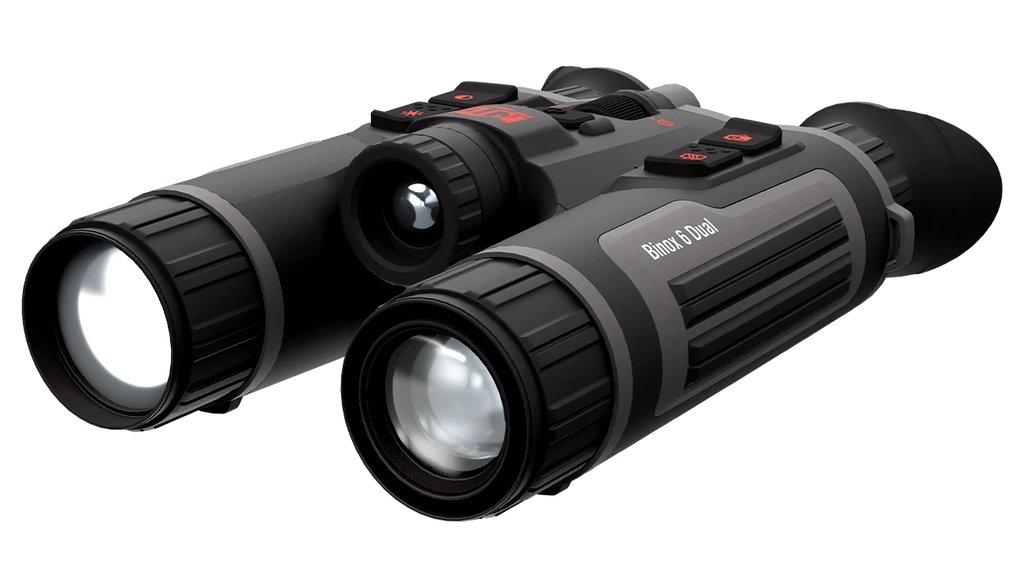
ATN Binox-6 Dual 384x288 5.5-44x — cheapest pair that handles the terrain
This is the affordable pair I'd trust to move between country types. The ATN Binox-6 Dual 384x288 5.5-44x runs a 384x288 thermal sensor, keeping it in the lowest tier of the two, and pairs it with the family's highest top-end magnification at 44x. On mixed ground, that reach plus a light 720 g body is exactly what lets a budget pair keep up. Terrain rarely stays one thing for long — you cross a plain, drop into timber, then work a draw within the same outing — so an affordable pair has to shift gears with you rather than only shining in one setting. This one does, and the weight savings matter more than they sound when you're carrying it across broken country all day.
Open plains: reaching out with high magnification
Bare plains are all about distance. When a signature sits far across a flat expanse, 44x magnification lets you inspect it without walking the ground, and a 2750 m detection range means you catch it early. High magnification only helps if the picture holds together as you zoom, and SharpIR AI does that work so the enlarged image stays usable instead of turning grainy. On truly open ground the animal you're after often shows up as a small warm mark on a wide, empty background, so being able to push in and study that mark without it dissolving is the difference between a confident read and a shrug. Range it with the built-in finder and you also know whether it sits inside your comfortable working distance or well beyond it.
Wooded edges: cutting a warm body out of clutter
Timber and brushy edges throw a confusing mix at the sensor — sun-warmed trunks, cool shade, tangled cover. Here the ≤15 mK NETD earns its keep, holding the small temperature separation that lifts a warm animal out of warm woods. Dial the magnification back down toward its 5.5x base for a wider view so you catch movement in the clutter instead of tunneling in on one spot.
Hilly draws: ranging across broken ground
Draws and folds hide heat and stretch distances unpredictably. The built-in laser rangefinder reads out to 1000 m so you can range a signature tucked in a fold and know whether it's near or far before you move. Twilight mode helps in the deep shade of a draw, and the compass and GPS let you keep your bearings when the terrain gets confusing.
Who it's for / not for
It's for the buyer who covers varied country on a budget and wants a light, affordable pair with real reach and ranging. It's not the pick when you need the finest possible detail on every ground type — the 640 lead resolves more, especially far out on open plains.

ATN Binox-6 Dual 640x512 3-24x — sharpest detail across terrain
When you want the crispest picture on every kind of ground and will pay for it, the ATN Binox-6 Dual 640x512 3-24x steps up. Same 4-in-1 design, same 1000 m rangefinder, same 6th-gen processing — but a full 640x512 thermal sensor. The extra pixels work like a higher-megapixel camera: finer detail, so a signature on a far plain or in a shaded draw reads clearly instead of as a soft shape.
Where the sharper sensor changes the terrain game
On open plains the 640's detail lets you identify a distant signature, not just spot it, and a 3100 m detection range gives it a touch more reach. In the woods, the sharper picture separates a warm body from clutter with less ambiguity. The trade is a lower top magnification of 3-24x versus the 384's 44x, so it inspects a far plain at less zoom — but every pixel it shows you is finer. For detail-first buyers on varied ground, that's the ATN Binox-6 Dual 640x512 3-24x to reach for.
Who it's for / not for
For the buyer who prioritizes the sharpest identification across every terrain and accepts the higher tier. Not for the budget-capped shopper who wants maximum reach for the least money — the 384 5.5-44x zooms farther and costs less.
How to choose the cheapest thermal binoculars by terrain
Match the pair to the ground you cross most. The terrain decides whether reach, clutter-cutting sensitivity, or ranging matters most to you.
- Open plains — favor magnification and detection range; the 384's 44x reaches distant signatures affordably.
- Wooded edges — lean on low NETD and a wide base view to cut a warm body out of cluttered cover.
- Hilly draws — insist on the 1000 m rangefinder to handle shifting distances across broken ground.
- Detail on every ground — the 640 3-24x gives the sharpest identification across all three terrains.
- Mixed country on a budget — the light, affordable 384 5.5-44x adapts across terrain for the least money.
How we picked these ATN thermal binoculars
This is an in-house comparison of ATN's own current binocular range, not an independent lab review. We considered only the 6th-gen Binox-6 family and judged each pair on one terrain question: how affordably can it stay useful as the ground shifts from bare plain to cluttered woods to broken draw?
- Magnification range — reach for distant plains, where the 384's 44x top end stretches farthest for the price.
- NETD (thermal sensitivity) — both ≤15 mK, the smallest temperature difference the sensor sees, for cutting heat out of cluttered woods.
- Ranging — a 1000 m laser rangefinder on both, essential across the changing distances of hilly ground.
- Sensor resolution — more pixels for finer identification across terrain, where the 640 pulls ahead.
- Weight and battery — a light body for covering country and ~8 hrs on swappable 18650 cells.
Honest trade-offs: the 384 5.5-44x is the most affordable and reaches farthest on open plains, but its 384 sensor gives up fine detail compared with the 640, most noticeably far out. The 640 3-24x is sharper on every terrain yet costs more and zooms less, so it inspects a distant plain at lower power. Neither pair is right for someone who only wants a daytime binocular — these are thermal tools. Weigh the ground you actually cross against your budget before you buy.
Frequently Asked Questions
Which ATN Binox-6 is the cheapest thermal binoculars for mixed terrain?
The ATN Binox-6 Dual 384x288 5.5-44x. It is the most affordable of the pair and adapts across terrain: up to 44x magnification for open plains, a low NETD for cutting a warm body out of cluttered woods, and a 1000 m rangefinder for the shifting distances of hilly draws.
What matters most for glassing open plains?
Reach. On bare, flat ground a signature can sit a long way off, so magnification and detection range decide how well you can inspect it. The 384x288 5.5-44x tops out at 44x, the highest in this pair, which makes it strong on open country for the money.
How do thermal binoculars perform in the woods?
Wooded edges throw warm trunks and cool shade at the sensor, so a low NETD is key. Both Binox-6 variants are rated ≤15 mK, the smallest temperature difference they can resolve, which lets you separate a warm animal from warm clutter. Dropping to a wider base magnification also helps you catch movement.
Why is a rangefinder useful in hilly draws?
Broken ground hides heat behind folds and stretches distances unpredictably, so guessing range is risky. Both variants carry a built-in laser rangefinder good to about 1000 m, so you can range a signature tucked in a draw and know whether it is near or far before you move.
Is the cheaper 384 sensor good enough across all terrain?
Yes, for most real use. It keeps the same NETD, rangefinder and 4-in-1 modes, so it stays useful on plains, in woods and in draws. It gives up some fine detail at extreme range compared with the 640, which is the trade for its lower price and higher magnification.
How long do these binoculars last in the field?
Both variants run about 8 hours on two 18650 cells and let you swap fresh cells while you are out. That covers a long day crossing varied country without leaving you without eyes when the terrain gets interesting.
If you cover varied country and want the cheapest thermal binoculars that still perform from open plains to wooded edges to hilly draws, start with the affordable ATN Binox-6 Dual 384x288 5.5-44x — a light value pick with 44x reach and a built-in rangefinder. When detail across every terrain matters most, the ATN Binox-6 Dual 640x512 3-24x steps up with the sharper 640 sensor. Compare both, spec by spec, on the ATN thermal binoculars collection and match the pair to the ground you actually cross.
Created: August 5, 2026 · 19:53:42 UTC