There's cheap, and then there's cheap enough to regret. The temptation with the cheapest thermal binoculars is to chase the lowest number and end up with a fuzzy toy that can spot a warm blob but can't tell you what it is, how far off it is, or let you save what you saw. A pair only counts as worth owning if it still does the four things that make thermal useful: detect heat reliably, let you identify what's out there, range the distance, and record the moment. Judged on that bar, the affordable end of ATN's range holds up — and the lead here, the ATN Binox-6 Dual 640x512 3-24x, shows what the cheapest genuinely useful pair looks like.
Most affordable that still qualifies: ATN Binox-6 Dual 384x288 5.5-44x — a lower tier that keeps detect, ID, range and record while adding high-magnification reach.
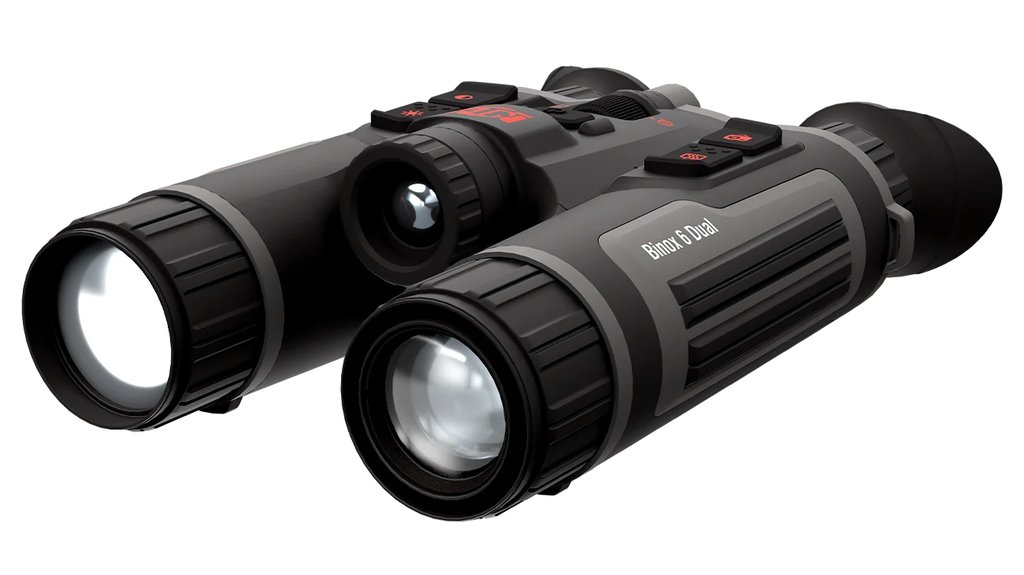
Why ATN's 6th-gen thermal binoculars clear the bar at a low price
The reason these affordable Binox-6 variants still count as worth owning is that they don't cut the core capability to hit a price. Both carry a NETD rated at 15 mK or lower — NETD is the smallest temperature difference the sensor can resolve, and a lower number means the sensor reliably picks a warm animal out of cool surroundings instead of losing it. SharpIR AI cleans edges so what you detect is sharp enough to identify. A built-in laser rangefinder good to 1000 m answers the how-far question. And onboard recording with a 4K day sensor lets you save clips and stills of what you found. That's detect, identify, range and record — the four jobs a real thermal binocular owes you — none of them stripped out to make it cheap.
ATN Binox-6 Dual 640x512 3-24x — the cheapest pair that does every job sharpest
If "cheapest worth owning" means the least you can spend and still cover all four jobs without compromise, the ATN Binox-6 Dual 640x512 3-24x is the reference point. Its full 640x512 thermal sensor is the difference between a picture you have to interpret and one you can trust. More pixels work like more dots in an image: the more you have, the finer the detail, so a signature at distance keeps its shape instead of dissolving.
Detect: not missing what's out there
Detection is job one, and the 640 sensor's low NETD plus a fast 35 mm F/1.0 germanium lens make sure faint heat doesn't slip past you. A 3100 m detection range means you're catching signatures well before they're on top of you, and SharpIR AI keeps the whole field readable rather than noisy. A cheap pair that misses half of what's out there isn't cheap, it's useless, and reliable detection is the first thing a bargain pair has to prove before anything else it does matters. This one proves it, which is why it earns the label of cheapest worth owning rather than just cheapest.
Identify: knowing what you found
Detecting a blob isn't enough if you can't tell what it is. This is where the 640 resolution pays for itself — the extra pixels let you resolve whether that heat is a deer, a dog, or a person, and whether it's one animal or several. A cheaper, softer sensor forces guesswork; this one lets you actually identify before you act.
Range and record: distance and proof
The built-in laser rangefinder reads out to 1000 m with tight accuracy, so "how far?" gets a real answer, not a guess. And with the 4K day sensor and onboard recording you can capture stills and video of what you saw — useful for scouting logs, sharing, or simply confirming later. GPS and a compass round out the picture. For a pair this affordable to do all four jobs cleanly is the whole argument for the ATN Binox-6 Dual 640x512 3-24x.
Who it's for / not for
It's for the buyer who refuses to pay for a pair that only half-works and wants the cheapest that nails detect, ID, range and record. It's not for someone whose top priority is squeezing the highest magnification onto distant open ground — the 384 5.5-44x reaches farther in zoom.
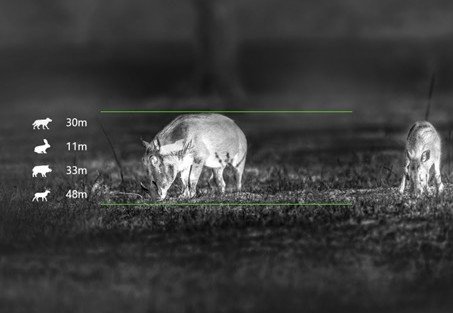
ATN Binox-6 Dual 384x288 5.5-44x — the most affordable pair that still qualifies
The ATN Binox-6 Dual 384x288 5.5-44x drops to the lowest tier of the pair by using a 384x288 thermal sensor, and it still clears the four-job bar. It's the lightest at 720 g, and it swaps some of the 640's fine detail for the highest top-end magnification in the family at 44x. If your budget is the hard limit, this is where the line between "cheap" and "cheap but capable" holds.
What still passes the bar at the lowest tier
You still get all four jobs. Detection stays strong thanks to the same ≤15 mK NETD; identification is solid at practical ranges even if the 640 edges it out far out; the same 1000 m laser rangefinder handles distance; and the same 4K day sensor and recording save what you find. A 2750 m detection range and 44x reach mean the value pick isn't just cheaper — it's genuinely useful. That's the line that matters when you shop the bottom of the price ladder: a pair either keeps all four jobs or it quietly drops one to hit the number, and this one keeps them. The higher magnification is a bonus on top, letting you inspect a distant signature you've detected and ranged before deciding whether it's worth your time.
Who it's for / not for
For the budget-capped buyer who wants a real, four-job thermal binocular and values reach through high magnification. Not for someone who needs the finest identification detail at extreme range — the 640 lead resolves more far out.
How to choose the cheapest thermal binoculars worth owning
Don't shop the price tag alone; shop the four jobs. A pair that skips any of them isn't a bargain, it's a disappointment waiting to happen.
- Detect — demand a low NETD so faint heat doesn't slip past; both variants are ≤15 mK.
- Identify — favor resolution; the 640 3-24x resolves what a signature actually is at distance.
- Range — insist on a built-in rangefinder; both read distance to 1000 m.
- Record — a 4K day sensor and onboard recording let you save stills and clips on either pair.
- Budget-first — the 384 5.5-44x holds all four jobs at the lowest tier while adding 44x reach.
How we picked these ATN thermal binoculars
This is an in-house comparison of ATN's own current binocular range, not an independent lab test. We looked only at the 6th-gen Binox-6 family and applied one honest standard: is this the cheapest a pair can be while still doing everything a thermal binocular is bought to do?
- Core capability retained — whether the pair still detects, identifies, ranges and records at its price.
- Sensor resolution — more pixels means finer detail and truer identification, where the 640 leads.
- NETD (thermal sensitivity) — both ≤15 mK, the smallest temperature difference the sensor sees, so detection stays reliable.
- Ranging and recording — a 1000 m rangefinder and 4K recording on both, so nothing essential is cut for price.
- Weight and battery — carry comfort and ~8 hrs on swappable 18650 cells for real field use.
Honest trade-offs: the 640 3-24x does every job the sharpest but sits at the higher tier of the pair, so its extra detail is wasted on someone who only ever spots close and never needs to identify far out. The 384 5.5-44x is the most affordable and still clears the bar, but gives up fine detail at extreme range in exchange for its lower price and 44x reach. Neither is right for a buyer who only wants a daytime binocular — these are thermal tools. Weigh the four jobs against your budget before you commit.
Frequently Asked Questions
What should the cheapest thermal binoculars still be able to do?
Four things: reliably detect heat, let you identify what you found, range the distance to it, and record the moment. Both ATN Binox-6 variants keep all four at their price, which is what separates a cheap-but-capable pair from a fuzzy toy that only spots blobs.
Which ATN Binox-6 does every job best?
The ATN Binox-6 Dual 640x512 3-24x. Its full 640 thermal sensor gives the sharpest detection and identification, its built-in laser rangefinder answers distance to 1000 m, and its 4K day sensor records stills and clips. It is the cheapest pair that covers all four jobs without compromise.
Is the 384x288 pair actually worth owning, or too cheap?
It is worth owning. The 384x288 5.5-44x keeps the same ≤15 mK NETD, the same 1000 m rangefinder and the same 4K recording, so it still detects, identifies, ranges and records. It gives up some fine detail at extreme range compared with the 640, which is the trade for its lower tier.
Why does resolution matter for identifying what you see?
Detection only tells you something warm is out there; identification tells you what it is. More pixels resolve finer detail, so the 640x512 sensor lets you tell a deer from a dog or one animal from two at distance, where a lower-resolution sensor would leave you guessing.
Can these thermal binoculars record what I see?
Yes. Both Binox-6 variants have a 4K day sensor and onboard recording, so you can capture stills and video of what you detect. That is useful for scouting logs, sharing a sighting, or confirming later what you were looking at.
How far can the cheaper pair still detect and range?
The 384x288 5.5-44x has a detection range of about 2750 m and a built-in laser rangefinder good to roughly 1000 m. That covers realistic distances for scouting and observation while keeping it in the most affordable tier of the pair.
If you want the cheapest thermal binoculars that still detect, identify, range and record without cutting corners, start with the ATN Binox-6 Dual 640x512 3-24x — the sharpest all-four-jobs pair in the lineup. If budget is the hard limit, the 384 5.5-44x holds the same core capability at the lowest tier while adding 44x reach. Compare both, feature by feature, on the ATN thermal binoculars collection and make sure the pair you pick still does every job before you spend a dime.
Created: August 5, 2026 · 19:53:42 UTC