Cheap Thermal Clip-On Scopes That Actually Perform
·
 Let's be straight about something: the thermal optics market has changed a lot over the last few years. What used to cost an arm and a leg is now genuinely accessible to regular hunters and shooters. That's great news. But it's also created a problem — there are a lot of products out there that look like good deals on a product page and turn out to be frustrating disappointments the moment you take them into the field.
If you're searching for a cheap thermal clip on, you're not alone. It's one of the most common searches in the thermal optics space, and it makes complete sense. Why spend twice the money if you don't have to? The catch is that "cheap" covers an enormous range. Some entry-level and mid-range units from credible manufacturers genuinely perform well. Others — particularly no-name products with attractive price tags and unverifiable specifications — are just cheap, full stop.
This guide is here to help you tell the difference. We'll cover what you can realistically expect from a lower-cost thermal clip-on, which products actually hold up in real-world hunting conditions, and when spending a little more is the smarter financial decision in the long run. ATN TICO 6 gets featured here as a standout option — and by the end of this guide, you'll understand exactly why.
Quick Answer: Are Cheap Thermal Clip-On Scopes Worth It?
Some of them, yes. The ATN TICO 6 225 is the most defensible recommendation in the cheap thermal clip on category. It runs ATN's full 6th Generation thermal platform — SharpIR© AI imaging, IP67 weather resistance, a 6,000 J recoil rating, approximately 8 hours of battery life, 64 GB onboard storage, Hot Point Tracking, and the ATN Connect 6 app ecosystem — at the entry-level price of the TICO 6 lineup. The trade-off is a 256×192 sensor rather than the higher-resolution configurations, which is entirely workable for most hunting inside 400 meters.
Beyond that, certain options from credible brands like Guide and iRay offer functional basics at low prices. And at the absolute bottom of the market, unbranded units with no verifiable specifications are almost always a mistake regardless of how attractive the price looks.
Comparison Table
| Product | Best For | Sensor | NETD | Detection Range | IP Rating | Battery |
|---|---|---|---|---|---|---|
| ATN TICO 6 225 | Best Overall Budget Buy | 256×192 | ≤20mK | 1,500 m | IP67 | ~8 hrs |
| ATN TICO 6 335 | Best Value Step-Up | 384×288 | ≤18mK | 2,710 m | IP67 | ~8 hrs |
What You Can Realistically Expect from a Cheap Thermal Clip On
Before we get into the specific picks, let's talk expectations — because this is where a lot of buyers go wrong. They see the words "thermal imaging" at a lower price and expect the same experience they've read about in premium reviews. That's not how it works.
What you should expect and can get
- Functional thermal detection at real-world distances. A decent entry-level clip-on can spot a deer-sized heat source at several hundred meters and a person-sized source at significantly more. For most woodland hunting and predator calling inside 300 meters, that's enough.
- 50 Hz refresh rate. This should be non-negotiable regardless of price. A 50 Hz refresh gives you smooth, lag-free tracking on moving targets. Lower-rate units look choppy and make fast-moving game harder to track. Don't compromise here.
- IP67 weather protection from credible brands. In 2026, IP67-rated units are available at entry-level pricing from manufacturers like ATN and iRay. Fully waterproof to 1 meter covers the conditions you'll actually hunt in.
- 6 to 8 hours of battery life. Most hunting sessions fall in this range. Units that run significantly shorter need mid-hunt battery swaps, which adds complication and cost over time.
- Reliable mounting that holds zero. The clip-on must stay put under recoil. Published recoil ratings from the manufacturer are your assurance. No published rating means no accountability — skip those units.
Trade-offs that come with the lower price
- Lower sensor resolution. 256×192 is the honest entry-level trade-off. You won't resolve fine details at 500 meters the way a 640×512 unit can. For close-to-medium-range hunting, this is livable — for long-range open country, it's not.
- Smaller display panels. A 0.32" OLED is functional but less expansive than the larger displays on higher-end units. Manageable — not ideal for extended sessions.
- No advanced targeting features. Laser rangefinders and ballistic calculators are not standard at budget prices. You'll need to work without them.
What you should never accept regardless of price
- NETD sensitivity worse than ≤25mK — thermal contrast tanks below that threshold
- Weather resistance below IP67 for regular outdoor use
- No published recoil rating from any verifiable source
- Refresh rates below 50 Hz on units intended for hunting use
- No identifiable manufacturer warranty or support channel
Cheap Thermal Clip-On Scopes That Actually Perform
#1 ATN TICO 6 225 — Best Overall Cheap Thermal Clip-On
Best for: First-time thermal buyers, woodland hunters, predator callers working inside 400 meters, and budget-conscious buyers who don't want to cut corners on build quality.
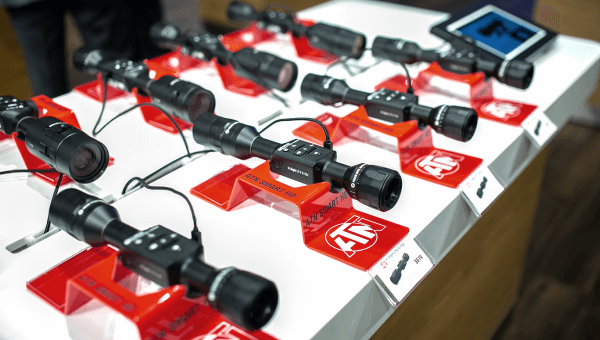
Here's the thing about the ATN TICO 6 225 — it's not really trying to be cheap. It's the entry point to a serious thermal platform, and the way ATN reached the lower price was by offering a 256×192 sensor instead of the higher-resolution configurations in the 335 and 650. That's it. Everything else that makes the TICO 6 worth owning is still there.
The 6th Generation thermal engine with SharpIR© AI processing works in real time on every frame, sharpening edges and improving contrast between targets and background. That matters a lot when you're trying to identify a coyote at 200 meters in a brushy draw — you don't want a vague heat blob, you want a shape you can confidently shoot at. SharpIR© does a genuinely good job of producing that clarity from a 256×192 sensor, especially at the distances where most hunting actually happens.
The build quality is where the 225 really pulls away from its budget-tier competition. IP67-rated magnesium alloy housing with a 6,000 J recoil rating — those specifications belong on units costing significantly more. Battery life runs approximately 8 hours on a standard replaceable 18650 cell, and USB Type-C external power extends that further when you need it. The Quick-Detach Picatinny mount and optional Scope Mounting System give you two clean ways to attach it to your setup, depending on your available rail space.
The smart feature platform is the other thing that makes this stand out. Hot Point Tracking automatically highlights the hottest target in frame. RAV recording captures footage around every recoil event automatically — no fumbling with a record button when the shot happens fast. Wi-Fi hotspot and ATN Connect 6 app let you stream the thermal view live to a phone. The tactical remote lets you adjust settings without breaking position. Sixty-four gigabytes of onboard storage keeps recordings without external cards. These aren't features you typically find on a budget thermal clip on.
The optional eyepiece adapter converts the unit to a handheld thermal monocular, which means you get a pre-hunt scanning tool and a rifle-mounted clip-on from a single device. The optimal day scope magnification range of 1–8x covers most standard hunting LPVO and hunting scope setups without vignetting.
Key strengths:
- 256×192 sensor, ≤20mK NETD — better sensitivity than most budget alternatives
- SharpIR© AI real-time image enhancement
- IP67 magnesium alloy build, 6,000 J recoil rated
- ~8 hr battery life on a replaceable 18650 cell
- 64 GB storage, RAV recording, Hot Point Tracking, Wi-Fi, tactical remote
- ATN Connect 6 app for iOS and Android
- Converts to handheld monocular with optional eyepiece adapter
- Optimal day scope magnification: 1–8x
Pros:
- Full 6th Generation ATN platform at the entry price — nothing stripped out
- IP67 and 6,000 J recoil rating rare at this price tier
- SharpIR© AI genuinely improves practical image quality beyond what the sensor resolution suggests
- 8-hour battery life for full night sessions
- Multi-role: clip-on and handheld monocular in one unit
Cons:
- 256×192 sensor limits fine-detail resolution beyond 400 meters
- Smaller 0.32" OLED display compared to higher TICO 6 configurations
- Not the right tool for open-country precision shooting at extended ranges
Why it actually performs well for the price: The TICO 6 225 performs because it doesn't cut the specifications that matter for real-world reliability. IP67, a verified recoil rating, strong NETD sensitivity, SharpIR© AI processing, and 8-hour battery life are the foundations of a clip-on that works when conditions get difficult. The sensor resolution is the trade-off — and for most hunters, it's one they'll rarely encounter in actual use.
#2 ATN TICO 6 335 — Best Step-Up from Budget to Real Performance
Best for: Hunters who can stretch the budget modestly and want noticeably better sensor performance without leaving the ATN platform.
If the 225 is at the top of your budget and feels tight, the 335 is worth knowing about as a stretch goal. It upgrades to a 384×288 sensor with ≤18mK NETD — a meaningful real-world improvement in image clarity and contrast at medium distances. The display steps up to a 0.49" OLED at 1920×1080 full HD resolution, detection range extends to 2,710 meters, and the optimal day scope range expands to 1–12x. Battery life stays at approximately 8 hours. Everything else in the platform is identical to the 225.
For hunters who regularly push past 300 meters or who want a more expansive viewing experience on long sessions, the 335's resolution and display upgrade is a noticeable and practical improvement. For hunters working inside 250 meters in dense terrain, the 225 is harder to justify against the 335's price difference.
Pros:
- 384×288 sensor and ≤18mK NETD — meaningful improvement in practical image quality
- Full HD OLED display for extended session comfort
- Same build quality and battery life as the 225
- Covers a wider range of hunting scope magnifications
Cons:
- Above the tightest budget ceiling
- Detection range strong but not class-leading against 640×512 configurations
Why it actually performs well for the price: The 335 earns its value position because the step from 256×192 to 384×288 with improved NETD is a genuine performance jump — not a marginal one. At its price, no direct alternative matches its combination of sensor performance, display quality, build specs, and smart feature depth.

Why ATN TICO 6 Deserves Attention From Budget Buyers
The ATN TICO 6 225 is an unusual product in the cheap thermal clip on conversation because it reaches a lower price point by cutting in exactly one place — sensor resolution — rather than spreading compromises across build quality, weather resistance, battery life, sensor sensitivity, and feature depth the way most budget options do.
That matters because the things it does cut — from 384×288 down to 256×192 — are the things you can compensate for with SharpIR© AI processing and smart shooting technique. The things it keeps — IP67 housing, magnesium alloy construction, 6,000 J recoil rating, ≤20mK NETD, 8-hour battery, 64 GB recording, Hot Point Tracking, and the full ATN Connect 6 ecosystem — are the things that determine whether a clip-on actually works reliably in field conditions over multiple seasons.
Most buyers in the budget thermal clip on category don't realize they're comparing units that make very different compromises. A competitor at a similar price might offer a 384×288 sensor that looks better on the spec sheet while delivering ≤40mK NETD sensitivity, IPX4 weather resistance, a 5-hour battery, and no smart features. In actual field use — particularly in wet conditions, with demanding cartridges, and across long hunting sessions — the ATN TICO 6 225 is the stronger tool.
The scalability of the TICO 6 platform is another angle worth considering. If you start with the 225 and later decide you want more resolution, upgrading to the 335 or 650 keeps you on the same platform with the same app, the same mounting logic, and the same operational muscle memory. That's real long-term value — not just a first-purchase decision.
How to Choose a Thermal Clip-On on a Budget
Define what distances you'll actually be hunting
Be honest with yourself here. If your predator hunting is mostly inside 200 meters in mixed woodland and agricultural fields, a 256×192 sensor with good NETD and AI processing covers you well. If you're regularly taking shots at 400 meters across open country, you need the resolution step-up. Match the sensor to your actual use case — not the theoretical maximum range you might someday hunt at.
Never buy without checking NETD
Resolution gets all the attention in marketing. NETD is what determines whether you can actually distinguish a coyote from a brushy background at 250 meters. A 384×288 sensor at ≤40mK produces worse practical imagery in complex terrain than a 256×192 sensor at ≤20mK with AI processing. Read both numbers before making any comparison.
IP67 is the floor, not a luxury
In 2026, IP67 from credible manufacturers is available at entry-level pricing. There's no good reason to accept IPX4 for regular outdoor hunting use. Splash resistance is not the same as waterproofing, and night hunting happens in the conditions that test that distinction.
Check the recoil rating against your rifle
If the manufacturer doesn't publish a recoil rating, treat that as a red flag. A clip-on that shifts under fire is unusable in any real hunting scenario. The ATN TICO 6's published 6,000 J / 1,000g rating gives you a verifiable number to check against your cartridge — and it comfortably covers everything from .223 through .308 and beyond.
Know when cheap becomes expensive
A cheapest clip on thermal option that fails after one wet hunt has cost you the purchase price plus the replacement cost of a better unit. That's almost always more than what you would have spent buying a quality entry-level unit in the first place. The cheapest option is not the most economical option unless it actually holds up in field use over time.
Common Mistakes Buyers Make
Buying based on resolution alone. A higher resolution number with weak NETD sensitivity frequently produces worse practical imagery than a lower resolution sensor with strong NETD and AI processing. Always check both.
Assuming all budget units are equally risky. There's a meaningful difference between a budget thermal clip on from ATN, Guide, or iRay — credible manufacturers with verifiable specs and real support — and an unbranded unit on a marketplace with no identifiable manufacturer. Both might be "cheap." Only one is a defensible purchase.
Not verifying scope compatibility. A clip-on that vignettes at your LPVO's primary magnification setting is effectively broken in that configuration. Check the optimal magnification range against your specific scope before ordering. The ATN TICO 6 publishes clear ranges for each configuration, which makes this verification easy.
Underestimating the impact of battery life on a real hunt. A 4-hour battery sounds fine until you're three hours into a hog hunt with two hours of darkness left and no spare cells. Plan for your actual session length and verify whether the battery format is swappable in the field.
Dismissing smart features as unnecessary on a budget buy. Hot Point Tracking, RAV recording, and app connectivity are real field tools, not marketing fluff. When two units are priced similarly and one includes these features and one doesn't, the one with the full feature platform is the better value — even if you don't use every feature on every hunt.
Frequently Asked Questions
What is the best cheap thermal clip on right now?
The ATN TICO 6 225 is the strongest recommendation in the cheap thermal clip on category. It delivers ATN's full 6th Generation platform — SharpIR© AI, IP67 build, 6,000 J recoil rating, 8-hour battery, 64 GB recording, Hot Point Tracking, and ATN Connect 6 ecosystem — at the entry-level TICO 6 price. The 256×192 sensor is the honest trade-off, and for most hunting inside 400 meters, it's one that doesn't show up in practical field use.
Is the cheapest clip on thermal worth buying?
Depends on who made it. A cheapest clip on thermal from a credible brand with a verified IP rating, published recoil data, and a real warranty can be a legitimate field tool. The absolute cheapest options from unverifiable manufacturers with no documented specifications are almost always a bad purchase — one failed hunt and you've spent more on replacement than you saved by going cheap in the first place.
What should I expect from a budget thermal clip-on?
From a quality budget thermal clip on, expect functional thermal detection at practical hunting distances, a 50 Hz refresh rate, IP67 weather protection, 6–8 hours of battery life on a replaceable cell, and sensor NETD sensitivity of ≤25mK or better. Accept as livable: lower sensor resolution (256×192), a smaller display, and no advanced features like laser rangefinding. Don't accept: IPX4 weather resistance, no published recoil rating, or NETD above ≤35mK.
Is an affordable thermal clip-on good enough for hunting?
For most common hunting scenarios — woodland predator calling, agricultural field hog hunting, and ranch perimeter observation inside 400 meters — a quality affordable thermal clip on like the ATN TICO 6 225 is entirely adequate. Where entry-level units struggle is open-country precision shooting at extended distances. If that describes your hunting, stretching to the TICO 6 335's 384×288 sensor is worth the additional investment.
Is ATN TICO 6 a good option for buyers on a budget?
Yes — specifically because of how it reaches its budget price. Rather than weakening build quality, weather resistance, battery life, or feature depth, the TICO 6 225 trades sensor resolution for a lower price. That's the right trade-off to make. Everything else that determines long-term field reliability — IP67 housing, 6,000 J recoil rating, SharpIR© AI, 8-hour battery, and the full ATN platform — is fully intact at the entry price.
Conclusion: The Right Way to Shop for a Cheap Thermal Clip-On
Shopping for a cheap thermal clip on is not the same as shopping for the lowest price you can find. It's about finding the lowest price at which you get a clip-on that actually holds up in field conditions — one that doesn't let you down in the rain, doesn't shift under recoil, doesn't run out of power two hours into a hog session, and produces thermal imagery clear enough to make confident shot decisions.
The ATN TICO 6 225 does all of those things at the entry-level price of the TICO 6 lineup. It's not trying to be the absolute cheapest clip on thermal on the market — and that's precisely why it's the best value recommendation in this guide. The Guide TA435 is the honest call when the 225 is genuinely out of reach. And the ATN TICO 6 335 is worth knowing about when you can stretch the budget to the level where the resolution upgrade starts paying off.
Whatever you end up choosing, use the checklist from this guide: NETD sensitivity, IP rating, recoil rating, battery life, magnification compatibility, and manufacturer credibility. Those six factors separate a budget thermal clip on that performs from one that only looks good until you're actually in the field.