For most value-minded hog hunters, the ATN Binox-6 Dual 384x288 5.5-44x is the smarter buy for stalking and general scouting, while the ATN Binox-6 Dual 640x512 3-24x wins any use case that leans on image clarity and long stationary glassing.
"Cheap thermal binoculars for hog hunting" almost never means the absolute lowest sticker — it means the ATN Binox-6 that spends your money where your actual hunt needs it. Both units here are current 6th-gen ATN thermal binoculars sharing the same 4-in-1 platform, so this is not a spec sheet beauty contest. It is a use-case decision. Below we put the flagship Binox-6 Dual 640 against the more affordable Binox-6 Dual 384 across four ways people really run hogs, and call the winner of each.
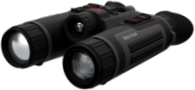
The two ATN Binox-6 models at a glance
Both are dual-sensor thermal binoculars: a thermal core plus a 4K day channel, laser rangefinder, GPS and compass, IR illuminator, SharpIR AI, DeFog and WDR — the whole 4-in-1 set. What separates them is where each one is tuned. The 640 leads on raw thermal resolution and detection reach; the 384 leads on zoom ceiling and price friendliness.
Use case 1: Crop-damage control on ag land
When you are protecting soybeans or a peanut field and hogs push in from wide, open edges, you are covering a lot of ground and often reaching out past a few hundred yards. This is where sensor quality does real work: more thermal pixels on a distant sounder means you can tell a rooting hog from a lone deer before you commit to a stalk or a shot lane.
Winner: Binox-6 Dual 640. Its 640x512 core and 3100 m detection give you cleaner target ID across a big field, and the lower base magnification keeps a wide enough picture to sweep the whole tree line without panning forever. On sprawling ag land, clarity at distance beats zoom ceiling.
Use case 2: Stalking small sounders in cover
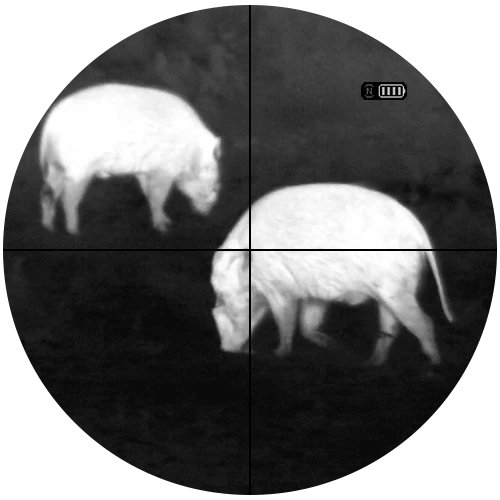
Slipping through hardwood bottoms after three or four hogs is a close, mobile game. You are moving light, glassing in short bursts, and picking a specific animal out of a tight group at moderate range. Here the day-to-day feel and value of the binocular matter more than headline detection numbers, and the ability to zoom in to confirm a boar versus a sow without changing position is genuinely useful.
Winner: Binox-6 Dual 384. It is the lighter of the pair and the friendlier buy, and its 5.5-44x range lets you punch in hard on a single hog once you have closed the gap. For a hunter who spends the night on foot in cover rather than parked behind a big field, the 384 delivers the use-case value without paying for reach you never use.
Use case 3: Long stationary glassing from a stand
Sitting a fixed stand over a feeder, a wallow, or a field corner is a patience game. You may glass the same distant edge for an hour before a sounder appears, and the first job is spotting heat at range and reading it correctly the moment it shows. Fine thermal detail on a far-off, motionless hog is exactly what wins here.
Winner: Binox-6 Dual 640. The extra thermal resolution and the longer 3100 m detection let you pick up and identify hogs at the far edge of your glassing lane sooner, and the 4K day channel plus rangefinder make ranging and logging a distant target effortless while you wait. For a stand hunter, the flagship earns its keep.
Use case 4: Multi-purpose scout-and-hunt
Plenty of hunters want one pair of thermal binoculars that scouts a property, ranges and marks sign by day, then runs hogs at night — without being the most expensive tool in the truck. This is the classic "cheap thermal binoculars for hog hunting" brief: broad capability, sensible spend, nothing wasted.
Winner: Binox-6 Dual 384. Same 4-in-1 feature set — 4K day channel, rangefinder, GPS, compass, IR — at the more affordable end, with a huge zoom ceiling for reading distant sign during daytime scouting. If you want the whole toolkit at the value price and can accept slightly less thermal detail at extreme range, the 384 is the all-rounder.
Which ATN Binox-6 wins your hunt
The pattern is simple: the 640 wins the reach-and-clarity use cases (big fields, long stand sits), and the 384 wins the value-and-mobility use cases (stalking, do-it-all scouting). Both are ATN thermal binoculars from the same current line, so you are choosing a tuning, not a downgrade. See the flagship on the Binox-6 Dual 640 page, the value pick on the Binox-6 Dual 384 page, or browse the full ATN thermal binoculars lineup.
How we compared them
We judged these two ATN Binox-6 thermal binoculars only against real hog-hunting use cases — crop-damage control, stalking in cover, stationary stand glassing, and all-purpose scout-and-hunt — weighing thermal resolution, detection range, magnification range, weight, the 4-in-1 feature set, and relative value for each job. This is an in-house comparison of ATN's own current 6th-gen range, not an independent lab review, and we only considered current-line models. Honest trade-offs: the 640 asks for more spend and gives back a narrower zoom ceiling, so it is not for the hunter who wants maximum magnification cheap; the 384 gives up thermal detail at extreme range, so it is not for someone whose hunts live at the far edge of a huge field. Check each spec against how you actually hunt hogs before you decide.
Frequently Asked Questions
Which ATN Binox-6 is the cheaper thermal binocular for hog hunting?
The ATN Binox-6 Dual 384x288 5.5-44x sits at the more affordable end of the pair and is the better value pick for hunters who stalk in cover or want one do-it-all scout-and-hunt tool without paying for maximum long-range clarity.
Do both models have a rangefinder?
Yes. Both the Binox-6 Dual 640 and the Binox-6 Dual 384 are 4-in-1 units, so both include a laser rangefinder along with the 4K day channel, GPS, compass and IR illuminator. The 640's rangefinder reaches out to 1000 m.
Is the higher-resolution 640 worth it for hogs?
For long stand sits and wide ag fields, yes — the 640x512 sensor and 3100 m detection give cleaner target ID at distance. For close, mobile stalking or general scouting, the 384's value and huge 5.5-44x zoom often make more sense.
Which one is better for stalking hogs on foot?
The Binox-6 Dual 384. It is slightly lighter and more affordable, and its 5.5-44x zoom lets you confirm a specific hog in a small sounder once you have closed the distance in cover.
Do the two binoculars share the same features?
Largely, yes. Both carry the same 4-in-1 platform: dual thermal-plus-4K-day sensors, ≤15 mK NETD, laser rangefinder, GPS, compass, IR illuminator, SharpIR AI, DeFog and WDR. They differ mainly in thermal resolution, detection range and magnification range.
How far can each detect a hog?
The Binox-6 Dual 640 lists 3100 m detection and the Binox-6 Dual 384 lists 2750 m. Both easily cover typical hog-hunting ranges; the 640's edge matters most for spotting distant sounders across large open ground.
Ready to match the right ATN Binox-6 to your hog hunts? Compare the Binox-6 Dual 640 and the Binox-6 Dual 384, or see the full ATN thermal binoculars range.
Created: August 5, 2026 · 19:53:42 UTC