For timber and river bottoms the ATN Binox-6 Dual 640x512 sees more; for glassing distant hogs across open ground the higher-zoom Binox-6 Dual 384x288 reaches further — pick by the land you actually hunt.
Hogs do not respect terrain lines, and neither should your gear talk. The honest question for anyone chasing pigs after dark is not “which thermal binocular is best” in the abstract — it is which one earns its keep on the ground you walk. A river-bottom hunter and a hill-country hunter are solving different problems, and the same optic will feel like a bargain to one and a compromise to the other.
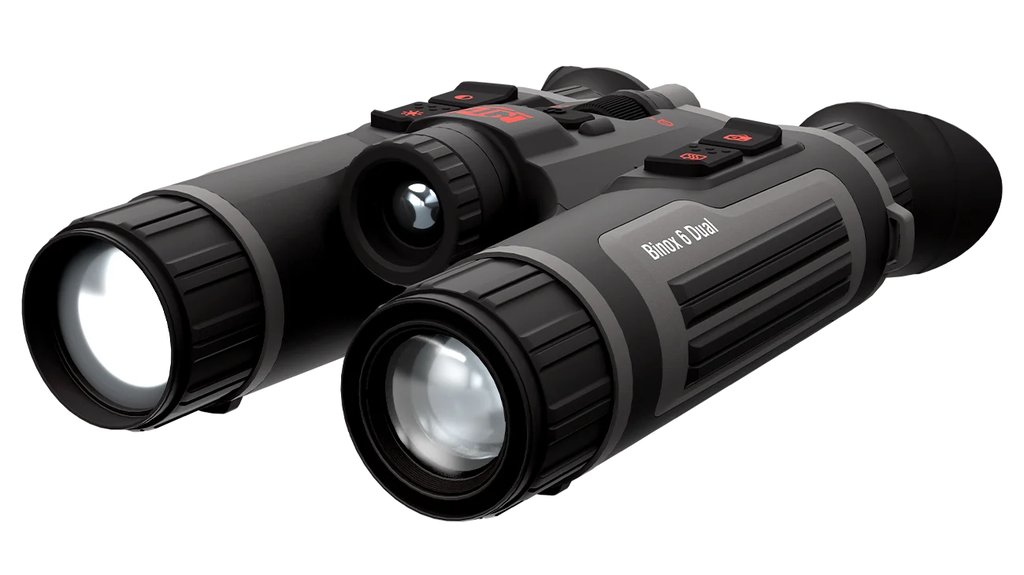
So this is a terrain-by-terrain shootout between two current 6th-generation glasses that both sit in reach for a working hog shooter: the ATN Binox-6 Dual 640x512 3-24x and the more affordable ATN Binox-6 Dual 384x288 5.5-44x. We walk them through four hog environments — thick timber and river bottoms, open ag fields, brushy transition edges, and rolling hill country — and call which glass wins each. Both live in the thermal binoculars family.
The two glasses at a glance
Before the terrain talk, here is what actually separates them. The 640 leads on raw thermal detail — a larger sensor grid that resolves a pig from the brush behind it further out. The 384 answers back with the family’s highest magnification and a slightly faster thermal lens, trading pixel count for reach and a friendlier tier. Everything else — the 4-in-1 Day/Night/Thermal/Twilight modes, NETD ≤15 mK sensitivity, the 4K day channel, dual-view switching, GPS and compass — is shared.
Terrain 1: thick timber and river bottoms
This is close, cluttered, and merciless on a thermal signature. Hogs shove through cane, cut through green briar, and put a wall of warm vegetation between themselves and you. Distance is rarely the issue — separation is. You need to tell a pig from the tangle it is standing in, often at thirty to eighty yards, and you need to do it in a half-second window before it moves on.
The Binox-6 Dual 640x512 owns this ground. The denser sensor grid paints more distinct thermal pixels across a hog’s body, so ears, snout, and the line where the animal ends and the brush begins stay crisp instead of smearing into a warm blob. Its 3x base magnification also keeps a wide, usable field so you can follow a moving sounder through timber without losing them off the edge of the frame. In a river bottom, that combination is the difference between a confident read and a guess.
The 384 is perfectly capable here too — its faster F/0.9 lens gathers a touch more thermal energy — but its lower base zoom starts at 5.5x, which is more magnification than you usually want in tight cover, and the smaller grid gives up detail on a partially screened animal. Timber winner: the 640.
Terrain 2: open ag fields
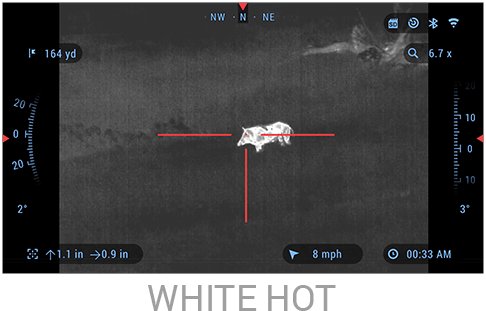
Now flip the problem. Standing on the edge of a picked corn or peanut field, the clutter disappears and reach becomes king. Pigs feed out at two, three, four hundred yards, and your job is to glass a wide-open expanse, pick a warm dot out of a black field, and then zoom in hard to confirm it is a pig and not a coyote, a calf, or a deer.
Here the Binox-6 Dual 384x288 earns its slot. Its 5.5-44x zoom — the highest in the whole Binox-6 line — lets you crank in on a distant heat source and read it clearly without walking closer and spooking the whole group. On flat, uncluttered ground the sensor’s lower pixel count matters far less, because there is nothing to separate the animal from; a hog against bare dirt is an unmistakable shape at any resolution. You get flagship-family features at a more accessible tier, which is exactly the “budget thermal binoculars hog hunting” sweet spot.
The 640 still reaches slightly further on paper (3100 m detection vs 2750 m) and its onboard laser rangefinder out to 1000 m is genuinely handy for calling shots across a field. But its 24x ceiling gives up real identification magnification to the 384’s 44x, and in open ground that extra zoom is what you reach for most. Open-field winner: the 384 for pure glassing reach; the 640 if you want the ranging edge.
Terrain 3: brushy transition edges
Most hog ground is not pure timber or pure field — it is the messy seam between them: fence lines, cedar breaks, the tree line where a bedding thicket meets a food plot. Pigs live on these edges because they can feed in the open and be in cover in three seconds. You are switching constantly between glassing the open side and picking apart the brushy side.
This is the honest coin-flip, and it leans to the 640. The moment a hog steps back toward cover, the resolution advantage returns — you can still read the animal against the brush edge, which is precisely where a lower-resolution glass starts to struggle. The 640’s wider 3x base also lets you sweep a long transition line quickly, then dual-view switch to the 4K day channel at first light without lifting a second device. The 384 handles the open side of the edge beautifully, but on the cover side it asks you to work a little harder. Edge winner: the 640, by a nose.
Terrain 4: rolling hill country
Hill country is a glassing game. You set up on a high point and pick apart the opposite slopes, the draws, and the far saddles — distances that stretch well past what timber or even flat fields demand. Elevation buys you sightlines, and long sightlines reward magnification above almost everything else.
The 384’s 44x is built for exactly this. From a ridge, you can lock onto a heat signature two draws over and zoom until you can count the pigs and judge the sounder’s size before you ever plan a stalk. The lighter, more affordable body is also welcome when you are carrying it up a long climb. The 640 remains an excellent all-rounder here and its slightly longer detection range helps at the extreme edge, but its 24x ceiling means more distant heat sources stay smaller in the frame. Hill-country winner: the 384.
So which one, for how you hunt?
- Timber and river-bottom hunters — go 640. Resolution beats reach when the problem is separating a pig from the tangle around it.
- Open-field and hill-country hunters — go 384. The family’s highest 44x zoom and friendlier tier win where distance, not clutter, is the challenge.
- Mixed-ground hunters who see a bit of everything — the 640 is the safer single glass, because its resolution edge rescues the hardest terrain (cover), while it still glasses the open acceptably.
- Value-first hunters on open country — the 384 gives you flagship-family features at a more accessible tier without giving up anything that matters on flat or high ground.
Neither is a compromise glass — they are two right answers to two different landscapes. Both share the ≤15 mK sensitivity, the 4-in-1 modes, roughly eight hours on swappable dual 18650 cells, and near-identical weight around 1.6 lbs, so the deciding factor really is the terrain math above.
How we compared them
We judged these two glasses against the criteria that actually decide a hog hunt across real ground: thermal resolution (how well the sensor separates an animal from cover), NETD sensitivity, magnification range, rated detection distance, weight for long carries, and battery endurance — each weighed differently depending on the terrain in question rather than scored in a vacuum. This is an in-house ATN-vs-ATN comparison of two products from our own current 6th-generation Binox-6 line, not an independent lab review, and only current-generation glass was considered. The honest trade-offs: the 640 costs you some top-end magnification for its resolution lead, and the 384 gives up pixel detail for its class-leading zoom. Who each is not for — the 640 is not the pick if you almost never hunt cover and want the longest possible identification zoom, and the 384 is not the pick if most of your shots come out of thick timber where reading a screened pig matters most. Check these specs against the ground you actually hunt, not against a spec sheet in isolation.
Frequently Asked Questions
Which ATN Binox-6 is better for hunting hogs in thick timber?
The Binox-6 Dual 640x512. In tight cover the higher-resolution sensor separates a partially screened pig from the brush far better than magnification does, and its wider 3x base keeps a moving sounder in frame.
Which one should I choose for open ag fields?
The Binox-6 Dual 384x288. Its 5.5-44x zoom — the highest in the family — lets you reach out and confirm a distant heat source as a hog without closing the gap, and on bare ground the lower pixel count barely matters.
Is the 384 a good budget option for hog hunting?
Yes. It sits at a more affordable tier while keeping the flagship-family 4-in-1 modes, ≤15 mK sensitivity and 4K day channel, which makes it a strong value pick for hunters working open or hilly country.
Which is better for rolling hill country?
The 384, because hill-country glassing is a magnification game. From a high point its 44x zoom lets you read hogs two draws over, and the lighter body helps on long climbs.
What about brushy transition edges between field and timber?
The 640 edges it. As soon as a hog steps back toward cover, its resolution advantage returns, so you can still read the animal against the brush while glassing the open side just fine.
Do both have a rangefinder?
The 640 carries an onboard laser rangefinder accurate to about a meter out to 1000 m, which is handy for calling shots across open fields. Both share the wider 4-in-1 Day/Night/Thermal/Twilight feature set.
If I only buy one glass for mixed hog ground, which is safer?
The 640. Its resolution rescues the hardest terrain — cover — while still glassing open ground acceptably, so it covers the widest range of landscapes as a single optic.
Match the glass to your dirt: the resolution-first ATN Binox-6 Dual 640x512 for timber and brushy edges, or the higher-zoom, more affordable ATN Binox-6 Dual 384x288 for open fields and hill country. Compare the full lineup on the thermal binoculars page and pick the one built for the ground you hunt.
Created: August 5, 2026 · 19:53:41 UTC