If you shop budget thermal binoculars hog hunting by the range you actually hunt, the choice between two ATN Binox-6 variants gets simple. Hogs at 80 yards in a food plot ask a different tool than hogs at 400 yards across a cut field. This comparison lines up the flagship Binox-6 Dual 640x512 3-24x against the value Binox-6 Dual 384x288 5.5-44x across three range bands — near, mid and far — so your ground decides the pick.
How the 640x512 3-24x works across the bands
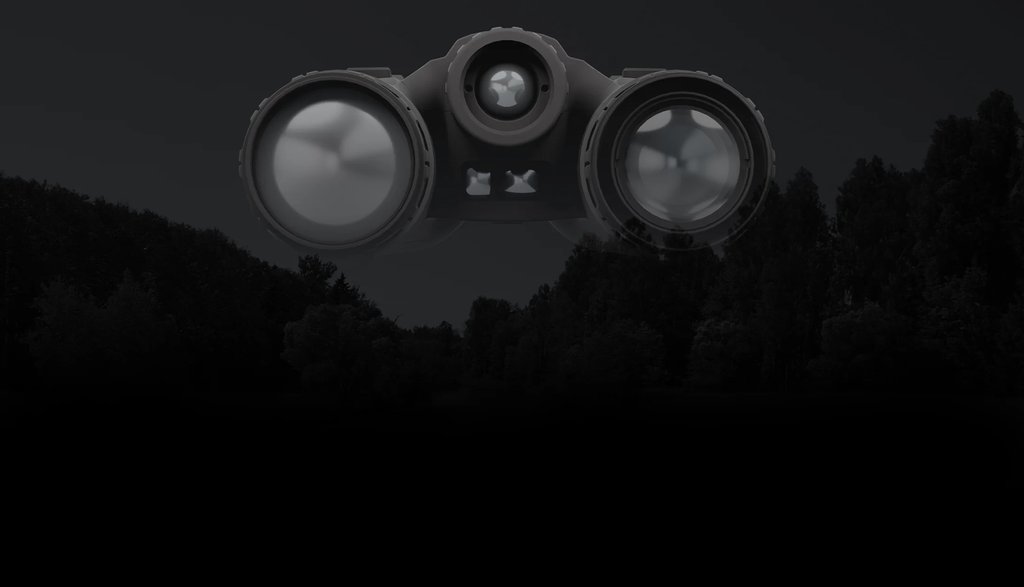
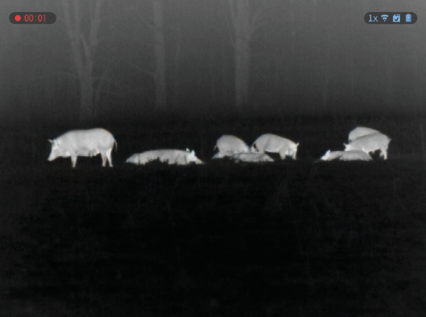
The ATN Binox-6 Dual 640x512 3-24x is built to hold detail as the range grows. Its 640x512 sensor packs more pixels onto the same hog — like moving from standard definition to HD — so at the far band a pig stays a recognizable animal instead of a soft blob. Near range, it works fine, it is simply more sensor than a close food plot requires. You will see a hog at 60 yards fill the frame with heat, and you barely need to touch the zoom to know it is a pig and not a deer.
Step out to the mid band and the wide 3x low end earns its keep. It sweeps big country fast, so you can pan a whole field edge in a few seconds instead of tunneling through a tight view and missing the sounder that just slipped into the timber. The <=15 mK sensitivity is the quiet hero here — that low millikelvin number means the sensor reads tiny heat differences, so a pig lying still in cool grass still glows against the ground instead of blending in. At the far band the 3100 m detection registers a heat signature long before it matters, and because the sensor has more pixels to spend, a specked-out pig at 400 yards keeps its edges when you push the magnification. That is the whole point of the extra resolution: it does not give up detail right when you need it most.
How the 384x288 5.5-44x works across the bands
The ATN Binox-6 Dual 384x288 5.5-44x is the value tier and covers the near and mid bands without complaint. At the near band it is honestly a little easy for it — a hog inside 100 yards is a bright, obvious target, and you spend more time watching the sounder than working to find it. Its 384x288 sensor and <=15 mK sensitivity — that low millikelvin number meaning it reads tiny heat differences — separate a warm pig from cool dirt cleanly, so even a pig half-tucked behind brush still reads as a distinct heat shape.
The mid band is where this unit shines for the money. Its 5.5-44x band actually out-zooms the 640 at the top end, so at 150 or 200 yards you can dwell hard on a sounder to count heads and pick your shot animal before you commit. Think of the resolution like SD next to the 640's HD: at these ranges the SD picture is still perfectly readable, so you are not paying for detail you would not use. Detection reaches 2750 m, which is far more than you will ever identify a hog at. The only place it yields ground is the far band — past 300 yards on open country the smaller sensor has fewer pixels to spread across a distant pig, so it softens sooner as you crank the zoom and a far specked-out hog turns fuzzy before the 640 would.
When to choose the 640x512 3-24x
Choose the 640 when the far band is your reality — big open leases, cut ag fields, pigs that show up as distant specks you must identify before a long stalk. The sharper sensor and 3100 m detection turn those far-band calls from guesses into clear reads, and the wide low end scans that ground faster. If most of your nights are spent glassing distance, the flagship earns the extra outlay.
Picture a 300-acre soybean field after harvest. You are set up on a rise, and a warm blob shows up along the far tree line, maybe 380 yards out. With the 640 you zoom in and can tell it is three pigs, not one, and you can see they are rooting, not moving off — so you know you have time to close the gap. On the value 384 that same blob at that range would read as a soft smear you could not split into individuals, and you would be stalking blind. When your ground routinely puts pigs that far out, that difference decides whether you get the shot.
When to choose the 384x288 5.5-44x
Choose the value-tier 384 when you hunt the near and mid bands, which is where most hog hunting actually happens — field edges, plots, timber openings inside a few hundred yards. It identifies pigs cleanly there, its 44x zoom gives you room to inspect, and it saves real money for reach you would rarely use. For a budget hog rig, that is the honest match.
Say you hunt a river-bottom lease — thick timber, small green plots, shooting lanes that top out around 150 yards. The pigs come in close and you never glass past the far edge of a two-acre opening. Here the 384 does everything the 640 would, and its extra top-end zoom actually helps you study a sounder in a tight lane and count piglets before you pick the sow. Paying the flagship premium for far-band reach you will never use is money left in the field. When your hunting lives inside the timber, the value tier is not a compromise — it is the smarter buy.
Our recommendation
For most budget hog hunters, the Binox-6 Dual 640x512 3-24x is the pick when the far band matters and the value-tier 384 is the pick when it does not — so start by mapping your ground. If you genuinely shoot and scan past 300 yards on open country, the 640's sharper sensor is worth it; if your hogs live inside the near and mid bands, the 384 covers them for less. Either way you stay inside ATN's thermal binoculars line, so you get the same 1000 m rangefinder, 4-in-1 vision and GPS regardless of which reach you buy.
How we compared them
This is an in-house, ATN-vs-ATN comparison of the two Binox-6 variants, not an independent lab review, so treat it as a way to match reach to your ground and confirm the figures against your own fields. We compared them across three practical range bands using the specs that change a hog night — sensor resolution, NETD, detection range and magnification band — within only the current 6th-gen line. The honest trade-off sits in the table: the 640 wins the far band but costs more and weighs a touch more; the 384 wins on value and top-end zoom but softens sooner at extreme distance. Who this comparison is not for: a hunter who only works close brush, where a simpler handheld thermal would do the job with less optic.
Frequently Asked Questions
Which Binox-6 is better value for hog hunting?
The 384x288 5.5-44x, if you hunt inside a few hundred yards. It identifies pigs cleanly at near and mid range and costs less than the 640, so it is the honest budget pick for typical hog ground.
When is the 640x512 worth the extra money?
At the far band — pigs past roughly 300 yards on open leases. Its sharper 640 sensor and 3100 m detection hold detail where the 384 starts to soften, so long-range identification is where it pays off.
Do both units range the target?
Yes. Both Binox-6 variants have the same built-in laser rangefinder, good to 1000 m with about a meter of accuracy, so you can measure distance to a sounder on either model.
Is more magnification better for hogs?
Not on its own. The 384 actually zooms to 44x versus the 640's 24x, but at the far band sensor sharpness matters more than raw zoom, which is why the 640 pulls ahead there despite less top-end magnification.
How far can each detect a hog?
The 640x512 3-24x detects to 3100 m and the 384x288 5.5-44x to 2750 m. Detection means spotting a heat signature is present; clear identification happens well inside those figures.
Can I hog hunt all night on one charge?
Both run about 8 hours and use two 18650 cells, so carrying charged spares lets you swap in fresh power for a full overnight sit on either variant.
Does the lower 384 resolution matter at close range?
Not really. Inside a few hundred yards a hog fills enough of the frame that the 384x288 sensor shows a clean, obvious target. The resolution gap only starts to bite past roughly 300 yards, where the 640x512 keeps a distant pig sharp while the 384 softens.
Is the weight difference between them a factor?
Barely. The 640x512 comes in around 730 g and the 384x288 around 720 g, so the roughly 10 g gap is not something you feel on a night hunt. Pick on range band and value, not on those few grams.
Mapped your range band? If your hogs live at distance, look closer at the ATN Binox-6 Dual 640x512 3-24x; if they are inside a few hundred yards, the value 384 saves you money. Compare both across ATN's thermal binoculars range and buy for the ground you actually hunt, not the number on the box.
Created: August 5, 2026 · 19:53:41 UTC