Hogs move at night, in groups, and rarely on your schedule. The optic you reach for depends less on your budget line and more on how you hunt them: sitting still over a feeder, walking fence lines on foot, glassing pastures from a truck seat, or patrolling for fresh crop damage. This roundup sorts the best budget thermal binoculars for hog hunting by those exact use cases, and every pick comes from ATN's current 6th-gen thermal binoculars lineup so you are comparing like for like.
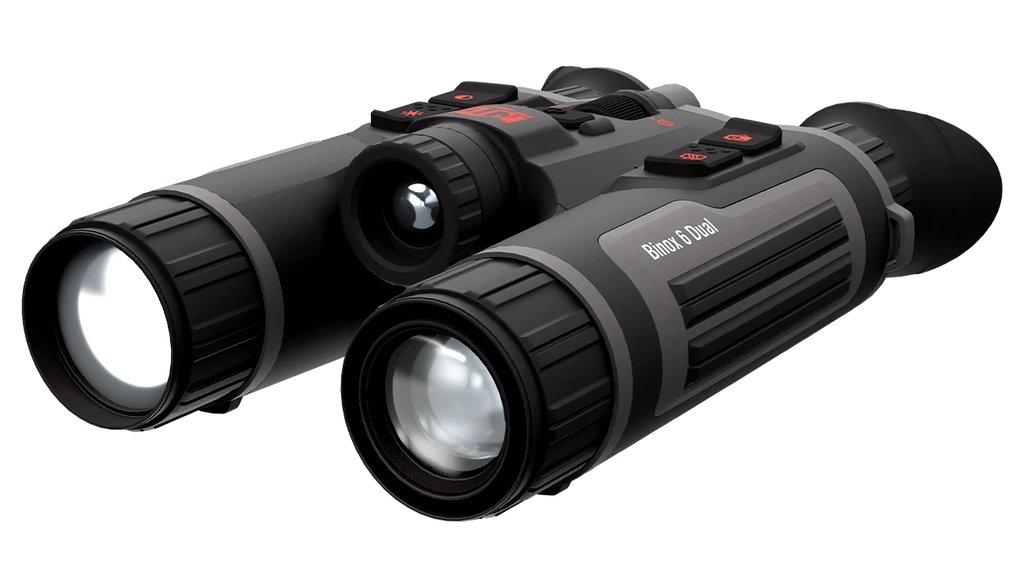
Two binoculars carry this list: the ATN Binox-6 Dual 384x288 5.5-44x as the value workhorse, and the ATN Binox-6 Dual 640x512 3-24x as the step-up flagship. Both are true binoculars with two eyepieces, both fuse a thermal core with a 4K day sensor, and both cover the four common hog scenarios below. The difference is where each one shines.
Use case 1: Stand hunting over a feeder or bait
For sitting still over a set feed point, the ATN Binox-6 Dual 384x288 is the pick. Stand hunting is a patience game: you scan the same known area for long stretches and want to identify a sounder the moment it steps out, tell a boar from a sow, and count numbers before you commit. The 384x288 thermal sensor with NETD ≤15 mK draws warm bodies cleanly against cooler ground cover, and the 5.5-44x magnification lets you zoom in on a specific hog at your feeder without leaving your seat.
Because you are stationary, battery life matters more than weight here. Roughly 8 hours from two swappable 18650 cells covers a full evening sit, and a spare pair keeps you out past midnight. The built-in laser rangefinder (out to 1000 m, +/-1 m) confirms how far that feeder actually sits, which is useful when you hand off to a rifle setup. At 720 g the 384 model is comfortable to raise and hold for repeated short scans across a night.
- Why it fits — long dwell time, high zoom to inspect a fixed area, rangefinder to confirm feeder distance.
- Sensor — 384x288 core, NETD ≤15 mK, so a bedded or feeding hog still reads warm.
- Endurance — ~8 hrs on 2x 18650, batteries swap in seconds for an all-night sit.
- Reach — 5.5-44x zooms onto one animal in a group without spooking the sounder.
Use case 2: Spot-and-stalk on foot
For covering ground and closing distance, the 384x288 again earns the nod, with the 640 as an upgrade for wide, open country. Stalking means you glass, move, and glass again, so a binocular you can carry all night without arm fatigue wins. The 384 model's 720 g weight and dual-eyepiece design reduce eye strain compared with squinting through a single tube, which matters when you are scanning for an hour before the first hog appears.
The 4-in-1 Day/Night/Thermal/Twilight modes let you pick up a heat signature in thermal, then flip to the 4K day channel or IR-assisted night view to read terrain and pick a stalk route. SharpIR AI sharpening and the DeFog mode keep the image usable in humid, low-contrast conditions common on late-night stalks. If your stalks routinely cross large open pastures where hogs appear as distant specks, the Binox-6 Dual 640x512 resolves them into recognizable animals sooner, at the cost of stepping up in price.
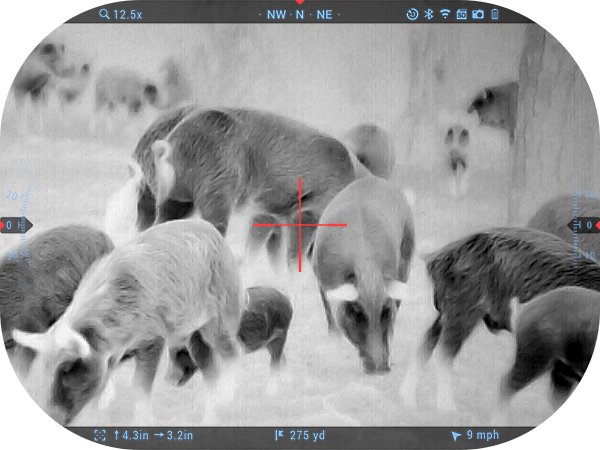
Use case 3: Thermal scanning from a truck or UTV
For glassing pastures and food plots from a vehicle, the ATN Binox-6 Dual 640x512 pulls ahead. Truck scanning is about detection distance: you creep along a road or field edge, sweep the horizon, and want to spot a sounder as far out as possible so you can plan the approach. The 640x512 sensor and 3100 m detection range read distant heat signatures earlier than the 384's 2750 m, and the higher resolution means those far-off blobs turn into countable hogs sooner.
The 3-24x magnification range on the 640 favors a wide field of view at the low end, which is exactly what you want for fast sweeping from a moving seat, then a quick zoom once something lights up. If detection distance is not your bottleneck, the 384 model still scans a truck lane perfectly well and keeps the setup in the value tier. Both run the same ~8-hour swappable-battery system, so neither strands you mid-route.
- Why the 640 fits — longer 3100 m detection and higher resolution spot sounders far down a pasture.
- Fast sweeping — the 3-24x range starts wide for scanning, then zooms to confirm.
- Budget alternative — the 384x288 handles the same lane at shorter detection distance and lower cost.
- Shared strengths — 4K day channel, GPS + compass to mark where a group crossed, ~8 hr runtime.
Use case 4: Property and crop-damage patrol
For walking or driving a property to find and log damage, the ATN Binox-6 Dual 384x288 is the practical all-rounder. Patrol work is mixed: you check known wallows, fence breaks, and torn-up field corners, sometimes on foot, sometimes from a side-by-side, often without a shot fired. Here the 384 model's blend of high 5.5-44x zoom, onboard GPS and compass, and the 1000 m rangefinder turns it into a survey tool as much as a hunting one. Mark where fresh rooting shows up, range the distance across a field, and build a picture of how the sounder is moving through your land.
The 4K UHD day sensor with Wide Dynamic Range means you can document damage in daylight too, not just chase heat at night. Because patrol nights can run long and unpredictable, the swappable dual 18650 batteries keep you covered without a full recharge. For a mixed patrol role that leans more on flexibility than on maximum detection range, the value-tier 384 is the sensible choice; upgrade to the 640 only if your property is large enough that reading hogs across the far pastures is a nightly need.
ATN Binox-6 Dual 384x288 vs 640x512: side by side
Both are 4-in-1 thermal binoculars with a 4K day sensor, the same NETD ≤15 mK thermal sensitivity, and near-identical ~8-hour runtime on swappable 18650 cells. The table shows where they part ways so you can match the pick to your dominant use case.
Read it this way: if your hunting is mostly stands, stalks, and patrol, the 384x288 covers everything and keeps the budget in check. If you spend most nights scanning big open ground from a vehicle and detection distance is the thing that decides whether you get a stalk started, the 640x512 is worth the step up.
What to check before you buy for hogs
- Match resolution to your distances: 384x288 is plenty for stands and closer stalks; 640x512 pays off across wide pastures.
- Prioritize NETD for cover: both hit ≤15 mK, which is what lets a hog read warm through brush and grass.
- Confirm the rangefinder if you hand off to a rifle: the 384 model ranges to 1000 m at +/-1 m.
- Plan battery swaps: carry a second pair of 18650 cells for any hunt that could run past a single ~8-hour charge.
- Weigh comfort for long scans: both sit near 720-730 g, light enough for repeated all-night glassing.
- Use the day channel: the 4K sensor documents crop damage and helps you scout routes in daylight.
How we picked these ATN thermal binoculars
This is an in-house comparison across ATN's own current 6th-generation Binox-6 range, not an independent lab test, so treat it as an honest sort of which of our binoculars suits which hog-hunting job. We ranked the two models against the things that actually decide a hog night: thermal sensor resolution (384x288 vs 640x512), thermal sensitivity measured as NETD, detection range, magnification span, weight for long handheld scanning, and battery endurance. The 384x288 leads the roundup because it clears every common hog use case while staying the value pick; the 640x512 wins only the long-distance scanning job. The honest trade-off: the 384 gives up some reach and fine detail at extreme range, and the 640 asks you to step up in price and gains little for close-in stand work. Who these are not for: anyone wanting a helmet-mounted or clip-on setup, or a hunter whose shots are all inside short bow-range where a simple handheld would do. Check the specs above against your own property and typical distances before deciding.
Frequently Asked Questions
What are the best budget thermal binoculars for hog hunting?
For most hog hunters, the ATN Binox-6 Dual 384x288 5.5-44x is the best budget choice. It is the more affordable of ATN's two current thermal binoculars, yet it covers stand hunting, spot-and-stalk, truck scanning and property patrol with a 384 thermal sensor, 5.5-44x zoom, a 1000 m rangefinder and ~8-hour swappable batteries.
Do I need the 640x512 model to hunt hogs?
No. The 384x288 handles the large majority of hog scenarios. The Binox-6 Dual 640x512 is worth the step up mainly if you scan wide open pastures from a truck or UTV and need to detect and identify sounders at greater distance, where its 3100 m detection range and higher resolution help.
How far can these ATN Binox-6 binoculars detect a hog?
Detection range is 2750 m on the 384x288 model and 3100 m on the 640x512. Detection means picking up a heat signature; you will identify and count individual hogs well inside those figures, and the higher-resolution 640 resolves distant animals into recognizable shapes sooner.
Are the Binox-6 thermal binoculars good in humid or foggy conditions?
Yes. Both models share NETD ≤15 mK thermal sensitivity plus DeFog and Wide Dynamic Range processing, which keep hogs readable in humid, low-contrast air. SharpIR AI sharpening further cleans up the image on the kind of muggy nights common during hog season.
How long do the batteries last for an all-night hunt?
Roughly 8 hours on two 18650 cells, and the cells are swappable, so a spare pair keeps you scanning past midnight. Battery endurance is one reason these binoculars suit long stand sits and unpredictable patrol nights.
Can I use these binoculars during the day too?
Yes. Both are 4-in-1 optics with Day, Night, Thermal and Twilight modes and a 4K UHD day sensor, so you can document crop damage or scout stalk routes in daylight, then switch to thermal after dark.
Do these thermal binoculars have a rangefinder?
Yes. The Binox-6 Dual 384x288 includes a laser rangefinder out to 1000 m at +/-1 m accuracy, which is useful for confirming feeder or field distances before you hand off to a rifle. The 640x512 also carries a rangefinder along with dual-view switching.
Match the binocular to how you hunt hogs: the value-tier ATN Binox-6 Dual 384x288 5.5-44x is the smart starting point for stands, stalks and patrol, while the flagship Binox-6 Dual 640x512 3-24x steps up for long-range truck scanning. See the full 6th-gen range on the ATN thermal binoculars page and pick the one that fits your ground.
Created: August 5, 2026 · 19:53:41 UTC