The smartest way to shop budget thermal binoculars hog hunting is by tier — decide which rung of the ladder you actually need before you spend, not the other way round. Hogs move in packs across dark fields, so you want glass that separates a warm pig from warm dirt without draining your wallet on reach you will never use. This roundup ranks the ATN Binox-6 line by tier, with the entry-tier Binox-6 Dual 384x288 5.5-44x leading as the value pick and the 640 sitting above it as the step-up.
Step-up tier: ATN Binox-6 Dual 640x512 3-24x — sharper 640 sensor and longer detection for when you want the flagship glass.
Who each is for: pick the 384 if you want the most hog-hunting capability per tier of spend; step up to the 640 only if you regularly need to identify pigs at the far edge of a big field.
Why ATN's 6th-gen Binox-6 fits budget hog hunting
ATN's 6th-gen Binox-6 fits budget hog hunting because a single unit does the job of several tools, so you are not buying a separate rangefinder, day binocular and thermal scanner. Both variants are 4-in-1 — day, night, thermal and twilight — with a built-in laser rangefinder good to 1000 m, GPS and compass, and a 4K day sensor. For someone watching a field edge for pigs, that means you range the sounder, mark the spot and scan in thermal without ever swapping devices. On the value tier that consolidation is where the real saving lives.
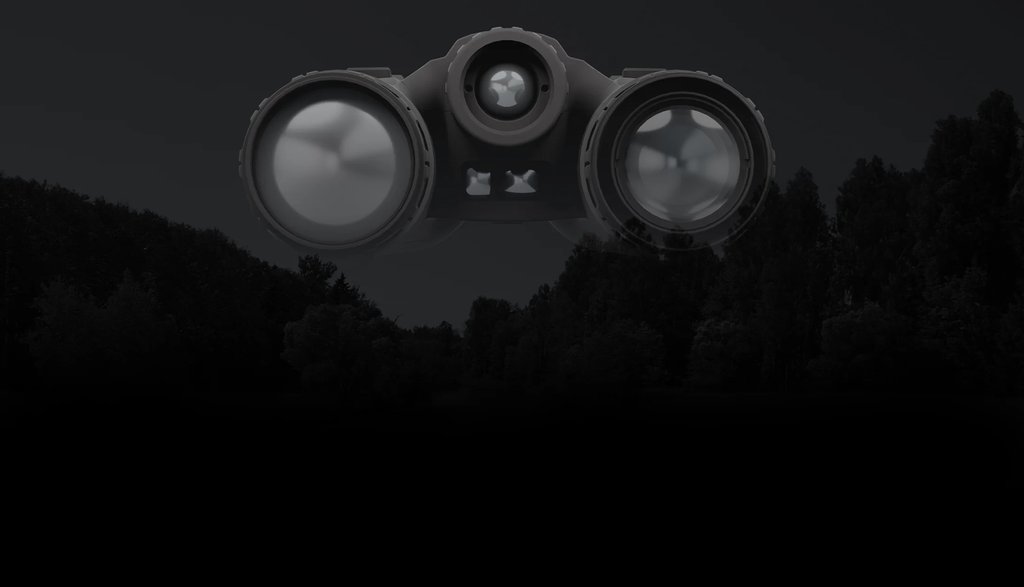
Entry tier: ATN Binox-6 Dual 384x288 5.5-44x
The ATN Binox-6 Dual 384x288 5.5-44x is the value tier and the pick most hog hunters should start on. Its 384x288 thermal sensor reads down to a <=15 mK temperature difference — that low millikelvin figure means it pulls a warm hog cleanly out of cool ground — and the 5.5-44x zoom band lets you push in on a distant sounder to count heads before you move.
Why the magnification suits pig work
That up-to-44x top end is the entry tier's standout. Hogs bed in cover and feed at the far side of fields, so being able to dwell at high zoom on a warm shape 300 yards out — and confirm it is a pig, not a calf, not a coyote — before you commit is exactly what the value tier should buy you. Cheaper thermals often top out well short of that, which leaves you creeping closer just to tell what you are looking at, and every step closer is a chance to bump the pack. Here you can sit still and let the zoom do the walking. The built-in rangefinder then hands you the distance so you know whether it is even worth the stalk, and the GPS marks the spot so you can find your way back to the same feeding ground the next night.
Who it is for: the hog hunter who wants the most capability per tier of spend and does most of their scanning at moderate to long range. Who it is not for: someone who needs to identify pigs at the extreme edge of a huge open lease every night — that job leans on the sharper 640 sensor above.
A real scenario: a pack feeding at the field edge
Picture a warm night on a cut cornfield. You glass the far treeline and pick up a cluster of pale shapes rooting along the edge. At 5.5x they are just warm blobs, so you zoom in. Somewhere in the 30-44x band the shapes sharpen into pigs, and you start counting — one big sow, three or four followers, a couple of small ones trailing behind. That head count matters, because a pack of a dozen wants a different plan than two loners. Next you hit the rangefinder and it hands you the distance, say 240 yards. Now you know the wind you need, the cover you have and whether the stalk is worth it before you take a single step. That whole read — spot, count, confirm, range — happens through one optic on the value tier, and it is exactly the loop hog hunters run a dozen times a night. Because the 384 gets you there without stretching the budget, most hunters find it does everything they actually ask of a scanner.
Step-up tier: ATN Binox-6 Dual 640x512 3-24x
The ATN Binox-6 Dual 640x512 3-24x is the flagship tier, and it earns the step up with a 640x512 sensor — think of it as jumping from standard definition to high definition, more dots painting the same hog. That extra resolution holds detail as you zoom and stretches usable detection to 3100 m.
When the step-up is worth it
The 640's wider 3-24x low end also scans big country faster, sweeping more field per pass so a running pack is easier to catch. A tighter low end forces you to search a wide field in narrow slices, and pigs can slip through the gaps while you are looking elsewhere; the wider view keeps more ground in front of you at once. If you hunt sprawling ag land where pigs show up as distant specks, the step-up tier turns a maybe into a clear call sooner — you see them earlier, watch them longer, and set up before they know you are there.
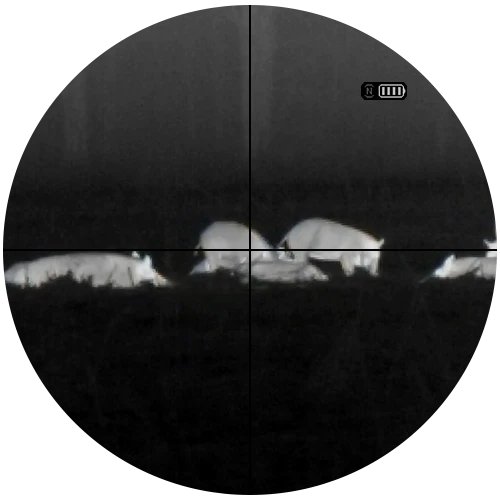
Who it is for: the hunter who wants the sharpest ATN thermal binocular and regularly works long, open ground. Who it is not for: the budget-first buyer, since the value-tier 384 already covers most hog nights for less outlay.
A real scenario: long-range open ground
Now put the 640 on a big, flat piece of ag land — a half-mile of bare stubble with a low rise at the back. On that ground the pigs often show up first as tiny, unmoving dots near the limit of what any thermal can catch. This is where the extra dots in the 640 sensor pay off. At the same distance a 384 might give you a warm smudge you cannot quite trust, while the 640 holds enough shape that you can tell a hog from a lone deer or a warm bale. The wider 3x low end lets you sweep the whole field in a few passes instead of grinding across it, so a pack that trots out of the far cover gets caught early. You range them, watch which way they drift, and pick a route while they are still a long way off. On short fields none of that matters — but on wide-open country the step-up tier turns a night of guessing into a night of clear calls, and that is precisely what you are paying more for.
What separates the two tiers on a hog field
Strip away the marketing and only four things really change between these tiers on a real pig night. Sensor resolution comes first: 384x288 versus 640x512 is roughly the jump from standard definition to high definition — the 640 paints the same hog with far more dots, so it stays a hog and not a blob as you zoom or push the range. NETD is the second, and here both tiers are equal at <=15 mK; that low millikelvin figure means the sensor reads tiny heat differences, so a bedded pig only a degree or two warmer than the dirt still lights up instead of blending in. Detection range is the third lever — 2750 m on the value tier against 3100 m on the step-up — and while neither of those is a shooting distance, more detection range means you spot movement sooner and have longer to set up. Magnification band is the fourth: the 384's 44x top end is built to dwell and identify far off, the 640's wider 3x low end is built to sweep big country fast. Put those together and the picture is simple. On tight fields and food plots, resolution and reach barely matter, so the value tier wins on capability per tier of spend. On sprawling open ground where pigs are distant specks, the sharper sensor and the wider sweep of the step-up tier earn their keep.
How to choose your tier
Choose your tier by how far you truly need to identify a pig, not by chasing the biggest number on the box.
- Range of your ground — small fields and food plots favour the value-tier 384; wide leases favour the step-up 640.
- Zoom versus width — the 384's 44x top end dwells on distant pigs; the 640's wider low end scans faster.
- Sensor sharpness — 640x512 identifies at extreme range; 384x288 is plenty for most hog distances.
- Shared kit — both give you the 1000 m rangefinder, GPS, IR illuminator and roughly 8-hour battery, so no tier feels stripped.
How we picked these ATN thermal binoculars
We ranked by tier using the specs that decide a hog night — sensor resolution, NETD sensitivity, detection range, magnification band, weight and battery — judged against real pack-hunting on dark fields, and only across ATN's current 6th-gen Binox-6 line. The honest trade-off: the value-tier 384 gives up outright sensor sharpness and a little reach to the 640, while the 640 gives up nothing but costs more, so 'budget' here means the smartest capability per tier of spend rather than the cheapest possible box. This is an in-house comparison of ATN's own range, not an independent lab test — check the numbers against your ground. Who neither is for: a hunter who only needs a quick handheld thermal for close brush, where high-magnification binoculars are more optic than the job needs.
Frequently Asked Questions
What makes thermal binoculars good for budget hog hunting?
A sensitive sensor that separates a warm pig from cool ground, enough magnification to identify at field distance, and a built-in rangefinder so you are not carrying extra gear. The Binox-6 384x288 delivers all three at the value tier.
Is the 384x288 Binox-6 enough for hogs?
Yes, for most hunting. Its 384x288 sensor and <=15 mK sensitivity pull pigs cleanly out of the background, and the 5.5-44x zoom reaches across typical fields. Step up to the 640 only if you must identify pigs at extreme range.
Why do these have a built-in rangefinder?
So you can measure the distance to a sounder without a second device — the Binox-6's laser rangefinder is good to 1000 m with about a meter of accuracy. That helps you decide whether a stalk is worth it before you move.
How long will the battery last on a hog hunt?
About 8 hours on the internal pack, and because it runs on two 18650 cells you can carry charged spares to swap in for an all-night sit. Both tiers share this.
Do I need thermal binoculars if I already have a thermal scope?
Many hog hunters carry both — binoculars for scanning and confirming, the scope for the shot. Scanning with a binocular saves swinging a loaded rifle around to search, which is safer and less tiring.
What is the real difference between the two tiers?
The value-tier 384x288 has a 44x top end and lower price; the step-up 640x512 has a sharper sensor and longer 3100 m detection. Both share the rangefinder, GPS and 4-in-1 vision.
Does NETD matter for spotting hogs?
Yes, a lot. NETD measures how small a temperature difference the sensor can read, and both Binox-6 tiers sit at <=15 mK. That low figure is why a bedded pig only a degree or two warmer than the ground still shows up as a clear shape instead of blending into the dirt, especially on cool, damp nights when heat contrast is weak.
Can I use these binoculars in daylight too?
Yes. Both tiers are 4-in-1 optics with a 4K day sensor, so they work as day binoculars, thermal scanners, night vision and twilight glass. For hog hunting that means one unit covers scouting a food plot in the afternoon and scanning the same field for pigs after dark, which is a big part of why they earn their place on the value tier.
Ready to pick your tier? Start with the value-tier ATN Binox-6 Dual 384x288 5.5-44x if you want the most hog-hunting capability for the money, or browse the full ATN thermal binoculars range to weigh the step-up 640 against it. Either way you get a 4-in-1 optic with a built-in rangefinder that turns a dark field of warm shapes into a clear picture of where the pigs are.
Created: August 5, 2026 · 19:53:41 UTC