If you hunt hogs, you already know they do their damage in the dark and they never take a season off. The tool that levels the field is a thermal binocular you can scan with all night, and the smart way to shop for budget thermal binoculars hog hunting is to match the optic to the season you hunt hardest. This roundup does exactly that, using ATN's current 6th-generation thermal binoculars line and leading with the ATN Binox-6 Dual 640x512 as the value anchor across the calendar.
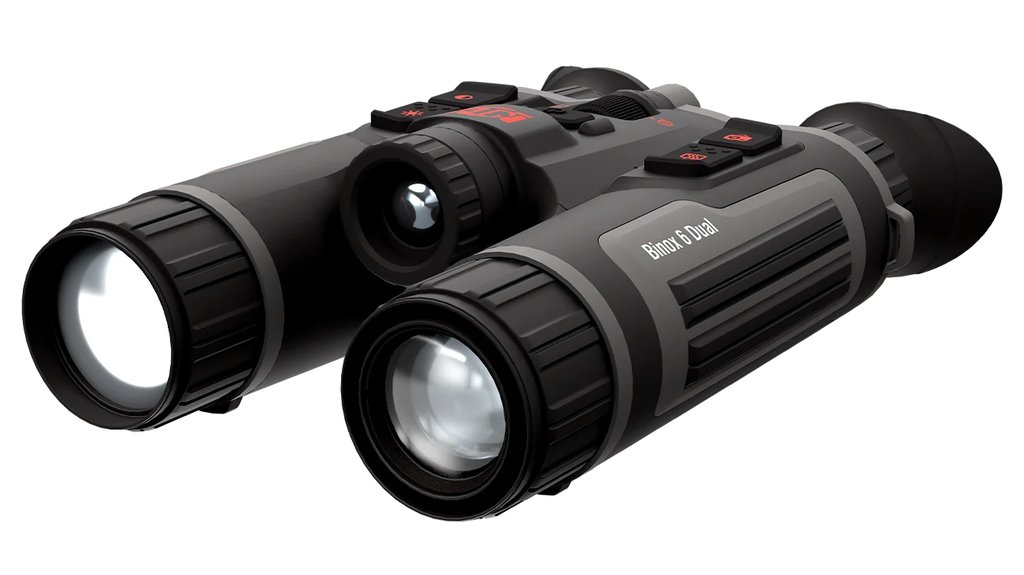
Why organize by season at all? Because thermal contrast is a weather story. In summer, sun-soaked dirt, rocks and tree trunks hold heat well after dark, so a hog stands out less and you need resolution and a low NETD to separate the animal from the background. In winter, cold ground makes a warm pig glow like a lantern, so reach and magnification matter more than raw pixel count. The Binox-6 family covers both ends, and "budget" here means the smartest value in a serious optic — not a throwaway toy that dies its first wet night.
Summer pick: ATN Binox-6 Dual 640x512 3-24x
Late-summer hog hunting is the toughest thermal test of the year. The ground has soaked up heat all day, so at midnight the whole scene reads warm and a pig no longer pops. This is where sensor resolution earns its place. The Binox-6 640x512 carries a 640x512 thermal sensor with an ≤15 mK NETD rating, which is the number that governs how well the optic separates a hog from hot dirt only a few degrees cooler. A finer sensor and a lower NETD together turn a vague smudge into a readable animal you can count legs on.
- 640x512 thermal sensor — the detail you want when summer ground is warm and contrast is thin.
- ≤15 mK NETD — a low sensitivity figure that keeps edges crisp in muggy, heat-soaked air.
- 3-24x magnification — a wide 3x base for sweeping a field fast, up to 24x to confirm a sounder before you commit.
- Detection out to 3100 m — you spot heat long before pigs are anywhere near a stand.
- Built-in laser rangefinder — range a hog to within a meter without a second device on your belt.
The 640x512 is the pick if you do most of your damage-control hunting in the warm months, when crops draw sounders in and the heat works against you. It is also the honest all-rounder: buy this one and you are covered from July stubble to January frost.
Cold-weather pick: ATN Binox-6 Dual 384x288 5.5-44x
Winter flips the problem. Cold ground gives a warm hog enormous natural contrast, so you no longer need every last pixel to see the animal — you need reach to work bigger, opener country and enough zoom to read a distant sounder before you close the gap. The Binox-6 384x288 answers that with a 5.5-44x magnification range, the widest zoom in the family, on a 384x288 sensor that still holds the same ≤15 mK sensitivity.
- 5.5-44x magnification — the standout: dial up to 44x to identify pigs across a frozen bean field.
- 384x288 sensor — plenty of resolution when winter contrast is already doing half the work.
- ≤15 mK NETD — the same low sensitivity as the flagship, so cold-morning detail stays clean.
- Detection out to 2750 m — more than enough for the long, cold sightlines of winter fields.
- Lighter at 720 g / 1.59 lbs — a touch easier to hold through a long, still, freezing scan.
This is the value-minded winter tool: it costs less than the 640 flagship, magnifies further, and leans on the season's natural contrast instead of fighting it. If your hogs move most in the cold months, start here. A frozen, wide-open bean field at 2 a.m. is the ideal setting for this binocular — the pigs stand out on their own, and all you need is the reach to read them and the patience to close the distance quietly across the crunching stubble.
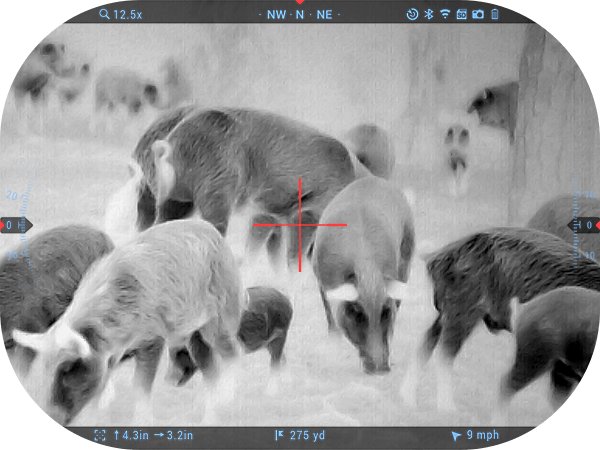
How the two picks compare
What both share for hog work
Whichever season you buy for, both binoculars are the same 4-in-1 platform: day, night, thermal and twilight modes in one housing, a 4K UHD day sensor, a laser rangefinder good to 1000 m, GPS and compass, an IR illuminator, and ATN's SharpIR AI cleaning up the image live. Both run on two swappable 18650 cells for roughly 8 hours, so a spare set in a chest pocket turns an all-night sit into a battery change rather than a dead unit. DeFog and Wide Dynamic Range keep the picture usable when a river bottom fogs over at 3 a.m.
Shoulder seasons: spring green-up and fall pressure
Summer and winter are the extremes, but hogs damage crops and dodge pressure in spring and fall too, and those shoulder seasons ask their own questions of a thermal binocular. In spring green-up, fresh vegetation holds moisture and moderate warmth, so contrast sits somewhere between the summer washout and the winter glow. The Binox-6 640x512 is the safer spring choice for the same reason it leads summer: more resolution and the low ≤15 mK NETD keep a hog crisp when the background is a patchy mix of warm and cool. In the fall, hogs get educated and nocturnal fast under hunting pressure, and long, careful glassing sessions become the norm — here the lighter 384x288 and its deep 44x zoom let you sit back, stay unseen, and read a wary sounder from far enough away that you never bump it.
- Spring green-up — mixed contrast; lean on the 640x512 for cleaner separation.
- Fall pressure — wary, long-range pigs; the 384x288's 44x zoom keeps you back and hidden.
- Either shoulder season — the 4K day mode doubles the binocular as a daytime scouting glass for finding sign and travel routes.
A season-by-season buying rule of thumb
If you take one thing from this roundup, make it this: buy for the season you hunt hardest, not the biggest number on the spec sheet. A hunter who runs summer crop-damage patrols on warm ground should start with the 640x512, because heat-soaked dirt is where resolution and low NETD matter most. A hunter whose pigs move mostly in cold, open winter country will get more real value from the 384x288, which magnifies further and rides on winter's natural contrast. And if your hunting spreads evenly across the calendar, the 640x512 is the honest do-everything pick — it never leaves you short in the hard summer months and still performs the rest of the year. Both are the same durable, IP67-sealed platform, so whichever you pick will run through a full season of dew, frost and river-bottom fog without complaint.
How we picked these ATN thermal binoculars
This is an in-house comparison of ATN's own current range, not an independent lab review, so treat it as an honest starting point and check the specs against the way you actually hunt. We judged the two Binox-6 variants on the things that decide a hog night — sensor resolution and NETD for separating an animal from warm ground, magnification and detection range for the distances you really shoot, and weight and battery for a full scan — and we weighted each by season rather than crowning one "best" for everyone. We only consider the 6th-generation line. The honest trade-off: neither of these is the cheapest thermal you can find, and if you only glass a field a couple of times a year, that is a fair reason to wait. Who it is not for: the once-a-season casual looker who wants the rock-bottom price above all else.
Frequently Asked Questions
Are thermal binoculars better than a monocular for hog hunting?
For scanning, yes — two eyes reduce fatigue over a long night and give you better depth sense when a sounder is moving through cover. The Binox-6 also adds a rangefinder and day optics a monocular usually lacks, so it doubles as your scouting glass.
Do I need the 640 sensor, or is 384 enough for hogs?
Both work. The 640x512 gives cleaner detail when summer ground is warm and contrast is thin; the 384x288 leans on winter's natural contrast and trades some pixels for far more zoom. Buy for the season you hunt hardest.
How far away can I spot a hog with these?
Detection reaches 3100 m on the 640 and 2750 m on the 384 — that is spotting a heat signature, not identifying it. You will confirm and count a sounder well inside that, then use the built-in rangefinder before a shot.
Will they work in summer when the ground is hot?
Yes, and that is exactly why the 640x512 leads the summer pick. Heat-soaked ground shrinks contrast, so the higher-resolution sensor and the low ≤15 mK NETD are what keep a hog readable when everything reads warm.
How long does the battery last on an all-night hunt?
Roughly 8 hours on two 18650 cells, and the cells are user-swappable. Carry a charged spare pair and you can cover dusk-to-dawn without the optic going dark on you.
Can I use these binoculars in daylight too?
Yes. Both are 4-in-1 units with a 4K day sensor plus thermal, night and twilight modes, so the same binocular scouts sign in the afternoon and hunts pigs after dark.
Does the season really change which model I should buy?
It genuinely does. In summer, heat-soaked ground shrinks contrast, so the 640x512's extra resolution and low NETD keep a hog readable. In cold winter, a warm pig already glows against frozen ground, so the 384x288's deeper 44x zoom and lighter weight matter more. Matching the optic to the season you hunt hardest is the smartest way to spend a budget.
Are ATN thermal binoculars tough enough for a full season of hog hunting?
Yes. Both Binox-6 models carry an IP67 seal, so dust cannot get in and rain, dew and river-bottom fog do not stop them. They are built to ride in a pack or around your neck through summer humidity and winter cold alike, night after night, without babying.
Ready to pick your season? Compare the ATN Binox-6 Dual 640x512 against the rest of ATN's thermal binoculars and match the optic to the months you hunt hardest. The right glass turns a dark field into a hog you can actually see.
Created: August 5, 2026 · 19:53:41 UTC