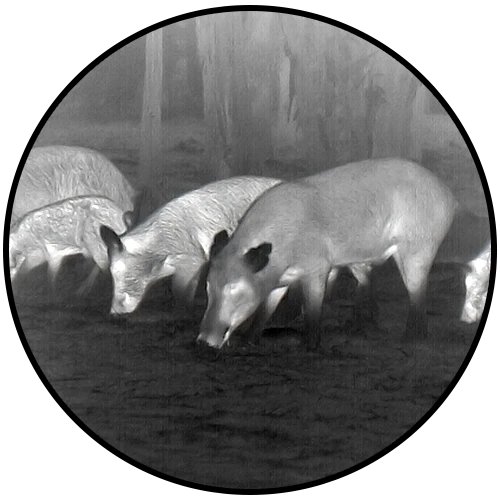
Hogs are a two-eyed problem. They move in groups, drift through cover at last light, and can cover ground fast once they break, so glassing them for a night is far easier on two eyes than one squinted through a monocular. That's why a lot of hog hunters want binoculars — and why they want them affordable, since the glass rides in your hand all night while the rifle does the shooting. The budget thermal binoculars hog hunting shopper is after the most capable pair that doesn't reach for the top shelf. The ATN Binox-6 Dual 384 is that pair, and this guide frames it against the flagship 640 so you can see where the smart-money line falls.
The ATN Binox-6 Dual 384x288 5.5-44x is the best budget thermal binoculars pick for hog hunting in 2026. Its 384 sensor, high 5.5-44x magnification, 2750m detection and built-in laser rangefinder cover a full night of glassing hogs, in a two-eyed 4-in-1 package for less than the flagship. Step up to the Binox-6 Dual 640 only if you need the sharpest possible picture at extreme range.
Quick answerBest budget hog glass overall: ATN Binox-6 Dual 384x288 5.5-44x — high magnification, ranging and a 4-in-1 view at the value tier, ideal for glassing and grouping up hogs.
Step up if you need it: ATN Binox-6 Dual 640x512 3-24x — the flagship sensor for the sharpest picture and longest reach across big country.
Bottom line: for most hog hunters, the 384's magnification and ranging do the whole job without paying flagship money.
Why ATN's 6th-gen Binox-6 makes budget hog glass easy
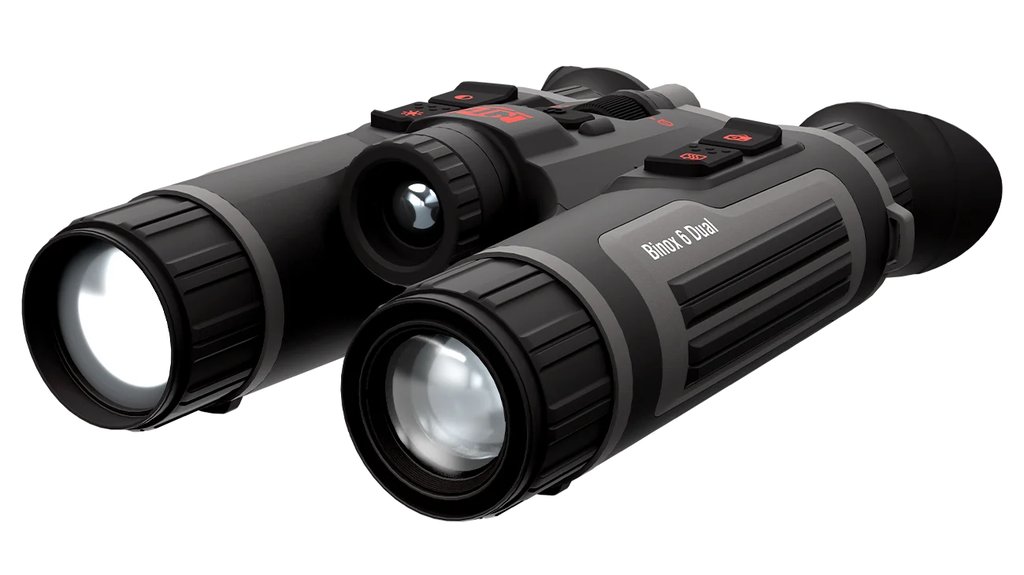
ATN's 6th-generation Binox-6 makes a budget choice easy because both variants share the same rich feature set, so the value pair isn't a stripped-down tool — it's the same platform with a smaller sensor. Both are true 4-in-1 optics, switching between Day, Night, Thermal and Twilight, so a single pair covers a hog hunt from the last of daylight into full dark. Both pack a 4K Ultra HD CMOS day sensor, a built-in laser rangefinder that reads to 1000 yards within about a meter, SharpIR AI image enhancement, Wide Dynamic Range, a DeFog mode, a Smart IR illuminator and Hot Point Tracking to flag the hottest object in a sounder. Six color palettes let you match contrast to the terrain, Dual View Switching and Picture-in-Picture help you scan and confirm, and both carry GPS, a compass, dual replaceable 18650 batteries for about eight hours, 64 GB of storage and an IP67 waterproof rating. With the toolset identical, the budget question comes down to sensor resolution and reach — and for hog work, the 384's numbers land right where value lives.
Best budget hog glass: ATN Binox-6 Dual 384
The ATN Binox-6 Dual 384x288 5.5-44x is the best budget thermal binoculars pick for hog hunting because it puts the money into the parts that actually find and range hogs, and asks you to give up only the last stretch of resolution. High magnification, a full 4-in-1 view and built-in ranging make it a genuine hog-glassing tool at the value tier, not a compromise you tolerate.
High magnification that reaches into a sounder
A 5.5x base with a pull to 44x is the highest optical reach in this pair, and for hog work that matters: sounders often bed and feed at distance, and the extra magnification lets you count pigs and pick a shooter across a field before you ever move. The 384x288 sensor keeps that magnified picture usable — more dots in the picture means a distant hog reads as a shape, not a smear, as you zoom in. That reach-and-clarity balance is the core of why the 384 is the smart budget pick.
Ranging and a 4-in-1 view for the whole night
The built-in laser rangefinder reads out to 1000 yards within about a meter, so when you spot a sounder you get the exact distance to call the stalk or hand the number to your shooter. A 2750m detection range covers a full field, and the 4-in-1 Day / Night / Thermal / Twilight modes mean one pair works from the last light into full dark — the exact window hogs move. A <=15mK NETD keeps the picture clean in the humidity hogs love, and dual 18650 batteries run about eight hours for a full night out.
Who it's for and who it isn't
It's for the hog hunter who wants a two-eyed thermal for glassing, counting and ranging sounders without paying flagship money. It's not the pick if you must pull the sharpest possible detail at the very edge of detection across huge open country — that's where the flagship 640's resolution pulls ahead, and where the extra spend is justified.
Step up if you need it: ATN Binox-6 Dual 640
The ATN Binox-6 Dual 640x512 3-24x is the flagship, and it's the pick when the sharpest possible picture at long range is worth the extra spend. It shares the 384's ranging, 4-in-1 view and full feature set, then adds a higher-resolution sensor and a touch more detection reach for hunting the biggest country.
The sensor step that shows at distance
Moving to a 640x512 sensor roughly doubles the dots in the picture over the 384 — the leap from standard definition toward a much crisper HD — so a far-off hog holds detail deeper into the zoom and identifies cleaner. Its 3100m detection range edges out the budget model, and a 3-24x span trades some top-end magnification for a wider base field of view that speeds scanning big ground. For a hunter working large ag fields or pasture, that clarity at the edge of detection is the reason to step up.
Who it's for and who it isn't
It's for the hunter on big open country who wants the crispest long-range picture and will pay for it. It's not for you if your hog ground is fields and edges within a few hundred yards — there, the budget 384's high magnification and ranging cover the job, and the flagship's extra resolution is headroom you rarely tap.
Why binoculars suit hog hunting on a budget
Hog hunting rewards patient, comfortable glassing, and that's the case for two-eyed thermal even when you're watching the budget. Sounders show up as clusters of heat that you have to count, sort and watch for a shooter, and doing that for an hour on one eye is genuinely tiring — two eyes stay relaxed and catch subtle movement longer. A monocular is cheaper, but for the hunter who scans more than they shoot, binoculars earn their place. The budget move isn't skipping binoculars; it's choosing the value sensor. The Binox-6 Dual 384 keeps the ranging, the 4-in-1 view and the high magnification that make hog glassing effective, and saves only on the resolution you'd feel at extreme range — the least-used stretch for most hog ground.
Two budget hog scenarios
- Field-edge sounder hunter — if you glass ag fields and food plots for groups within a few hundred yards, the Binox-6 Dual 384's magnification and ranging are the value pick and the flagship's reach is headroom.
- Roaming property patrol — walking a place at night to locate hogs before setting up rewards a light, all-in-one pair, and the 384's 4-in-1 view and eight-hour battery handle it without flagship cost.
- Big-country long-range glasser — if you scan huge open ground and want the crispest ID at the edge of detection, the Binox-6 Dual 640's sensor is worth the step up.
How to choose budget thermal binoculars for hogs
Buying budget hog glass is about protecting the features that find pigs and saving on the reach you rarely use. Run through these:
- How far do you glass hogs? — If most sounders are within a few hundred yards, the Binox-6 Dual 384's 2750m reach is plenty and the flagship's extra range is headroom.
- Do you need to range? — A built-in laser rangefinder turns a spotted sounder into an exact distance; both Binox-6 pairs include one, so you don't pay extra for it at the budget tier.
- Do you hunt across the light change? — A 4-in-1 Day / Night / Thermal / Twilight view lets one pair work dusk to dark, which is exactly when hogs move.
- How much magnification do you want? — The budget 384's 5.5-44x reaches deep into a distant group; the flagship 640 trades some top zoom for a wider scanning base.
- What are your conditions? — A low <=15mK NETD keeps the picture clean in the humidity hogs favor; both pairs share it.
- How long are your nights? — Both run about eight hours on dual replaceable 18650s, so plan a charged spare set for back-to-back hunts.
Put both variants side by side in the full ATN thermal binoculars range, and if value is your whole angle, our best thermal binoculars for the money for hog hunting guide digs deeper into price-to-performance.
How we picked these budget ATN thermal binoculars
Here's the honest logic behind the pick. Both pairs come only from ATN's current 6th-generation Binox-6 line — nothing discontinued padding the list. For budget hog glassing, the specs that decide the hunt carried the weight: sensor resolution and detection range to find and identify sounders, magnification to reach into a distant group, NETD for a clean picture in humidity, and the built-in rangefinder for exact distances, then battery and weight for a full night in hand. Trade-offs are stated plainly — the 384 gives up resolution at extreme range, the 640 costs more for it. These are ATN's own optics, so treat this as a candid in-house comparison of the range rather than an independent lab test, and check the specs against how and where you hunt hogs.
Frequently Asked Questions
What are the best budget thermal binoculars for hog hunting?
The ATN Binox-6 Dual 384x288 5.5-44x is our 2026 budget pick for hogs. It pairs a 384 sensor, high 5.5-44x magnification, 2750m detection and a built-in laser rangefinder in a two-eyed 4-in-1 package, covering a full night of glassing sounders for less than the flagship. It keeps the features that find hogs and saves only on extreme-range resolution.
Are thermal binoculars better than a monocular for hogs?
For glassing, often yes. Hogs travel in groups you have to count and watch, and doing that for a night is far easier on two relaxed eyes than one. A monocular is lighter and cheaper, but the Binox-6's two-eyed comfort and 4-in-1 view make long hog-glassing sessions less tiring.
Does the budget Binox-6 Dual 384 have a rangefinder?
Yes. The built-in laser rangefinder reads out to 1000 yards within about a meter, so when you spot a sounder you get the exact distance immediately. Both the budget 384 and the flagship 640 include it, so ranging isn't a feature you sacrifice by choosing the value pair.
How is the Binox-6 Dual 384 different from the flagship 640?
They share the same ranging, 4-in-1 view, NETD and full feature set. The 384 has a value sensor with higher 5.5-44x magnification, while the flagship 640 has a sharper 640x512 sensor, a bit more detection range and a wider 3-24x base. The 640 is worth it only if you need the crispest picture at long range.
How far can the budget Binox-6 detect a hog?
The Binox-6 Dual 384 detects heat out to about 2750m. Detection means catching a signature; counting and identifying a sounder happens closer than that maximum, which is where the high 5.5-44x magnification helps. That reach covers a full field and most hog-glassing distances.
Can I use these binoculars during daylight too?
Yes. The Binox-6 is a 4-in-1 optic with Day, Night, Thermal and Twilight modes and a 4K day sensor, so one pair works from midday scouting through full dark. That versatility is a big part of why it suits hog hunting, where the action spans the light change.
Will the battery last a night of hog glassing?
Yes. The Binox-6 Dual 384 runs about eight hours on dual replaceable 18650 batteries, which covers a typical night out. The batteries swap quickly, so a charged spare set gets you through the longest sits or a second night without a recharge.
Budget hog glass shouldn't skip the parts that find pigs, and the ATN Binox-6 Dual 384 keeps them all — high magnification, built-in ranging and a dusk-to-dark 4-in-1 view, for less than the flagship. If you need the crispest long-range picture, the Binox-6 Dual 640 and the rest of the ATN thermal binoculars line step up cleanly. Pick the pair that matches your ground, charge the cells, and let two eyes do the finding while the rifle waits.
Created: July 7, 2026 · 14:32:46 UTC