At the top of the budget — five thousand dollars — you should stop paying for reach alone and start paying for precision. The gear that earns this money doesn't just show you an animal far away; it tells you exactly how far, and it puts the right holdover on the reticle before you press the trigger. That is what separates the best thermal scope under 5000 from a merely long-range one: a built-in rangefinder and a ballistic solution, so the distant shot is a known quantity, not a guess. The ATN ThOR 6 LRF 640 is built around exactly that, and it lands at $4,495 — under the mark.
Best for one-shot precision: ATN ThOR 6 LRF 640 — range, solve, and hold, all inside the scope.
Best value alternative: ATN ThOR 6 384 — for hunters who don't need integrated ranging and want to keep budget back.
Why ATN's 6th-gen LRF scope defines the under-$5,000 class
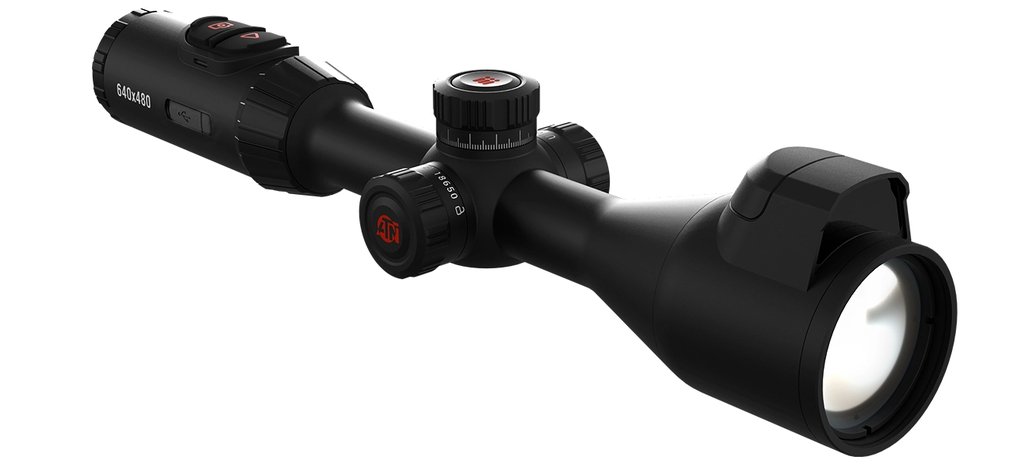
The jump from a long-range scope to a precision one happens when ranging moves inside the optic. ATN's 6th-generation ThOR 6 LRF 640 makes that jump under five thousand dollars. On top of a 640x512 sensor — the highest dot count in the family, so a distant animal holds its shape — it carries a built-in laser rangefinder good to 1,000m at plus-or-minus one meter, using an eye-safe 905nm Class 1 laser. Range the target and a ballistic calculator with up to six profiles works the solution, so you get the correct holdover instead of estimating drop in the dark. Feeding all of that is a 50mm F/1.0 objective and a 3,650m detection range, with SharpIR AI enhancement sharpening the frame and a NETD of 15mK or better keeping the picture readable in fog and humidity. A 50Hz refresh keeps a moving target smooth even far out. In short, everything the reach-class scope does, plus the two tools — ranging and ballistics — that turn a long shot into a confident one. That integration is what defines this class and what the picks below are measured against.
Best overall under $5,000: ATN ThOR 6 LRF 640 3-24x
The ATN ThOR 6 LRF 640 3-24x comes in at $4,495 — a real current price under the $5,000 line — and every dollar of that premium over a standard 640 scope buys integration. The rangefinder and ballistic calculator live inside the scope, so the whole range-solve-hold sequence happens without lowering the rifle or reaching for a separate device. That is what makes it the precision pick.
Range, solve, and hold without breaking position
The built-in laser rangefinder reads distance to 1,000m at plus-or-minus one meter, and the ballistic calculator — carrying up to six rifle profiles — turns that reading into the correct holdover on the reticle. You range the animal and take the shot from the same position, which matters most on the committed long shots where a guessed distance is the difference between a hit and a miss.
Clarity and reach to match the ranging
None of the ranging helps if the picture is soft, so the LRF scope pairs it with the full reach package: the 640x512 sensor keeps a distant animal identifiable, the 50mm F/1.0 objective feeds a 3,650m detection range, and SharpIR sharpens the frame in real time. A 50Hz refresh keeps motion smooth. Two replaceable 18650 batteries give around 9 hours, with 64GB storage, Recoil Activated Video, ATN Connect 6 streaming, and an IP67 waterproof build.
Who it's for: the hunter taking deliberate long-range shots who wants ranging and ballistics built in, not bolted on. Who it's not for: close, fast hunters who'll never use the rangefinder — they're paying for integration they won't touch.

Best value alternative: ATN ThOR 6 384
If integrated ranging isn't part of how you hunt, the ATN ThOR 6 384 (2.5-20x) is the sensible alternative that keeps a lot of budget back. It runs the same 6th-gen brains — SharpIR, 50Hz refresh, IP67 build, app connectivity — on a 384x288 sensor with a 25mm objective and a 2,300m detection range. There's no rangefinder or ballistic calculator, but for versatile, moderate-range hunting you may not need them.
Who it's for: the all-round hunter who ranges by feel or a separate tool and wants to save. Who it's not for: precision long-range shooters who want the solve built into the optic.
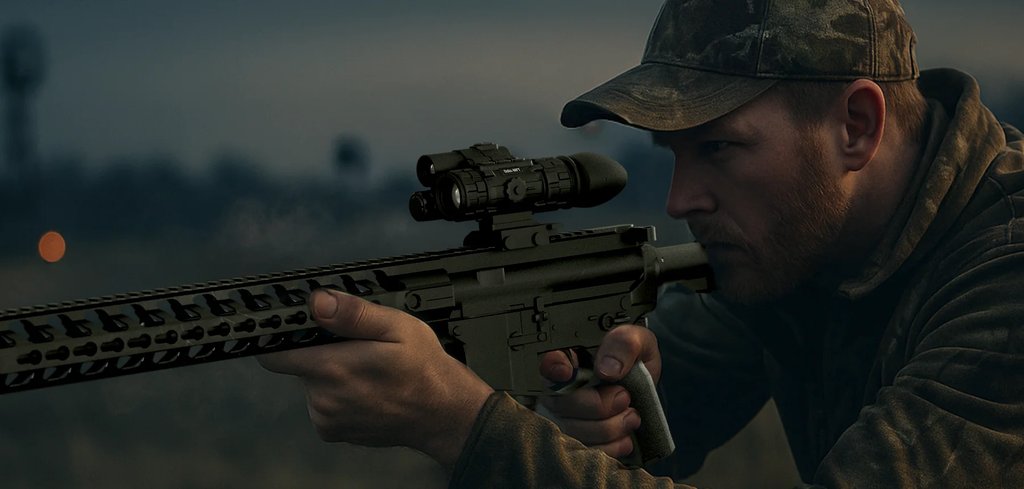
How the built-in ranging changes the shot
The reason integrated ranging is worth the top of this budget comes down to what happens in the seconds before a long shot. Without it, you spot the animal, guess the distance, dial or hold what you think is right, and hope — and at real distance a fifty-yard misjudgment is a clean miss or, worse, a wounded animal. With the ThOR 6 LRF 640 the sequence is different. You put the reticle on the coyote, tap the rangefinder, and get an exact distance to plus-or-minus a meter. The ballistic calculator — loaded with your rifle's profile — instantly returns the correct holdover on the reticle. You never lower the rifle, never break your position, never reach for a handheld unit and lose the animal in the dark while you fumble. On a still night that whole chain takes a couple of seconds, and it turns a hopeful long poke into a shot you can actually commit to. That's the difference between a scope that shows you something far away and one that helps you hit it.
Up to six profiles for your rifles
If you hunt more than one rifle — a lighter setup for coyotes, a heavier one for hogs — the ballistic calculator holds up to six profiles. You switch profiles instead of re-entering load data in the field, so the holdover the scope gives you always matches the rifle on your shoulder. It's a small thing until you own two rifles, and then it's the feature that keeps the ranging honest across your whole rack.
How to choose a precision thermal scope under $5,000
At this level you're paying for integration, so make sure it's integration you'll actually use:
- Built-in rangefinder — ranging inside the scope means you don't break position to measure distance. On the ThOR 6 LRF it reads to 1,000m at plus-or-minus one meter.
- Ballistic calculator — a scope that solves the holdover for you removes the guesswork on long shots; look for multiple rifle profiles.
- Sensor resolution — 640x512 so the distant animal you just ranged is still identifiable.
- Objective and range — a 50mm objective and a long detection range so the reach matches the ranging.
- Only pay for what you'll use — if you never take shots long enough to need ranging and ballistics, a standard scope like the 384 is the smarter spend.
How we picked these ATN thermal scopes
This is an in-house comparison of ATN's current range, not an independent lab test, so here's the honest method. We kept the field to the 6th-generation ThOR line — no discontinued models — and asked which scope makes the best use of a five-thousand-dollar ceiling. Because that budget unlocks integrated ranging, we judged the built-in rangefinder and ballistic calculator alongside the usual criteria: sensor resolution, NETD, objective size, detection range, refresh rate, weight, and battery, all against real precision long-range use. Then we confirmed the current price sat under the line. The trade-off is plain: the ThOR 6 LRF 640 is a precision instrument, so its rangefinder and ballistics are wasted on close, fast hunts — and that integration is why it costs more than a standard scope. If you won't use the ranging, the 384 alternative is the better value. Match these specs to how far and how deliberately you actually shoot before you buy.
Frequently Asked Questions
What is the best thermal scope under 5000?
The ATN ThOR 6 LRF 640 3-24x is our pick for the best thermal scope under 5000. At $4,495 it sits under the $5,000 line and adds a built-in 1,000m laser rangefinder and a ballistic calculator on top of a 640x512 sensor and a 3,650m detection range.
How much does the ATN ThOR 6 LRF 640 cost?
The ATN ThOR 6 LRF 640 3-24x is priced at $4,495, keeping it under the $5,000 budget. The premium over a standard 640 scope buys the integrated rangefinder and ballistic calculator.
How accurate is the built-in rangefinder?
The ThOR 6 LRF 640 has a built-in laser rangefinder that reads distance to 1,000 meters with plus-or-minus one meter accuracy, using an eye-safe 905nm Class 1 laser. That precision feeds the ballistic calculator so you get the right holdover.
What does the ballistic calculator do?
It takes the ranged distance and your rifle's load data and works out the correct holdover, showing it on the reticle. It supports up to six rifle profiles, so you can switch between setups without re-entering data.
Do I need a rangefinder scope, or is a standard 640 enough?
It depends on how you hunt. If you take deliberate long-range shots, integrated ranging and ballistics make each shot a known quantity and are worth the premium. If your shots stay closer, a standard scope like the ATN ThOR 6 384 covers you for less.
How far can the ATN ThOR 6 LRF 640 detect?
It has a detection range of 3,650 meters, fed by its 50mm objective and 640x512 sensor. Detection range is how far heat is picked up; the rangefinder then measures exact distance to your target out to 1,000 meters.
Does it work in rain and fog?
Yes. Its NETD of 15mK or better keeps the image readable in humid and foggy air, and it is IP67 waterproof, so rain and dew are not a concern. Reliable weather performance matters most on the long shots this scope is built for.
If your shots are long and deliberate, the ATN ThOR 6 LRF 640 puts ranging and ballistics inside the scope — range to 1,000m, solve the holdover, and shoot without breaking position — all for $4,495, under the $5,000 line. Compare it with the standard 640 and the value 384 on the ATN thermal scopes page, decide whether integrated ranging fits how you hunt, and buy the precision you'll actually use.
Created: July 7, 2026 · 19:23:07 UTC