Coyotes do not walk up to the truck. They hang at the edge of the field, circle downwind, and give you one narrow window at distance before they wise up and vanish. A rig built for that has to reach — you need to spot the glow, confirm it is a dog and not a deer, and hold enough magnification to place the shot before it moves. That is what the best thermal scope coyote hunting 2026 pick has to deliver, and it is why we lead with the ATN ThOR 6 640x512 3-24x: a 50mm lens, 640 clarity and 3650m of detection built for the long, open shots coyotes give. This roundup ranks the 6th-gen ThOR 6 scopes for the 2026 predator season.
For 2026 coyote season the best thermal scope coyote hunting pick is the ATN ThOR 6 640x512 3-24x: a 50mm lens and 640 sensor push detection to 3650m, so you spot and identify dogs at the ranges they actually give you. Add the LRF version when you want an exact distance before the trigger.
Quick answerBest overall for coyotes: ATN ThOR 6 640x512 3-24x — 50mm lens, 640 sensor, 3650m detection for long open-field shots.
Best for ranged precision: ATN ThOR 6 LRF 640x512 3-24x — the same reach plus a built-in laser rangefinder and ballistic calculator, so you know the exact distance before you break the shot on a called-in dog.
Why ATN's 6th-gen ThOR 6 owns the 2026 coyote rig
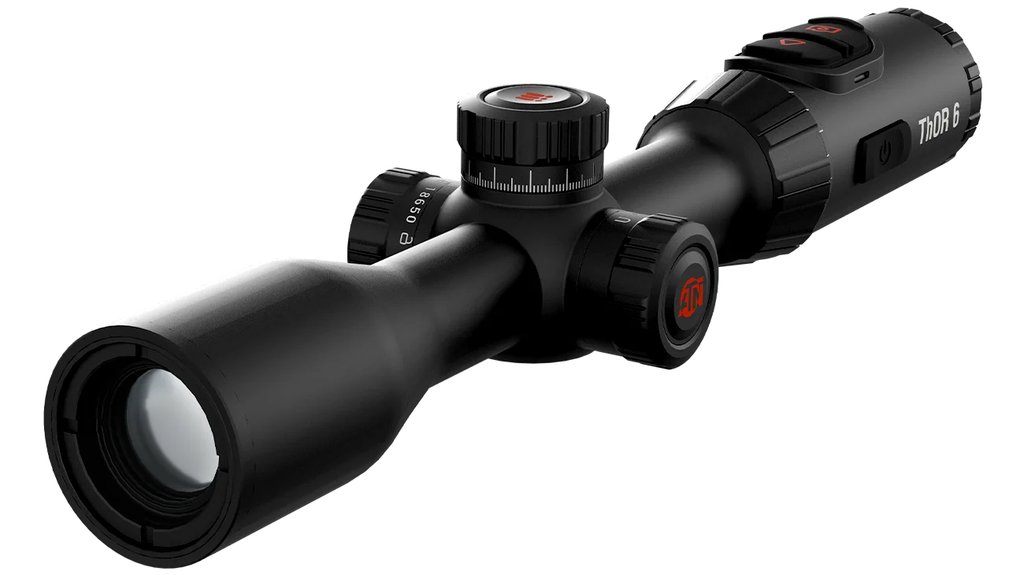
Coyote hunting rewards reach and clarity, and the 6th-gen ThOR 6 640 was built to give both. The 50mm germanium objective gathers a lot of heat signal, and paired with the 640x512 sensor it drives detection out to 3650 meters. In plain terms: you catch the glow of a distant dog earlier and, because 640 packs more dots into the frame, you can zoom in to confirm the pointed ears and low tail before you ever touch the trigger. The 3-24x magnification range covers the wide scan and the tight aim, so one optic handles a coyote circling the far treeline and one that hangs up at the call. <=15mK sensitivity keeps the animal readable in the damp, foggy air common on a still winter stand, and SharpIR cleans the edges so the picture does not go mushy at high zoom. Add the 50 Hz refresh for smooth tracking of a trotting dog and Hot Point Tracking to keep your eye on the mark, and you have a rig that answers the way coyotes actually behave: fast, wary and far off.
Best overall for coyotes: ATN ThOR 6 640x512 3-24x
The ATN ThOR 6 640x512 3-24x is the scope we mount when the plan is calling dogs across open ground. Its 50mm lens and 3650m detection mean you see the far edge of the field, not just the near half of it.
Reach that matches how coyotes come
A called coyote often hangs up at distance, downwind, deciding. The 640 sensor and long detection range let you find that glow early and watch it work, and the 3-24x zoom lets you go from a wide scan to a tight hold as it commits. More dots in the picture means you can push the magnification to identify and aim without the image breaking into blocks. The 50mm objective is doing quiet work here: a bigger lens gathers more of the faint heat coming off a dog a quarter mile out, so the signature you see is brighter and cleaner than a small-lens optic would give you at the same distance. On open ground where coyotes give you the longest looks, that extra reach is often the whole difference between spotting a dog in time to set up and never knowing it was there.
Reading a dog from a deer
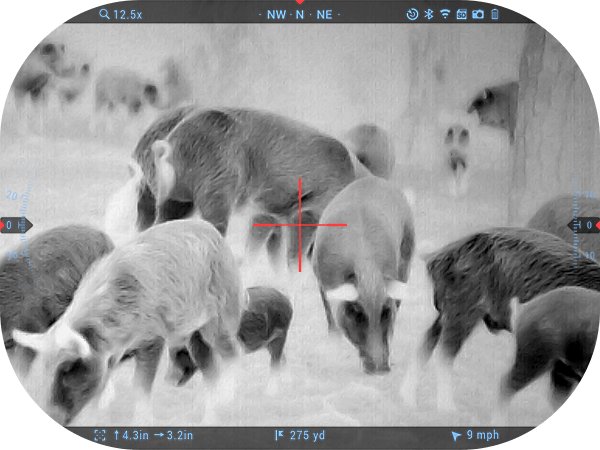
At range, positive ID keeps you legal and safe. The clean 640 image and <=15mK sensitivity make the difference between the tall body and rack of a deer and the low, pointed profile of a coyote clear even through light fog. SharpIR and the Full-HD OLED hold that detail as you zoom.
Who it's for, who it's not
This is for the predator hunter who works open country and wants maximum reach and clarity. It is not the pick if you specifically want an on-board rangefinder for precise holdovers — for that, go to the LRF version below.
Best for ranged precision: ATN ThOR 6 LRF 640x512 3-24x
The ThOR 6 LRF 640x512 3-24x takes the same long-reaching optic and adds a built-in laser rangefinder good to 1000m plus a ballistic calculator. On a coyote hanging at an unknown distance, that turns a guess into a number.
Why an exact range changes the shot
Guessing distance is where long coyote shots go wrong. The LRF returns the range to about a meter, and the ballistic calculator (up to six profiles) turns that into a precise holdover, so you break the shot on the right aim point instead of a hopeful hold. Everything else — the 640 sensor, 3650m detection, 50 Hz refresh — carries over intact.
Who it's for, who it's not
Built for the hunter who takes deliberate, longer shots and wants ranging and holdover done in the optic. Not needed if your shots are close and fast, or if you already run a separate rangefinder — the standard 640 saves a little weight and money.
Reading coyote behavior through a thermal
A big part of coyote success is not the gear but knowing what the glowing shape in your scope is about to do, and a good thermal lets you read that. A dog working a call almost never comes straight in. It swings wide to get downwind, checking the air for the thing making the sound, so the first heat signature you catch is often off to one side and moving with purpose rather than drifting like a deer. The 640 sensor and the 3-24x zoom let you watch that behavior develop: you pick the dog up far out at low magnification, follow it as it circles, and read the body language — ears up, tail low, a stiff trot — that says it is committed rather than spooked. When it hits the downwind edge and pauses to scent-check, that pause is usually your shot window. With a clear picture you recognize it; with a fuzzy one you hesitate and the dog is gone. This is why resolution and refresh rate are not just numbers on a coyote rig — they are what let you turn watching into shooting.
Terrain and weather change the read, too. On a still, humid night the air holds heat oddly and a distant coyote can look softer than it should, which is exactly where the <=15mK sensitivity earns its keep by holding the animal's outline against a warm background. In snow or on a hard-frozen field the contrast swings the other way and a dog lights up sharply — a good time to lean on Black Hot or Iron Red to keep the detail from blooming. Learning to switch palettes to match the night is a skill, and having six of them on the ThOR 6 means you always have one that reads the conditions in front of you.
The 640 versus 384 question for coyotes
For coyotes specifically, the choice between the 640 and 384 sensor comes down to how far your dogs hang up. A coyote is a small, lean animal compared to a hog or a deer, so it gives off less heat and presents a smaller target, and that puts real pressure on resolution at distance. The 640x512 sensor packs roughly twice the dots of the 384, which is what lets you keep pushing the zoom to identify a distant dog before the picture breaks into blocks. On open country where a called coyote often stops to scent-check at two, three, even four hundred yards, that extra clarity is the difference between confidently reading the pointed ears and low tail and squinting at a warm smudge. The 384 is not a bad sensor — it is genuinely capable at closer and moderate ranges, and in tighter country where dogs commit inside a couple hundred yards it will do everything you ask. But coyotes are the animal most likely to make you wish you had more resolution, because they are the ones that hang up far and refuse to close. If your ground is wide and your dogs are wary, the 640 earns its keep.
The lens size works hand in hand with the sensor here. The 640 model's 50mm objective gathers far more of the faint heat coming off a coyote at distance than a smaller lens can, so the signature you see is brighter and more defined before you have even touched the zoom. A big lens and a high-resolution sensor together are why the 640 reaches out to 3650m of detection while the 384 sits at 2300m — and on coyotes, detection range is not about shooting that far, it is about spotting the dog early enough to set up before it busts you.
Getting the most out of the ThOR 6 on a coyote stand
A great scope only pays off if you run it well, and a few habits make the ThOR 6 far deadlier on coyotes. First, start every stand at the low end of the zoom. The wide view at 3x lets you sweep the whole field and catch a dog slipping in from the side, and you only push the magnification up once you have found the animal and need to confirm or aim. Hunters who leave the scope cranked to 24x miss dogs that circle in wide, because their window is too narrow to catch the movement. Second, learn the palettes before the season, not during it. White Hot is the reliable default, but on a humid night a distant coyote can look soft, and switching to Iron Red or Black Hot often snaps the outline back into focus. Practice cycling them in the dark so it is muscle memory when a dog is committing and you have three seconds to decide.
- Sweep wide, then zoom. Scan at low magnification to find the dog, then push in to identify and aim — never hunt cranked all the way up.
- Use Hot Point Tracking on a committed dog. Once you have picked your coyote out of a pair, let the tracking hold your eye on it so you do not confuse it with a second animal.
- Set your zero once and confirm it. The ThOR 6 holds zero across the night; sight in before the season and trust it rather than second-guessing in the field.
- Let Recoil Activated Video run. It records from the shot automatically, so you can review whether a second dog was hanging back after the first went down.
- Carry a charged spare battery pair. The dual 18650 cells run about nine hours, but a long night of stand-hopping past dawn is easier with a fresh set in your pocket.
A field scenario: doubling on a pair at the field edge
Picture a frosty pre-dawn stand on the downwind corner of a pasture. You start a rabbit-in-distress sequence and begin sweeping the far treeline with the ThOR 6 640 at 3x. Ninety seconds in, two warm shapes break the treeline together — a pair coming to the call. The wide low-zoom view catches them both immediately, and because the 640 sensor keeps their outlines crisp even at four hundred yards, you can already read them as coyotes and not deer. They split as they cross the field, one swinging downwind toward your corner, the other cutting straight in. You push the zoom to hold on the closer dog, use Hot Point Tracking to keep it locked as it trots, and take it when it stops broadside at the fence post. The recoil starts the video. You swing back to find the second dog, which has stopped to look at the sound of the shot — a fatal mistake — and the clean picture lets you settle on it and finish the double. Afterward you replay the recording to confirm no third dog hung back. That whole sequence, from spotting the pair to the second shot, lived and died on resolution and refresh: seeing them early, reading them as coyotes, and keeping both smooth and trackable through the chaos.
How to choose a coyote thermal scope for 2026
A coyote rig is about seeing far and confirming fast. Weigh these against the country you hunt:
- Detection range and lens — a 50mm lens and 3650m detection let you catch dogs at the far edge; smaller optics see less of the field.
- Resolution for ID — 640x512 packs more dots so you can zoom to tell a coyote from a deer before you shoot.
- Rangefinding — the LRF's on-board laser and ballistic calculator matter for deliberate long shots; skip it for close, fast work.
- Thermal sensitivity — <=15mK keeps a dog readable in the fog and damp of a winter stand.
- Refresh rate — 50 Hz keeps a trotting or circling coyote smooth, not smeared.
- Magnification spread — 3-24x covers both the wide scan and the tight aim from one scope.
How we picked these ATN thermal scopes
We ranked these for the specific job of killing coyotes: spotting a wary dog at distance, confirming the ID, and making a precise shot before it bolts. That put detection range and lens size at the top, followed by 640x512 resolution for identification, <=15mK sensitivity for foggy stands, refresh rate for tracking movers, and on-board ranging for longer holds. Only ATN's current 6th-gen ThOR 6 family was considered, so no discontinued glass slipped in. The honest trade-offs: the long-reaching 640 optics are heavier than a compact scope, and the LRF adds a little weight and cost for its rangefinder — worth it only if you take deliberate ranged shots. This is an in-house comparison of ATN's own scopes, not an independent lab review, so line these numbers up against the ranges your ground actually offers.
Frequently Asked Questions
What is the best thermal scope for coyote hunting in 2026?
The ATN ThOR 6 640x512 3-24x is the top pick, because its 50mm lens and 640 sensor push detection to 3650m and let you identify a coyote at the long, open ranges the animal tends to give. If you want exact distances, the LRF version adds a built-in rangefinder and ballistic calculator.
Do I need a 640 sensor or is 384 enough for coyotes?
For long open-field coyote work the 640x512 sensor is worth it, because more dots in the frame let you zoom in to confirm the animal at distance without the image turning blocky. A 384 works at closer ranges, but coyotes often hang up far off where the extra resolution pays.
How does the built-in rangefinder help on coyotes?
The ThOR 6 LRF ranges targets to about a meter out to 1000m and feeds that into a ballistic calculator, so a coyote at an unknown distance gets an exact holdover instead of a guess. That matters most on deliberate, longer shots.
Can I tell a coyote from a deer through the scope?
Yes. The clean 640 image and <=15mK sensitivity make a coyote's low, pointed profile clearly different from a deer's tall body and rack, even through light fog. Always confirm the target with the magnification up before you shoot.
Will the ThOR 6 last a full night of stand-hopping?
It runs about nine hours on replaceable dual 18650 batteries, which covers a long night of moving between calling setups. Carry a charged spare pair and you can hunt past dawn without stopping to charge.
Is the 3-24x magnification range good for calling coyotes?
It is well matched to the job. The low end gives you a wide field to scan a called dog working the wind, and the high end lets you tighten up for a precise shot when it finally commits.
Chasing dogs across open country this season? The ATN ThOR 6 640x512 3-24x reaches to the far treeline and holds enough clarity to confirm the shot before a coyote figures you out. Compare it and the LRF version across the full ATN thermal scope lineup to match the reach and ranging to your ground. Zero it, load your stands, and be ready when the first dog answers the call.
Created: July 7, 2026 · 11:11:27 UTC