The gap between a hit and a clean miss is almost always the range guess. You spot a coyote sitting on a field edge, you think it's 220 yards, and it's really 290. The best thermal scope built-in laser rangefinder 2026 solves that by putting a laser inside the scope, so the number is real, not a hunch. The ATN ThOR 6 LRF is built around exactly that idea: press a button, get the distance, and let the onboard ballistic calculator move the aim point for you. This roundup looks at the ThOR 6 LRF as the pick and where its non-LRF sibling still makes sense.
Best value (no laser): ATN ThOR 6 640x512 3-24x — same 640 sensor and glass, minus the built-in laser, if you already carry a rangefinder.
Bottom line: if you want the distance handled inside the scope, the LRF is the model that earns the keyword.
Why ATN's 6th-gen ThOR line leads on ranging
A built-in laser rangefinder only matters if the rest of the scope is good enough to use the number. On the ThOR 6 LRF, the laser is paired with a 640x512 thermal sensor — think of resolution like dots in a picture, so more dots let you zoom further before the image turns blocky and you lose the animal in the fuzz. The NETD sits at 15mK or lower, which is the scope's ability to tell tiny heat differences apart; a lower figure means a cleaner picture in humid, foggy, or drizzly air when a warmer target barely stands out from the background. The 50Hz refresh keeps a trotting coyote smooth rather than smeared, so when you range it and it's still moving, the picture stays honest. Put together, the laser gives you the distance and the ballistic calculator, fed by up to six saved profiles, turns that distance into a corrected aim point. That closed loop — range, calculate, hold — is what separates a ranging scope from a thermal scope you happen to range with a handheld.
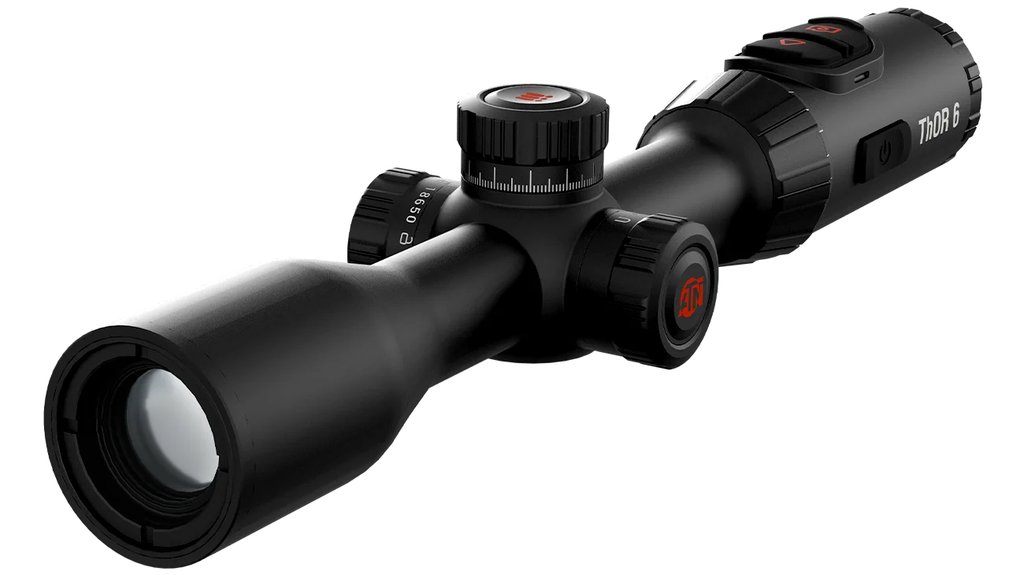
Best overall for ranging: ATN ThOR 6 LRF 640x512 3-24x
The ATN ThOR 6 LRF is the pick because it does the one job the keyword asks for and does it inside the scope. The laser reads out to 1000m within about a meter, and it's a 905nm Class 1 emitter — eye-safe, so you range without a second thought. That number drops straight into the ballistic calculator, which can hold up to six profiles for different rifles or loads, and the reticle shifts to the corrected point.
Why the laser being built in matters
A separate rangefinder means dropping the rifle off your shoulder, ranging, remembering the number, and re-shouldering while the animal moves. With the laser in the scope, you never break the sight picture. On a 300-yard coyote that is the difference between a shot and a busted stand.
The rest of the package
You also get SharpIR image enhancement, a Full-HD 1920x1080 OLED display, Hot Point Tracking, Recoil Activated Video, dual replaceable 18650 batteries for about nine hours, 64GB of storage, and an IP67 waterproof body. It's under 2.2 lbs, so it doesn't turn a light rifle into a club. Who it's for: hunters who take longer, deliberate shots and want ranging handled. Who it's not for: someone who only takes close, walk-up shots and would rather save money on the laser.
How it plays out on a stand
Picture a cold night on a field edge. You catch a coyote working the fenceline, and it stops broadside. With the LRF you tap the ranging button without moving off the animal, the display shows the distance, and the reticle already reflects the corrected hold from your saved profile. You break the shot before the coyote takes another step. Do that same sequence with a separate rangefinder and you've lowered the rifle, lased, re-shouldered, and the animal is now quartering away or gone. The built-in laser isn't a luxury on shots like that — it's the reason the shot happens at all. The 50Hz refresh keeps the coyote's movement smooth in the glass while you work, so a moving target never turns to a smear at the moment you need it sharpest.
Best value without the laser: ATN ThOR 6 640x512 3-24x
If you already own a good handheld rangefinder, the ATN ThOR 6 640x512 3-24x gives you the identical 640 sensor, the same 50mm glass, 3650m detection range, and the whole 6th-gen feature set — minus the built-in laser. It steps down in price from the LRF because you're not paying for the emitter. You lose the one-press ranging loop, so you range separately and dial or hold manually.
Where it fits
This is the sensible choice for a hunter whose shots are mostly inside a range they already know cold, or who bought a quality rangefinder last season and doesn't want to duplicate it. Who it's for: value-minded shooters with ranging already covered. Who it's not for: anyone who wants the number and the correction to live in one device.
Same picture, one less button
It's worth being clear about what you keep and what you give up. The picture is identical to the LRF — same 640 sensor, same NETD of 15mK or lower for clean detail in damp air, same Full-HD OLED, same 3650m detection. Nothing about seeing the animal changes. What you give up is the closed loop: you range with a handheld, read the number, then dial or hold on your own. For a lot of hunters that's a fair trade, especially if their shots cluster around a couple of known distances they've already memorized. The scope still records the shot with Recoil Activated Video, still tracks a hot target, still runs the full night on swappable cells. You're simply doing the ranging step with your other hand.
How to choose a ranging thermal scope
Start with how far you actually shoot, then work backward. If most shots are past 150 yards or the terrain hides the true distance, the built-in laser earns its keep and the LRF is the answer. If you shoot close and known distances, the non-LRF ThOR 6 saves money without giving up picture quality.
- Ranging need — long or unknown distances point to the built-in laser; close, known ground does not.
- Resolution — 640x512 gives you room to zoom before the picture breaks down, which matters at the ranges where you'd bother lasing.
- Ballistic profiles — the ThOR 6 LRF holds up to six, so one scope can serve several rifles or loads.
- Weight and battery — both stay under 2.2 lbs and run about nine hours on replaceable cells, so a full night is realistic.
- Storage and recording — 64GB and Recoil Activated Video mean you keep the footage of the shot without fumbling.
How we picked these ATN thermal scopes
We judged these two against one job: putting a real distance in front of you and turning it into a corrected shot. The criteria were the ones that decide a ranging scope's worth — sensor resolution and NETD for a picture clear enough to trust at distance, refresh rate for moving animals, the laser's reach and accuracy, the ballistic calculator's profile count, plus weight and battery for a real night afield. We only considered ATN's current 6th-gen line, so nothing here is discontinued. The honest trade-off: the LRF costs more for the emitter, and if your shots are short you're paying for a feature you won't lean on. This is an in-house comparison of ATN's own scopes, not an independent lab test, so check these specs against the distances you actually shoot.
Frequently Asked Questions
What is the best thermal scope with a built-in laser rangefinder in 2026?
The ATN ThOR 6 LRF 640x512 3-24x. It combines a 640 thermal sensor with an integrated laser that ranges to 1000m and a 6-profile ballistic calculator, so ranging and aim correction happen inside one device.
How far does the ThOR 6 LRF's laser reach?
The built-in laser ranges out to about 1000m with roughly one-meter accuracy. It uses a 905nm Class 1 emitter, which is eye-safe for normal use in the field.
Do I still need a separate rangefinder?
No. The whole point of the ThOR 6 LRF is that the laser lives in the scope, so you range without dropping the rifle. If you buy the non-LRF ThOR 6 instead, you would carry a handheld rangefinder separately.
What does the ballistic calculator do with the range?
It takes the measured distance and your saved profile — up to six can be stored — and shifts the aim point to the corrected hold. That turns a raw number into a shot you can take without doing math in your head.
Is the ThOR 6 LRF good in fog or humidity?
Yes. Its NETD of 15mK or lower means it separates small heat differences well, which is exactly what keeps the picture usable in humid, foggy, or drizzly air when a target barely stands out.
How long does the battery last?
About nine hours on dual replaceable 18650 batteries. Because the cells swap out, you can carry spares and keep hunting through a full night without waiting on a recharge.
Can one ThOR 6 LRF serve more than one rifle?
Yes. The ballistic calculator stores up to six profiles, so you can save a setup for each rifle or load and switch between them. The ranging and correction then work correctly whichever profile you've selected.
Is the 640 sensor important on a ranging scope?
It helps at the distances where ranging matters most. The 640 resolution gives you more dots in the picture, so you can zoom in on a far target and still identify it clearly before you commit to the corrected shot.
If ranging is the feature you keep wishing your scope had, the ATN ThOR 6 LRF puts the laser and the ballistic solution in one sight, so the distance stops being a guess. Prefer to compare the whole family first? Browse the full lineup of ATN thermal scopes and match the sensor and glass to the ranges you hunt. Either way, decide by the distances you actually shoot — that single question tells you whether the built-in laser is worth it for you.
Created: July 7, 2026 · 11:11:27 UTC