Not all night vision sees in the same dark. The classic image-intensifier kind borrows whatever starlight or moonlight is left and multiplies it, so on a heavy-overcast, no-moon night it has almost nothing to work with and quietly goes blind. Thermal doesn't care about light at all — it reads the heat pouring off a living body, so an animal is just as visible on the blackest night as under a full moon. That is the real reason people searching for the best thermal night vision monocular land on thermal: they want a night sight that never runs out of light to amplify. The ATN BlazeTrek 6 640x512 is that tool for most people — sharp, wide, and light enough to carry from dusk deep into the small hours. Above it sits a long-range flagship for anyone who has to reach out into the far dark.
Best long-range detail: ATN BlazeHunter XD LRF 1280x1024 2-16x — an extreme-definition sensor plus a built-in laser rangefinder for spotting and ranging heat far out in the dark.
Why thermal, not light-amp: a thermal night sight makes its own picture from heat, so a moonless, cloud-covered night that blinds image-intensifier gear is no obstacle.
Why ATN's 6th-gen thermal beats classic night vision for dark work
Light-amplifying night vision has one hard limit: it can only brighten light that already exists. Give it a clear, moonlit sky and it does fine; take that away with heavy cloud, dense canopy or a new moon and the picture starves. A thermal monocular has no such ceiling, because it detects the temperature of what's in front of you rather than the light bouncing off it — a warm body reads clearly on the darkest night of the season, and it will even pick out heat behind light brush that a light-amp tube would never resolve. That is what makes a thermal unit such a dependable night sight. ATN's 6th-generation Blaze line stacks a shared toolkit on that foundation: SharpIR AI enhancement firms up edges so a detected animal reads as a real shape, not a warm smear; six palettes (White Hot, Black Hot, Iron Red, Alarm, Green Hot, Sepia) let you pick the contrast that lifts the target off tonight's ground; and Hot Point Tracking flags the warmest object so it doesn't get lost against the dark. A 50 Hz refresh keeps a moving animal smooth, every unit is IP67 sealed and USB-C charged, and all link to the ATN Connect 6 app. The picks below differ only in sensor resolution, reach and ranging.
Best overall: ATN BlazeTrek 6
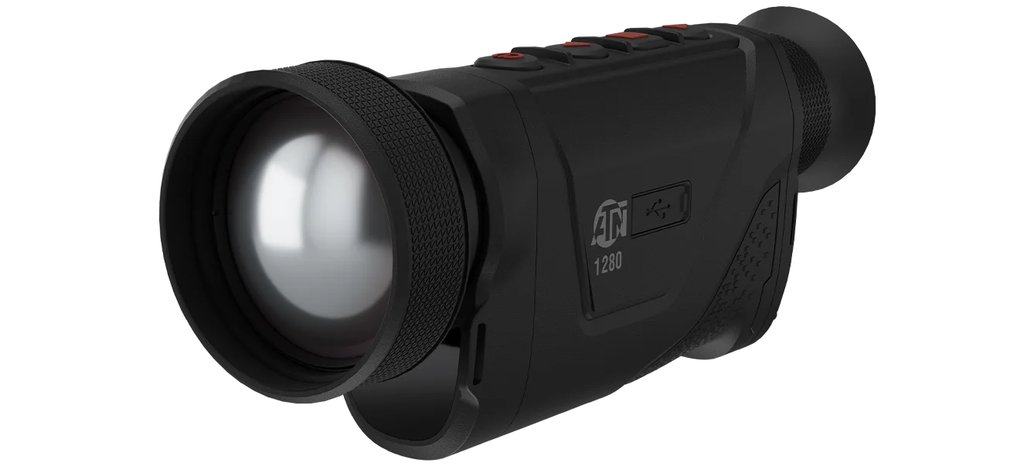
The ATN BlazeTrek 6 640x512 1.5-12x is the night sight most people should reach for first, because it pairs a genuinely sharp heat sensor with a wide detection picture in a body of about 0.7 lb. When there is no moon and no ambient light to lean on, that combination is what lets you keep seeing when other night gear has given up.
A sensor that turns pure heat into a clear animal
The 640x512 thermal sensor reads far more heat points than an entry sensor, which is the gap between a vague warm patch and a shape you can name in complete dark. Picture the step from standard definition up to HD: more dots means detail survives further into the zoom. Paired with a low NETD of <=18mK, it holds a clean picture through humid, foggy air where a light-amp tube would just amplify grain. And because it needs zero ambient light, its 1000m detection range works exactly the same at the blackest hour of a moonless night as it does at dusk.
A wide view built for finding heat in zero light
Working the dark is mostly detecting, and the BlazeTrek 6 is built to detect. The 1.5x base opens a wide 22.8 by 18.3 degree field, so you cover a treeline in a couple of sweeps instead of tunneling in and missing a warm shape at the edge. When something lights up, smooth digital zoom to 12x pulls it in to confirm what you're looking at. Hot Point Tracking keeps the warmest object flagged as it drifts — a real help when the only thing telling you an animal is there is its heat signature in an otherwise black frame.
Palettes and AI that pull the target out of the dark
In true darkness, the right palette is what turns a warm smudge into a confident call. The BlazeTrek 6 gives you six — White Hot, Black Hot, Iron Red, Alarm, Green Hot and Sepia — so you flip to whatever contrast lifts tonight's target off the ground behind it. Black Hot often makes an outline stand proud of a lighter background, while Iron Red can peel a warm body away from warm earth on a muggy night. SharpIR AI runs behind all of them, tightening the raw heat data so edges stay crisp and a detected animal reads as itself. Because none of this depends on outside light, it works identically whether the moon is up or the sky is solid cloud — which is exactly where light-amplifying night vision falls apart.
Built to survive an all-night sit
A night sight lives in a rough world — dew, cold hands, long walks in the black — and the BlazeTrek 6 is built for it. The IP67 rating shrugs off rain and heavy dew so a damp stand won't shut you down, and the internal battery runs about 6.5 hours and tops up over USB-C from the same power bank you already carry. Thirty-two gigabytes banks a full season of clips, and the ATN Connect 6 app with its AI assistant lets you review footage and adjust settings from your phone. It's a tool you lean on night after night, not a gadget you baby.
Who it's for and who it isn't
It's for anyone who needs to reliably detect warm animals in total darkness — the hog, coyote and general-purpose hunter who wants one handheld night sight that never runs out of light to work with. It's not the pick if you must positively identify game out past several hundred yards or want distance readouts; for that, jump to the BlazeHunter XD.
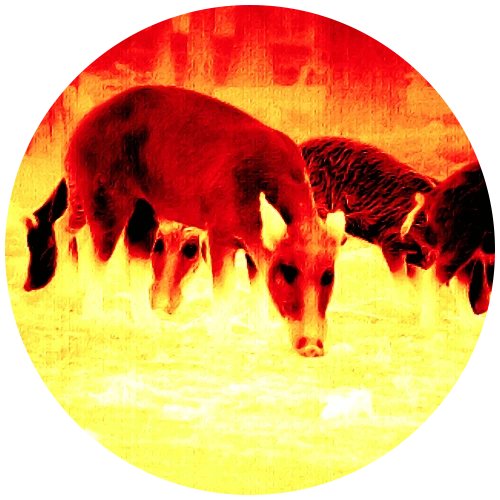
Best long-range detail: ATN BlazeHunter XD LRF
The ATN BlazeHunter XD LRF 1280x1024 2-16x is the flagship for people who need to detect and read fine detail deep into the dark. Its headline is an extreme-definition 1280x1024 sensor — over a million more pixels than a standard thermal — which is like jumping to a much higher megapixel camera: the picture holds together as you zoom, so you can separate a hog from a deer well before you close in, and all of it under no ambient light at all.
Extreme detail where it counts
That 1280x1024 sensor isn't just a bigger spec — it changes what you can resolve in the dark. With over a million more pixels than a standard thermal, fine features survive the zoom, so at long range you can often read the shape of a coyote's ears and tail, or tell a hog from a deer, far sooner than a smaller sensor would allow. On a big property where your target is a distant glow in a black field, that extra detail turns a maybe into a sure call. A Full-HD 1920x1080 OLED display shows every bit of it, and the same six palettes, Hot Point Tracking and SharpIR AI carry over from the rest of the line.
Ranging and reach built in
A built-in laser rangefinder reads distance out to 1000m to within about a meter, so you know exactly how far off that heat signature is before you make a move. The 50mm objective and 3400m detection range let you sweep enormous stretches of black country, and dual removable 18650 batteries deliver 10+ hours total, so the longest sit doesn't run you dry — and because the cells swap out, you can carry charged spares. It's heavier at about 1.1 lb, the fair trade for that much sensor and glass, and it steps up in price over the BlazeTrek 6.
Who it's for and who it isn't
It's for the serious predator and big-country hunter who works the far end of the field after dark. It's more monocular than a close-cover hunter needs, so if most of your detection happens inside a few hundred yards, the BlazeTrek 6 is the smarter buy.
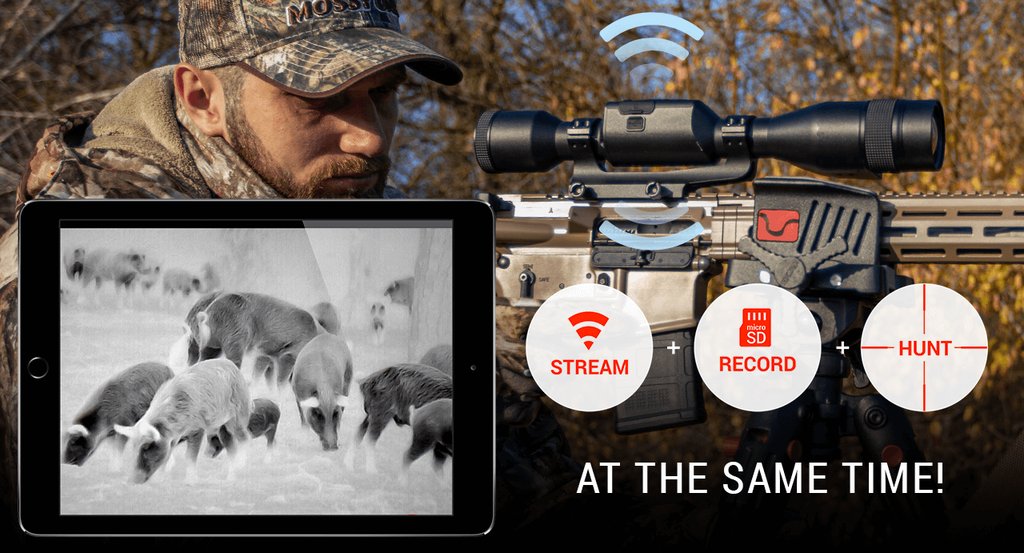
How thermal detection changes what you can do after dark
A thermal night sight changes the game by removing the light problem entirely. With image-intensifier gear you are always negotiating with the sky — a passing cloud, a dip into timber, a moonless window — and the picture rises and falls with it. Thermal detection is steady: heat is heat, so the darkest, most overcast night is just another night, and often the best one, because that's exactly when animals move and other night gear is useless. You stop sweeping a light that spooks everything, and instead make slow passes and let warm bodies announce themselves out of pure black. On a called stand that means you catch a coyote the instant it steps clear, not once it's already on top of you.
It also reveals the animals you would otherwise never register. A hog bedded in tall grass, a coyote hung behind a fence line, a deer frozen in shadow — none of them reflect enough light for a tube to grab, but all of them radiate heat, so they surface on the BlazeTrek 6 even in a scene your eyes read as solid dark. Fewer animals slip in on you, and fewer slip away unseen. The same holds after the shot: a downed animal stays warm for a good while, so the tool that detected it in the black can walk you straight to it — no flashlight fumbling, no light-dependent gear that quits the moment the sky closes over.
Detect, confirm, close
The routine is simple, and both ATN night sights here are built for it. You detect wide at low magnification to cover ground fast — a broad field is your friend, which is why the BlazeTrek 6 opens up so much picture. When a heat source glows, you confirm by zooming and switching palettes, since Iron Red or Black Hot often reveal shape and species that White Hot alone leaves ambiguous. Then you close, letting Hot Point Tracking hold the target as you move. Recording the whole sequence lets you study it afterward — and none of it ever waited on the moon.
Palettes worth knowing after dark
- White Hot — the everyday default; warm things glow bright, easy to sweep with in zero light.
- Black Hot — inverts it so heat reads dark; many find an animal's outline pops against a lighter background.
- Iron Red — color grading that can peel a warm body off warm ground on a humid night.
- Alarm, Green Hot, Sepia — extra options for contrast preference and eye comfort over a long dark sit.
How to choose the best thermal night vision monocular
Start with how far into the dark you actually need to detect, then work back through sensor, view and ranging. A few honest questions sort it fast:
- How far do you detect? — Close cover and field edges reward a wide, light night sight like the BlazeTrek 6; big open country rewards the reach of the BlazeHunter XD.
- How much detail do you need? — Higher resolution means more heat points in the picture, so you can zoom further before it turns blocky and identify game sooner. Step up in sensor if positive ID at distance matters.
- Do you need distance readouts? — Only the BlazeHunter XD LRF has a built-in rangefinder; pick it if knowing the exact yardage changes your approach.
- How long are your nights? — The BlazeTrek 6 covers a typical outing; the BlazeHunter XD's dual batteries carry the longest sits.
- What weight will you carry? — A lighter night sight gets used more; if you tend to leave gear behind, lean toward the lightest option that still reaches your ground.
- What light will you actually have? — If your nights are often moonless or overcast, this is the deciding point: thermal detects on heat and works in any darkness, while light-amplifying night vision needs a sky it may not give you.
Whatever you land on, browse the full thermal monoculars lineup to compare the exact variant that fits your ground, and see our best thermal monocular for hunting guide if hunting use is your deciding factor.
How we picked these ATN thermal monoculars
Here is how these picks were chosen, so you can judge them for yourself. Every option here is from ATN's current 6th-generation line only — no discontinued models padding the list. Each was weighed on the specs that decide a real hunt: sensor resolution, thermal sensitivity (NETD), detection range, refresh rate, and battery life, then sanity-checked against how it actually performs for thermal as night sight. Where a model gives something up, that trade-off is called out plainly rather than hidden. These are the maker's own optics, so treat this as an honest in-house comparison of the range — not an independent lab review — and cross-check the specs against your own needs.
Frequently Asked Questions
What is the best thermal night vision monocular overall?
The ATN BlazeTrek 6 640x512 1.5-12x is the best all-round pick for most people. It balances a sharp 640x512 sensor, a wide detection view and about 6.5 hours of battery in a 0.7 lb body. Because it reads heat, it works as a night sight in complete darkness where light-amplifying night vision starves.
Is thermal better than regular night vision for dark hunting?
For finding warm animals, usually yes. Classic night vision amplifies existing light and fails on moonless, overcast nights, while thermal builds its picture from heat and needs no ambient light at all. A warm coyote or hog glows on a thermal monocular even in pitch black.
How far can these monoculars detect game in the dark?
Detection range depends on the sensor and objective lens. The BlazeTrek 6 detects heat to about 1000m, and the flagship BlazeHunter XD reaches out to 3400m. Detection means spotting body heat; positive identification happens closer than that maximum.
Do thermal night sights work in fog and rain?
Yes, unlike light-amplifying gear that fades when the sky closes over. Thermal builds its picture from heat, so damp, foggy air still shows warm bodies; a low NETD like the BlazeTrek 6's <=18mK keeps that picture clean. Both units are IP67 sealed, so a wet, black night is no problem.
Can I record my night hunts with these monoculars?
Yes. Both ATN monoculars offer video and photo recording with onboard storage, and both connect to the ATN Connect 6 app over Wi-Fi so you can review and share footage from your phone. The BlazeTrek 6 holds 32 GB of clips.
Do I need a rangefinder built into my monocular?
Only if the exact distance to your target changes how you'll approach or shoot. The BlazeHunter XD LRF has a laser rangefinder accurate to about a meter out to 1000m. The BlazeTrek 6 skips it to stay lighter and more affordable.
Can I use a thermal monocular to aim my rifle?
No. A monocular is a handheld detection and tracking tool, not an aiming device. Many hunters detect a warm animal with the BlazeTrek 6, then take the shot through a dedicated rifle-mounted optic. The monocular's job is to find and follow the animal in the dark, and it does that far more flexibly than a scope because you can use it on foot without shouldering a firearm.
Ready to own the dark? The ATN BlazeTrek 6 640x512 is the night sight most people should start with — a thermal monocular that makes its own picture from heat and never waits on the moon. If you want the longest reach and built-in ranging, compare it against the rest of the ATN thermal monoculars and match the sensor and range to your ground. Pick the one that fits how you actually hunt, charge it up, and let heat do the detecting on the very nights that shut down light-amplifying gear.
Created: July 7, 2026 · 08:31:01 UTC