If you want the best thermal monocular the sub-budget tier of 2026 has to offer, the honest answer is a small, pocketable unit you will actually carry every time you head out. That means the ATN BlazeSeeker 6. It sits in ATN's budget tier of thermal monoculars, but it still runs the current 6th-gen brain: SharpIR image cleanup, six color palettes, and on-board video. This is the tool for close-range scanning around the barn, the tree line, or the back forty, when you would rather grab something light than lug a full-size optic.
The best thermal monocular in the entry tier for 2026 is the ATN BlazeSeeker 6. Its 256x192 sensor, wide 24-by-18-degree view, and roughly 8-hour battery make it the easiest-to-carry way to spot warm animals at close range without stepping up to a flagship price.
Quick answerBest overall (budget tier): ATN BlazeSeeker 6 256x192 1.2-9.6x — the widest view and the lightest carry.
Best for a touch more reach: ATN BlazeSeeker 6 256x192 1.7-13.6x — the same body with a longer 10mm lens for a little more distance.
Bottom line: both are the same value-priced platform. Pick the 1.2-9.6x if you scan close and wide; pick the 1.7-13.6x if you want to reach a bit farther across a field.
Why ATN's 6th-gen BlazeSeeker leads the entry tier
ATN's 6th-gen line is where the budget tier stopped feeling like a downgrade. The BlazeSeeker 6 shares its processing with pricier ATN monoculars, so you get SharpIR AI image enhancement pulling detail out of a small 256x192 core, Hot Point Tracking that tags the warmest object in frame, and an 800x600 OLED display that stays sharp edge to edge. Think of the 256x192 sensor as a smaller grid of dots than a 384 or 640 chip — plenty for finding a hog or coyote inside a few hundred yards, less so for picking apart a target far out. The 50 Hz refresh keeps a trotting animal smooth instead of smeared, and the whole thing weighs about 0.6 lb, so it lives in a jacket pocket. That combination — real 6th-gen features at the lowest step of the range — is why it anchors this list.
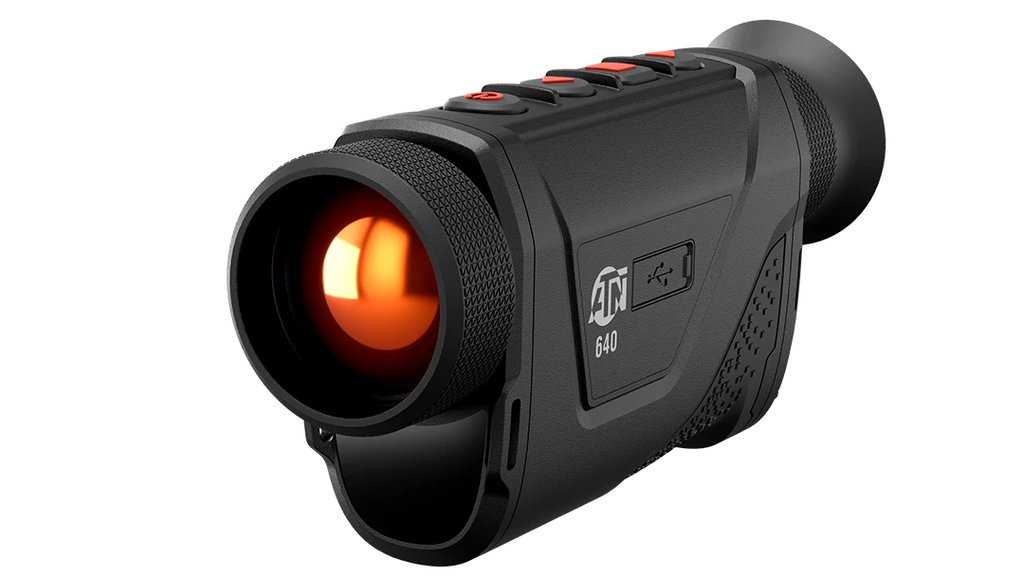
Best overall budget pick: ATN BlazeSeeker 6 256x192 1.2-9.6x
The ATN BlazeSeeker 6 1.2-9.6x is the one to grab first. Its short 7mm lens opens up a wide 24-by-18-degree field of view, which is the whole point of a scanning tool — the more ground you see at once, the faster you catch the warm shape moving through it. Start at 1.2x to sweep a field, then push the digital zoom up to 9.6x to confirm what you found.
Why the wide view matters
When you are walking a fence line or checking the yard, you are not trying to read a tag at 400 yards — you are trying to not miss anything close. A wide view means fewer sweeps to cover the same arc, and less chance an animal slips past the edge of the picture while you pan. Six palettes (White Hot, Black Hot, Iron Red, Alarm, Green Hot, Sepia) let you switch to whatever separates the animal from the background fastest.
Who it's for and who it's not
It's for anyone who wants a light, honest close-range spotter without paying flagship money — hog and coyote scanning inside a few hundred yards, property checks, and general night walks. It's not for someone who needs to identify animals way out past 400 yards; for that you want more resolution and a longer lens from higher up the range.
Recording and the app
Even at the entry tier you can save what you see. The BlazeSeeker records video and stills to 32 GB of internal storage and links over Wi-Fi to the ATN Connect 6 app, which doubles as a second screen and an AI assistant for settings. That turns a quick scan into a record — proof of what's raiding the food plot, a clip to show a buddy, or a running log of what crosses your ground week to week. It's not a photography rig, but for documenting a night it's more than most budget optics bother to include.
Best for a little more reach: ATN BlazeSeeker 6 256x192 1.7-13.6x
The ATN BlazeSeeker 6 1.7-13.6x is the same value-tier body with a longer 10mm objective. That trades a slice of the widest view for detection out to about 460m instead of 345m, and a higher base magnification. Everything else — the 256x192 core, roughly 8-hour battery, IP67 weatherproofing, 32 GB of on-board storage — carries straight over.
When the longer lens earns its keep
If most of your scanning happens across open ground rather than tight woods, the extra reach helps you pick up heat sooner and gives you more room to confirm before an animal closes the distance. It is the small-upgrade choice, not a different class of tool.
Who it's for and who it's not
It's for the field scanner who wants the budget platform but leans toward open country. It's not the pick if you value the absolute widest sweep — the 1.2-9.6x still wins there.
What the BlazeSeeker actually shows you on a real night
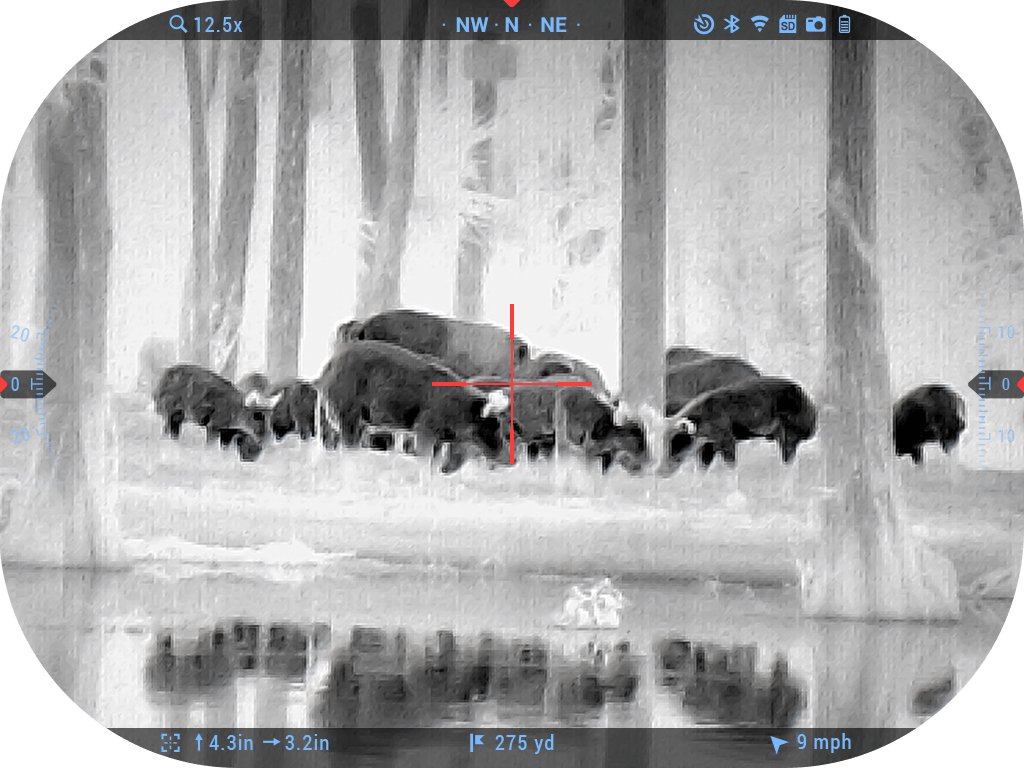
It helps to set expectations before you buy, because thermal doesn't work like a camera or a flashlight. On a still night the BlazeSeeker paints anything warmer than its surroundings — a hog rooting a field edge glows plainly, a coyote crossing a lane shows as a bright shape, even a rabbit ticks up against cool grass. Cold ground, wet leaves, and standing water read dark, so a warm animal pops out of that background instead of blending in the way it would in the dark to your naked eye. What you won't get at the 256 tier is fine texture at distance — a deer at 300 yards reads as 'deer-shaped and warm' rather than 'a mature doe with her ears back.' That's the honest ceiling of the entry sensor, and for a scanner whose job is to catch that something is there and roughly what it is, it's exactly enough. Switch palettes as conditions change: White Hot is the everyday default, Black Hot can make edges easier to read against a busy background, and Iron Red helps some people pick warm shapes out faster.
Handling and everyday carry
The reason a budget monocular gets used is that it never feels like a chore to bring. At about 0.6 lb the BlazeSeeker rides in a coat pocket or a chest rig without pulling on you, comes up to your eye one-handed, and wakes fast so you're scanning within a second or two of pulling it out. The internal battery charges over USB-C from the same bank that tops your phone, so there's no separate charger to forget. IP67 sealing means a walk through wet brush or an accidental drop in the leaves doesn't end your night. None of this shows up as a headline spec, but it's what separates an optic you actually reach for from one that lives in the safe.
How to choose a thermal monocular in the budget tier
At this tier, spend your attention on the things that actually change your night rather than chasing a spec sheet. Both BlazeSeeker variants share a core, so the choice is mostly about lens length and how you hunt.
- Field of view vs. reach — a short 7mm lens gives you the widest sweep for close work; the 10mm lens trades some width for distance. Match it to your ground.
- Resolution expectations — 256x192 is a smaller grid of dots, so treat it as a detector and close-range spotter, not a long-range identifier.
- Battery for a full outing — roughly 8 hours covers most nights without a swap; keep a USB-C bank in the truck for long sessions.
- Weight you'll actually carry — at about 0.6 lb, this is the optic you don't leave at home, which beats a heavier one that stays in the safe.
- Weatherproofing — IP67 means dew, drizzle, and a dropped-in-the-grass moment won't end the hunt.
How we picked these ATN thermal monoculars
We judged these two against what the keyword actually asks for — the most monocular you can carry at the entry tier — so we weighed sensor resolution, NETD (thermal sensitivity in humid or foggy air), detection range, refresh rate, battery, and weight against real close-range scanning, not lab charts. We only considered ATN's current 6th-gen line, so nothing here is a leftover older model. The honest trade-off: a 256x192 core keeps the price low but limits how far out you can identify an animal, and the internal battery means you can't hot-swap cells the way you can on a flagship. This is an in-house comparison of ATN's own range, not an independent lab review, so check these specs against your own ground and typical distances before you buy.
Frequently Asked Questions
Is a budget-tier thermal monocular actually worth it?
Yes, for close-range scanning it is. The ATN BlazeSeeker 6 gives you real 6th-gen features — SharpIR, six palettes, on-board recording — in a light body you will carry every night. It won't identify animals at extreme range, but for finding warm shapes inside a few hundred yards it does the job.
What is the detection range on the ATN BlazeSeeker 6?
The 1.2-9.6x variant detects heat out to about 345m and the longer 1.7-13.6x reaches roughly 460m. Detection means picking up that something warm is there; clear identification happens closer in, especially on a 256x192 sensor.
How long does the battery last?
Both BlazeSeeker 6 variants run about 8 hours on the internal rechargeable battery. That covers most nights. For back-to-back long sessions, keep a USB-C power bank handy since the cell isn't user-swappable.
Can I record what I see?
Yes. Both variants shoot video and photos to 32 GB of on-board storage and connect over Wi-Fi to the ATN Connect 6 app, so you can pull clips off and share your night's finds.
Will it work in rain or fog?
It's IP67 waterproof, so dew, drizzle, and being set down in wet grass are fine. Thermal actually cuts through light fog and darkness better than your eyes, though heavy rain and dense fog reduce how far any thermal optic sees.
Which BlazeSeeker variant should I get?
Pick the 1.2-9.6x for the widest view and fastest close-range scanning. Pick the 1.7-13.6x if you scan more open country and want a little extra reach. Both share the same sensor, battery, and features.
Ready to add a light, honest thermal spotter to your kit without stepping into flagship money? The ATN BlazeSeeker 6 is the easiest way into 6th-gen thermal — grab it, charge it, and you're scanning the tree line the same night. If you're weighing lens lengths or want to see the rest of the family side by side, browse the full range of ATN thermal monoculars and match the sensor and reach to your ground. Your first warm shape in the dark tends to sell you on it.
Created: July 7, 2026 · 11:11:27 UTC