You've already priced out the sub-$1,000 monoculars. Maybe you own one. The question that actually matters now is whether the next $500 buys you something real, or just a bigger number on the spec sheet. Under $1,500, the answer is a resolution jump — from 384×288 to 640×512 — and a longer detection range that shows up when you're glassing open ground instead of a fence line. This guide compares the best thermal monocular under $1,500 against the top pick from the $1,000 shelf, spec for spec, so you know exactly what the upgrade buys.
Stepping up from $1,000 to $1,500 gets you a 640×512 sensor instead of 384×288 — nearly triple the pixel count reading the same scene, plus a longer detection range and a smoother zoom range. We break down whether that's worth the extra money for your kind of hunting.
Quick answer: best thermal monocular under $1,500
- Best overall: ATN BlazeTrek 6 640 (TIMNBLT625G6) — 640×512 sensor, 1300 m detection range, $1,895
- Best for the money: ATN BlazeTrek 6 640 1.5-12x (TIMNBLT619G6) — same 640×512 sensor, 1000 m range, $1,695
- Best mid-tier step-up: ATN BlazeTrek 6 325 (TIMNBLT325G6) — 384×288 sensor with the longer 25mm lens, $1,195
- Budget pick on this shelf: ATN BlazeTrek 6 325 (TIMNBLT325G6) at $1,195
Why the jump to 640×512 stands out
A 640×512 sensor reads 327,680 pixels per frame against the 110,592 pixels a 384×288 sensor captures — nearly three times the data describing the same scene. In the field, that shows up as an animal holding its shape at distance instead of dissolving into a blob of heat. Both the 384 and 640 lines here share the same ≤18mK NETD rating and 50 Hz refresh, so the temperature sensitivity and motion handling are identical — the difference is purely resolution and, on the 625, lens size. The 640×512 monoculars also carry a longer 25mm F/1.0 lens option that stretches detection range to 1300 m, versus the 19mm lens on the entry 640 model and the sub-$1,000 shelf's shorter glass.
Comparison table: $1,000 shelf vs. $1,500 shelf
| Model | Sensor | NETD | Magnification | Detection range | Battery life | Weight | Price |
|---|---|---|---|---|---|---|---|
| BlazeTrek 6 384 (TIMNBLT319G6) — $1,000 shelf top pick | 384×288 | ≤18mK | 2.25-18x | 1000 m | ~8 hrs | 320 g / 0.7 lb | $995 |
| BlazeTrek 6 325 (TIMNBLT325G6) | 384×288 | ≤18mK | 2.8-22x | 1300 m | ~8 hrs | 320 g / 0.7 lb | $1,195 |
| BlazeTrek 6 640 1.5-12x (TIMNBLT619G6) | 640×512 | ≤18mK | 1.5-12x | 1000 m | ~6.5 hrs | 320 g / 0.7 lb | $1,695 |
| BlazeTrek 6 640 1.75-14x (TIMNBLT625G6) | 640×512 | ≤18mK | 1.75-14x | 1300 m | ~6.5 hrs | 320 g / 0.7 lb | $1,895 |
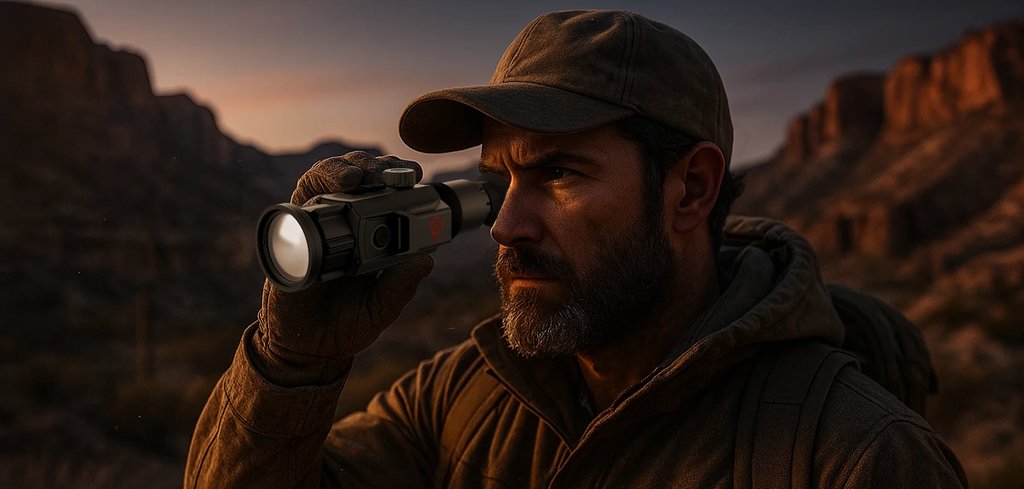
Best overall: ATN BlazeTrek 6 640 (1.75-14x)
The BlazeTrek 6 640 (TIMNBLT625G6) is the best thermal monocular under $1,500 if you want the longest detection range and highest resolution this budget can buy. At $1,895, it's $900 more than the top pick under $1,000 — here's exactly what that gets you.
Image quality
The 640×512 sensor at 12μm pixel pitch and ≤18mK NETD delivers close to three times the pixel data of the 384×288 sensor in the $1,000-tier BlazeTrek, at the same temperature sensitivity. Where the 384 sensor shows you a recognizable shape, the 640 sensor shows you posture and movement detail at the same distance — the difference between "there's an animal" and "that animal just turned its head toward you."
Range and magnification
Detection range is rated at 1300 m, matching the top of the 384-class BlazeTrek 325 but with far more resolution behind it. Magnification runs 1.75-14x through a 25mm F/1.0 lens, with a 17.5° x 14° field of view — tighter than the entry 640 model's 22.8° x 18.3°, trading field of view for reach.
Battery and build
Battery life drops to about 6.5 hours, down from the ~8 hours on the 384-class models — the tradeoff for driving the larger sensor. Weight stays at 320 g / 0.7 lb, identical to every other model in the BlazeTrek 6 line, so the resolution jump doesn't cost you anything in the hand. IP67 rating and -30°C to 55°C operating range carry over unchanged.
Smart features
Same ATN 6 Connect app, same hot point tracking, same 32 GB storage and six color palettes as every model in this comparison. The upgrade dollars go entirely into the sensor and lens, not into extra features.
Buy this if you're regularly glassing open fields or crop edges past 1000 meters and need the resolution to identify, not just detect, at that range. Skip it if your hunting ground is closer-in brush and timber where 1000 m of range never gets used.
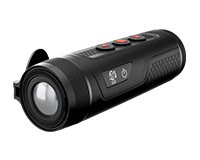
Best for the money: ATN BlazeTrek 6 640 (1.5-12x)
The BlazeTrek 6 640 1.5-12x (TIMNBLT619G6) gets you the same 640×512 sensor as the top pick for $200 less, at $1,695, by trading lens size instead of sensor quality.
Image quality
Identical sensor, identical ≤18mK NETD, identical 50 Hz refresh to the 625 above it. If resolution is what you're paying for, this model delivers exactly the same imaging engine.
Range and magnification
The shorter 19mm lens brings detection range down to 1000 m — the same range as the $995 BlazeTrek 6 384, but now backed by a 640×512 sensor instead of 384×288. Magnification runs 1.5-12x with a wider 22.8° x 18.3° field of view, which makes it easier to track a moving target at closer range than the 625's tighter glass.
Battery and build
Same ~6.5 hour battery life and 320 g weight as the 625. The only difference between these two models is the lens.
Buy this if your effective hunting range tops out around 1000 meters and you'd rather have the wider field of view than the last 300 meters of reach. Skip it if 1300 m of detection range is the reason you're shopping this tier in the first place.
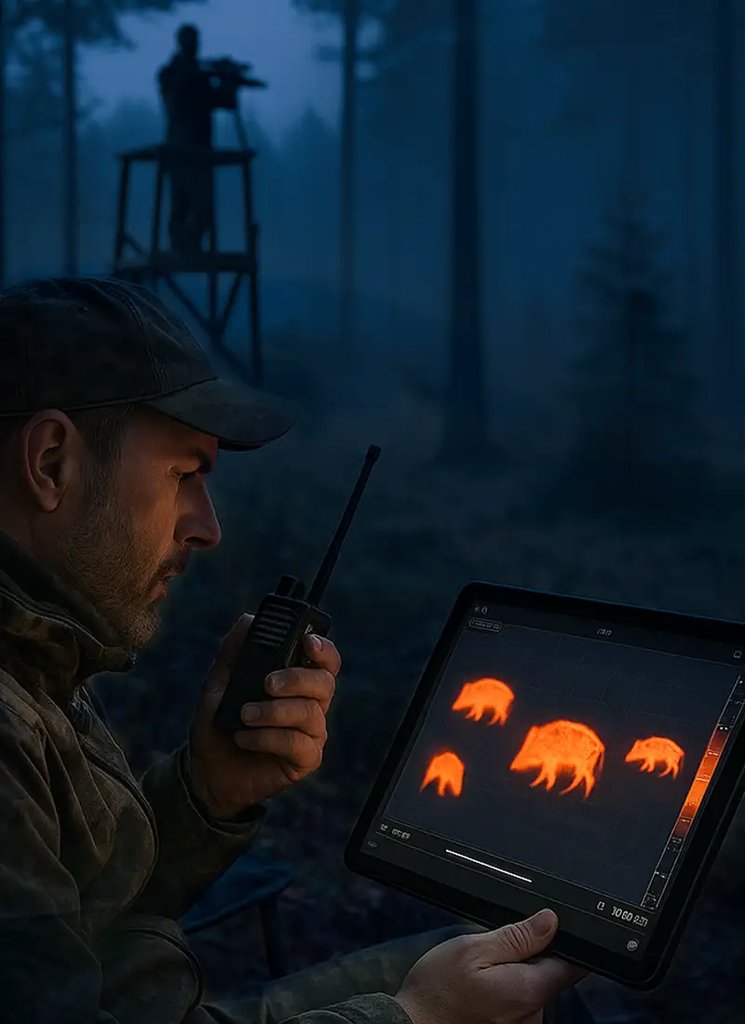
Best mid-tier step-up and budget pick: ATN BlazeTrek 6 325
The BlazeTrek 6 325 (TIMNBLT325G6) is worth calling out separately because it answers a real question: what if you want more range than the $1,000 shelf offers, without paying for a full sensor upgrade? At $1,195, it's the cheapest way onto this shelf.
Image quality
Same 384×288 sensor and ≤18mK NETD as the entry BlazeTrek 6 384. Nothing changes at the sensor level — this model is about the lens, not the imaging chip.
Range and magnification
The 25mm F/1.0 lens pushes detection range to 1300 m, matching the top-tier 640 model's range, with 2.8-22x magnification and a narrow 10.9° x 8.2° field of view — the tightest field of view in this entire comparison, since a long lens on a smaller sensor concentrates the view even further.
Battery and build
Battery life holds at ~8 hours, matching the other 384-class models rather than dropping to the 6.5 hours of the 640-class monoculars. Weight and durability specs are unchanged across the line.
Buy this if you want 1300 m of detection range without spending $700 more for a 640×512 sensor you may not need. Skip it if you specifically need the resolution to identify game at that distance — range and resolution are two different upgrades, and this model only buys the first one.
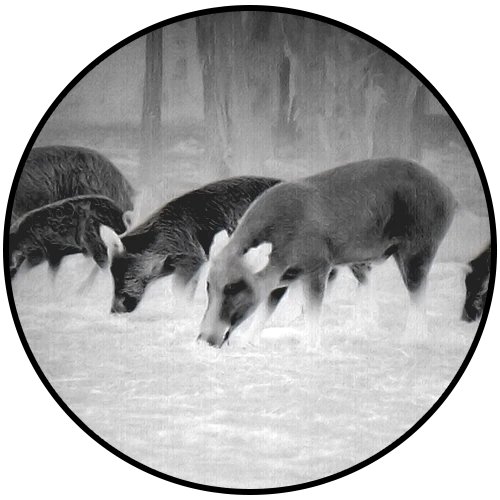
Is the step from $1,000 to $1,500 worth it?
It depends on which upgrade you actually need. If range is the bottleneck — you can identify what you're looking at, but you can't spot it far enough out — the BlazeTrek 6 325 gets you from 1000 m to 1300 m for $200 more than the top $1,000 pick, without touching sensor resolution. If resolution is the bottleneck — you can see something is out there, but can't tell what it is until it's closer than you'd like — that's a sensor problem, and only the 640×512 models fix it. That's where the real $700-900 jump from the $1,000 shelf to the top of the $1,500 shelf happens.
Terrain decides which bottleneck you're actually fighting. Open cropland and pasture reward resolution, because targets sit at distance long enough for extra pixels to matter. Tight brush and timber reward the wider field of view on the entry 640 model over the longer, narrower 625 — you're reacquiring targets constantly, and a tight field of view works against you there. Battery life is the one place this tier gives something back: every 640×512 model here runs about 90 minutes shorter than the 384-class options, so if you're out for a full night without recharging, that's worth weighing against the resolution gain.
FAQ
What is the best thermal monocular under $1,500?
The ATN BlazeTrek 6 640 (TIMNBLT625G6), priced at $1,895, offers a 640×512 sensor and 1300 m detection range, the longest range and highest resolution available under this budget.
Is it worth spending $1,500 instead of $1,000 on a thermal monocular?
It's worth it if you need either longer detection range or a higher-resolution sensor than the $1,000 shelf provides. The BlazeTrek 6 325 adds range for $200 more; the 640×512 models add resolution for $700-900 more.
What's the actual difference between a 384 and 640 sensor?
A 640×512 sensor captures roughly three times the pixel data of a 384×288 sensor at the same NETD rating, meaning it holds shape and detail on a target at distances where a 384 sensor shows a less defined heat blob.
Does a longer lens always mean better detection range?
Yes, within a given sensor — a 25mm lens outperforms a 19mm lens on detection range on both the 384 and 640 sensor lines here, but it also narrows the field of view, so you trade reach for a wider scanning angle.
Why does battery life drop on the 640×512 models?
The larger sensor and higher pixel throughput draw more power, which brings battery life down from about 8 hours on the 384-class BlazeTrek models to about 6.5 hours on the 640-class models.
Do all these monoculars use the same app and features?
Yes — ATN 6 Connect app support, hot point tracking, six color palettes, and 32 GB internal storage are identical across every model in this comparison. The price difference is entirely in sensor and lens.
Should I buy the 1300 m or the 1000 m version of the BlazeTrek 6 640?
Buy the 1300 m version (TIMNBLT625G6) if you regularly need to spot game past 1000 meters. Buy the 1000 m version (TIMNBLT619G6) if you'd rather have the wider field of view for closer, faster-moving targets and save $200.
The bottom line
The $1,000 to $1,500 step isn't a straight upgrade — it's two different upgrades bundled into one price tier, and only one of them might matter for how you actually hunt. If resolution is what's been limiting you, the ATN BlazeTrek 6 640 (TIMNBLT625G6) is the clear pick and worth the full jump. If range was the only gap, the BlazeTrek 6 325 closes it for a few hundred dollars less. Compare specs side by side on the full thermal monocular lineup, or go straight to the BlazeTrek 6 640 product page to check current pricing and availability.