A price ceiling changes how you shop. If you have a grand to spend and you want it all to count, the real question is which thermal gives you the most sensor and reach right up against that line without going over. The best thermal monocular under $1000 for coyote hunting is the one that spends your whole budget on the part that matters — the sensor — and stops there. That pick is the ATN BlazeTrek 6 640. It brings a top-tier 640x512 sensor into a handheld that stays under $1,000, which is the kind of resolution most hunters assume costs far more.
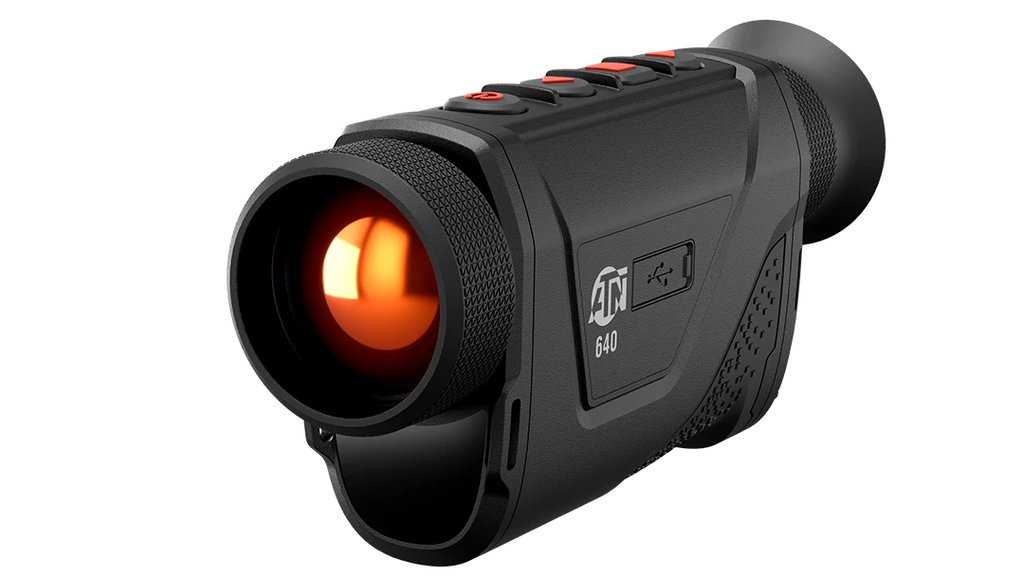
The best thermal monocular under $1000 for coyote hunting is the ATN BlazeTrek 6 640x512. It puts a flagship-grade 640x512 sensor and 1000m detection range into a pocketable handheld that stays under $1,000 — the most resolution you can buy against that price ceiling. For a coyote caller who wants sharp target ID without crossing the line, this is the pick.
Quick answerBest under $1,000: ATN BlazeTrek 6 640x512 — the most sensor you can buy while staying under the $1,000 line.
Best if you want money left over: ATN BlazeSeeker 6 256x192 — a lighter, wider close-range option that sits well below the ceiling.
Bottom line: to spend the whole $1,000 on the resolution that sharpens coyote ID, the BlazeTrek 6 640 is the buy.
Why does the $1,000 line change the ATN pick?
A $1,000 budget lets you reach the resolution tier that a tighter budget cannot, and that is why the pick changes when the ceiling is $1,000 instead of a lower number. Every 6th-gen ATN monocular shares the same processing brain — SharpIR AI enhancement, Hot Point Tracking, a 50 Hz refresh — so the thing your extra budget actually buys is a bigger, sharper sensor. Under $1,000, you can step all the way up to a 640x512 sensor, which is the same class of resolution found in far pricier optics. That is the smart way to spend against a ceiling: put the money where the picture quality lives. For coyote hunting, sharper resolution is the difference between guessing at a heat blob on a distant fence line and clearly reading four legs and a bushy tail. Everything here stays under $1,000, so you are choosing how to spend that budget, not whether you can afford the category at all. The answer is to buy the sensor.
How do the ATN sub-$1,000 monoculars compare?
Best under $1,000: ATN BlazeTrek 6 640x512
The ATN BlazeTrek 6 640x512 is the best thermal monocular under $1000 for coyote hunting because it lands the highest sensor resolution in the category while staying under $1,000. It answers the price question head-on: with a grand to spend, buy the 640 sensor.
640x512 is the resolution that stays under the line
Picture resolution is dots in the image, and 640x512 packs in the most dots of any monocular here. When a coyote works a fence line at the far edge of your call, that sensor lets you zoom in and actually read the animal instead of squinting at a warm smudge. A 640x512 chip holds detail as you push into the 1.5-12x zoom range, so a dog that is only a few pixels tall on a coarser sensor still shows legs, a low-slung body, and that bushy tail on the BlazeTrek. That is what separates a confident read from a hopeful guess. With up-to-1000m detection you spot the heat early — a warm mark at the treeline you would otherwise never notice — and then the 640 sensor lets you confirm it is a coyote and not a stray dog before it commits. Detection gets you looking; resolution tells you what you are looking at. That level of clarity in a monocular that stays under $1,000 is the whole reason this is the pick.
Wide, smooth, and ready for a wet night
The wide 22.8 x 18.3 degree field of view keeps enough scene in front of you to catch a coyote busting in from the side, which is exactly how a called dog tends to arrive — not straight down the barrel but circling downwind. A narrow field lets that flanker slip past the edge of your view; the BlazeTrek's wider window holds him in the picture. The 50 Hz refresh keeps that dog crisp as it moves, so a trotting coyote reads as an animal instead of a smeared blur, and SharpIR AI sharpens the edges of the heat signature so the outline is easier to call. The <=18mK sensitivity cleans up the picture in damp, humid air, it is IP67 waterproof, and at 0.7 lb / 320 g it pockets easily between stands. Battery runs about 6.5 hours — the one honest give versus lower-res models, because pushing a 640 sensor draws more power. Who it is for: the hunter with a full $1,000 budget who wants the sharpest coyote ID available under that line. Who it is not for: someone who mostly calls close and would rather keep money in pocket.
Where the budget goes, and where it does not
It is worth being clear about what your $1,000 is and is not buying here. It is buying the sensor — the 640x512 chip is the single most expensive part to build up, and it is the part you look through on every stand. It is not buying a different feature set: the six color palettes, Hot Point Tracking, the 800x600 OLED display, 32 GB of storage, and the ATN Connect 6 app all appear on cheaper models too. So under the $1,000 line, the right move is to route the budget straight into resolution and range, because those are the specs a cheaper monocular genuinely cannot match. Everything else you would have gotten anyway. That is why, against a $1,000 ceiling specifically, the 640 BlazeTrek is the pick that makes the budget work hardest.
Confirm the target before you commit
On coyotes this matters more than most specs. Farm dogs, house cats, deer, and the neighbor's Lab all glow the same warm color through a thermal, and a coarse sensor turns them into interchangeable blobs at distance. The 640x512 chip is what lets you read gait and body shape — the low, purposeful trot of a coyote versus the loose amble of a stray dog — before you ever shoulder anything. The six color palettes help here too: flipping between White Hot, Black Hot, and an Iron mode changes the contrast so a subtle outline pops against different backgrounds. Being able to positively ID an animal at the far end of a call, in the dark, is the single most useful thing a coyote hunter buys with the extra resolution, and under $1,000 the BlazeTrek 6 640 is where you get it.
A field read: the open cut-field stand
Say you set up on the corner of a picked cornfield an hour after dark and start a distress sequence. Ten minutes in, you sweep the far fence line and catch a small warm mark hanging at the edge — too far to call with the naked eye, easy to miss on a low-res sensor. You settle the BlazeTrek, push the zoom up through its range, and the 640 sensor resolves the shape: low body, long legs, ears up, working the wind along the wire. That is a coyote, not a stray dog, and it is inside your detection window well before it is inside range. You track it with Hot Point Tracking as it cuts the corner, the 50 Hz refresh keeping it crisp the whole way in. None of that costs more than the $1,000 you set out to spend — it is what buying the sensor first, right up against the line, actually gets you on stand.
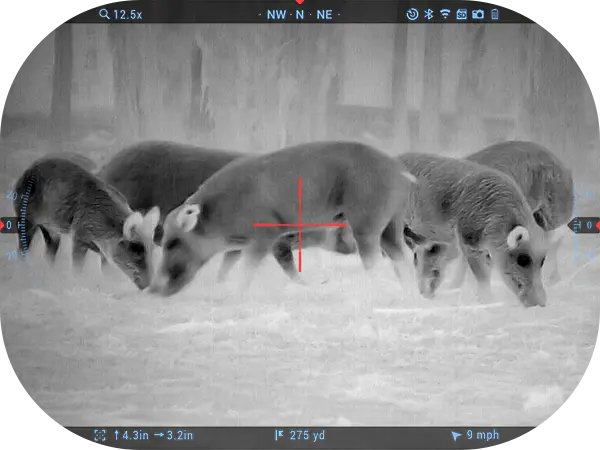
Money-left-over pick: ATN BlazeSeeker 6 256x192
If $1,000 is a hard ceiling but you would rather not spend all of it, the ATN BlazeSeeker 6 256x192 sits comfortably below the line and leaves budget for calls, a light, or a spare battery. It trades reach and resolution for a lower price.
Cheap of the pair, wide, and close-range capable
Its 256x192 sensor and 345m detection keep it in the close-to-mid game, and the wide 24 x 18 degree view suits brushy stands. Same 50 Hz refresh, same AI processing, lighter at 0.6 lb, and about eight hours of runtime — a bit longer than the 640 because the smaller sensor sips less power. Who it is for: the caller working cover who wants to stay well under $1,000 and pocket the difference. Who it is not for: anyone glassing open fields who needs to reach out and read a distant dog — that hunter should put the full budget into the 640, because the whole reason to shop against a $1,000 ceiling is that you can afford the better sensor.
How to spend a $1,000 thermal budget wisely
With a $1,000 ceiling, the goal is to spend on what changes the picture and skip what does not. Here is how to shop the line:
- Buy the sensor first — under $1,000 you can reach a 640x512 sensor, and resolution is the single upgrade you notice every time you zoom to ID a coyote.
- Know the shared engine is free — AI processing, 50 Hz refresh, and Hot Point Tracking come on every 6th-gen model, so paying more does not buy those; it buys sensor and reach.
- Weigh battery honestly — the 640 draws more power (about 6.5 hours); pack a USB-C power bank if you run all night.
- Match reach to terrain — open fields reward the 640's 1000m detection; tight brush is fine on the cheaper model and leaves cash in your pocket.
- Stay under the line on purpose — every option here comes in under $1,000, so decide how much of that budget you actually want to spend.
See how the variants stack up across the ATN thermal monoculars range so you can place your $1,000 exactly where it does the most good.
How we picked these ATN thermal monoculars
With a firm $1,000 ceiling, we asked which monocular puts the most picture quality against that line for a coyote caller. We compared sensor resolution, thermal sensitivity (NETD), detection range, field of view, refresh rate, weight, and battery life, and we weighted each one by how it plays out on an actual stand rather than how it reads on a spec sheet. For coyotes specifically that meant leaning hardest on resolution and detection range — the two specs that decide whether you can find a dog at the edge of a field and then tell it apart from a stray — while treating the shared processing engine as a given, since every 6th-gen model carries the same SharpIR AI, Hot Point Tracking, and 50 Hz refresh. Only the current 6th-gen ATN line was in play, so everything here is a shipping product that stays under $1,000. The honest trade-off on the 640 pick: its bigger sensor draws more power, so battery life is shorter than the lower-res models, and its wider zoom range gives up nothing you would miss at coyote distances. This is an in-house comparison of ATN's own monoculars, not an independent lab review — check the specs against your terrain, your typical calling distance, and how much of the budget you actually want to use before deciding.
Frequently Asked Questions
What is the best thermal monocular under $1000 for coyote hunting?
The ATN BlazeTrek 6 640x512. It fits a 640x512 sensor and 1000m detection range into a handheld that stays under $1,000, which is the most resolution you can buy against that price ceiling. For sharp coyote ID at distance, it is the pick.
Can you really get a 640 thermal monocular under $1,000?
Yes. The ATN BlazeTrek 6 640 puts a 640x512 sensor into a monocular that stays under $1,000, a resolution class most hunters assume costs far more. That is exactly why it is the value play against the $1,000 line for coyotes.
Is the 640 sensor worth it over a cheaper model under $1,000?
For open-country coyote hunting, yes. More resolution means more dots in the picture, so you can zoom in on a distant dog and read it clearly instead of guessing at a heat blob. If you only call in close cover, a cheaper model may serve and leave money in your pocket.
How far can the BlazeTrek 6 640 detect a coyote?
Up to 1000m of detection range in good conditions. Detection is picking up the heat signature; positive ID and an ethical shot happen closer, and the 640 sensor is what lets you confirm the animal at those longer distances.
How long does the BlazeTrek 6 640 battery last?
About 6.5 hours on the internal rechargeable battery. That is a little shorter than lower-resolution models because the 640 sensor draws more power. It recharges over USB-C, so a power bank covers longer nights.
Should I spend the full $1,000 or save some?
If you hunt open fields and want the sharpest possible coyote ID, put the budget into the 640 BlazeTrek. If you call mostly in tight cover, the cheaper BlazeSeeker 6 finds coyotes fine and leaves room for calls or a light. Both stay under $1,000.
Does the BlazeTrek 6 640 handle wet weather?
Yes. It is IP67 waterproof, so dew and rain are not an issue, and its <=18mK thermal sensitivity gives a cleaner picture in humid air. That matters because coyotes often move on damp, still nights.
What magnification does the BlazeTrek 6 640 have?
It runs a 1.5-12x zoom range. The wider low end keeps a big field of view for scanning and catching a coyote that circles in from the side, and the higher end lets you push in to read and confirm a distant dog on the 640x512 sensor before it commits. All of it stays under $1,000.
If your budget tops out at $1,000 and you want every bit working on picture quality, the ATN BlazeTrek 6 640 is the sharpest coyote-spotting handheld you can buy under that line. Take a closer look, and browse the full range of ATN thermal monoculars to confirm the 640 is the right place to spend your $1,000 for the way you hunt.
Created: July 7, 2026 · 14:32:46 UTC