The best thermal monocular law enforcement 2026 shortlist has to hold up across the whole calendar, because patrol and search work does not stop for weather. A missing person on a cold March night, a suspect who bolted into summer brush at dusk, a perimeter you have to hold through a long winter shift: each season changes what heat looks like and how far you can see it. This roundup picks ATN's 4-in-1 Odin MFT line for that reason, and it leads with the standard ATN Odin MFT as the best all-round choice for a badge that works year-round.
Best when distance matters: ATN Odin MFT LRF 640x480 1-8x — the same core plus a built-in laser rangefinder for an exact distance to a hidden or fleeing subject.
Best for weight-critical helmet use: ATN Odin MFT 640x480 1-8x — at 360 g without battery it is the one to run on a helmet through a long shift.
Why ATN's 6th-gen Odin MFT line fits law enforcement
ATN's 6th-gen Odin MFT line fits law enforcement because one small unit covers the jobs a shift throws at you. The 4-in-1 design means a single monocular works as a handheld for scanning a treeline, a helmet-mounted optic for hands-free movement, a clip-on ahead of a day optic, or a weapon sight when the situation calls for it. That flexibility matters more in police work than in most fields, because an officer rarely knows in advance which role the night will demand. Both units in this roundup share a 640x480 thermal sensor and ≤15 mK sensitivity, so the image quality is identical; the choice comes down to whether you need the built-in rangefinder.
There is a practical reason to keep the shortlist inside one family. When a department standardizes on a single line, training carries over, spare batteries and mounts are shared, and an officer who moves from patrol to a search team already knows the controls in the dark. The Odin MFT line also refreshes on a fast cycle, so the 6th-gen units carry current sensor tuning and the SharpIR AI enhancement that older thermal gear simply cannot run. For a buyer weighing a fleet purchase, that consistency is worth as much as any single spec.
ATN Odin MFT 640x480 1-8x — best overall for LE
The ATN Odin MFT is the best overall thermal monocular for law enforcement in 2026 because it delivers a clean, high-resolution image in the lightest version of ATN's 4-in-1 tactical body. For patrol and search work that runs the same unit for hours, weight and versatility beat every other consideration, and this model wins on both.
A 640x480 image that reads people, not just heat
The 640x480 sensor is the pixel count of the thermal detector, and more pixels work like moving from a standard screen to a high-definition one: you can tell a person from a fence post at a longer distance instead of just seeing a warm blob. For an officer trying to confirm whether that heat signature in the brush is a suspect or a deer, those extra pixels are the difference between acting and second-guessing.
≤15 mK sensitivity for faint, cooling signatures
NETD is the smallest temperature difference the sensor can pick up, measured in millikelvin, and a low number like ≤15 mK means a cleaner, higher-contrast image when heat differences are faint. That matters on a cool night when a subject who has been still is barely warmer than the ground, or in summer when hot terrain masks a body. Lower NETD keeps the picture readable across both extremes.
4-in-1 body that adapts to the call
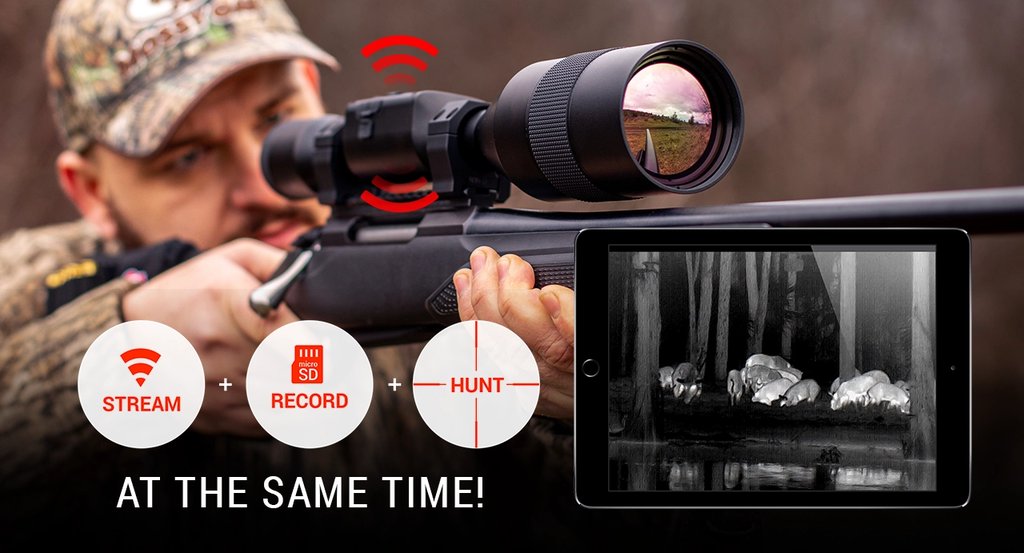
The same unit clips onto a day optic, mounts to a helmet for hands-free movement, drops into a hand for a quick scan, or runs as a weapon sight. It also carries SharpIR AI enhancement, Picture-in-Picture, a Zeroing Freeze feature, and a nine-profile ballistic calculator. At 360 g without a battery it is the lightest way to get all of that on a helmet through a long shift.
Who it is for: almost any officer who wants one versatile thermal for patrol, tracking, and search. Who it is NOT for: a role that constantly needs an exact distance to a distant subject, where the ATN Odin MFT's lack of a built-in rangefinder becomes a limit and the LRF model is the better tool.
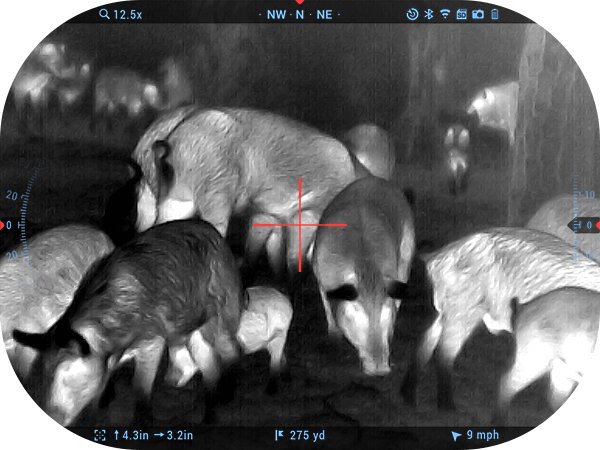
ATN Odin MFT LRF 640x480 1-8x — best when distance matters
The ATN Odin MFT LRF is the pick when knowing the exact distance to a subject changes your decision. It runs the same 640x480 sensor and ≤15 mK sensitivity as the standard model, then adds a built-in laser rangefinder in the same tactical body.
A one-press distance to a hidden subject
The integrated laser rangefinder reads distance out to 1000 m with about a meter of accuracy in a single press. On a cold, open winter search, where there are no landmarks to estimate range from, that number tells you exactly how far a heat signature sits, which shapes how you approach, how you call it in, and how you deploy a team. It is the one capability the standard model cannot match.
Ballistic profiles for a sight role
When the LRF runs as a weapon sight, the measured range feeds the nine-profile ballistic calculator automatically, so the aim point is corrected for distance without manual input. For units that occasionally mount the monocular to a rifle, that pairing keeps accuracy honest across the ranges a night can present.
Who it is for: officers who need exact ranging on open ground or who run the unit as a sight. Who it is NOT for: weight-critical helmet work in landmark-rich terrain, where the extra 40 grams buys a feature you rarely use and the standard Odin MFT is the smarter carry.
Season by season with the ATN Odin MFT line
Because police work runs year-round, it helps to think about how each unit behaves as the calendar turns. Neither model changes its sensor, but the conditions change what you ask of it, and that shifts which one earns its place on your belt.
- Winter — cold, open ground makes a warm body stand out sharply, which plays to the ≤15 mK sensitivity, but the lack of landmarks makes distance hard to judge, so the LRF's laser ranging shines on searches and long perimeters.
- Spring — mixed cover and mild temperatures keep contrast reasonable; the lighter standard Odin MFT is comfortable for the long, variable shifts this season brings.
- Summer — hot terrain can mask a still subject, so the low NETD matters most here, and dense foliage gives plenty of range references that let the lighter model hold its own.
- Fall — cooling nights and thinning cover sit between the extremes; either unit performs well, so the choice falls back to your primary role rather than the weather.
How to choose a law enforcement thermal monocular for 2026
Choosing the right unit comes down to how your season and your role actually play out. Both units share the same image, so the real questions are about weight, ranging, and how you mount them.
- Season and terrain — cold, open ground with few landmarks favors the LRF's laser ranging; warm cover with fence lines and field edges lets the lighter standard model shine.
- Primary role — patrol, tracking, and helmet-based search reward the lightest body; a role that mounts the unit as a sight or needs exact distance rewards the LRF.
- Weight over a long shift — 40 grams sounds trivial until it is on a helmet for eight hours, so favor the standard Odin MFT if you rarely need the laser.
- Battery strategy — both run about eight hours on an 18650 and accept a hot-swapped spare, so plan spares for the length of your shift, not a single charge.
- One kit or many — the 4-in-1 design lets one unit cover handheld, helmet, clip-on, and sight roles, which keeps a department's kit list short.
How we picked these ATN thermal monoculars
We picked these against what law enforcement actually does across a full year, and we considered only ATN's current 6th-gen Odin MFT line. The criteria were sensor resolution and ≤15 mK NETD for whether the image reads a person cleanly on a cold or a hot night, detection range for how early a subject appears, refresh smoothness for tracking someone on the move, weight for hours of helmet or handheld carry, battery runtime for a full shift, and the presence of a laser rangefinder for judging distance on open terrain. Honest trade-off: because both units share the same core, this roundup is really about weight versus ranging, not image quality. Who these are NOT for: an officer who never needs a measured distance and works only in landmark-rich cover gains little from the LRF, while a role that always needs exact range should not save grams with the standard model. This is an in-house comparison of ATN's own range, not an independent lab review; weigh the specs against your department's real callouts.
Frequently Asked Questions
What is the best thermal monocular for law enforcement in 2026?
For most officers, the ATN Odin MFT is the best all-round choice: a 640x480 sensor and ≤15 mK sensitivity in the lightest version of ATN's 4-in-1 tactical body. It serves as a handheld, helmet monocular, clip-on, or sight, which suits the mix of patrol, tracking, and search a shift demands.
When should an officer choose the ATN Odin MFT LRF instead?
Choose the LRF when knowing the exact distance to a subject changes your decision, such as on a cold, open search with no landmarks to estimate range from. Its built-in laser rangefinder reads out to 1000 m with about a meter of accuracy, at the cost of roughly 40 grams more weight.
Can these ATN monoculars be worn on a helmet?
Yes. Both units are 4-in-1 designs that mount to a helmet for hands-free movement, in addition to working as a handheld, a clip-on, or a weapon sight. The standard Odin MFT is about 40 grams lighter without a battery, which is the one to favor for long helmet shifts.
How does the 640x480 resolution help in police work?
Resolution is the pixel count of the thermal sensor, and 640x480 gives enough detail to tell a person from an object at a longer distance rather than seeing a shapeless warm patch. For confirming whether a heat signature is a suspect or an animal, that clarity supports a faster, safer decision.
Are prices listed for these units?
No. Both sit in ATN's flagship tactical tier, and we describe them in relative terms rather than exact figures. For current pricing on either the standard Odin MFT or the LRF model, check the product pages on the ATN site directly.
How long do the batteries last on a shift?
Both units run about eight hours on a single 18650 battery, or roughly an hour on a CR123. Because the battery is user-replaceable, you can carry and hot-swap spares to cover a full shift rather than relying on one charge.
Do these work as a rifle sight as well as a monocular?
Yes. Both are 4-in-1 units that run as a weapon sight, and both carry a nine-profile ballistic calculator. The LRF model feeds it a measured distance automatically, while the standard model uses ranges you estimate, so the LRF is the stronger choice for a sight role.
For a department that needs one thermal to cover patrol, tracking, and search through every season, start with the ATN Odin MFT — the lightest 4-in-1 body with a clean 640 image. If your callouts regularly put you on open ground where an exact distance matters, the Odin MFT LRF adds a built-in rangefinder to the same core. Compare both, plus the full current lineup, on the ATN thermal monoculars page and match the unit to the way your officers actually work.
Created: August 10, 2026 · 09:39:32 UTC