Coyotes work the dark, cover ground fast, and won't sit still for a slow optic — so the best thermal monocular for coyote hunting is the one you can raise, scan, and track with in a single sweep. That's the ATN BlazeTrek 6 640x512 1.5-12x. Its wide field of view lets you sweep a whole pasture edge in one pass instead of peering through a soda straw, it weighs barely more than a can of soup so your arm holds steady on a stand, and the 640 sensor is sharp enough to tell a coyote from a stray dog before you ever touch a call. This roundup covers our ATN picks for coyote work, how they compare, and how to choose.
Best for going light and fast: the same BlazeTrek 6 at 320 grams — you can glass all night without arm fatigue.
Best for extreme detail and ranging: ATN BlazeHunter XD LRF 1280x1024 2-16x — a huge sensor plus a built-in laser rangefinder for far-off, positive ID.
Why ATN's 6th-gen monoculars suit coyote hunting
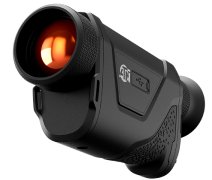
Coyote hunting is a scanning game before it's a shooting game — you spend the night sweeping fence lines, draws, and pasture edges looking for a warm body moving in the dark. A monocular is the right tool for that because it's fast to raise, light to hold, and easy to sweep. ATN's 6th-generation thermal monoculars are built for exactly this. The BlazeTrek 6 leads with a genuinely wide 22.8 x 18.3 degree field of view, so you catch more ground in one look and a coyote breaking cover doesn't slip out of frame. SharpIR AI enhancement keeps the picture clean, a 50 Hz refresh keeps a running dog smooth instead of smeared, and the ATN Connect 6 app even brings an AI assistant along. For hunters who want the absolute sharpest look and instant ranging, the BlazeHunter XD LRF steps up to a 1280x1024 sensor. We only consider this current 6th-gen line here; older monoculars are out.
Best overall for coyotes: ATN BlazeTrek 6 640x512
The ATN BlazeTrek 6 640x512 1.5-12x is the coyote hunter's monocular because it's built around the two things predator work demands: a wide view and a light body. That 22.8 x 18.3 degree field of view means you sweep a whole tree line in one pass and keep a moving coyote in frame instead of chasing it around a narrow circle. The 1.5x base magnification keeps that view wide for scanning, and you can push to 12x when you need to confirm what you're looking at.
Why light weight wins on a long stand
At 320 grams — about 0.7 of a pound — the BlazeTrek 6 is light enough to hold to your eye through a whole calling sequence without your arm shaking the picture. That steadiness matters when you're trying to pick a coyote out of brush at the edge of range. It's also IP67 waterproof and records video and stills, so you can save the sequence when a dog comes to the call.
Why the AI assistant helps on a call stand
The BlazeTrek 6 ties into the ATN Connect 6 app with an AI assistant, which is more useful than it sounds when you're new to a piece of ground or a new call setup. You can ask it about settings, palettes, or how to get the cleanest picture for the conditions you're in without digging through a manual by headlamp. Combined with Hot Point Tracking flagging the warmest object in view, it means a hunter still learning to read thermal can pick a coyote out of a busy field faster. Less time fiddling with the optic is more time watching for the dog that slips in silent from downwind.
Who it's for and who it's not
It's for the coyote hunter who scans, calls, and tracks on foot or from a stand and wants a fast, wide, light optic. It's not the pick if you need to positively identify animals way out past a thousand meters or want ranging built in — that's the BlazeHunter XD LRF.
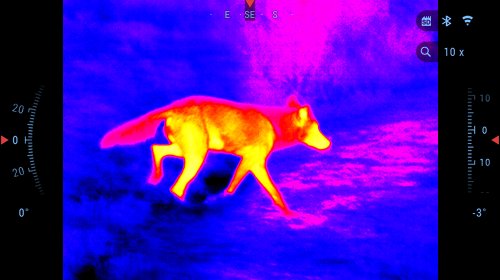
Best for extreme detail and ranging: ATN BlazeHunter XD LRF
The ATN BlazeHunter XD LRF 1280x1024 2-16x is the pick when you hunt big open country and need to identify and range coyotes at serious distance. Its 1280x1024 sensor holds over a million more pixels than a standard thermal — think of it as jumping from HD to extreme definition — so a far-off dog is a clear, identifiable shape rather than a warm blur. Detection reaches about 3,400m, and a built-in laser rangefinder reads distance to 1000m within about a meter.
What the big sensor buys you
All those extra dots let you zoom deep before the picture breaks down, which is exactly what you want when a coyote is hanging up at the far edge of a section. The rangefinder means you also know how far it is before you decide to shoot or reposition. Two removable 18650 batteries give 10+ hours total, so an all-night sit is covered.
Who it's for and who it's not
It's for the open-country predator hunter who prizes maximum detail and ranging over the widest view. It's not for the hunter who mostly scans close cover and wants the lightest, widest, fastest handheld — the BlazeTrek 6 owns that job.
How to choose a thermal monocular for coyote hunting
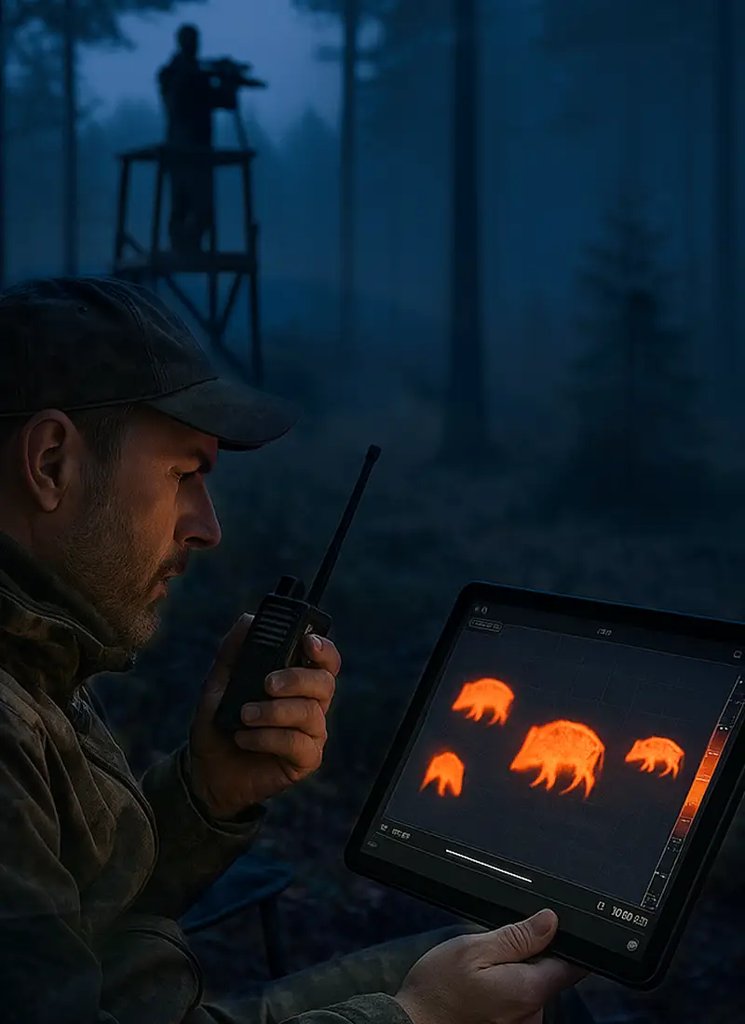
Match the optic to your terrain and how you hunt. Close cover and a lot of walking reward a wide, light, fast monocular; wide-open country rewards a bigger sensor and more reach. Start with field of view and weight, then work toward resolution and range.
- Field of view — a wider FOV like the BlazeTrek 6's makes sweeping a pasture edge and tracking a running coyote far easier than a narrow view.
- Weight — a light body (320 g on the BlazeTrek 6) keeps your arm steady through a long calling sequence.
- Resolution — 640x512 is plenty to ID a coyote at normal range; 1280x1024 on the BlazeHunter XD lets you push detail way out in open country.
- Thermal sensitivity (NETD) — lower is cleaner in humid, foggy, or damp air; the BlazeHunter XD's <=15mK edges the BlazeTrek 6's <=18mK.
- Detection range — 1,000m on the BlazeTrek 6 versus 3,400m on the XD; that's spotting distance, so match it to how far you actually see coyotes.
- Battery — the XD's swappable dual batteries give 10+ hours for all-night sits; the BlazeTrek 6's internal pack runs about 6.5 hours.
How we picked these ATN monoculars
We judged these monoculars on what coyote hunting actually asks of a handheld: raise it fast, sweep wide, hold it steady, and see clearly enough to tell a coyote from a dog before you commit. We weighed field of view, weight, resolution, thermal sensitivity (NETD), detection range, refresh rate, and battery against that use, and we only considered ATN's current 6th-gen line. The honest trade-off is that the wide, light BlazeTrek 6 gives up ultimate detail and reach, while the BlazeHunter XD trades some field of view and weight for a far bigger sensor and built-in ranging. Neither is meant to be a rifle-mounted sight — these are handheld scanners. This is an in-house comparison of ATN's own range, not an independent lab test, so match these points to your terrain before you buy.
Frequently Asked Questions
What is the best thermal monocular for coyote hunting?
For most coyote hunters the best thermal monocular is the ATN BlazeTrek 6 640x512 1.5-12x. Its wide field of view makes scanning and tracking running coyotes easy, it weighs just 320 grams for steady handheld glassing, and the 640 sensor is sharp enough to identify a coyote before you commit. Hunters in wide-open country who want extreme detail and ranging may prefer the BlazeHunter XD LRF.
Why use a monocular instead of a thermal scope for coyotes?
A monocular is faster to raise, lighter to hold, and easier to sweep across a wide area, which suits the scanning-heavy nature of coyote hunting. You spot and track with the monocular, then aim with your rifle optic. Many predator hunters carry both, using the monocular to find the coyote and the scope to make the shot.
How wide is the BlazeTrek 6 field of view?
The ATN BlazeTrek 6 has a wide 22.8 x 18.3 degree field of view. A wider field of view lets you sweep more ground in one look and keep a running coyote in frame instead of chasing it around a narrow circle. That is a big advantage when scanning fence lines and pasture edges at night.
Can a thermal monocular tell a coyote from a dog?
Yes, with enough resolution you can distinguish a coyote from a stray dog by body shape, size, and how it moves. The BlazeTrek 6's 640x512 sensor is sharp enough for this at normal calling ranges, and you can zoom to 12x to confirm. In big open country the BlazeHunter XD's 1280x1024 sensor gives even more detail at long distance.
How long will the battery last on a night coyote hunt?
The ATN BlazeTrek 6 runs about 6.5 hours on its internal rechargeable battery, which covers most single-night sits. The BlazeHunter XD LRF uses two removable 18650 batteries for 10+ hours total, so you can swap in a fresh cell for an all-night hunt. Cold weather can shorten runtime, so carry a backup power option in winter.
Is the BlazeTrek 6 waterproof for wet-weather coyote hunts?
Yes, the ATN BlazeTrek 6 carries an IP67 rating, meaning it resists dust and can handle rain and brief immersion. That lets you keep hunting through drizzle and damp conditions without worrying about the electronics. It is not meant to be left submerged for long periods.
Does the BlazeTrek 6 record video?
Yes, the BlazeTrek 6 records video and stills to its internal storage and connects to the ATN Connect 6 app over Wi-Fi. That lets you save the moment a coyote responds to your call and review it later. The app also includes an AI assistant to help with settings.
When a coyote breaks cover at the far edge of your call, you want an optic that's already up and sweeping. The ATN BlazeTrek 6 640x512 1.5-12x gives you a wide field of view, a light body you can hold steady all night, and a sensor sharp enough to make the call before you shoot. Compare it against the higher-detail BlazeHunter XD LRF on the ATN thermal monocular page and match the field of view, reach, and weight to the country you hunt.
Created: July 7, 2026 · 19:23:01 UTC