If you want the best thermal monocular built-in LRF 2026 has to offer, the question is not just "can it see heat?" It is "how far away is that heat, exactly?" A monocular with a built-in laser rangefinder answers both at once: you spot the animal, tap the button, and read the distance without lowering the unit or reaching for a separate tool. That one habit changes how you shoot. The ATN BlazeHunter XD LRF pairs an extreme-definition 1280x1024 sensor with a 1000m laser, so you range and confirm in the same look. This roundup ranks the current ATN handhelds that carry a rangefinder onboard and shows which one fits your kind of night.
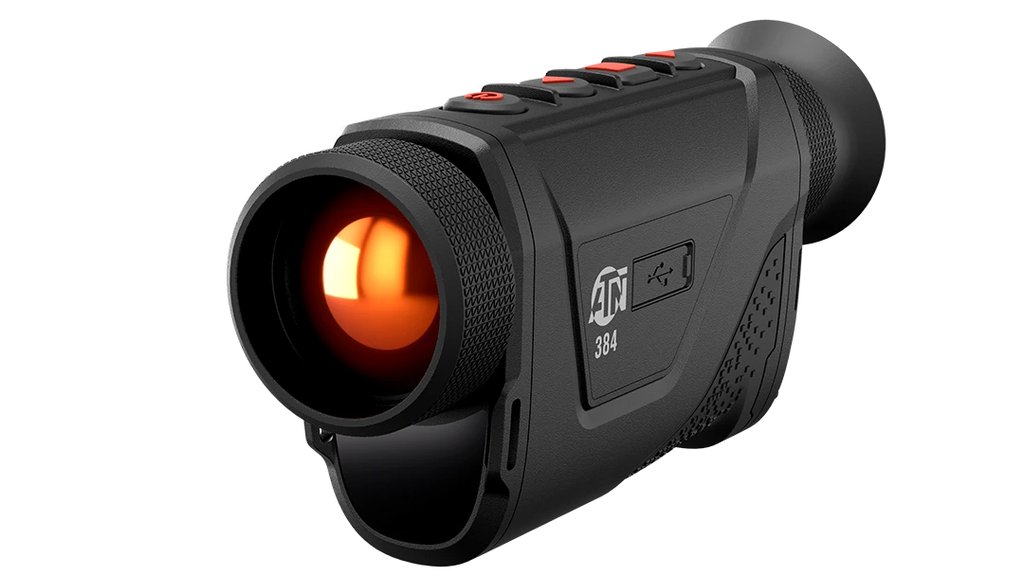
Best multi-role: ATN Odin MFT LRF 640x480 1-8x — a lighter 4-in-1 that ranges and also works as a clip-on or helmet goggle.
Best for pure detection distance: BlazeHunter XD LRF again — a 3400m detection range and a 50mm lens read heat far past where you would ever range it.
Why ATN's 6th-gen handhelds carry the rangefinder onboard
A built-in laser rangefinder matters because thermal flattens distance. Heat has no depth cues, so a coyote at 150 yards and a coyote at 350 yards can look almost the same size in the screen. Guessing that gap is where clean shots turn into misses. ATN's current 6th-gen line solves it by building the laser into the same unit you are already looking through. You range in the same second you identify the animal — no fumbling for a handheld rangefinder, no taking your eye off the target. Both units in this roundup put an exact number on the screen, feed it into a ballistic calculator where the device supports one, and let you commit to the shot with a real figure instead of a hopeful guess. Only ATN's newest models are considered here; older discontinued handhelds are left out because their sensors and ranging simply do not keep up.
Best overall: ATN BlazeHunter XD LRF
The ATN BlazeHunter XD LRF is the best thermal monocular with a built-in rangefinder because it pairs the sharpest sensor ATN makes with a laser that reads out to 1000m. When you spot heat at the edge of a field, you get an exact yardage and a picture clean enough to tell a hog from a stump before you ever commit.
The 1280x1024 sensor is the real story
Think of resolution like megapixels on a camera. The 1280x1024 sensor carries over a million more pixels than a standard 640 handheld, so the picture holds together when you push the 2-16x magnification. More dots in the frame means you can zoom in on a distant shape and still read ears, legs and posture instead of a warm blob. With a <=15mK NETD, faint heat differences stay visible in damp or foggy air, which is exactly when guessing goes wrong.
Ranging that feeds the shot
The built-in 1000m laser is accurate to about a meter, so the distance you read is the distance you dial. Add a 3400m detection range from the 50mm lens and you are picking up heat far beyond where you would ever range it — the laser simply confirms the exact number when the animal is inside your working distance. SharpIR image enhancement and Hot Point Tracking keep a moving target crisp and marked while you range.
Built to run all night
Two removable 18650 batteries give you 10+ hours total, and because they swap out you are never stranded mid-hunt — carry a spare pair and the unit runs as long as you do. A Full-HD 1920x1080 OLED display shows every bit of that 1280x1024 sensor, so the detail the camera captures actually reaches your eye. Thirty-two gigabytes of storage plus video and audio recording mean you can save the stalk, and the ATN Connect 6 app over Wi-Fi lets you review or share it. It is IP67 waterproof, so dew, fog and a sudden shower do not end the night.
Who it's for: hunters and scouts who want the most detail and the longest confident reach in a handheld, and who range before every shot. Who it's not for: someone who needs the unit to also mount on a rifle or a helmet — for that, look at the Odin below.
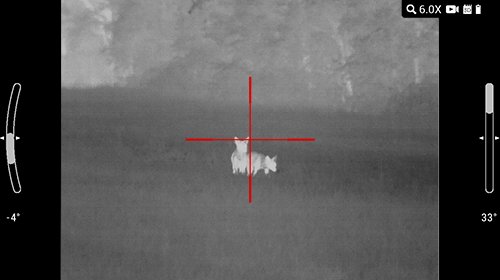
Best multi-role: ATN Odin MFT LRF
The ATN Odin MFT LRF is the pick when the same unit has to do more than spot. It is a 4-in-1: handheld monocular, clip-on in front of a day scope, standalone weapon sight, and helmet-mounted goggle. It carries the same 1000m laser rangefinder, so wherever you mount it, you still get an exact distance.
Lighter, faster, more places to put it
At 400 g the Odin is lighter than the BlazeHunter XD and rides comfortably on a helmet for hands-free scanning. Its 640x480 sensor gives a clean picture for its role, and a built-in ballistic calculator with up to nine profiles turns the ranged distance into a firing solution when you run it as a sight. Picture-in-Picture, customizable reticles and Recoil Activated Video round out the tactical feature set.
One device, four jobs
The value of the Odin is that it replaces several tools. In the morning it scans as a handheld, at night it clips in front of a day scope, on a dedicated build it serves as the sight itself, and on a helmet it becomes hands-free goggles. Through all of it the 1000m laser stays with you, so you always have a distance. A Zeroing Freeze feature makes sighting-in easier, NV retention mode keeps your dark adaptation, and shake-to-wake standby saves battery between looks. It runs on 18650, CR123 or USB-C power and holds 64 GB of footage, all inside an IP67 waterproof body.
Who it's for: anyone who wants one ranging device that spots, clips on and mounts to a helmet. Who it's not for: a hunter chasing maximum image detail and reach — the higher-resolution BlazeHunter XD wins on pure picture and distance.
How to choose a thermal monocular with a built-in LRF
Start with how you hunt, then match the feature set. A built-in rangefinder is worth the step up when your shots stretch past easy-guess distance or when the terrain hides the true gap. Weigh these points:
- Resolution — 1280x1024 lets you zoom further before the picture turns blocky; 640 is plenty for shorter, faster work.
- Detection range — a longer number (3400m vs 1700m) means you pick up heat sooner and have more time to range and set up.
- Rangefinder reach — both here read to 1000m at about a meter of accuracy, which covers realistic shot distances with margin.
- Mounting — if the unit must also clip onto a rifle or ride a helmet, the multi-role Odin is the answer; if it stays in your hand, the BlazeHunter XD is the sharper tool.
- Battery — plan for a full night; the BlazeHunter XD runs 10+ hours on its two batteries, the Odin around 8.
- Weight — a few ounces matter on a long walk-in or on a helmet, so the lighter Odin has an edge there.

How we picked these ATN thermal monoculars with built-in LRF
We only looked at ATN's current 6th-gen handhelds that actually carry a laser rangefinder inside the unit, then judged them against what a ranging monocular is really for: putting an exact distance on a target you can clearly identify. We weighed sensor resolution, NETD (thermal sensitivity in bad air), detection range, rangefinder reach and accuracy, refresh rate for tracking movement, weight for long carries, and battery life for a full night out. The honest trade-off is real: the BlazeHunter XD gives you the sharpest, longest-reaching picture but weighs more and stays in your hand, while the Odin gives up resolution and range for weight and the ability to mount almost anywhere. This is an in-house comparison of ATN's own range, not an independent lab test, so check the specs against your own distances and terrain before you buy.
Frequently Asked Questions
What is the best thermal monocular with a built-in LRF in 2026?
The ATN BlazeHunter XD LRF is the best overall. Its 1280x1024 sensor delivers the most detail of any ATN handheld and its onboard 1000m laser rangefinder gives you an exact distance the moment you spot a target. If you also need the unit to clip onto a rifle or mount on a helmet, the ATN Odin MFT LRF is the better multi-role choice.
Why does a built-in rangefinder matter on a thermal monocular?
Thermal flattens distance because heat has no depth cues, so an animal can look the same size at very different ranges. A built-in laser rangefinder gives you an exact yardage in the same look you use to identify the target, so you can dial or hold with a real number instead of a guess. That is the difference between a clean shot and a miss at distance.
How far can the ATN BlazeHunter XD LRF range and detect?
Its built-in laser rangefinder reads out to about 1000m with roughly a meter of accuracy. Separately, its 50mm lens and 1280x1024 sensor give a detection range of around 3400m, meaning you can pick up heat well beyond where you would ever take a shot and then range it precisely once it is in your working distance.
Can I use these ranging monoculars for more than spotting?
The Odin MFT LRF is a true 4-in-1: handheld monocular, clip-on in front of a day scope, standalone weapon sight, and helmet-mounted goggle, all with the same 1000m laser. The BlazeHunter XD LRF is built as a dedicated handheld spotter, so it stays in your hand but rewards you with a sharper, longer-reaching picture.
Does higher resolution really help at long range?
Yes. A 1280x1024 sensor holds far more detail than a 640, so when you zoom in on a distant shape the picture stays readable instead of turning into a warm blob. That extra detail is what lets you positively identify an animal before you commit, which matters most exactly when it is far away.
How long will these run on a night hunt?
The BlazeHunter XD LRF runs 10+ hours total on its two removable 18650 batteries, so you can swap on the fly and cover a full night. The Odin MFT LRF runs around 8 hours and accepts 18650, CR123 or USB-C power, which gives you flexible options in the field.
Ready to stop guessing distance in the dark? The ATN BlazeHunter XD LRF gives you the sharpest handheld picture ATN makes and puts an exact yardage on every target with its built-in laser. If you want a lighter unit that also clips onto a rifle or rides a helmet, compare it against the rest of ATN's thermal monoculars and pick the one that matches your distances and your setup. Either way, you head out with a device that spots the heat and tells you exactly how far it is.
Created: July 7, 2026 · 11:11:27 UTC