"Best thermal binoculars for the money" means something different on your first hog hunt than it does on your hundredth. A hunter who has never watched a sounder glow on a thermal screen needs an optic that forgives mistakes and shows game fast. A hunter who already reads heat signatures at a glance is chasing something else entirely: raw magnification and the extra yards of detection that turn a distant smudge into a confirmed shot. Both hunters are looking at the same family here — the ATN Binox-6 Dual — but the version that is genuinely worth their money is not the same one.
This is an ATN-vs-ATN comparison between two Binox-6 Dual configurations: the 640x512 3-24x and the 384x288 5.5-44x. Instead of ranking them by price tier or terrain, we frame the choice around who is holding them — the newcomer building confidence versus the seasoned night hunter squeezing every last yard out of a night in the field.
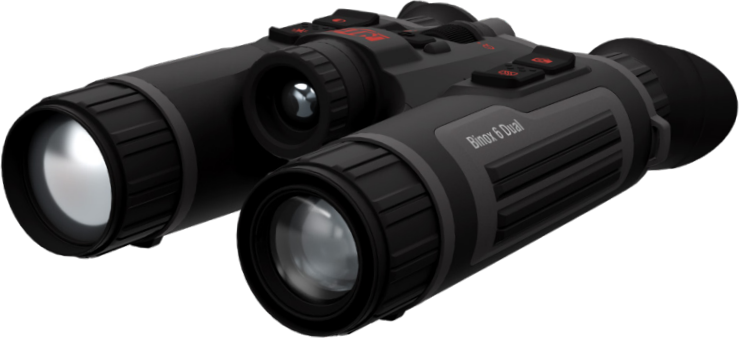
The two Binox-6 Dual models at a glance
Both are dual-sensor binoculars — a thermal channel plus a 4K day channel — with the same 4-in-1 feature set, the same NETD thermal sensitivity, and roughly the same weight and battery life. The difference that matters for a hog hunter lives in two numbers: thermal resolution and the magnification range.
The first-season hog hunter: why the 640 is the smarter money
If this is your first year hunting pigs after dark, the single biggest obstacle is not shooting — it is finding. A newcomer sweeps a field and cannot always tell a warm rock from a bedded hog, or loses a moving sounder the moment it slips behind brush. That is exactly where the 640x512 sensor earns its keep.
- More detail to interpret. A 640x512 thermal image packs far more pixels onto the same scene than 384x288, so a hog looks like a hog — legs, snout, the shape of the back — instead of a warm blob you have to guess at. For a hunter still learning to read heat, that clarity shortens the learning curve.
- A forgiving 3x low end. Starting at 3x gives a wide field of view, which means you can scan a field quickly and keep a running sounder in frame. High zoom is useless if you can never get on target; the wide base magnification is what actually lets a beginner find and follow pigs.
- Longer detection cushion. The 640 model reaches out to 3,100 m of detection versus 2,750 m, so a newcomer picks up heat sooner and has more time to plan a stalk rather than getting surprised at close range.
- Built-in rangefinder. New hunters are the worst at eyeballing distance in the dark. The 1000 m laser rangefinder removes the guesswork before a shot.
For "best thermal binoculars for the money hog hunting" in a beginner's hands, value is measured in successful, confident hunts — and the 640x512 3-24x simply produces more of them early on. It is the model that grows with you rather than one you outgrow after a season.
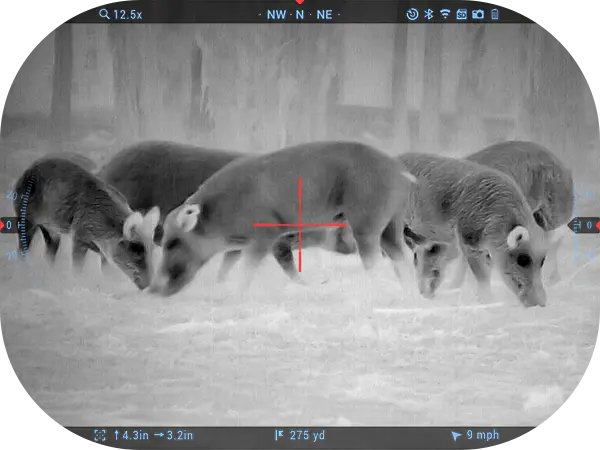
The seasoned night hunter: when the 384 5.5-44x is the better buy
An experienced hog hunter reads a thermal scene fast and already knows a boar from a barrow at a distance. What limits them is not interpretation — it is reach and identification at extreme range. For that hunter, the trade the 384x288 5.5-44x makes can be the right one.
- Highest zoom in the pair. 5.5x to 44x means a veteran can push in hard on a distant hog to confirm size, count a sounder, or pick a specific animal out of a group before committing — a call an experienced hunter actually knows how to make.
- A fast 35 mm F/0.9 thermal lens. The slightly faster aperture gathers heat efficiently, and a seasoned eye squeezes real usable detail out of the tighter zoom.
- The same 4-in-1 toolkit for less outlay. The 384 keeps the dual 4K day channel, rangefinder, GPS and compass, so an experienced hunter who does not need 640-level clarity keeps the features that matter while spending less on the sensor.
- You already own the skill the 640 sells. The main thing 640 resolution buys is easier target ID — something a veteran can already do at 384. Paying the premium for it is money better spent elsewhere.
The honest caveat: 384x288 is a lower-resolution image, so at very long range the picture is coarser and small or partially hidden pigs are harder to call. A veteran who hunts thick country at moderate range may still prefer the 640. The 384 rewards a hunter with the experience to work within its limits and the appetite for extra zoom.
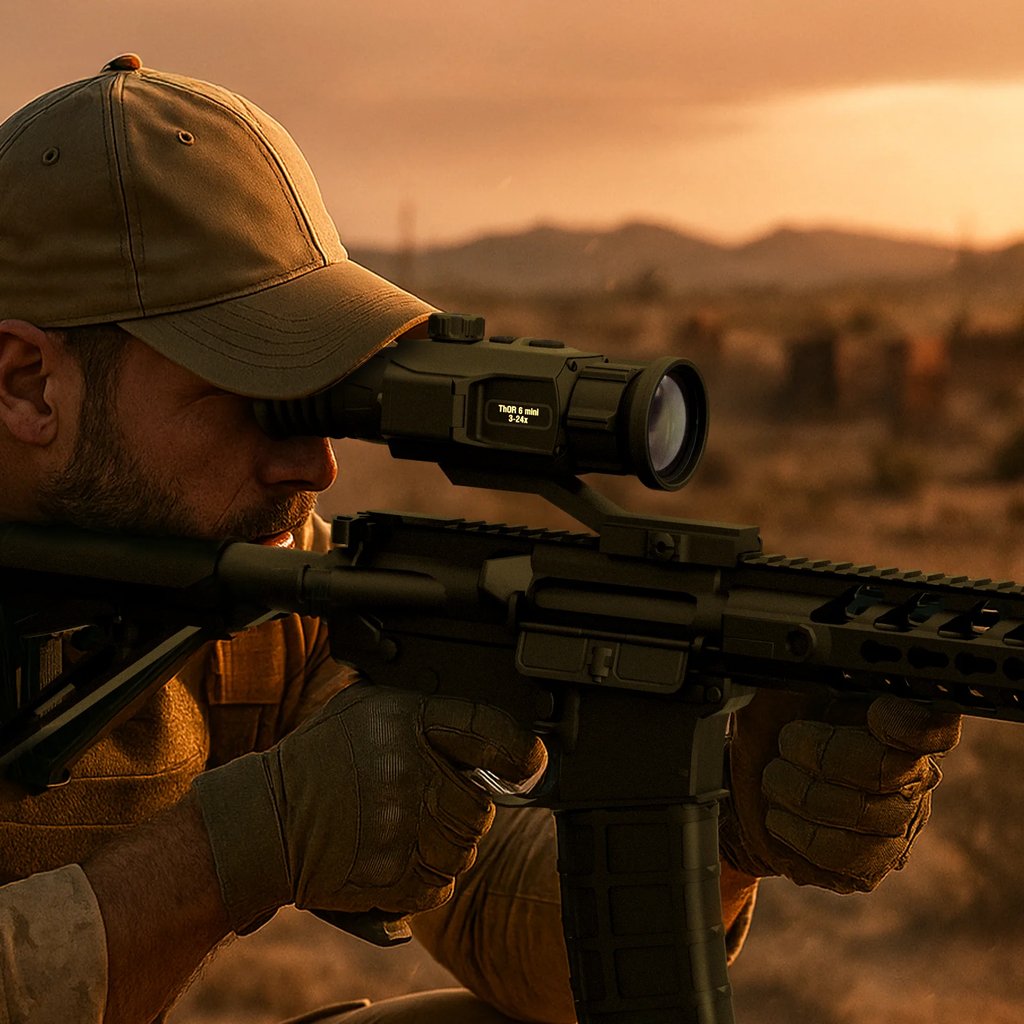
Where they overlap — and where experience tips the choice
Because they share a family, a lot is identical: dual thermal-plus-4K-day channels, ≤15 mK NETD, dual-view switching, SharpIR AI image enhancement, DeFog and WDR, IR illuminators, swappable 18650 batteries and near-identical weight. Neither will feel cheap in the hand and both are true hog-hunting binoculars, not repurposed monoculars.
So the deciding question is not "which is better" in the abstract — it is "which matches where you are." A new hunter benefits most from resolution and a wide, forgiving view (the 640). A hunter who has already banked the field skills and wants to reach and zoom further leans toward the 384 5.5-44x. Buy the one that fixes your current weakness, not the one with the biggest number on the box.
How we compared them
We weighed the two Binox-6 Dual configurations on the specs that actually change a hog hunt — thermal resolution, NETD sensitivity, magnification range, detection distance, weight and battery life — but judged each spec against a hunter's experience level rather than in isolation. Resolution and a wide low-end zoom count double for a first-timer who is still learning to find and identify game; maximum magnification and reach count more for a veteran who already reads thermal scenes and wants extra distance. This is an in-house comparison of two models from ATN's own current 6th-generation binocular line, not an independent lab test, and only current-line configurations were considered. The trade-offs are real: the 640 asks for more outlay to buy clarity a seasoned hunter may not need, while the 384 gives up resolution for zoom and is a poor first optic for someone who cannot yet tell heat shapes apart. Check these criteria against your own nights in the field and pick accordingly.
Frequently Asked Questions
I'm on my first year hunting hogs — which ATN Binox-6 is the best money?
The Binox-6 Dual 640x512 3-24x. Its higher-resolution image and wide 3x starting view make pigs far easier to find and identify, which is the hardest part for a new hunter. It is the model that shortens the learning curve.
I've hunted with thermal for years — is the 384 5.5-44x worth it over the 640?
It can be. Experienced hunters already read thermal scenes well, so the 640's main advantage — easier target ID — matters less to them. The 384's 5.5-44x zoom gives that hunter more reach and detail at distance for a lower spend on the sensor.
Which model finds hogs faster in an open field?
The 640x512 3-24x. Its wider low-end field of view lets you scan quickly and keep a moving sounder in frame, and its 3,100 m detection reaches slightly farther than the 384's 2,750 m so you pick up heat sooner.
Does the higher zoom on the 384 make it better for long-range hog hunting?
For an experienced hunter, often yes — 5.5-44x pushes in hard to confirm a distant hog. But 384x288 resolution means a coarser image at extreme range, so newer hunters may struggle to identify small or partly hidden pigs even at high zoom.
Do both binoculars have a rangefinder for judging distance to a hog?
Yes. Both carry a laser rangefinder plus GPS and compass; the 640 model's LRF reaches 1000 m. This is especially valuable for newer hunters who are still learning to estimate distance in the dark.
Are these true binoculars rather than a monocular?
Yes — both are dual-eyepiece Binox-6 thermal binoculars with a thermal channel and a 4K day channel. They give a two-eyed view that many hunters find easier for long scanning sessions than a single-eye monocular.
If I plan to grow into serious hog hunting, which should I buy?
The 640x512 3-24x is the safer long-term buy for most hunters because its resolution and forgiving view serve you as a beginner and still hold up as you improve. Choose the 384 5.5-44x only if you already have the field skills and specifically want maximum zoom and reach.
Match the optic to where you are as a hunter: see the ATN Binox-6 Dual 640x512 3-24x if you want the most forgiving, high-resolution view for finding hogs, or the ATN Binox-6 Dual 384x288 5.5-44x if you're a seasoned night hunter chasing maximum zoom. Browse the full ATN thermal binoculars lineup to compare.
Created: August 5, 2026 · 19:53:40 UTC