Most hog-hunting binocular guides sort optics by range or price. Pigs do not care about either. They show up wherever the setup lets you spot them — and the way you carry and steady your glass at night decides whether you ever see them at all. So this roundup of the best thermal binoculars for the money hog hunting is organized by rig: how you actually run the optic in the dark. For each setup we name the ATN Binox-6 variant that fits it best, so you buy for the way you hunt rather than for a spec sheet.
Why we sort hog binoculars by setup, not by season
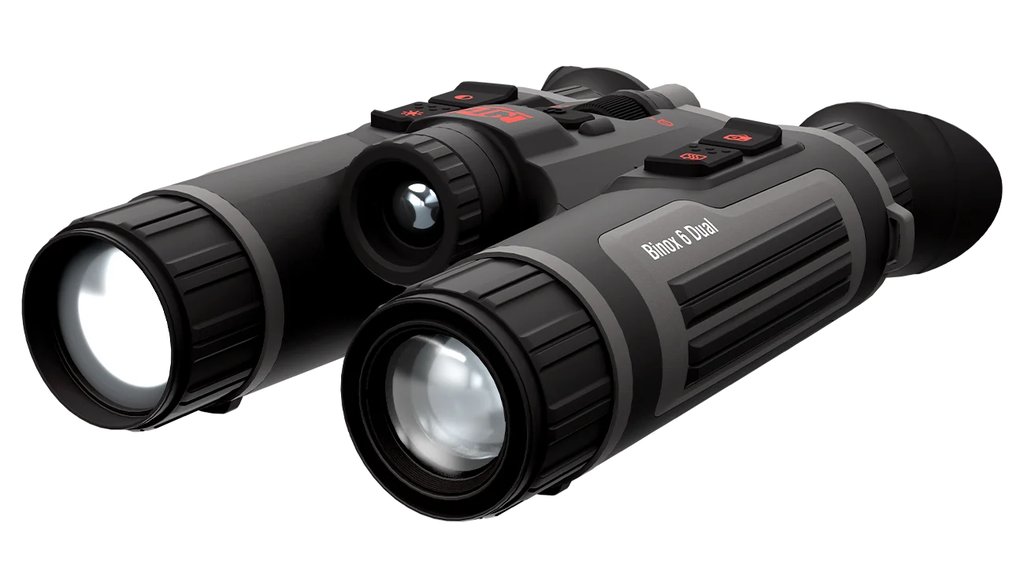
A thermal binocular that is a joy freehand on a walk-in can be the wrong tool bolted to a truck window, and the model you glass from a tripod all night may be overkill jammed in a light pack. Hogs are nocturnal, they move as a sounder, and they punish a slow or shaky first look. Match the optic to how you steady it and how far you have to hike it, and the same money buys a noticeably better night. Both picks here come from ATN's current 6th-generation Binox-6 line — both dual-sensor (thermal plus a 4K day channel), both NETD ≤15 mK, both with the 4-in-1 Day / Night / Thermal / Twilight modes — so you are choosing a fit, not compromising on the platform.
1. Handheld freehand scanning: ATN Binox-6 Dual 384x288 5.5-44x
This is how most hog hunters actually run binoculars — up to the eyes, sweeping a field edge or a feeder lane, then moving. For freehand work you want the widest useful zoom band and the lightest body you can get without dropping sensor quality, and the Binox-6 384x288 5.5-44x is built for exactly that. At about 720 g / 1.59 lbs it hangs on a harness all night, and its 5.5-44x is the highest magnification range in the family, so you can scan wide low and then reach out on a distant heat blob without swapping optics.
The built-in 1000 m laser rangefinder is the freehand hunter's best friend: tag the pig, read the distance, decide whether to close in — all without lowering the glass. Detection runs out to 2750 m, far past any range you'll shoot a hog freehand, and SharpIR AI plus DeFog and WDR keep a hand-held image clean when your arms drift. For the price, this is the one most hog hunters should start with.
- Best for: harness-carry, walk-and-glass, still-hunting field edges freehand.
- Why it wins the rig: highest zoom in the line (5.5-44x) plus onboard 1000 m rangefinder — scan and range without a second device.
- Trade-off: 384x288 sensor is a touch coarser than the flagship at extreme distance — a non-issue at freehand hog ranges.
2. Tripod / monopod glassing from a stand: ATN Binox-6 Dual 640x512 3-24x
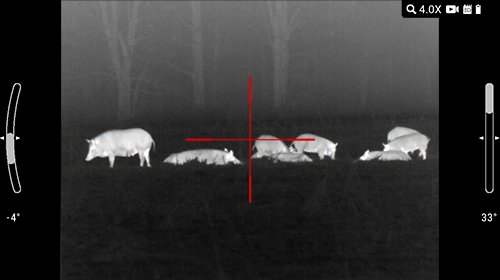
When you park behind a tripod or monopod and glass one big pasture for the night, resolution beats reach-out zoom. A steady base cancels the wobble that limits handheld magnification, so the payoff shifts to how much detail the sensor resolves — telling a hog from a deer, counting a sounder, reading movement at the far tree line. That is where the flagship Binox-6 640x512 3-24x earns its keep: the 640x512 thermal core shows a cleaner, denser image than the 384, and detection stretches to 3100 m for those wide-open stand setups.
The 3-24x band is deliberately lower on top-end zoom than the 384 model, and on a tripod that is a feature, not a limit — you rarely need 44x when the glass isn't shaking, and the wider low end keeps more of the field in view while you wait a sounder out. At about 730 g / 1.61 lbs it's barely heavier than the 384, and the same NETD ≤15 mK and dual day/thermal switching carry over. If your hog hunting is mostly sit-and-glass over open ground, this is the money well spent.
- Best for: seated tripod / monopod glassing over big open pastures and CRP.
- Why it wins the rig: 640x512 resolution and 3100 m detection turn a steady base into extra reach and cleaner target ID.
- Trade-off: flagship tier, so it costs more than the 384, and 24x top zoom is lower — fine on a tripod, less ideal for extreme freehand reach.
3. Truck-window / UTV mount cruising: ATN Binox-6 Dual 384x288 5.5-44x
Road-hunting a big lease means glassing from a rolled-down window or a UTV clamp, killing the engine, then re-glassing every hundred yards. You are picking the optic up and setting it down constantly, so a lighter body and a fast, forgiving image matter more than the last bit of sensor density. The Binox-6 384x288 5.5-44x fits the cab rig: lighter to snatch off the seat, wide-to-tight 5.5-44x so you can sweep the ditch lines and then zoom a heat signature in the far field without moving the truck, and the onboard rangefinder to size a shot before you ever open the door.
GPS and compass log where you spotted each sounder, and the swappable dual 18650 batteries (about 8 hrs) mean a spare pair in the console keeps you cruising all night. For pattern-the-property, cover-ground hog hunting from a vehicle, the 384 is the value pick again — the same optic that serves your freehand nights.
- Best for: truck-window and UTV-mount cruising, stop-and-glass road hunting.
- Why it wins the rig: light to grab-and-glass, 5.5-44x for ditch-to-far-field sweeps, onboard rangefinder for a fast shot decision.
- Trade-off: a mounted rig can steady higher zoom than freehand — but the 384's sensor, not zoom, is the ceiling at long truck distances.
4. Pack-in minimalist setup: ATN Binox-6 Dual 384x288 5.5-44x
Hunting hogs deep off the road — a long walk into river bottoms or back sections — means every gram and every spare battery rides on your back. The minimalist packer wants one optic that does the scanning, ranging and target ID jobs so nothing else has to come along. The Binox-6 384x288 5.5-44x is that one-box kit: ~720 g / 1.59 lbs is the lighter of the two, the 4-in-1 modes cover day arrival through full-dark hunting, and the built-in rangefinder means you leave a separate rangefinder at the truck.
IR illuminators at 850/940 nm extend it into pitch-black timber, and the dual swappable 18650s let you carry a light spare set instead of a heavy power bank. When the whole night hinges on what you can hike in, the more affordable, lighter, do-everything 384 is the honest value pick.
- Best for: long walk-ins, run-and-gun, one-optic minimalist loadouts.
- Why it wins the rig: lightest of the two, all-in-one modes plus onboard rangefinder replaces extra gear, swappable batteries beat carrying a power bank.
- Trade-off: pack-in usually means freehand or a monopod, so you won't tap the full sensor advantage of the flagship anyway.
ATN Binox-6 by setup: side-by-side
Both models share the platform: dual thermal + 4K day sensors, 4-in-1 Day / Night / Thermal / Twilight modes, a 1000 m laser rangefinder, GPS with compass, SharpIR AI image cleanup, DeFog and WDR, and ~8 hrs on two swappable 18650 cells. See the full lineup on the ATN thermal binoculars category page.
How to pick the right Binox-6 for your hog rig
- Name your dominant setup first — freehand, tripod, truck/UTV, or pack-in. That single choice narrows the pick more than any spec.
- If you steady the glass (tripod), spend on resolution: the 640x512 flagship turns a stable base into cleaner target ID and longer detection.
- If you carry or grab the glass constantly (freehand, cruising, pack-in), the 384x288 5.5-44x wins on weight, top-end zoom and value.
- Either way, lean on the onboard 1000 m rangefinder and 4-in-1 modes so one optic covers scanning, ranging and low-light arrival.
How we picked these ATN thermal binoculars
This is an in-house comparison of ATN's own current 6th-generation Binox-6 range for hog hunting — not an independent lab test — so read it as setup guidance and check the specs against your own ground. We judged each variant against the demands of real hog rigs: thermal resolution (384x288 vs 640x512) for target ID, NETD / thermal sensitivity for image clarity in humid Southern nights, detection range against the distances each setup actually glasses, magnification band matched to whether the optic is steadied or handheld, weight against how far you carry it, and battery life plus swappable cells for all-night sits. Honest trade-off: the flagship 640 costs more and tops out at 24x, while the 384 gives up some sensor density for the highest zoom, lighter weight and better value. Who these are not for: hunters wanting a helmet-mounted or rifle-mounted device rather than a hand-carried binocular, or anyone needing a single ultra-budget throwaway — the Binox-6 is a do-everything platform, and you're choosing which one fits your rig.
Frequently Asked Questions
What are the best thermal binoculars for the money for hog hunting?
For most hog hunters the ATN Binox-6 Dual 384x288 5.5-44x is the best value: it's the more affordable of the two, the lightest to carry, has the highest zoom in the family (5.5-44x) and a built-in 1000 m rangefinder. Step up to the 640x512 flagship only if you glass mostly from a tripod over big open ground.
Do I need 640 resolution or is 384 enough for hogs?
384x288 is plenty for freehand, cruising and pack-in hog hunting, where you rarely engage past a few hundred yards and the optic is moving. Choose 640x512 when you glass from a steady tripod or monopod over wide pastures — a stable base lets the higher resolution pay off in cleaner target ID and longer detection out to 3100 m.
Which Binox-6 is best for scanning from a truck or UTV?
The Binox-6 384x288 5.5-44x. Truck and UTV cruising means picking the optic up and setting it down constantly, so its lighter body, wide 5.5-44x zoom for ditch-to-far-field sweeps, onboard rangefinder and GPS logging fit cab hunting better than the heavier flagship's extra sensor density.
Can one thermal binocular cover a long pack-in hunt?
Yes. The Binox-6 384x288 5.5-44x is a one-box kit for walk-ins: about 720 g, 4-in-1 Day/Night/Thermal/Twilight modes, a built-in 1000 m rangefinder so you leave a separate unit behind, 850/940 nm IR for dark timber, and swappable dual 18650 batteries so a light spare set replaces a heavy power bank.
How long do the batteries last on a hog hunt?
Both Binox-6 models run about 8 hours on two 18650 cells, and the cells are swappable. Carry a charged spare pair and you can cruise, glass or hike all night without hunting for a wall outlet or lugging a power bank.
Do these have a rangefinder built in?
Yes. Both the Binox-6 384x288 5.5-44x and the 640x512 3-24x include a laser rangefinder good to 1000 m, so you can tag a hog, read the distance and decide the shot without lowering the glass or reaching for a second device.
What's the difference between the 384 and 640 Binox-6 for hunting?
The 384x288 5.5-44x is the mid-tier, more affordable pick — lighter, with the highest zoom and 2750 m detection — ideal for handheld, cruising and pack-in rigs. The 640x512 3-24x is the flagship: higher resolution and 3100 m detection that shine from a steady tripod, at a higher price and a lower 24x top zoom.
Ready to match a Binox-6 to your hog rig? Start with the value pick, the ATN Binox-6 Dual 384x288 5.5-44x, or step up to the ATN Binox-6 Dual 640x512 3-24x flagship for tripod glassing — and browse the full ATN thermal binoculars lineup.
Created: August 5, 2026 · 19:53:40 UTC