The best thermal binoculars for the money hog hunting depend heavily on the terrain you hunt — thick timber, broken creek bottoms and small plots ask for different glass than wide-open ag country. Get the terrain match right and you stop paying for reach you cannot use. This roundup sorts the ATN Binox-6 line by terrain, with the high-zoom Binox-6 Dual 384x288 5.5-44x leading for tight-to-medium ground and the 640 as the open-country step-up.
Open-country step-up: ATN Binox-6 Dual 640x512 3-24x — sharper sensor and longer detection for wide fields.
Terrain call: if your ground is broken or wooded, the 384's high zoom picks pigs out of gaps; if it opens up for hundreds of yards, the 640's reach and sharpness pay off.
Why ATN's 6th-gen Binox-6 handles varied hog terrain
ATN's 6th-gen Binox-6 handles varied hog terrain because both variants pack the full toolkit into one weatherable unit you can carry through brush or set on a tripod. Each is 4-in-1 — day, night, thermal, twilight — with a 1000 m laser rangefinder, GPS, compass and 4K day sensor. Whether you are picking pigs out of a timber gap or ranging them across a bean field, the same binocular does it, which is where the value lives when terrain varies from night to night.
Best value: ATN Binox-6 Dual 384x288 5.5-44x
The ATN Binox-6 Dual 384x288 5.5-44x is the best thermal binocular for the money on tight and mixed terrain, and its 44x top-end zoom is why. When pigs show through a gap in timber or at the far corner of a small plot, you can push magnification hard and confirm the animal even though the window is narrow.
Timber and broken ground
In woods and creek bottoms you rarely see a whole field — you see slices between trees. The 384's <=15 mK sensitivity pulls a warm hog out of those slices, and its high zoom lets you read the animal through the gap. Shots and sightings here are close-to-medium, well inside the sensor's comfort zone, so you get full capability without paying for open-country reach.
Who it is for: the hunter working wooded, broken or small-field terrain who wants the most zoom and value per tier of spend. Who it is not for: the hunter on sprawling open leases who must identify pigs at extreme distance — that is the 640's terrain.
Small food plots and green fields
A food plot is its own kind of ground. It is not timber and it is not a wide bean field — it is a pocket, maybe a hundred yards across, ringed by cover. Pigs slip in at the edges and feed in the middle, and you often watch from a stand or a truck at one end. Here the 384's 44x top-end is the tool you reach for. Drop the zoom low to sweep the whole plot in one pass and count heads, then push it hard when a sounder steps out so you can read the shape and pick your animal. On a small plot you rarely need every meter of detection range, so the 384 gives you the working capability without charging you for reach you will not use. The <=15 mK sensitivity matters more here than raw resolution: green fields and dew-wet grass throw a lot of ambient warmth, and a low-NETD sensor is what keeps a hog crisp against that noisy background so a bedded pig does not blur into the plot itself.
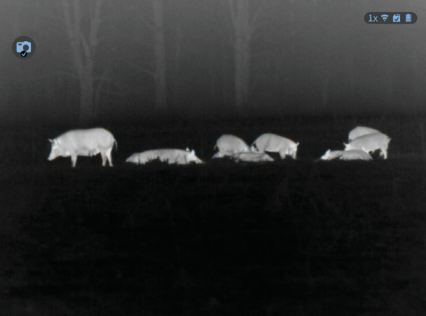
Open-country step-up: ATN Binox-6 Dual 640x512 3-24x
The ATN Binox-6 Dual 640x512 3-24x is the terrain step-up for wide-open ground. Its 640x512 sensor holds detail out where the 384 would soften, and the 3100 m detection means a pig registers as heat long before it is a shot.
Wide-open ag country
On cut fields and big pasture the challenge is distance, not gaps. The 640's wide 3x low end sweeps the whole field in a pass, and the sharper sensor lets you separate a sounder from cattle or deer at range. When your terrain opens up for hundreds of yards, that clarity is what the extra money buys.
Who it is for: the open-country hunter who glasses long distances every night. Who it is not for: the timber or plot hunter, since the value-tier 384 already covers that terrain for less.
River-bottom ag and picked corn at distance
The hardest open-country call is not spotting heat — it is telling what the heat is. On a river-bottom bean field or a picked corn field at distance, you are looking at a mix: pigs, deer, maybe cattle in the next field over, all of them warm blobs to a softer sensor. This is where the 640x512 earns its keep. The extra resolution lets you see body shape, not just a glow, so you can separate a sounder from a group of deer or a line of cattle before you ever commit. The 3100 m detection means you catch that heat early, while you still have time to range it, watch it move and read it. On big open ground pigs travel, and a wide 3x low end lets you follow a sounder crossing a quarter mile of stubble without losing them off the edge of the frame. That combination — sharp sensor, long detection, wide sweep — is exactly what long open shots demand, and it is why the money moves to the 640 once your ground stops being broken.
How terrain changes what the specs mean
The same spec sheet reads differently depending on where you hunt, so it helps to translate the numbers into ground. Sensor resolution is the clearest example: think of 384x288 as a sharp standard-definition picture and 640x512 as high-definition. In timber, where a pig fills the gap you are looking through, SD is plenty — the animal is close and large in the frame. Push that same SD sensor out across a picked cornfield and the pig shrinks to a handful of pixels, and that is when the HD 640 pulls ahead, because it keeps enough detail on a small, distant target to tell you what it is. NETD works the opposite way — it matters everywhere. Both variants sit at <=15 mK, and that low figure is what lets either one lift a hog off a warm, cluttered background, whether that is a dew-heavy green plot or sun-baked stubble still giving off the day's heat. Detection range is a terrain filter more than a bragging number: the 384's 2750 m is far more range than any timber gap or small plot will ever ask of it, so paying for the 640's 3100 m only makes sense when your fields genuinely open up past what the 384 can reach. Zoom band tells the same story from the other side. The 384's 5.5-44x is built to punch in tight and read animals through a narrow window, while the 640's 3-24x is built to start wide and sweep, catching movement across a big field before you zoom in to confirm. Read the numbers against your ground, not against each other, and the right variant becomes obvious.
How to choose by your terrain
Match the variant to the ground you cross most nights, not the ground you cross once a season.
- Timber and creek bottoms — the 384's 44x zoom reads pigs through narrow gaps.
- Small plots and mixed fields — the 384's value and reach fit close-to-medium sightings.
- Wide-open ag land — the 640's sharper sensor and 3100 m detection settle far calls.
- Any terrain — both bring the 1000 m rangefinder, GPS and ~8-hour battery, so neither leaves you under-equipped.
How we picked these ATN thermal binoculars
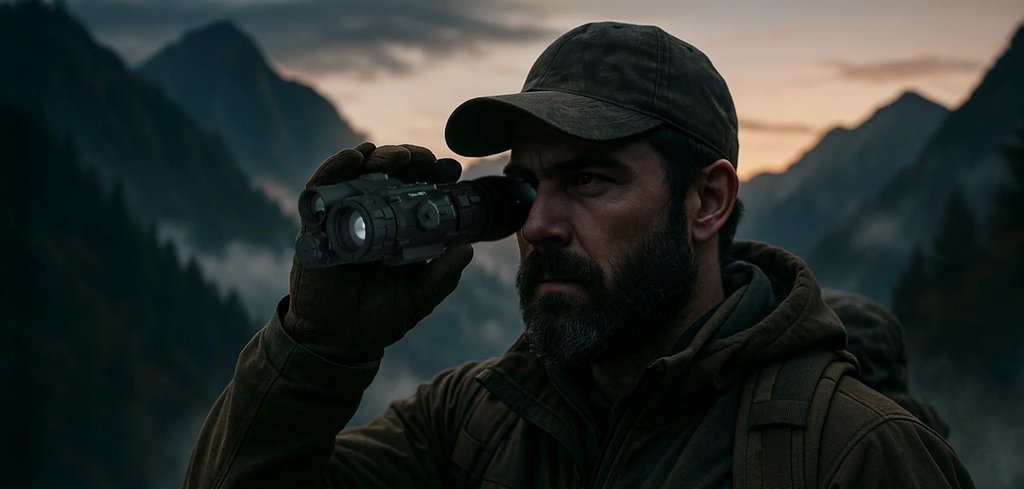
We sorted these by terrain, judging the specs that decide a hog night — sensor resolution, NETD, detection range, magnification band, weight and battery — against the ground hog hunters actually cross, from tight timber to open ag fields, and only within ATN's current 6th-gen Binox-6 line. The honest trade-off runs along terrain: the 384 wins tight and mixed ground on zoom and value but softens at extreme range, while the 640 wins open country on sensor sharpness but costs more than a woods hunter needs to spend. This is an in-house comparison of ATN's own range, not an independent lab review, so match the numbers to your terrain. Who neither is for: a hunter who wants a pocket close-range spotter and will not use high zoom or long detection on any terrain.
Frequently Asked Questions
Which Binox-6 is best value for wooded hog hunting?
The 384x288 5.5-44x. Its 44x zoom reads pigs through narrow timber gaps, and sightings in woods are close enough that its sensor is never the limit, so you get full capability for less.
When does open terrain call for the 640?
When your fields open up for hundreds of yards. The 640x512 sensor holds detail at range and its 3100 m detection catches heat far out, which the 384 cannot match at extreme distance.
Does terrain really change which binocular I need?
Yes. Tight ground rewards zoom and value, open ground rewards sensor sharpness and reach. Matching the variant to your terrain is how you avoid paying for capability you cannot use.
Can one binocular cover both terrains?
Both can, but each has a sweet spot. If you split time evenly between timber and open fields, the 640 is the safer all-terrain pick; if you mostly hunt woods and plots, the 384 saves money.
Do both handle weather in the field?
Yes, both Binox-6 variants are built for field use with the same 4-in-1 vision and a 1000 m rangefinder, so brush, dew and cold do not change how you scan across terrain.
How long will they run through a night?
About 8 hours each, on two 18650 cells, so carrying spares gets you through an all-night sit regardless of the terrain you are covering.
Is the 384 enough sensor for food plots and green fields?
Yes. A plot is close-to-medium ground, so the 384x288 sensor is never the limit there. What carries you is its 44x zoom to read a sounder in the middle of the plot and the <=15 mK sensitivity that keeps a hog crisp against warm, dewy grass.
How do I tell pigs from deer or cattle at distance?
That is where the 640x512 sensor helps most. On open river-bottom ag the extra resolution lets you read body shape at range, not just a warm glow, so you can separate a sounder from deer or cattle before you commit — and the 3100 m detection catches them early enough to watch and confirm.
Matched your terrain? For timber, plots and broken ground, look closer at the value ATN Binox-6 Dual 384x288 5.5-44x, or step up to the 640 for open country by comparing both across ATN's thermal binoculars range. The right terrain match is what makes a binocular the best value for the money on your ground.
Created: August 5, 2026 · 19:53:40 UTC