Hog hunting rarely happens at one fixed distance. A sounder can bust out of thick cover ten steps in front of you, mill around a bait pile at a hundred yards, or work the far edge of a cut field where you need every bit of reach you can get. The smartest way to shop for value here is not to ask which pair is cheapest, but to ask which pair earns its keep at the distance you actually hunt. This roundup ranks the best thermal binoculars for the money hog hunting by range band, so you can match the glass to the ground.
Quick answer: top picksBest all-round value across every band: the ATN Binox-6 Dual 640x512 3-24x — its 640 sensor and 3-24x range cover close cover, mid field, and long open ground without swapping optics. Best for zoom-heavy long looks on a leaner budget: the ATN Binox-6 Dual 384x288 5.5-44x, which trades sensor resolution for the highest magnification in the line.
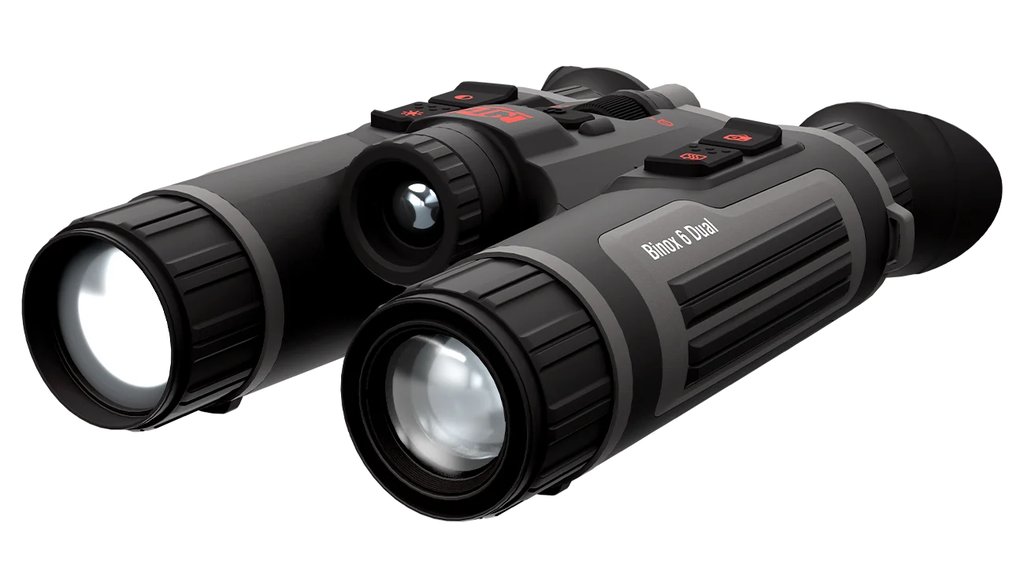
Both picks come from the current Binox-6 family, ATN's 6th-generation thermal binoculars. That matters for value: you are buying the newest sensor generation and feature set rather than paying a discount price for a discontinued model that will feel dated in a season. Below, each range band gets its own recommendation so the money you spend lands where your shots do.
Close cover: 0-75 yards
Close-in hog work is a scanning game more than a reaching game. Pigs erupt from creek bottoms, briar tangles, and standing crops at bad-breath distance, and your binocular's job is to catch heat fast, hold a wide picture, and let you read exactly how many bodies are in the mess. Extreme magnification hurts here — too much zoom narrows the field and turns a moving sounder into a blur.
Best value for close cover: ATN Binox-6 Dual 640x512 at the low end of its 3-24x range. Backed off to roughly 3x, the 640 sensor throws a dense, detailed heat image across a wide field, so a hog stepping out at 40 yards fills the frame with clean edges instead of a soft blob. The ≤15 mK NETD (thermal sensitivity) means a bedded pig radiating only a little heat against warm ground still separates cleanly, which is exactly the situation that gets missed in thick stuff. You are not using the detection range here, you are using the resolution and the wide low-zoom picture.
The 384x288 model can cover this band too, but its zoom range starts at 5.5x, so its widest view is tighter than the 640's 3x. For a hunter who spends most nights in close cover, the extra field and higher pixel count of the 640 is the better spend.
Mid field: 75-200 yards
This is the meat of most hog hunting: bait sites, feeder lanes, food plots, and pasture edges where sounders settle in to feed. You need enough magnification to count animals and pick a target, enough thermal detail to tell a mature boar from a shoat, and a stable picture you can glass for long stretches without eye strain.
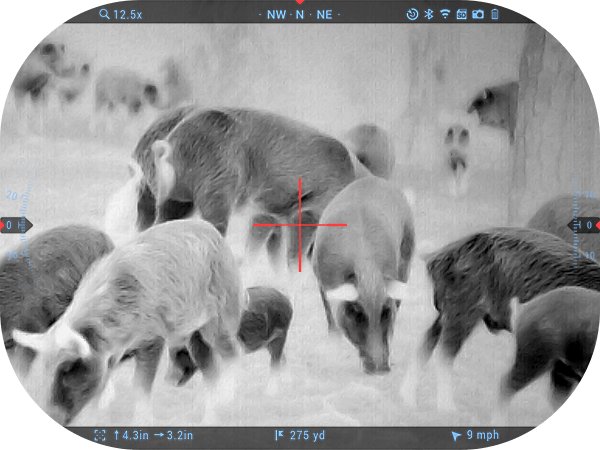
Best value for mid field: ATN Binox-6 Dual 640x512 in the middle of its 3-24x range. Dialed to somewhere around 8-12x, the 640 shows individual pigs as distinct heat signatures with readable body shape at a hundred-plus yards, and the SharpIR AI processing keeps the edges crisp as you zoom. The built-in 1000 m laser rangefinder (accurate to about a meter) is a genuine value feature at this band: you range the sounder, then hand off a real number to your shooter or your own scope instead of guessing hold-over. The 4-in-1 Day/Night/Thermal/Twilight modes and dual-view switching let one pair of glass serve dawn, dusk, and full dark on the same stand.
For a hunter who mostly works mid-field bait and plots and wants the widest useful zoom for the money, the 384x288 5.5-44x is a strong second call. Its 5.5-44x range brackets this whole band comfortably, and the highest top-end zoom in the line means you can push a mid-field look tighter than the 640 when you need to read a specific animal. You give up sensor resolution, so the picture is a touch coarser, but at feeder distances that trade lands lightly.
Long open ground: 200 yards and out
Cut fields, pivots, and big pastures let hogs travel a long way in the open, and here the questions change: can the binocular even find heat that far out, and can you zoom in enough to confirm what you are looking at once you do? This is where detection range and top-end magnification carry the value.
Best value for long open ground: ATN Binox-6 Dual 640x512 3-24x. Its stated detection range reaches out to 3100 m for a large heat source, the longest in this pair, so a sounder crossing a big field registers as heat long before you could identify it. Zoomed toward the top of the 3-24x range, the 640 sensor still holds enough detail to sort hogs from cattle or deer at distance — a real problem on mixed-use ground. The 35 mm F/1.0 germanium thermal objective gathers more of the faint long-range signal than a slower lens would, which is why it stays usable when the target is small in the frame.
The 384x288 5.5-44x plays a specific role out here: its 5.5-44x range gives you the highest magnification in the family for that final confirming look on a far animal, and its 2750 m detection range is still long. If most of your hunting is long-field glassing and you want maximum zoom for the money over maximum resolution, it is the value-forward choice. Just know that at extreme range the 640's denser sensor gives a cleaner image than the 384's higher zoom alone can match.
Range-band comparison at a glance
Specs that decide value by band
A few numbers do most of the work when you are matching glass to distance for hogs. Reading them against the band you actually hunt is how you avoid overspending on reach you never use, or underspending and missing pigs at the edge.
- Sensor resolution — 640x512 vs 384x288 governs how much real detail survives when you zoom. It matters most in close cover (reading bodies) and at long range (sorting species). The 640 leads both bands.
- NETD / thermal sensitivity — both pairs are ≤15 mK, so faint heat against warm ground still shows. This is what catches a bedded hog in cover that a duller sensor would miss.
- Magnification range — the 640 runs 3-24x (wider low end for close work); the 384 runs 5.5-44x (highest top end for long confirming looks). Pick by which end of the range you live in.
- Detection range — 3100 m on the 640, 2750 m on the 384. Only relevant once you are shooting the long open band; wasted money if you never leave cover.
- Laser rangefinder — the 640's 1000 m LRF (±1 m) turns a guessed hold into a known number at mid and long distance, a real value add for shooters.
- Weight and battery — both sit near 720-730 g and run about 8 hours on two swappable 18650 cells, so an all-night hog sit is realistic on either.
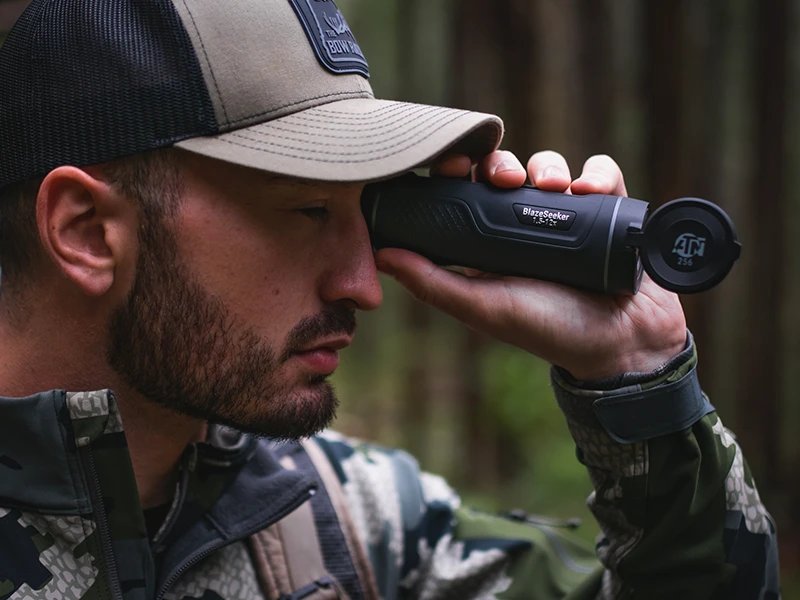
Both binoculars share the same 4-in-1 Day/Night/Thermal/Twilight core, a 4K day sensor, GPS and compass, an 850/940 nm IR illuminator, and DeFog with WDR, so the platform features do not change between them. Explore the full lineup on the ATN thermal binoculars category page to compare variants side by side.
How we picked these ATN thermal binoculars
This is an in-house comparison of ATN's own current thermal binocular range, not an independent lab review, so treat it as ATN's honest read on which of its 6th-generation Binox-6 pairs earns the money at each hog-hunting distance. We judged each model on the specs that actually change outcomes on the ground: sensor resolution (640x512 vs 384x288), NETD thermal sensitivity, stated detection range, the width and top end of the magnification range, weight, and battery runtime, all weighed against real close-cover, mid-field, and long-ground shooting rather than a spec sheet in isolation. Only the current Binox-6 line was considered. The honest trade-off is straightforward: the 640 wins on resolution and detection reach and adds the laser rangefinder, while the 384 wins on top-end zoom for less outlay but shows a coarser picture as you push it. Neither is the pick for a hunter who never leaves tight timber and wants the smallest, lightest monocular they can carry — a binocular platform is heavier and built for two-eye glassing. Check these specs against how you actually hunt before you buy.
Frequently Asked Questions
What are the best thermal binoculars for the money for hog hunting?
For most hog hunters the ATN Binox-6 Dual 640x512 3-24x is the best value overall, because its 640 sensor and 3-24x range cover close cover, mid field, and long open ground on one pair of glass. If you mainly glass long and want the highest zoom for less, the Binox-6 Dual 384x288 5.5-44x is the leaner pick.
Do I need the 640 sensor, or is the 384 enough for hogs?
The 384x288 is enough for close and mid-field hog work and gives you the highest top-end zoom in the line. Step up to the 640x512 if you regularly shoot long open ground or need to sort hogs from deer and cattle at distance, since the denser sensor holds detail better when zoomed.
Which Binox-6 is best for close-cover hogs under 75 yards?
The Binox-6 640x512 3-24x, backed off toward its 3x wide end. That gives the widest field for scanning thick stuff, and the high-resolution sensor reads how many bodies are in the sounder at bad-breath range where too much zoom only hurts.
Which one reaches out best for long field hogs past 200 yards?
The Binox-6 640x512 3-24x, with a 3100 m detection range and a 35 mm F/1.0 thermal lens that keeps a far, small target usable. The 384x288 5.5-44x is the alternative if you want the highest magnification for that final confirming look and a leaner spend.
Does either pair have a built-in rangefinder for hog shots?
The Binox-6 640x512 includes a laser rangefinder good to about 1000 m with roughly one-meter accuracy, which is a real advantage at mid and long distance for handing a known range to your shooter or your scope.
Can I hunt an all-night hog sit on one charge?
Yes. Both the 640 and 384 Binox-6 run about 8 hours on two swappable 18650 batteries, so you can carry a spare pair and keep glassing through a full night rather than pack up early.
Are these ATN binoculars usable in daylight too?
Yes. Both Binox-6 pairs use a 4-in-1 Day/Night/Thermal/Twilight system with a 4K day sensor, so the same binoculars serve you at dawn, dusk, and in full dark on the same hog stand.
Ready to match the glass to your ground? Start with the ATN Binox-6 Dual 640x512 3-24x for all-band value, compare it against the Binox-6 Dual 384x288 5.5-44x, or browse the full ATN thermal binoculars range.
Created: August 5, 2026 · 19:53:40 UTC