If you call coyotes, you already know the problem: a dog hangs up at 250 yards, quartering, and you have seconds to decide whether that's a shot or a wasted stand. The best thermal binoculars for the money for coyote hunting aren't the ones with the biggest sensor on paper — they're the ones that hand you a confirmed distance and a clean heat signature in the same glance. That single feature, a built-in laser rangefinder married to the thermal core, is what separates a binocular that earns its keep from one that just glows. This roundup organizes ATN's current thermal binoculars lineup around exactly that: which feature does the most work for the budget when you're the one behind the call.
Best value: ATN Binox-6 Dual 384x288 5.5-44x — the more affordable body, still with the rangefinder, and extra magnification for wide fields.
Both share: 4-in-1 day/night/thermal/twilight vision, ≤15 mK sensitivity, GPS and compass, and Wi-Fi streaming — so the money you spend covers scanning, ranging and recording in one device.
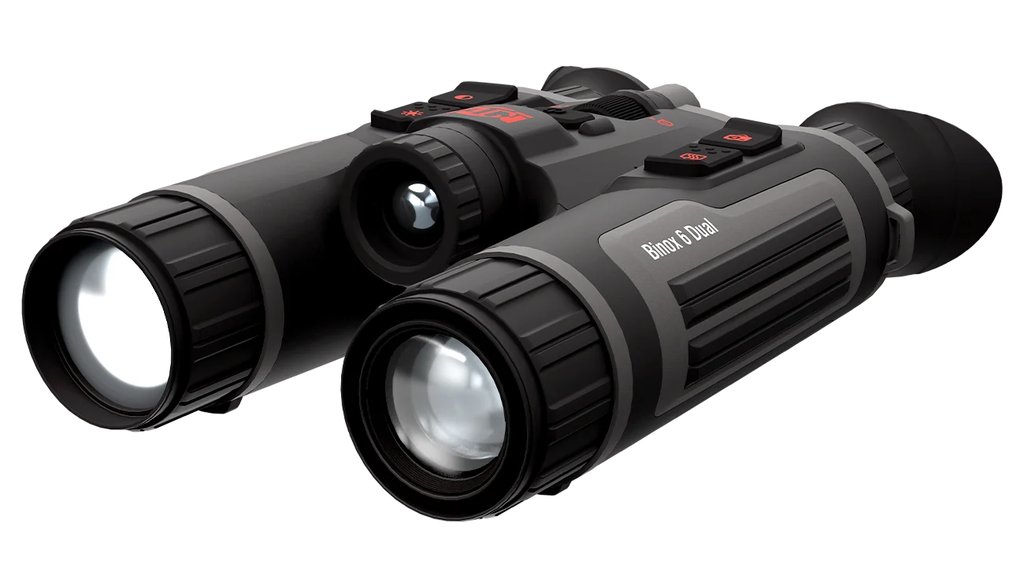
Why ATN's 6th-gen Binox-6 is built for coyotes, not just glowing blobs
The reason the Binox-6 line makes sense for predator work is that it folds four jobs into one hand-held unit, and the feature that matters most for coyotes — ranging — is built in rather than bolted on. A coyote is a small, low-mass target compared to a hog or a deer, so a fuzzy heat blob at distance tells you almost nothing about whether the shot is ethical. The Binox-6's laser rangefinder reads out to 1000 m with about ±1 m accuracy, so the moment you catch the signature you also know if it's inside your rifle's honest window. Pair that with a sensor whose ≤15 mK NETD — a measure of how small a temperature difference it can resolve, where lower means a cleaner, higher-contrast picture — and a coyote reads as a coyote, not a smudge.
Both current models are 4-in-1: true day optics through a 4K CMOS sensor, plus night, twilight and thermal modes in the same housing. For coyote hunting that means you glass the field in daylight to learn the terrain, then flip to thermal after dark without swapping gear or re-learning a menu. The table below lines up the two on the numbers that decide a coyote stand.
Best overall for the money: ATN Binox-6 Dual 640x512 3-24x
The feature that pays for itself: rangefinder + 640 sensor together
The ATN Binox-6 Dual 640x512 3-24x is the pick when you want the single feature that does the most for a coyote hunter: a high-resolution sensor and a laser rangefinder that fire off the same button press. The 640x512 detector packs roughly four times the heat-reading pixels of a 384 core — think the jump from standard definition to HD — so a coyote's ears, gait and body shape resolve early enough to tell a dog from a stray cat or a fox before you ever shoulder the rifle. Then you tap the rangefinder and the distance appears on the same screen. No second device, no lasing with your off hand while the coyote drifts.
Detection reach for called-in dogs
Detection tops out around 3100 m, which for coyotes matters less as a bragging number and more as headroom: you pick up movement on the far edge of a cut field long before it commits to your call, giving you time to get set. The 3-24x zoom is deliberate — the wide 3x end keeps enough field of view to catch a dog circling downwind, and 24x is plenty to confirm the shot on a stationary target. It's for the caller who wants the fastest, most confident ID and doesn't mind spending at the flagship tier. It's not for someone who mostly hunts wide-open desert flats and wants maximum top-end magnification above all else — that's the other model's job.
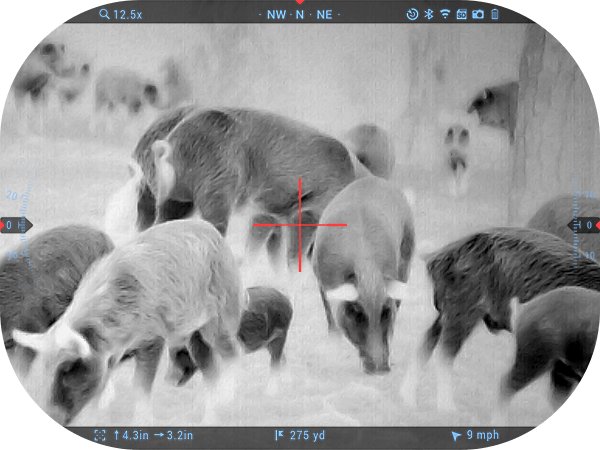
Best value: ATN Binox-6 Dual 384x288 5.5-44x
Same rangefinder, more zoom, lighter cost
The ATN Binox-6 Dual 384x288 5.5-44x keeps the feature that matters — the built-in 1000 m rangefinder and the same ≤15 mK sensitivity — while stepping down to a 384x288 sensor to land at a friendlier price. For a lot of coyote hunters that's the smarter money. The 384 core still resolves a dog cleanly at real calling distances, and you're spending the savings where you'll feel it. In exchange you get a taller zoom ceiling, 5.5-44x, which suits hunters glassing long across open ground.
Where the extra magnification earns its keep
On big flats and picked fields, that 44x top end lets you study a distant heat signature and decide whether it's worth working before you burn a stand. Detection sits around 2750 m — slightly shorter than the 640, but well past the range at which you'd take a coyote anyway. It's for the value-minded caller who hunts open country and wants ranging without the flagship spend. It's not for the hunter chasing the absolute sharpest close-in ID in brushy edges — the 640 model reads finer detail there.
How to choose the best value for your coyote setup
Start from the one question that actually decides ethical coyote shots: can you confirm the range fast? Both ATN models answer yes because the rangefinder is built in — so your choice is really about how much sensor and zoom you need for your ground.
- Prioritize the rangefinder — on coyotes, confirmed distance is worth more than raw magnification. Both Binox-6 models have it built in, which is why they lead this list on value.
- Pick the 640 for detail and speed — if you hunt brushy edges and timber where fast, certain ID matters, the 640x512 sensor is the money well spent.
- Pick the 384 for reach on a budget — open flats and a tighter wallet favor the 384x288 5.5-44x, which still ranges and still reads a dog clearly.
- Count the 4-in-1 modes as value — day, twilight, night and thermal in one unit means you're not buying a second optic for scouting.
- Battery for a full night — roughly 8 hours on two swappable 18650 cells covers an all-night sit with a spare pair in your pack.
How we picked these ATN thermal binoculars
This is an in-house comparison of ATN's own current 6th-generation Binox-6 range, not an independent lab review, and we've kept it honest about trade-offs. We judged both models against what actually decides a coyote stand: sensor resolution and NETD for clean target ID, the built-in laser rangefinder for ethical shot distance, magnification and field of view for scanning versus confirming, and battery life for an all-night sit. Because coyotes are small and often called in close before drifting off, we weighted the rangefinder and sensitivity heaviest — that's the framing behind naming the 640x512 3-24x best overall. Neither of these is the right tool if you only want a cheap viewer with no ranging; they're built for hunters who take the shot decision seriously. Check the specs against your own ground and how far your rifle honestly reaches.
Frequently Asked Questions
What makes thermal binoculars good value for coyote hunting specifically?
The single most useful feature is a built-in laser rangefinder tied to the thermal sensor, because coyotes are small targets and confirmed distance decides whether a shot is ethical. Both ATN Binox-6 models fold ranging, high-sensitivity thermal, and day optics into one unit, so you're not paying for three separate devices. That bundling is what makes them the best value for the money for this job.
Is the 640x512 sensor worth it over the 384x288 for coyotes?
It depends on your terrain. The 640x512 sensor resolves a coyote's shape and gait sooner, which helps in brushy edges and timber where fast identification matters. If you hunt open flats and want to save money, the 384x288 5.5-44x still reads a dog clearly and adds more top-end zoom, making it the stronger value pick for many callers.
How far can these ATN thermal binoculars detect a coyote?
The Binox-6 Dual 640x512 detects heat signatures out to roughly 3100 m and the 384x288 to about 2750 m. Detection means spotting that something is there, not identifying it, so practical ID and shooting distances are much closer. Both give plenty of headroom to catch a coyote working toward your call before it commits.
Can I use these binoculars in daylight too?
Yes. Both are 4-in-1 units with a 4K CMOS day sensor plus twilight, night and thermal modes. You can scout a field in daylight to learn the terrain, then switch to thermal after dark without swapping gear. That all-day usefulness is part of why they earn their price.
Do I need the rangefinder if I already know my property distances?
Even on familiar ground, coyotes move and set up at unpredictable spots, so a built-in rangefinder confirms the actual distance to the animal in the moment rather than a landmark. It removes guesswork on holdover for a small target. That's why we rank the rangefinder as the top value feature for coyote hunting.
How long will the battery last on a night hunt?
Both models run about 8 hours on two 18650 cells, which covers a typical all-night sit. Because the cells are user-replaceable, you can carry a charged spare pair and hot-swap them to keep hunting. Cold weather shortens runtime, so a spare set is wise in winter.
Are these binoculars only for hunting, or can I use them for observation?
The 4-in-1 design, GPS, compass and Wi-Fi streaming make them useful for general observation, property monitoring and scouting as well as hunting. The same features that help you find and range a coyote also help you locate livestock or check a fence line at night. That versatility adds to their value for the money.
If confirmed range is what you care about most on a coyote stand — and it should be — the feature-for-the-money pick is the ATN Binox-6 Dual 640x512 3-24x, with the sharpest sensor and the built-in rangefinder working together. Watching your budget on open ground? The 384x288 5.5-44x keeps the ranging and adds zoom for less. Compare both, plus the full spec sheets, on the ATN thermal binoculars page and match the sensor and magnification to the country you call in and how far your rifle honestly reaches.
Created: August 5, 2026 · 19:53:40 UTC