If you hunt or scout big country, you already know the problem: most handheld thermals show you a warm blob at 300 yards and leave you guessing. The best long range thermal monocular is one that still gives you a picture you can read and range at distances where other units quit. Our pick is the ATN BlazeHunter XD LRF. It pairs an extreme-definition 1280x1024 sensor with a built-in laser rangefinder and a 3400m detection range, so you spot heat far off, confirm what it is, and know exactly how far it sits. This guide walks through the top ATN picks for reach, how to choose, and what actually matters when the target is a long way out.
Best all-round value: ATN BlazeTrek 6 640x512 1.5-12x — lighter, wider field of view, ideal for scanning and shorter engagements.
If weight matters most: the BlazeTrek 6 rides in a coat pocket at about 0.7 lb, so it is the easy all-nighter carry.
If detail at distance matters most: the BlazeHunter XD, every time — more pixels means you can zoom in on a far-off shape and still tell coyote from dog.
Why ATN's 6th-gen thermals reach farther
Long range performance comes down to three things working together: sensor resolution, lens size, and image processing. ATN's 6th-gen units push all three. Higher resolution — 1280x1024 on the BlazeHunter XD versus 640x512 on the BlazeTrek 6 — is like the jump from standard definition to 4K on a TV. More dots in the picture means you can digitally zoom in on a distant heat signature and still see a shape instead of a smear. A bigger objective lens gathers more of that faint far-away heat, and the 50mm lens on the BlazeHunter XD is a big reason it reaches out to a 3400m detection range. On top of that, SharpIR AI enhancement cleans up the frame in real time, and a fast 50 Hz refresh keeps a trotting coyote crisp instead of ghosting across the screen. Put those together and you get a monocular that still hands you a usable, readable picture where lesser units give up.
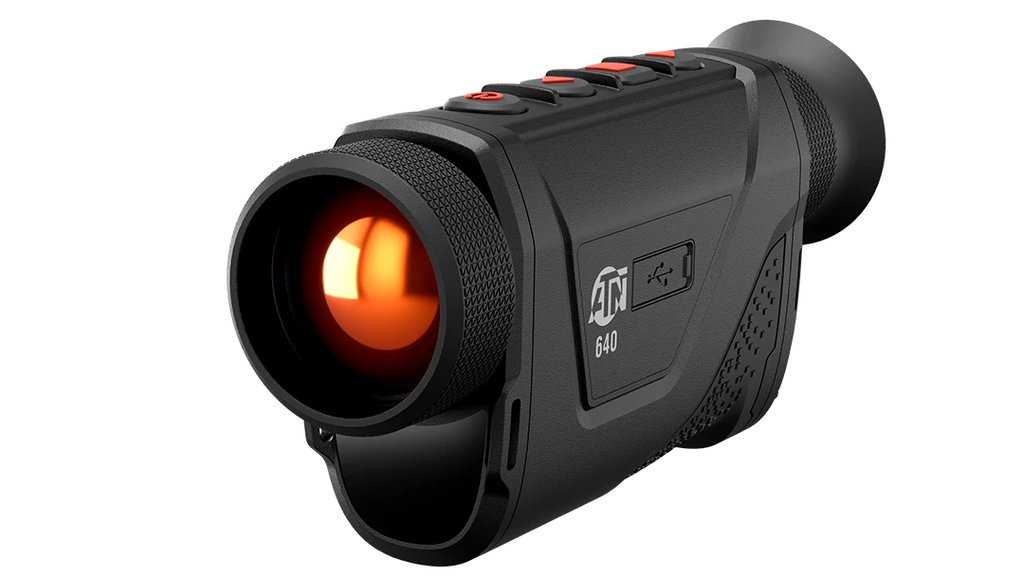
Best for range: ATN BlazeHunter XD LRF
The ATN BlazeHunter XD LRF is the clear choice when your engagements happen at real distance. Its standout is the 1280x1024 sensor — over a million more pixels than a 640 unit — which is what lets you zoom in on a far-off signature and still read it as an animal, not just a warm dot. The 50mm F/1.0 objective is doing the heavy lifting on the light-gathering side, feeding that big sensor enough heat data to hit a 3400m detection range.
The rangefinder that closes the loop
Spotting something a long way off is only half the job. The built-in laser rangefinder ranges out to 1000m at +/-1m, so the moment you see a signature you know its exact distance. That number feeds a smart, honest shot decision instead of a guess, and it saves you fumbling with a separate rangefinder in the dark.
Built to run all night
Two removable 18650 batteries give 10+ hours total, so you swap a cell mid-hunt instead of packing up. A Full-HD 1920x1080 OLED display shows off all that sensor detail, and the IP67 housing shrugs off rain and dew. It is heavier than the BlazeTrek at 1.1 lb, but that is the trade for the glass and reach.
Detail you can trust at distance
The reason people reach for a big sensor for long range is simple: detection without identification is not much use. Anything can be a warm blob at 500 yards. What you need is enough resolution to tell a coyote from a deer, a hog from a stump, a person from an animal — and to do it far enough out that you have time to react. The BlazeHunter XD's extreme-definition sensor is what makes that call possible deeper into the dark than lower-res units, and the <=15mK NETD keeps the picture clean when moisture in the air would otherwise wash out fine detail. Six color palettes let you flip to whatever contrast makes the shape pop against its background, which matters more the farther out you push.
Who it is for: hunters and scouts working open fields, big ag ground, or long draws where targets show up far out. Who it is not for: someone who mostly scans thick timber inside 150 yards and wants the lightest possible carry — the BlazeTrek covers that better.
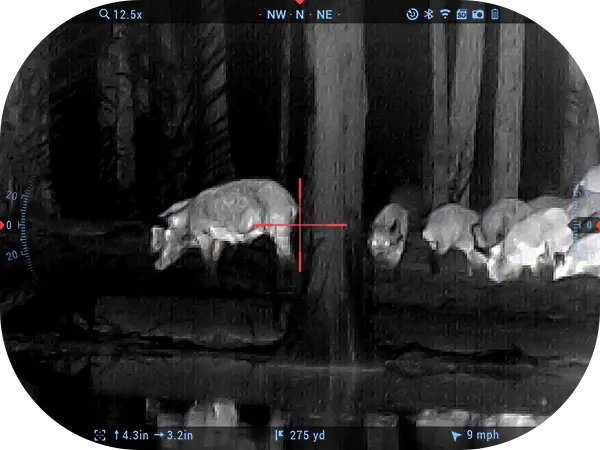
Best all-round value: ATN BlazeTrek 6
The ATN BlazeTrek 6 640x512 1.5-12x is the lighter, wider companion when reach is not the only goal. Its 1.5x base magnification opens up a wide 22.8 x 18.3 degree field of view, which makes finding and following a moving animal far easier than a high-power optic that shows you a soda straw of the field.
Fast, wide scanning
That wide field of view is the BlazeTrek's superpower. Sweeping a tree line or a field edge, you cover more ground per pass and pick up motion quicker. A 640x512 sensor still holds solid detail out to its 1000m detection range, which covers the large majority of real handheld shots.
The carry-anywhere size
At about 0.7 lb it disappears in a pocket or on a chest rig, and the internal battery runs roughly 6.5 hours. It is the unit you grab when you want to walk light and scan a lot of country without a signature-far-off requirement.
Who it is for: hunters who scan and stalk inside a few hundred yards and value light weight and a wide view. Who it is not for: long-range field shooters who need to identify and range animals way out — that is BlazeHunter XD territory.
A useful way to think about the two is as a spotting pair. The BlazeTrek 6 rides in your hand for the walk, catching movement quickly with its wide view. The BlazeHunter XD comes up when something distant needs a hard look and a range number. Many serious long-range hunters end up carrying both for exactly that reason — a fast, light scanner and a high-detail spotter that reaches. If you can only pick one and distance is your priority, the XD is the answer; if you want to travel light and most of your work is close, the BlazeTrek keeps you nimble.
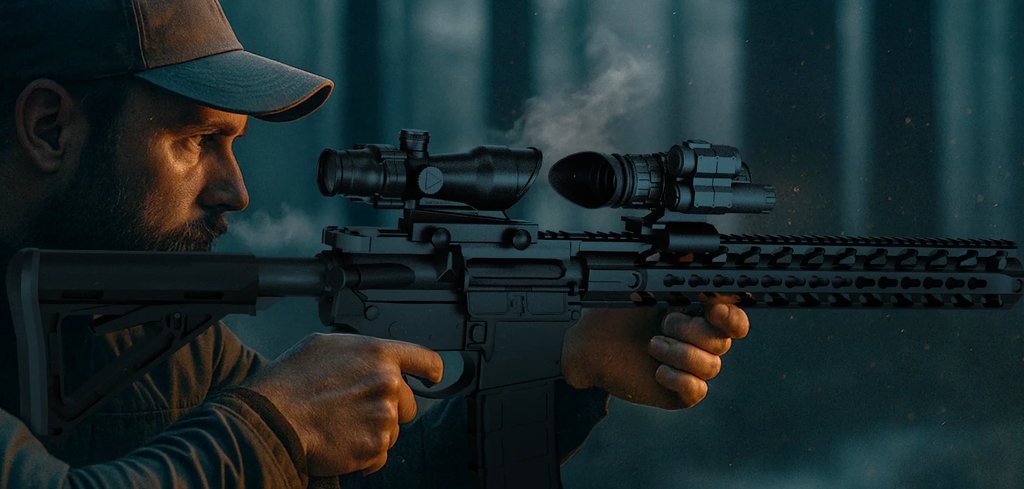
How to choose a long range thermal monocular
Match the optic to the country you actually hunt. If your shots and sightings happen far out in open ground, prioritize resolution and lens size — they set how far you can see and still identify. If most of your work is closer and faster, prioritize field of view and weight. Here is what to weigh:
- Resolution — more pixels (1280 vs 640 vs 256) let you zoom farther before the picture turns blocky. For long range, this is the single biggest lever.
- Lens diameter — a bigger objective (50mm vs 19mm) gathers more faint heat from distance, which is why the BlazeHunter XD out-ranges the BlazeTrek by a wide margin.
- NETD — a lower NETD (<=15mK on the XD) means a cleaner picture in humid, foggy, or rainy air, exactly when far-off detail is hardest to hold.
- Rangefinder — a built-in laser rangefinder turns a distant sighting into a confirmed distance, so your shot call is based on a number, not a hunch.
- Battery — dual removable batteries mean you keep hunting through the night with a quick swap instead of quitting early.
- Field of view vs reach — high magnification reaches farther but narrows the view. Decide whether spotting far or scanning wide matters more for your ground.
Getting the most reach out of your monocular
The right optic is only half of long-range performance; how you use it matters just as much. A few habits stretch what you can see and identify. First, glass with intention: scan slowly in overlapping sweeps rather than swinging fast, because your eye needs a beat to register a faint distant signature. Second, use magnification in layers — spot at a lower zoom where the field of view is wide, then step up the zoom only once you have a shape to study, so you do not lose track of it. Third, mind the conditions: heat picks up best against a cool background, so the coldest part of the night often gives the cleanest long-range picture, while a rain-soaked or heavily wooded scene shortens practical range. Finally, lean on the rangefinder early. Ranging a distant shape the moment you spot it tells you whether it is even worth a stalk, and it feeds a smart, ethical shot decision if the animal is game. Used this way, the BlazeHunter XD's hardware advantage turns into real, repeatable reach in the field.
How we picked these ATN thermal monoculars
Full transparency on how this shortlist was built. Every option here is from ATN's current 6th-generation line only — no discontinued models padding the list. Each was weighed on the specs that decide a real hunt: sensor resolution, thermal sensitivity (NETD), detection range, refresh rate, and battery life, then sanity-checked against how it actually performs for max detection. Where a model gives something up, that trade-off is called out plainly rather than hidden. These are the maker's own optics, so treat this as an honest in-house comparison of the range — not an independent lab review — and cross-check the specs against your own needs.
Frequently Asked Questions
What is the best long range thermal monocular from ATN?
The ATN BlazeHunter XD LRF is the best long range pick in ATN's 6th-gen lineup. Its 1280x1024 sensor, 50mm lens, and 3400m detection range let you spot and identify heat much farther out than a standard 640 unit, and the built-in rangefinder confirms the distance instantly.
How far can the BlazeHunter XD detect an animal?
It carries a 3400m detection range, meaning it can pick up heat signatures that far away under good conditions. Detection is not the same as identification — you will positively identify an animal closer than that — but the high resolution keeps a distant shape readable much deeper than lower-res units.
Does resolution really matter for long range?
Yes, more than almost anything else. Higher resolution is like going from standard definition to 4K: more dots in the picture means you can digitally zoom in on a far-off signature and still see a real shape. The BlazeHunter XD's 1280x1024 sensor is the main reason it holds detail at distance.
Why is a built-in rangefinder useful on a monocular?
Because knowing the exact distance to what you are looking at changes the whole plan. The BlazeHunter XD's laser rangefinder ranges to 1000m at +/-1m, so a distant sighting becomes a confirmed number for a smart shot decision, with no separate device to fumble in the dark.
Is the BlazeTrek 6 good enough for long range?
The BlazeTrek 6 is excellent for scanning and shots inside a few hundred yards, with a wide field of view and light weight. For true long-range identification and ranging, the BlazeHunter XD's bigger sensor, larger lens, and rangefinder pull well ahead.
How long will these run on a night hunt?
The BlazeHunter XD runs 10+ hours on its two removable 18650 batteries, so you swap a cell and keep going. The BlazeTrek 6 runs about 6.5 hours on its internal battery, which covers most single outings.
Are these thermal monoculars weatherproof?
Both carry an IP67 rating, so they handle rain, dew, and dust without trouble. That matters for long-range work because humid, wet nights are exactly when you need a clean picture and reliable gear.
Ready to see how far you can really reach after dark? The ATN BlazeHunter XD LRF gives you extreme-definition detail, a big light-gathering lens, and a built-in rangefinder in one handheld unit — the setup for spotting, identifying, and ranging game way out in open country. If you want to compare it against the lighter, wider BlazeTrek 6 or the rest of the 6th-gen family, browse the full range of ATN thermal monoculars and match one to the ground you hunt. Pick the reach you need, then go find heat that used to be out of sight.
Created: July 7, 2026 · 08:31:01 UTC