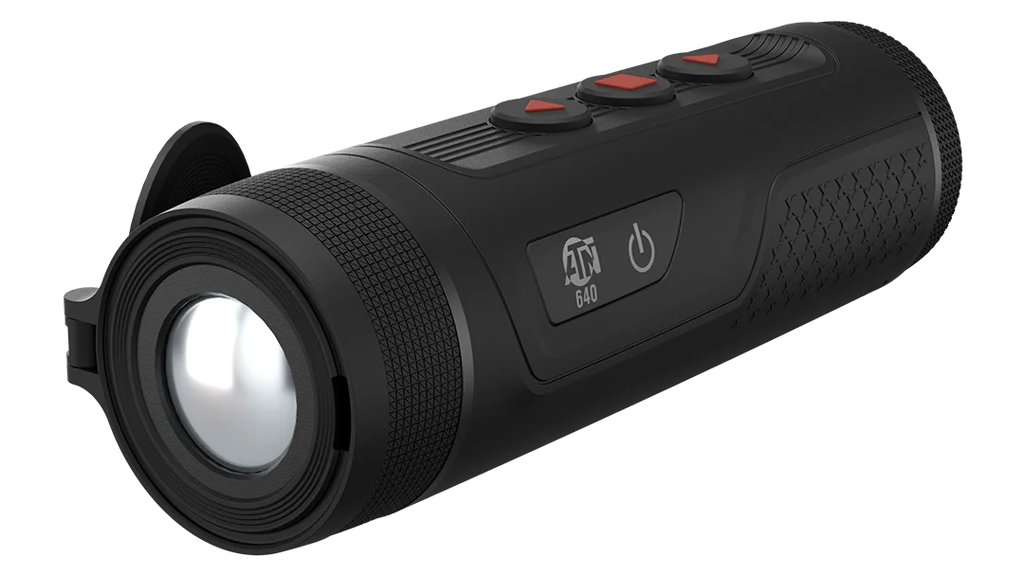
The best helmet mounted thermal monocular is the one that disappears on your head and lets you walk, glass, and scan without ever raising a hand. That job changes with the ground under your boots, so this roundup sorts ATN's 6th-gen monoculars by terrain, from open pasture to tight timber, thick brush, and snow-covered fields. Leading it is the light, wide-viewing ATN BlazeTrek 6 640x512 1.5-12x, which pairs with a head or helmet mount for hands-free scanning on almost any landscape.
Best for open ground and long reach: ATN BlazeHunter XD LRF 1280x1024 2-16x — extreme resolution and a built-in rangefinder for wide, distant country.
Best value: ATN BlazeTrek 6 384x288 2.25-18x — the same light body with more magnification, kinder on the budget.
Why ATN's 6th-gen monoculars suit head and helmet mounting
ATN's 6th-gen monoculars suit head and helmet mounting because the whole line is built light, sensitive, and quick to wake, which is exactly what hands-free scanning demands. Every model here reads down to a low NETD, the smallest temperature difference the sensor can separate; a lower millikelvin figure means a cleaner, higher-contrast picture, so a warm animal pops against cool ground even when you are just walking and glancing. What changes between models is resolution, magnification, reach, and weight, and those are the traits that decide which terrain each one owns on a mount.
ATN BlazeTrek 6 640x512 1.5-12x — open ground and mixed terrain
The ATN BlazeTrek 6 640x512 1.5-12x is our best all-terrain pick for helmet scanning because it is light enough to forget you are wearing it and wide enough to sweep a lot of ground per glance. On a head or helmet mount, those two traits matter more than raw reach: you want to walk, turn your head, and pick up heat without stopping.
Wide view for fast scanning
The 22.8-degree horizontal field of view is the widest in this group, so on open pasture or a cutover you catch movement at the edges instead of tunnel-visioning straight ahead. Field of view is simply how much ground you see at once; a wider one means fewer sweeps to clear a hillside. The low 1.5x base keeps that picture natural for walking, and you can push to 12x when something warm needs a closer look.
Detail that holds in timber
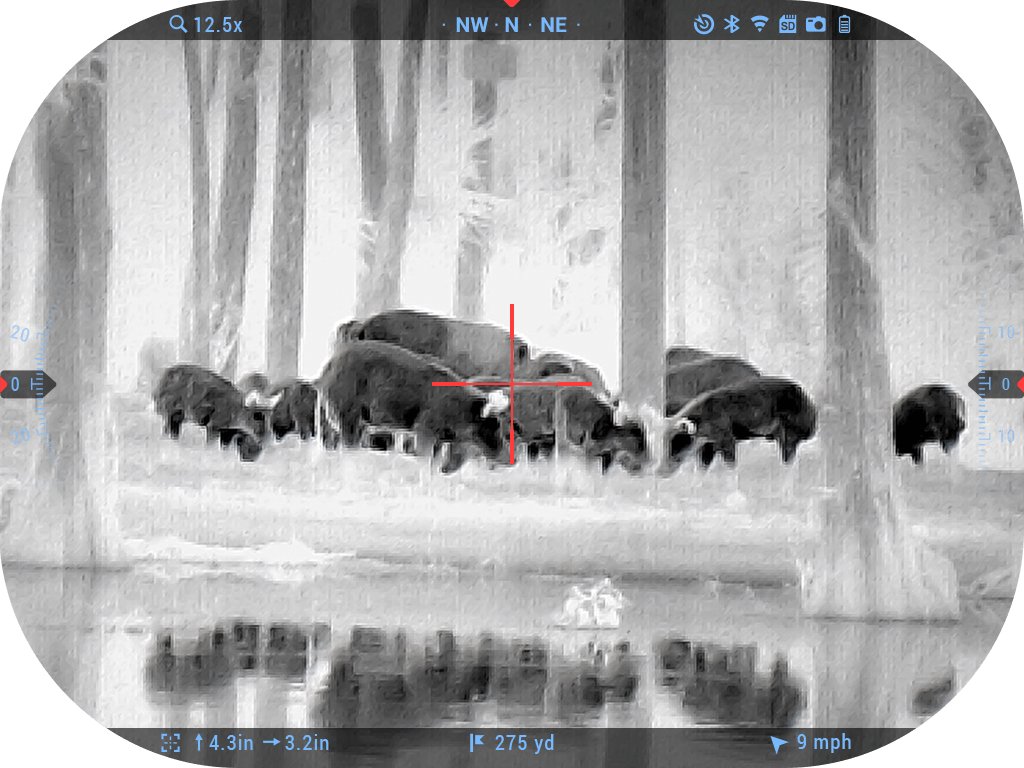
The 640x512 sensor carries plenty of pixels, the way a high-resolution photo lets you zoom in without the image turning to mush. In timber, where a hog might be half-hidden behind a trunk, that extra detail helps you read the shape rather than guess at a warm blob. SharpIR AI enhancement cleans the frame further, and Hot Point Tracking flags the hottest object as you scan.
Comfort on the mount
At about 0.7 lb it is one of the lightest options here, so a long walk-and-scan session does not turn into a neck ache. Internal rechargeable power runs roughly 6.5 hours, Wi-Fi and ATN Connect 6 let you stream or pull footage, and 32 GB of storage holds a full night of clips. It pairs with a standard head or helmet mount for genuine hands-free use.
Who it is for: hunters and walkers who want a light, wide-viewing monocular that scans every terrain hands-free. Not for: those who need to range and identify heat far across wide-open country — that is the flagship's job.
ATN BlazeHunter XD LRF 1280x1024 2-16x — wide-open ground and distance
The ATN BlazeHunter XD LRF 1280x1024 2-16x is the terrain answer for wide-open country, where targets sit far off and you need to both see and measure them. It is the flagship of this group, with an extreme-definition sensor and a built-in laser rangefinder, and it earns its place on a helmet when the ground opens right up.
Extreme resolution for long sight lines
The 1280x1024 sensor packs well over a million more pixels than a standard thermal chip, so at the far end of a field a heat signature reads as an animal, not a smudge. Think of the jump from standard definition to full HD: same scene, far more detail. Backed by a 3,400 m detection range, it registers heat long before you would ever act on it, which is exactly what open-ground scanning rewards.
Ranging built in
The onboard laser rangefinder reads out to 1,000 m with roughly one-meter accuracy, so when you spot something across a snow-field or a wide pasture you know how far it sits without a second device on your belt. On a helmet mount that means one glance gives you both the picture and the distance.
Who it is for: open-country hunters who need the most resolution and a real rangefinder in a head-mountable body. Not for: tight-timber walkers who value the lightest, widest package over reach — at about 1.1 lb it asks a little more of your neck.
ATN BlazeTrek 6 384x288 2.25-18x — brush, thickets, and mid-range value
The ATN BlazeTrek 6 384x288 2.25-18x is the value terrain pick, best in brush and thickets where shots and sightings are closer and magnification helps you pick a warm shape out of tangled cover. It shares the light BlazeTrek body but trades some sensor resolution for a friendlier price and a higher top zoom.
More zoom for cluttered cover
The 2.25-18x range tops out higher than the 640 model, which pays off in brush: when a coyote is bedded in a thicket 150 yards off, extra magnification helps you separate it from the branches. The 384x288 sensor is ample at these closer distances, and at about 0.7 lb the body stays just as comfortable on a helmet.
Honest notes on the value tier
In easy contrast and at brush ranges, most people would struggle to tell its picture from the 640 model. The gap only opens at distance and in low-contrast heat, where the higher-resolution monoculars pull clearly ahead. Internal power runs around 8 hours, and the same Hot Point Tracking, six palettes, Wi-Fi and Connect 6 features carry over.
Who it is for: value-focused hunters scanning brush and mid-range ground hands-free. Not for: anyone whose scanning lives or dies on long-range, low-contrast clarity.
How to choose a helmet-mounted thermal monocular by terrain
Match the monocular to the ground you scan most, not to the biggest spec on the box. A wide field of view earns its keep in open and mixed country, while extra magnification pays off in brush, and weight matters everywhere once it is riding on your head.
- Open ground — favor resolution and detection range so distant heat reads clearly; the flagship shines here.
- Timber and mixed cover — favor a wide field of view and a low base magnification so you catch movement at the edges while walking.
- Brush and thickets — favor higher top-end zoom to pick a warm shape out of clutter at shorter range.
- Snow-fields and cold country — favor a low NETD for clean contrast when the whole scene runs cold.
- Every terrain — mind weight and battery: a lighter body and a longer runtime keep hands-free scanning comfortable all night.
How we picked these ATN thermal monoculars
We ranked ATN's current 6th-gen monoculars for hands-free, helmet-mounted scanning by weighing the traits that actually matter on a head mount: sensor resolution for reading distant heat, NETD for contrast in poor conditions, detection range against real scanning distances, field of view for how fast you clear ground, and weight and battery for comfort over a long night. Only current-generation models were considered. The honest trade-off is that no single monocular wins every terrain — the light, wide BlazeTrek 6 640 sweeps mixed ground best but yields reach to the heavier flagship, and none of these ship as a dedicated helmet system, so plan to pair one with a head or helmet mount. This is an in-house comparison of ATN's own range, not an independent lab test; check each spec against the ground you hunt.
Frequently Asked Questions
Which ATN monocular is the best helmet mounted thermal monocular overall?
The ATN BlazeTrek 6 640x512 1.5-12x is our overall pick for helmet mounting. At about 0.7 lb with a wide 22.8-degree field of view and a high-resolution 640x512 sensor, it stays comfortable hands-free and scans terrain quickly. For long open ground, the BlazeHunter XD LRF steps up in reach.
Can these ATN monoculars actually be mounted on a helmet?
Yes. These are handheld thermal monoculars that pair with a standard head or helmet mount for hands-free scanning while you walk or glass. They are light enough for comfortable head wear; you supply the mount to match your helmet or headgear.
Does field of view matter more than magnification for scanning?
For walking and scanning, a wide field of view usually helps more than high magnification because you clear ground faster and catch movement at the edges. Magnification matters once you have spotted something and want a closer look, or in brush where targets hide in clutter.
How long will the battery last for a night of scanning?
The BlazeTrek 6 640 runs about 6.5 hours on internal power and the 384 model about 8 hours, while the BlazeHunter XD LRF reaches 10-plus hours on replaceable cells. For all-night sessions, plan spare power or pick the longer-running model.
Is the higher-resolution model worth it for helmet use?
On open ground and at distance, the 1280x1024 BlazeHunter XD LRF pulls clearly ahead in detail and adds a rangefinder. In timber and brush at shorter range, the lighter 640 and 384 BlazeTrek models scan just as usably and sit easier on your head.
Why does a lower NETD number matter for scanning at night?
NETD is the smallest temperature difference the sensor can detect, measured in millikelvin. A lower number means the monocular separates warm from cool more finely, so an animal shows sharper contrast against cold ground, snow, or damp cover. That clarity is what makes hands-free scanning quick and confident.
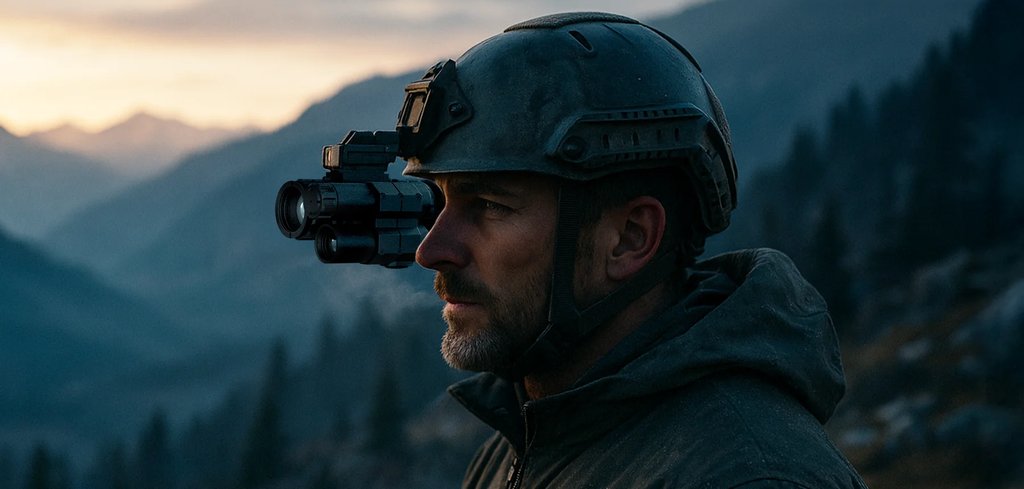
The best helmet mounted thermal monocular is the one that fits the ground you scan. For light, wide-viewing, hands-free comfort across almost any terrain, the ATN BlazeTrek 6 640x512 1.5-12x led our terrain ranking. If you scan wide-open country and need long reach with ranging, the BlazeHunter XD LRF steps up instead. Compare the full ATN thermal monocular lineup, pick the body that matches your terrain, and pair it with a head or helmet mount for genuine hands-free scanning.
Created: August 5, 2026 · 19:53:40 UTC