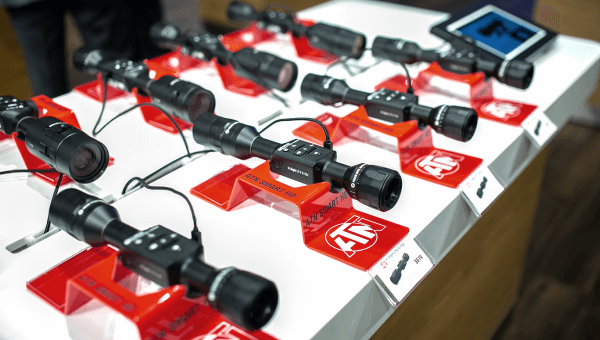
Two ATN TICO 6 clip-ons keep coming up as the best cheap thermal clip on for coyote hunting, and hunters get stuck choosing between them: the 640x512 and the 384x288. Both bolt thermal onto the day scope you already run, both peel apart into a handheld monocular, and both call themselves affordable ways into night hunting. The difference is one feature — sensor resolution — and it ripples out into detection range, weight and price tier. This comparison puts the two head to head, feature by feature, so you can see precisely what the extra pixels buy a coyote hunter and whether your ground needs them.
How the TICO 6 640x512 works
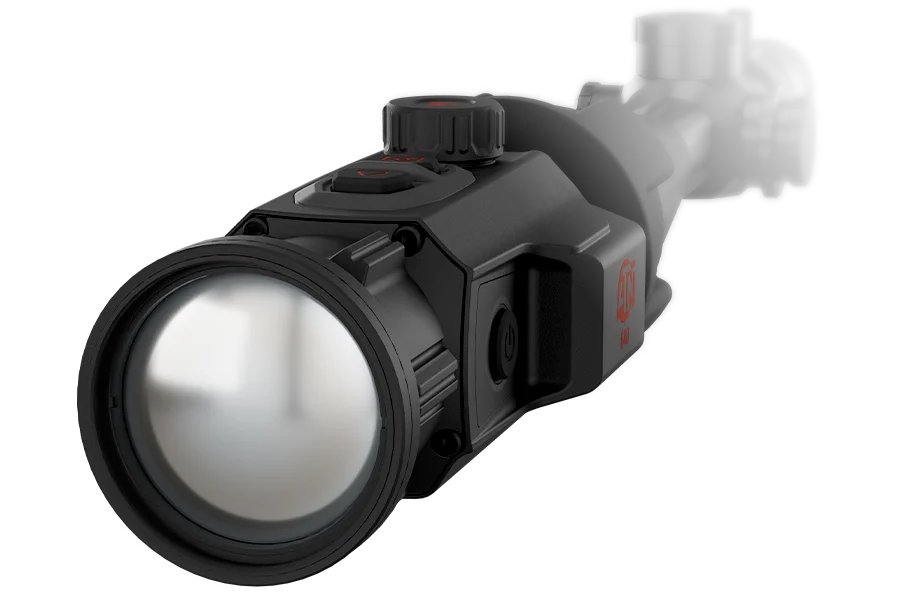
The ATN TICO 6 640x512 1-15x is the flagship clip-on, built around the line's finest sensor. It mounts in front of your day scope's objective with the included Quick Detach mount, feeding a thermal picture through your existing crosshair so your zero never moves. The key spec is that 640x512 core: it draws the scene with roughly four times as many heat-reading dots as a 384 sensor, the jump from a standard-definition picture to HD. On a coyote that means the animal keeps its shape — ears, legs, the line of the back — at ranges where a coarser sensor smears it into a warm blob. A 50 mm germanium lens and 3500 m detection push that clarity to the far edge of a big field, and SharpIR AI enhancement, Recoil Activated Video and Hot Point Tracking round out the package.
How the TICO 6 384x288 works
The ATN TICO 6 384x288 1-12x works the same way — clip in front of the day optic, or pull the removable eyepiece and scan with it as a monocular — but it uses a 384x288 sensor and a 35 mm lens. That still resolves a coyote cleanly at the distances most dogs are actually shot, and it shares the same ≤18 mK sensitivity, so faint heat off a cool background still lifts out. Detection reaches about 2710 m, plenty for field edges and mixed cover. It's lighter at 524 g, runs about 8 hours on a single 18650 cell, and sits in the mid, value tier rather than the flagship one. The trade is at long range: past the point where the 384 starts to soften, the 640 still shows a clear, identifiable dog.
When to choose the TICO 6 640x512
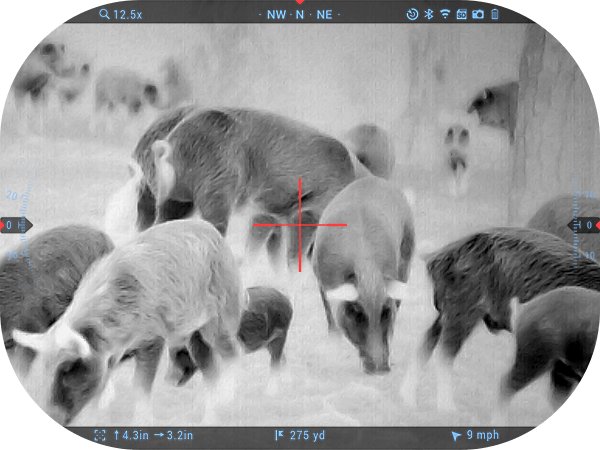
Choose the 640 when your coyote ground is open and your shots stretch. Big ag fields, desert flats and cut pasture let a dog hang up at distance, and that's exactly where the higher-resolution sensor earns its keep — you can confirm it's a coyote and read its body language before you commit, instead of squinting at a smudge. The longer 3500 m detection also buys reaction time on a dog that appears far out and moves fast. It costs more and weighs a touch more, so the honest case for it is terrain, not bragging rights: if you regularly need to identify targets past where a 384 goes soft, the flagship sensor pays for itself in cleaner, more confident shots.
When to choose the TICO 6 384x288
Choose the 384 when you want to spend less, carry less, and most of your shots fall inside mixed cover. Field edges, fence lines, brushy corners and cut corn make up the bulk of coyote hunting, and at those ranges the 384's sensor reads a dog plainly — the extra pixels of the 640 mostly matter beyond where you'd shoot anyway. It's the lighter unit for a night on foot, it gets a slightly longer battery run, and it lands in the value tier. If you don't routinely glass across a full section, the 384 gives you the clip-on-and-monocular flexibility without paying for reach your ground never uses.
Our recommendation
For the surest coyote identification and the reach that open ground demands, our pick is the ATN TICO 6 640x512 1-15x. The single feature that separates these two — sensor resolution — is the one that decides whether a dog at the far edge of a field reads as a coyote or a question mark, and for a hunter who works open country that clarity is worth the step up in price. If your shots stay inside mixed cover, the 384x288 is the smarter, lighter spend, and a hunter on the tightest budget can even step down to the compact 256x192 for close timber work. See all three side by side on the ATN thermal clip-on page and match the sensor to your longest realistic shot.
How we compared them
This is an in-house comparison of two units from ATN's own current 6th-generation TICO 6 clip-on range, not an independent lab test. We held everything constant except the one feature that actually separates them — sensor resolution — and traced how it drives detection range, long-distance identification, lens size, weight and price tier against the real distances a coyote hunter faces. We judged both on clean identification of a small target (resolution and NETD), reach for the terrain (detection range), and practicality for a night on foot (weight and battery). We recommend the 640 for open ground because the finer sensor keeps a dog identifiable where the 384 softens; the 384 wins on value and carry weight for mixed cover. Neither is the right tool if you'd rather run a permanent dedicated thermal weapon sight than clip thermal onto your day scope. Weigh the resolution difference against how far you actually shoot before you decide.
Frequently Asked Questions
Is the 640x512 or the 384x288 the better cheap clip-on for coyotes?
It depends on your ground. The 640x512 gives the clearer, longer-range identification that open flats demand, while the 384x288 costs less, weighs less, and handles the mixed cover where most dogs are called. Neither is simply better; match the sensor resolution to your longest realistic shot and your budget.
What does the higher 640 resolution actually change on a coyote?
It keeps the animal's shape sharp at longer range. With roughly four times the heat-reading dots of a 384 sensor, the 640 holds a coyote's ears, legs and outline where a coarser sensor blurs it into a warm smudge. That difference matters most past the range where you can still identify a target with the 384.
How does a TICO 6 clip-on mount to my rifle?
It attaches in front of your day scope's objective with the included Quick Detach mount and feeds a thermal image through your existing optic. Your reticle, magnification and zero stay exactly as they were, so there is no new sighting system to learn. Both the 640 and 384 mount the same way and both convert to a handheld monocular when you remove the eyepiece.
Does the cheaper 384 give up sensitivity to the 640?
No. Both share the same ≤18 mK NETD, so both detect the same faint temperature differences and lift a coyote off a cool background equally well. The difference between them is resolution and detection range, not thermal sensitivity. That is why the 384 remains a capable coyote optic at normal shooting distances.
Which is lighter to carry all night?
The 384x288 is lighter at 524 g versus 564 g for the 640, and it gets a slightly longer battery run. Over a full night of walking and calling, that weight and runtime edge is noticeable. If carry comfort ranks high and your shots stay moderate, the 384 has the advantage.
Can either one work as a standalone scanner?
Yes. Both have a removable eyepiece that turns the clip-on into a handheld thermal monocular, so you can scan for dogs between stands and only mount to the rifle when one commits. This dual role is a big reason both count as good value. It also spreads their usefulness to scouting and property checks.
Is there an even cheaper TICO 6 than the 384?
Yes, the compact 256x192 1-8x sits below the 384 as the budget-tier step. It suits tight timber and short-range calls where you do not need long detection, and it is the lightest in the line. For open-country work, though, step up to the 384 or the 640 so distant dogs stay identifiable.
The choice between these two clip-ons comes down to one feature and one question: how far do you really shoot coyotes? If your ground is open and your dogs hang up at distance, the extra resolution of the ATN TICO 6 640x512 1-15x keeps them identifiable and your shots confident. If you work mixed cover and want to spend and carry less, the 384x288 is the value pick. Compare both, plus the compact 256x192, on the ATN thermal clip-on page and pick the sensor your terrain earns.
Created: August 10, 2026 · 09:39:31 UTC