Cheap Thermal Binoculars for Coyote Hunting 2026
 Most experienced hunters approach cheap thermal optics with healthy skepticism, and history has generally supported that skepticism. Early low-cost thermal devices produced blurry, low-contrast images that made confident animal identification difficult and left hunters questioning whether the investment was worth anything at all. That reputation has stuck around longer than it deserves.
In 2026, the thermal optics market looks meaningfully different. Sensor technology has matured, manufacturing costs have come down, and AI-enhanced image processing has started appearing in units that would have been considered budget-tier just a few product cycles ago. That does not mean all affordable thermal binoculars are equal — there are still units that underdeliver — but it does mean that a careful buyer can find real hunting utility at a price point that used to feel impossible.
This guide is about helping coyote hunters think clearly about what the best cheap thermal binoculars for coyote hunting can actually do, where they still fall short, and how to make a practical purchase decision without being misled by either overblown marketing or outdated assumptions.
Quick Reality Check Before You Buy
Let's be direct about a few things before diving into specific options and categories.
Cheap thermal binoculars are not premium professional-grade optics. At lower price points, you are generally accepting trade-offs in sensor resolution, maximum identification range, image processing sophistication, and sometimes build quality. Those trade-offs are real and matter more in some hunting situations than others.
That said, they can still be genuinely useful for coyote hunting. Detection — spotting a heat signature in a dark field — is well within the capability of affordable thermal systems at practical hunting distances. Sustained scanning across fields and brush edges, reducing eye fatigue compared to monoculars, and improving nighttime situational awareness before committing to a shot are all things affordable thermal binoculars can support.
The smartest purchase depends on honest self-assessment: How often do you hunt? At what distances? What conditions do you typically face? What are you willing to accept as a compromise? A hunter who goes out six nights per season has different needs than one who runs calling setups three nights per week through winter.
The ATN Binox 6 Dual fits into this conversation as a practical affordable dual-eye thermal hunting option. Built on ATN's 6th Generation thermal platform with multispectral vision, integrated rangefinding, and field-grade construction, it sits above the absolute entry tier while remaining accessible for hunters who don't want to pay premium-system prices. It is a strong fit for coyote hunters who want real dual-eye scanning comfort and capable thermal detection without overbuying.
Myths About Cheap Thermal Binoculars That Need Addressing
Myth: Cheap Thermal Binoculars Are Useless
This was more defensible a few years ago. Today, entry-tier thermal systems use 12 µm uncooled VOx sensor technology — the same foundational platform that professional systems use, just at lower base resolution. A coyote-sized warm-blooded animal produces a strong heat signature relative to ambient nighttime terrain. Detecting that signature at practical hunting distances does not require a military-grade sensor. The usefulness of an affordable thermal binocular depends heavily on what you're asking it to do and at what range. For field scanning at realistic coyote-hunting distances, the claim that cheap equals useless simply does not hold up in 2026.
Myth: You Must Buy Premium Optics to Hunt Coyotes at Night
Premium thermal optics offer real advantages — higher resolution, longer identification range, more refined image processing. Those advantages matter in specific situations: very long-distance identification, consistently challenging terrain, or professional-grade use. For a hunter scanning a 300-yard pasture on a cold night in Kansas, the practical difference between a capable affordable system and a premium one is narrower than the price gap suggests. The premium tier is not required for effective coyote hunting; it is optimal for certain demanding applications.
Myth: All Low-Cost Thermal Devices Have the Same Performance
This is genuinely false and potentially costly to believe. Thermal sensitivity (measured in millikelvin), image processing quality, refresh rate, and lens quality vary significantly across products at similar price points. A unit with a 50 Hz refresh rate and AI-enhanced imaging will produce meaningfully better results than one with a 25 Hz refresh and no processing enhancement, even at the same nominal sensor resolution. Specification details matter, and buyers who skip past them will occasionally end up with a unit that underperforms in exactly the conditions they hunt most.
Myth: Thermal Binoculars Are Only for Professional Hunters
This myth likely originated when thermal binoculars cost as much as used trucks. In 2026, accessible options have made dual-eye thermal scanning a practical tool for any serious predator hunter, not just those with professional budgets or government contracts. If you hunt coyotes regularly and want the comfort advantage of binocular-format scanning without the monocular fatigue penalty, affordable thermal binoculars are a legitimate option.
Myth: Dual-Eye Viewing Is Just a Luxury
This misunderstands how hunting fatigue actually works. Holding a monocular to one eye for two hours strains the orbital muscles, causes eye divergence fatigue, and accelerates the attention lapses that let coyotes slip through your scanning pattern unnoticed. Binocular-format thermal optics allow a natural two-eye hold that is physiologically more sustainable. On long calling setups, that difference translates into more consistent scanning and fewer missed animals. It is a performance advantage, not merely a comfort preference.
Affordable Thermal Binocular Picks for Coyote Hunting in 2026
Best Affordable Dual-Eye Pick: ATN Binox 6 Dual
Why it matters: For coyote hunters who want genuine dual-eye thermal scanning without the price of a dedicated professional system, the Binox 6 Dual occupies a strong position. Its 6th Generation thermal engine, SharpIR AI-enhanced imaging, and multispectral 4-in-1 design give it more capability per dollar than most units in its category.
What to realistically expect: The 256×192 base configuration provides reliable detection at practical coyote-hunting distances with good contrast on cold terrain. The SharpIR processing pulls cleaner edge definition out of the sensor than raw resolution numbers would suggest. This is a capable scanning tool, not a substitute for premium-tier identification clarity at extreme ranges.
Practical advice: Choose the 256×192 model if your hunting is primarily at moderate distances in open terrain. Consider stepping up to 384×288 or 640×512 if you regularly hunt brush-heavy environments or longer distances where identification detail matters more.
Best for Hunters Upgrading from a Monocular
Why it matters: The upgrade from a monocular to a binocular-format thermal optic is one of the most noticeable comfort improvements in predator hunting. If you've been pressing a monocular to your eye for hours and wondering why you're tired and missing movement, the answer is the format, not the season.
What to expect: The Binox 6 Dual's adjustable interpupillary distance (60–74 mm) and 15 mm eye relief make it physically accessible for most users, including eyeglass wearers. The 0.49-inch OLED display at 1920×1080 with a 50 Hz refresh reduces the visual strain that slower displays create during extended scanning.
Practical advice: Upgrading to a binocular format also means accepting more weight than a monocular. The Binox 6 Dual weighs between 1.56 and 1.61 lbs depending on configuration — manageable for stationary setups, but worth considering if you're primarily a mobile hunter who covers ground between stands.
Best for Long Scanning Sessions
Why it matters: Coyote calling requires sustained attention. The longer you can maintain quality scanning posture without fatigue, the more likely you are to catch the animal that circled wide before committing.
What to expect: Up to 8 hours of battery life from two replaceable 18650 cells, with USB-C external power support for sessions that run longer than a full charge. The standard tripod mount allows you to rest the unit on sticks or a tripod during long sits rather than holding it continuously.
Practical advice: Cold weather reduces battery performance on all lithium systems. Carrying a spare set of 18650 cells is a simple safeguard that costs very little relative to ending a hunt early on a dead battery.
Best for Budget-Conscious Predator Hunters
Why it matters: Every gear category in a predator hunting setup competes for budget. A thermal binocular that covers more ground — handling thermal, night vision, daylight viewing, and rangefinding in one device — reduces the total gear investment compared to buying each function separately.
What to expect: The Binox 6 Dual's 4-in-1 design means you're not buying a separate daylight binocular, a separate rangefinder, or a separate night vision device. The integrated 1,000-yard laser rangefinder (±1 m accuracy) alone replaces a device that otherwise sits in your kit at additional cost and weight.
Practical advice: When comparing total cost of ownership against alternatives, account for the accessories the Binox 6 Dual includes: two 18650 batteries, a charger, neck strap, portable bag, data cable, and lens cap. These items add up quickly when sourced separately for cheaper units that don't include them.
Best for Practical Detection Without Premium Pricing
Why it matters: Many hunters do not need maximum identification range or the highest possible thermal resolution. They need to know something warm is moving at the edge of a field and have enough image clarity to decide whether to call it in or move on. An affordable thermal system built on a quality sensor platform and a 50 Hz refresh rate handles that task reliably.
What to expect: Hot Point Tracking on the Binox 6 Dual automatically flags the warmest object in frame, reducing the cognitive load of systematic scanning and making it harder to miss incoming movement at field edges. Six thermal color palettes let you adjust for terrain conditions: White Hot and Black Hot for clean detection, Iron Red for faster identification against complex backgrounds.
Practical advice: DeFOG mode is worth understanding before your first foggy morning. Activating it when mist or thermal bloom reduces contrast can recover meaningful image clarity during the exact low-light windows when coyote activity peaks.
Best for Beginners Who Want Thermal Awareness
Why it matters: First-time thermal users often overestimate how different thermal is from conventional optics and underestimate how quickly they adapt. A unit that is approachable, starts fast, and does not require complex menu navigation under hunting pressure is a better first thermal optic than a feature-rich system that takes months to use confidently.
What to expect: The Binox 6 Dual starts in under 7 seconds from cold — effectively instant from standby — and the ATN Connect 6 app (iOS and Android) provides an accessible interface for reviewing footage, managing settings, and understanding the unit's capabilities without needing to navigate everything on-device.
Practical advice: Spend time with the unit before your first hunt. The multispectral features — Dual View Switching, picture-in-picture, multiple color palettes — have real field value, but only if you've practiced with them in daylight before trying to use them in the dark under pressure.
ATN Binox 6 Dual: A Detailed Look at the Affordable Pick
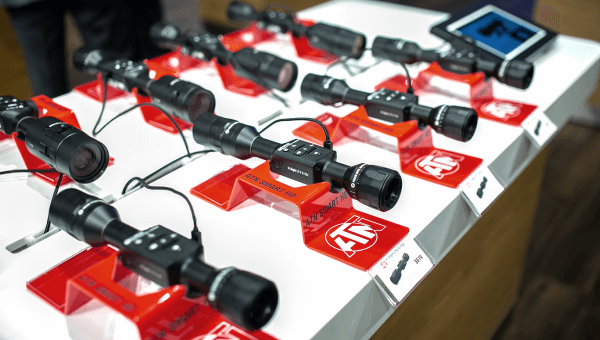
The ATN Binox 6 Dual is a multispectral binocular built on ATN's 6th Generation thermal engine. For coyote hunters evaluating affordable dual-eye options, it warrants a closer look than most units in its price range because it brings features to the affordable tier that typically require stepping up to more expensive systems.
The thermal core is a 12 µm VOx uncooled focal plane array, available in 256×192 (≤20 mK), 384×288 (≤15 mK), and 640×512 (≤15 mK) configurations. All three run at 50 Hz — important for smooth motion rendering when tracking moving animals — and are paired with high-transmission germanium lenses. ATN's SharpIR AI-enhanced imaging processes every frame in real time, improving edge definition and target contrast beyond what the base sensor would produce without processing. Wide Dynamic Range processing balances hot and cool zones in the image, preventing warm objects from washing out cooler background detail that hunters need to read terrain accurately.
The 4-in-1 vision system is a practical advantage for coyote hunters who use their optics across a full hunting day. Day mode uses a 1.8-inch 4K CMOS sensor at 3840×2160 resolution for daylight scouting. Twilight mode covers dawn and dusk. Night Vision mode activates the built-in IR illuminator, rated for visibility to approximately 350 meters without emitting visible light. Thermal mode cuts through darkness, fog, and brush for heat signature detection regardless of ambient light. Dual View Switching lets you run thermal alongside a daytime or night vision image simultaneously, giving terrain context while tracking heat signatures — a combination that helps with shot setup and situational awareness.
The integrated 1,000-yard laser rangefinder (±1 m accuracy) is a practical standout at this price tier. Nighttime distance estimation without a rangefinder is genuinely unreliable, and poor distance calls lead to unethical shots. Having confirmed distance data built into the binoculars changes that equation without adding a separate device to carry.
Physical construction uses magnesium alloy, IP67-rated waterproof and dustproof, with impact-resistant housing. Weight runs between 1.56 and 1.61 lbs depending on configuration. Battery life is rated at approximately 8 hours continuous from two replaceable 18650 cells, with USB-C external power support. Internal storage is 64 GB, supporting 4K daytime and 1080p thermal recording. Built-in Wi-Fi connects to the ATN Connect 6 app.
The Binox 6 Dual is well suited for coyote hunters who want a practical, capable, all-condition optic that handles most of what the full hunting day demands. It is a strong option for hunters who prioritize dual-eye scanning comfort, integrated rangefinding, and multispectral flexibility at a price point below dedicated professional thermal systems. It is not a unit for hunters who need maximum identification range at extreme distances or professional-grade image processing — but for the majority of coyote hunting situations, those limitations rarely determine the outcome of a night in the field.

Buyer's Guide: What to Expect from Affordable Thermal Binoculars in 2026
Detection vs. Identification
Detection is how far out you can register a heat signature. Identification is how far out you can tell what that heat signature is. All thermal binoculars detect farther than they identify. At affordable price points, the identification range is shorter relative to the detection range than it is on premium systems. Understand this distinction before buying, and be honest about how far away your typical shot decision happens.
Sensor Quality and Image Clarity
Thermal sensitivity (millikelvin rating) and image processing quality both determine how useful the image is when animals are at distance or partially obscured. A ≤20 mK rating is the reasonable minimum for hunting use. AI-enhanced processing — present in the Binox 6 Dual — can recover meaningful additional clarity from a base sensor. Refresh rate matters too: 50 Hz keeps moving animals clear; slower rates produce blur during fast movement.
Refresh Rate and Smooth Scanning
A 50 Hz refresh rate is the practical standard for hunting use. Lower rates — common on some truly entry-level units — create a stop-motion effect that makes it harder to track moving animals and can cause visual fatigue during long sessions. Verify the refresh rate of any unit you're considering before purchasing.
Field of View
Wider field of view at low magnification means you cover more ground per sweep. For coyote hunting, the ability to scan broadly and then zoom in to confirm is more valuable than being locked at a single high magnification. Units with flexible zoom ranges — starting at 3x–6x — are generally more practical for predator hunting than fixed-magnification systems.
Battery Life
Honest runtime matters. A unit rated for 8 hours will typically deliver 5–7 hours on a cold night in the field. If your sessions run three hours or more, a minimum 6-hour rating under normal conditions — or replaceable batteries that let you swap mid-hunt — is a practical requirement.
Weight and Comfort
Thermal binoculars are heavier than conventional optics. Most run between 1.5 and 2 lbs. For stationary calling setups where the unit sits on a tripod or shooting sticks, this is not a significant concern. For hunters who carry the unit actively between stands, the weight adds up. Know your hunting style before prioritizing one over the other.
Weather Resistance and Durability
IP67-rated waterproofing handles rain and condensation reliably. Units without a published IP rating should be treated as weather-sensitive until proven otherwise. Dustproof construction matters in agricultural environments where you're scanning crop fields and stubble. Impact resistance determines how many field drops the unit can absorb before something fails internally.
Controls and Ease of Use with Gloves
If you're hunting in January in the Midwest, you're wearing gloves. Controls that require precise fingertip operation become a frustration that breaks your attention at the worst possible moments. Buttons large enough to find by feel, simple menu structures, and quick access to frequently used functions — like zoom and color palette switching — all matter more than they appear to in a showroom.
Cold-Weather Performance
Cold reduces battery capacity, increases condensation risk, and makes controls harder to use. Units with operating temperature ratings down to -22°F and replaceable battery systems that let you swap cold cells for warm spares handle cold conditions better than sealed designs. The Binox 6 Dual is rated for operation down to -22°F (-30°C) with replaceable 18650 cells.
Warranty and Long-Term Value
A warranty is only as good as the manufacturer's customer service. Before purchasing, check what support options exist and whether the manufacturer has a documented track record of honoring warranty claims. A cheap unit from an unfamiliar brand with no service infrastructure is a risk that often does not pay off over multiple seasons.
What Affordable Thermal Binoculars Can Do Well
Inexpensive thermal binoculars in 2026, when properly selected, are genuinely capable of several things that matter to coyote hunters:
- Spotting heat signatures in dark fields at practical hunting distances — coyotes are warm-blooded and produce strong thermal contrast against cold nighttime terrain
- Scanning large open areas, fence lines, and field edges systematically without missing movement at the periphery of a sweep
- Watching brush edges and draws where coyotes approach but haven't committed to an open crossing
- Reducing eye fatigue significantly compared to sustained monocular use, allowing hunters to maintain quality attention longer through a calling session
- Supporting better pre-shot decision-making — seeing that something is in the field, getting closer, and identifying it before committing — which reduces unethical shots and wasted calling time
- Providing thermal awareness during the twilight windows at dawn and dusk when coyote activity is highest and visibility is most difficult for the naked eye
What Affordable Thermal Binoculars May Not Do Well
Honesty here is more useful than optimism. Cheap thermal binos for hunting have real limitations that serious buyers should understand before purchasing:
Lower image detail at distance is the most significant constraint. At extended ranges, base-resolution sensors produce images that detect heat but do not resolve enough detail for confident animal identification. If your hunting regularly involves shot decisions at 500 yards or more, an affordable system may not give you the image clarity you need to hunt ethically.
Shorter confident identification distance is a direct consequence of lower sensor resolution. You may detect a heat signature at 400 meters but only confidently identify it as a coyote at 200 meters. Understanding that gap — and hunting within it — is what separates effective use of affordable thermal optics from frustrating use.
Low budget thermal optics at the absolute entry tier often lack the advanced features that improve situational awareness: no rangefinder, no recording capability, no AI image processing, limited color palette selection. These are not fatal flaws for basic detection use, but they represent functionality you will wish you had once you've hunted with better-equipped units.
Battery and durability trade-offs are more common at lower price points. Sealed battery designs that cannot be swapped in the field, plastic housings without IP ratings, and limited operating temperature ranges are all more common below a certain investment level. These constraints matter most during exactly the conditions — cold, wet, dark — when you're most likely to be hunting coyotes.
Image processing quality varies enormously at the affordable tier. A unit without meaningful processing enhancement will show you raw sensor data, which at base resolution looks noticeably coarser than a processed image from a comparable sensor. If a unit doesn't specify its image enhancement features, assume the processing is minimal.
Thermal Optics Comparison Table
| Option Type | Best For | Main Advantage | Main Limitation | Honest Value Verdict |
|---|---|---|---|---|
| Thermal monocular | Mobile hunters, lightweight kits | Compact, portable, lower cost | Eye fatigue on long sessions, one-eye use only | Useful but physically limiting for extended calling setups |
| Cheap thermal binoculars | Budget-conscious hunters, beginners | Dual-eye comfort at lower entry cost | Variable image quality, fewer features, durability risk | Worth considering if specs are verified; skip if no IP rating or refresh rate listed |
| Mid-range thermal binoculars | Regular weekend hunters | Better processing, more features, stronger build | Higher cost than entry options | Strong value for hunters who go out 10+ nights per season |
| Premium thermal binoculars | Professional use, extreme range | Maximum resolution, best identification range, advanced features | High cost; performance often exceeds typical coyote hunting requirements | Justified for professional predator control or long-range identification demands |
| ATN Binox 6 Dual | Serious coyote hunters wanting dual-eye value | 6th Gen thermal, 4-in-1 multispectral, integrated rangefinder, IP67 | Heavier than a monocular; higher configurations increase cost | Strong affordable pick for hunters who want real capability without premium pricing |
Pros and Cons: Affordable Thermal Binoculars for Coyote Hunting
| Pros | Cons |
|---|---|
| Dual-eye viewing reduces fatigue during multi-hour scanning sessions | Base resolution units have shorter confident identification distances than premium systems |
| 6th Generation thermal sensor with ≤20 mK or ≤15 mK sensitivity provides real detection capability | Heavier than a monocular; less practical for mobile-only predator setups |
| SharpIR AI processing improves image clarity beyond raw sensor output | Feature-rich multispectral system has a learning curve for new thermal users |
| 4-in-1 vision modes eliminate the need for separate daylight, night vision, and thermal optics | Cold weather reduces practical battery runtime below the rated 8-hour maximum |
| Integrated 1,000-yard laser rangefinder improves shot accuracy without a separate device | Higher-resolution configurations cost more, partially reducing the affordable positioning |
| IP67 waterproof, dustproof, and impact-resistant for genuine field conditions | Not suited for extreme-range professional identification demands |
| Replaceable 18650 batteries allow mid-session swaps; USB-C external power extends runtime | On-device menus require familiarization before hunting under pressure |
| 64 GB internal storage and Wi-Fi eliminate need for external media and devices | Weight between 1.56–1.61 lbs requires a neck strap or rest during extended sessions |
Who Should Buy the ATN Binox 6 Dual
The Binox 6 Dual is a practical match for coyote hunters in the following situations:
- Hunters who want dual-eye comfort: If you've been using a monocular and your eyes are fatiguing after an hour of scanning, this solves the problem directly and sustainably.
- Hunters who scan for long periods: The 8-hour battery, tripod-mountable design, and OLED display all support extended calling setups without the physical degradation that shortens useful scanning time.
- Buyers skeptical of expensive thermal optics: The Binox 6 Dual delivers a feature set that is difficult to dismiss — 6th Generation thermal, integrated rangefinder, recording, IP67 construction — at a price point that does not require justifying to your spouse at length.
- Hunters upgrading from handheld monoculars: The jump from a basic monocular to a multispectral binocular with rangefinding and recording is a genuine platform upgrade, not just a marginal improvement.
- Budget-conscious predator hunters: The 4-in-1 design replaces multiple separate devices, which reduces total gear cost and simplifies the kit.
- Beginners who want practical thermal awareness: Fast startup, approachable controls, and a companion app make this accessible to hunters new to thermal without sacrificing the capability to grow with the system.
- Hunters looking for affordable dual-eye thermal hunting in 2026: This is a unit that delivers genuine dual-eye thermal scanning at a price that does not require a professional-grade budget to justify.
Who Should Spend More
There are hunters for whom the Binox 6 Dual is not the right answer, and being honest about that is part of making a useful recommendation.
If you run professional predator control operations where you're hunting multiple nights per week across large properties and making frequent long-range identification calls, the additional resolution and processing of a premium system may translate into measurable performance improvements over a full season. The economics of professional use favor the highest-capability tool more strongly than recreational use does.
If maximum detection and identification range is a primary requirement — because your hunting consistently involves scanning at 600 yards and beyond where confident coyote identification before a shot is critical — the 640×512 higher-resolution configurations or dedicated premium systems offer more identification detail at those distances.
If you hunt in consistently severe conditions — dense fog every night, extreme temperature swings, heavy brush that requires pulling heat signatures from very complex thermal backgrounds — advanced image processing from premium-tier units may produce consistently better results than capable mid-tier processing.
For everyone else — hunters who go out regularly, hunt at realistic coyote-hunting distances, and want a dependable, well-built optic that handles everything the hunting day asks of it — a well-chosen affordable unit represents a sound investment without the premium price.
Frequently Asked Questions
What are the best cheap thermal binoculars for coyote hunting in 2026?
The best cheap thermal binoculars for coyote hunting in 2026 are units that combine a 12 µm sensor, ≤20 mK or better thermal sensitivity, a 50 Hz refresh rate, dual-eye comfort, and weather-resistant construction — without requiring a premium-tier investment. The ATN Binox 6 Dual meets those criteria and adds 4-in-1 multispectral vision, an integrated 1,000-yard rangefinder, and AI image processing that most units at comparable price points do not offer.
Are cheap thermal binoculars actually useful for hunting?
Yes, with realistic expectations. Affordable thermal binoculars are well suited for detecting coyote-sized heat signatures at practical hunting distances, scanning fields and brush edges, and reducing scanning fatigue compared to monoculars. They are not substitutes for premium systems when very long-range identification or professional-grade image clarity is required. For the majority of recreational coyote hunting situations, a capable affordable thermal binocular is genuinely useful.
Can inexpensive thermal binoculars detect coyotes at night?
Yes. Coyotes produce a strong thermal signature as warm-blooded animals on cold terrain. Even base-tier thermal systems with modest sensor resolution reliably detect coyote-sized animals at practical hunting distances under normal nighttime conditions. The limitation at lower price points is identification clarity — confirming it is a coyote specifically — not basic detection capability.
Are cheap thermal binos for hunting better than a thermal monocular?
For sustained scanning, yes. The dual-eye binocular format reduces eye fatigue significantly during extended calling setups. Cheap thermal binos for hunting are generally heavier and more expensive than monoculars, but the comfort advantage pays off in more consistent scanning and fewer missed animals during long sessions. For short outings or mobile hunting where weight is the priority, a monocular may still be the better fit.
What should I expect from low budget thermal optics?
Low budget thermal optics can reliably deliver heat signature detection, field scanning, and basic nighttime awareness. Expect shorter confident identification distances than premium systems, potentially fewer advanced features, and more variable build quality. Verify thermal sensitivity (mK rating), refresh rate, and IP rating before purchasing — these three specifications separate capable affordable units from genuinely disappointing ones.
Is Binox 6 Dual a good affordable thermal binocular option?
Yes, for coyote hunters who want dual-eye scanning comfort and multispectral capability at a price below premium thermal systems. Its 6th Generation thermal engine, SharpIR AI processing, integrated rangefinder, IP67 construction, and 8-hour battery life give it a feature set that outperforms most units at its price point. It is a strong option for hunters who prioritize practical field performance without overbuying for capabilities they won't regularly use.
What is the biggest mistake hunters make when buying cheap thermal binoculars?
The most common mistake is purchasing based on the lowest price without verifying the specifications that actually determine field performance: thermal sensitivity, refresh rate, image processing capability, IP rating, and battery life. A unit that lists a detection range but omits its mK rating, refresh rate, or weather resistance should be treated with caution. The second most common mistake is buying a unit with a fixed or narrow magnification range that prevents the scanning-to-identification workflow that coyote hunting requires.
Are affordable dual-eye thermal hunting optics worth it?
Affordable dual-eye thermal hunting optics are worth it for hunters who regularly sit for extended calling sessions and want sustained scanning comfort. The dual-eye format's physiological advantage over monoculars is real and compounds over a long hunt. If you go out frequently enough that eye fatigue has affected your attention during a calling setup, upgrading to a binocular-format thermal is a practical solution with measurable hunting benefits.
Conclusion: An Honest Take on Affordable Thermal Binoculars for Coyote Hunting
The answer to whether cheap thermal binoculars are worth considering in 2026 is: it depends on which unit, what your hunting demands, and whether you've understood the trade-offs clearly. The blanket dismissal of affordable thermal optics belongs to an earlier era of the technology. The equally blanket claim that any affordable unit is good enough belongs to overenthusiastic marketing copy.
The best cheap thermal binoculars for coyote hunting in 2026 are the ones that deliver reliable detection at practical distances, honest dual-eye scanning comfort, enough image clarity for confident decision-making, and field-grade construction that survives the conditions you actually hunt in. They are not going to replicate the performance of a $5,000 professional thermal system. They are going to give you a meaningful advantage over hunting without thermal, more scanning endurance than a monocular, and a platform that improves your nighttime awareness without requiring a major financial commitment.
The ATN Binox 6 Dual is one of the stronger options in that space — a unit that brings 6th Generation thermal technology, AI-enhanced imaging, multispectral 4-in-1 vision, and an integrated rangefinder to an accessible price point. For coyote hunters who want practical dual-eye thermal scanning in 2026 without the premium price tag, it is a well-considered starting point for a purchasing decision.