Best Thermal Scope Under $1000: Top Entry-Premium Picks

If you’ve been sitting on the fence about getting into night hunting, you’ve probably seen the prices on thermal optics and winced. We get it. Thermal technology used to be something only the military, pest control pros, or guys with deep pockets could afford. But things have changed. Today, the $1,000 mark is the undeniable turning point where thermal scopes stop being a cheap novelty and start being a reliable, game-changing tool out there in the field.
If you are looking for the best thermal scope under 1000, you are in the right place. We’re going to break down exactly what this ""entry-premium"" price point buys you, what you need to avoid, and why spending your hard-earned money here is a much smarter move than scraping the absolute bottom of the barrel.
What You Actually Get Under $1,000
Here’s the deal: a few years ago, a thermal scope under 1000 meant you were buying a toy. You’d get a tiny, low-resolution screen, a choppy image, and a detection range that made a 50-yard shot feel like a gamble. Not anymore.
At this price point today, you are stepping into what we call the ""entry-premium"" threshold. You get realistic, usable hunting technology. We're talking about capable 256x192 resolution sensors built on modern 12-micron cores. You get smooth refresh rates of 50 Hz, meaning the image doesn't lag or stutter when a hog takes off running. You get detection ranges pushing past 1,000 yards.
On top of the core performance, you also get the smart features that used to cost extra. Think built-in video recording, Wi-Fi connectivity to your phone, and multiple color palettes. In plain English, you get a scope that pulls its weight in the field and actually helps you put fur on the ground.
Why This Price Range Matters
Let’s talk about the gap between ultra-budget gear and the entry-premium level. If you look around, you can find thermal scopes for $400, $500, or $600. But heavy compromises live in that sub-$600 range. Those ultra-cheap optics usually run ancient 160x120 sensors with 9 Hz refresh rates. Looking through them feels like watching a blurry slideshow through a screen door.
The $1,000 range matters because it’s where the compromises stop ruining the hunt. You’re paying slightly more, but the jump in image quality, durability, and reliability is massive. It’s the difference between guessing if that glowing blob in the distance is a coyote or a warm rock, and actually knowing. Smart buyers start thinking about long-term value here, not just the upfront price tag.
Cheapest Thermal Rifle Scope vs. Smart Investment
We see it all the time. A hunter types ""cheapest thermal rifle scope"" into a search bar, buys the very first thing that pops up, and ends up totally frustrated. Why? Because the absolute cheapest scopes on the market often can't hold zero on a real hunting rifle. Their internal batteries die in two hours, and their cheap plastic mounts crack when the temperature drops.
Cheapest does not equal best. When you buy the absolute lowest-priced scope available, you are buying a headache. By stepping up to that entry-premium $1,000 threshold, you move from a risky purchase to a smart investment. You get rugged housings, software that actually works, and a device that will survive a bumpy ride in the bed of your truck.
Key Features to Look for at This Level
If you're dropping a grand on a thermal optic, you need to know what specs matter in the dark. Don't just look at the box; look at what the numbers mean for your hunt.
- Sensor Resolution (The 384 vs 640 Discussion): Here’s the reality—at the $1,000 mark, you are looking at a 256x192 sensor. It’s highly capable for hunting inside 150 yards. If you want a 384x288 or a flagship 640x512 sensor to stretch your positive identification ranges out to 300+ yards, you’ll need to increase your budget significantly. But for the vast majority of hunters, 256 resolution is the perfect starting point that gets the job done without breaking the bank.
- Thermal Sensitivity (NETD): Look for a rating of ≤20mK or lower. The lower the number, the better the scope can tell the difference between a warm animal and the cool ground around it, giving you a sharper image.
- Refresh Rate: Demand 50 Hz. Anything lower will stutter and lag when you're tracking a moving target.
- Battery System: Avoid built-in, non-removable batteries. You want a scope that uses standard, rechargeable batteries (like 18650s) so you can swap them out in seconds when you're miles from a charger.
- Ergonomics and Weight: A heavy scope throws off the balance of your rifle. Look for compact, lightweight designs that won't wear you out on a long stalk.
Performance vs Price: Where Compromises Still Exist
Let’s be honest. A $1,000 scope is a massive step up, but it’s still not a $4,000 flagship model. You need to know its limits.
First, let's talk about magnification. When you use digital zoom on a 256-resolution sensor, the image will pixelate faster than it would on a higher-end 640 core. A 100- to 150-yard shot is well within its wheelhouse, but trying to identify small details on an animal at 300 yards gets tough.
Second, extreme weather performance. When the humidity is 100% or a thick, wet fog rolls in, lower-resolution thermals struggle a bit more to push through the moisture compared to high-end sensors. You'll still see the heat signature of an animal, but the background environment might wash out. Acknowledging these limitations is just part of being a smart, prepared hunter.
Real-World Use Cases
How does an entry-premium thermal scope actually perform on the hunt?
Hog Hunting
This is where these scopes shine. Hogs are big, warm targets that usually travel in groups. At 75 to 100 yards, a 256-resolution scope gives you a crystal-clear picture of the sounder. You can easily pick out the biggest boar, check your backstop, and put the crosshairs exactly where they need to be.
Predator Hunting
Coyotes are a different challenge. They're smaller, faster, and often hang up further out. A $1,000 scope is perfect for calling coyotes into that 100-yard sweet spot. You'll detect them coming through the brush from a long way off, giving you plenty of time to get on the gun before they catch your wind.
Scanning vs. Shooting
One great way to use these scopes is simply for scanning your property or lease. You can spot deer moving through the brush long before the sun comes up, letting you plan your morning sit or navigate to your blind without spooking the woods.
Product Spotlight: ATN ThOR 6 Mini (The Value Benchmark)

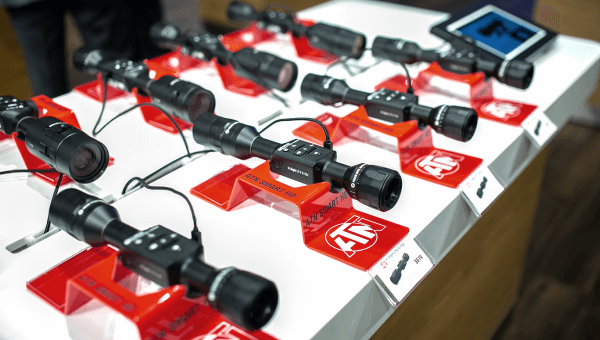
If you want to see exactly what the entry-premium threshold should look like, look no further than the ATN ThOR 6 Mini (specifically the 256x192 models like the ThOR 6 Mini 215). We built this scope to be the absolute benchmark for hunters stepping out of budget compromises and into real performance.
The ThOR 6 Mini punches way above its weight class. It runs on a 12-micron thermal core with an impressive ≤20mK NETD sensitivity rating. In plain English: it cuts through the dark and delivers high-contrast heat signatures even when the conditions aren't perfect.
It’s also built for the real world. The housing is made from rugged magnesium alloy, yet the whole unit weighs under 500 grams (about 1.1 lbs). It won't turn your lightweight AR or bolt gun into a boat anchor.
Powering it is a single, easily replaceable 18650 battery that gives you around 8 hours of continuous run time. No dead internal batteries ruining your night.
Plus, it’s packed with ATN's smart tech: SharpIR© AI image enhancement for crisper edges, Picture-in-Picture (PIP) for zoomed-in precision without losing your wide field of view, and Recoil Activated Video (RAV), which automatically records the 10 seconds before and after you pull the trigger. No more forgetting to hit record when a coyote charges the call.
How to Choose the Right Scope Under $1,000
Picking the right optic comes down to a simple decision framework:
- Hunting Style: Are you hunting tight woods or wide-open fields? If you hunt dense brush, look for a model with lower base optical magnification (like 2x) for a wider field of view so you don't lose fast-moving targets.
- Need for Portability: If you spot and stalk, weight is everything. A compact scope keeps you mobile and reduces fatigue on long hikes.
- Image Clarity vs Weight: You want the best sensor you can afford, but remember that bigger objective lenses add weight. Find the balance that fits your specific rifle setup.
Common Buyer Mistakes
Don't fall into these traps when shopping in this price range:
- Chasing specs without understanding them: A cheap scope might boast ""10x magnification,"" but if it's all digital zoom on a low-res 160 sensor, the image will look like a blurry block of pixels. Focus on optical base magnification and sensor resolution first.
- Ignoring the battery system: A proprietary internal battery means when it dies in the field, your hunt is officially over. Always look for standard removable batteries.
- Confusing marketing claims with real performance: Don't expect a $1,000 scope to give you 4K television clarity at 500 yards. Keep your expectations grounded, and you'll be thrilled with the performance inside your practical shooting ranges.
The Bottom Line
The reality is simple: the $1,000 mark is the smartest entry point into serious thermal hunting. By stepping up to the entry-premium level, you avoid the frustrations of ultra-cheap gear and invest in an optic that actually earns its keep on the rifle. Finding the best thermal scope under 1000 isn't about cutting corners; it's about balancing practical performance, rugged durability, and an honest price.
Whether you're clearing invasive hogs off a ranch or calling coyotes on a freezing winter night, optics like the ThOR 6 Mini prove you don't need to empty your savings account to own the night. Ready to upgrade your hunt? Check out the ATN ThOR 6 Mini and see the difference for yourself.
Spec Box: ATN ThOR 6 Mini 256x192 (Model 215)
- Sensor Resolution: 256×192 (12μm VOx)
- Thermal Sensitivity (NETD): ≤20mK
- Refresh Rate: 50 Hz
- Magnification: 2-16×
- Detection Range: 1,200 meters
- Weight: 500 g / 1.10 lbs
- Battery: Single 18650 Rechargeable (~8 hours life)
- Video Recording: Yes, with Recoil Activated Video (RAV)
- Connectivity: Wi-Fi & USB Type-C
- Housing: Magnesium Alloy (IP67 Waterproof)