The ground you hunt should decide the glass you buy long before the spec sheet does. Timber, a wide open field and rolling brush each ask something different of a scope, and the best 640 thermal scope for one is not automatically right for the next. This roundup matches ATN's 6th-generation thermal scopes to the terrain they shine on. The versatile centrepiece is the ThOR 6 640x512 2-16x, and every option is an ATN model.
Best for wide-open country: ThOR 6 640x512 3-24x — the longest 640 detection in the line.
Best for tight brush and stalks: ThOR 6 384x288 2.5-20x — lightest to swing and carry.
Why terrain, not just range, should pick your 640
Two hunters can both want a 640 scope and need completely different builds, because the shape of the land changes what the optic has to do. In thick timber you rarely see far, so a wider field of view at the low end matters more than a huge top-end zoom. Across a bean field the opposite is true — you want reach and a tight, detailed high magnification to identify a target at distance. Every ThOR 6 here carries the same 640-class sensor tech: SharpIR AI cleaning the image in real time, an <=15mK NETD that survives fog and drizzle, a 50 Hz refresh that keeps motion smooth, and roughly 9 hours of runtime. What changes between them is the lens and zoom band — and that is exactly what terrain should decide.
For mixed timber and field: ThOR 6 640x512 2-16x
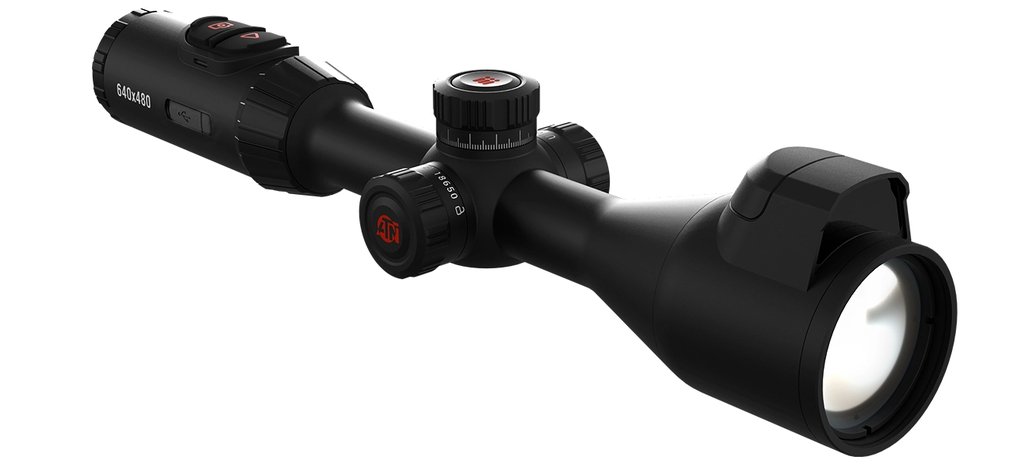
The ThOR 6 640x512 2-16x earns the centrepiece slot because its 2x low end opens a wide field of view for reading a tree line, while the full 640 sensor still reaches a 3100m detection range when the ground opens up. The replaceable 18650 battery system means terrain that keeps you out longer is not a problem.
How it reads the ground
Drop into the timber and the wide bottom end lets you catch a hog slipping between trunks; step out to the edge of a field and you zoom to confirm the same clarity you had up close. This is the ThOR 6 that adapts to whatever the walk-in throws at you.
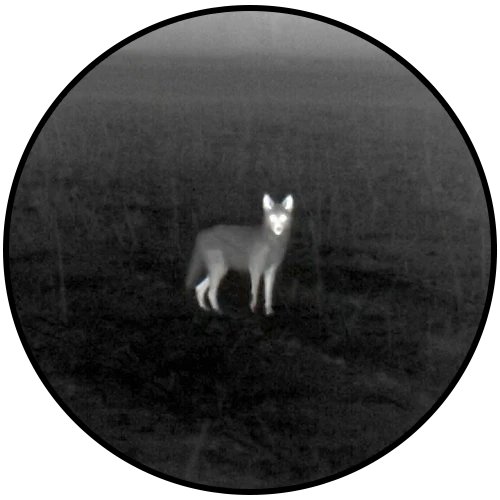
For wide-open country: ThOR 6 640x512 3-24x
When the land is flat and far, the ThOR 6 640x512 3-24x is the terrain match. Its 50mm objective and 3-24x zoom band push detection to 3650m, so you spot and identify a coyote across a section of ground while it is still a distant heat signature.
How it reads the ground
On open country the extra reach turns into more time to make a plan — you see the animal earlier, watch its line, and set up the shot instead of reacting to something that appears at fifty yards. In dense terrain that top-end zoom is wasted, which is why it is the specialist here, not the all-rounder.
For tight brush and stalks: ThOR 6 384x288 2.5-20x
Rough, brushy country where you cover ground on foot rewards the lightest rig, and that is the ThOR 6 384x288 2.5-20x at 790 g / 1.74 lbs. Its 384 sensor and 2300m detection are ample for the short sight lines brush gives you, and six colour palettes help you separate an animal from cluttered background heat.
How it reads the ground
On a stalk you swing the rifle constantly, and the lighter unit is the one that does not wear you down. Sight lines in brush are short, so the 384 sensor gives up nothing you would actually use, and the palette options let you tune contrast to the messy thermal picture that thick cover creates.
How to match a 640 thermal scope to your terrain
- Measure your longest realistic sight line — open fields justify the 3-24x; timber and brush rarely need it.
- Prioritise the low end in cover — a wider field of view finds moving heat between trees better than raw magnification.
- Count your walking — the more you stalk, the more the lighter 384 pays off.
- Use palettes for cluttered ground — brush and heat-soaked soil read better when you can switch contrast.
- Match power to time out — swappable 18650 cells suit terrain that keeps you moving past a single charge.
A night on mixed ground
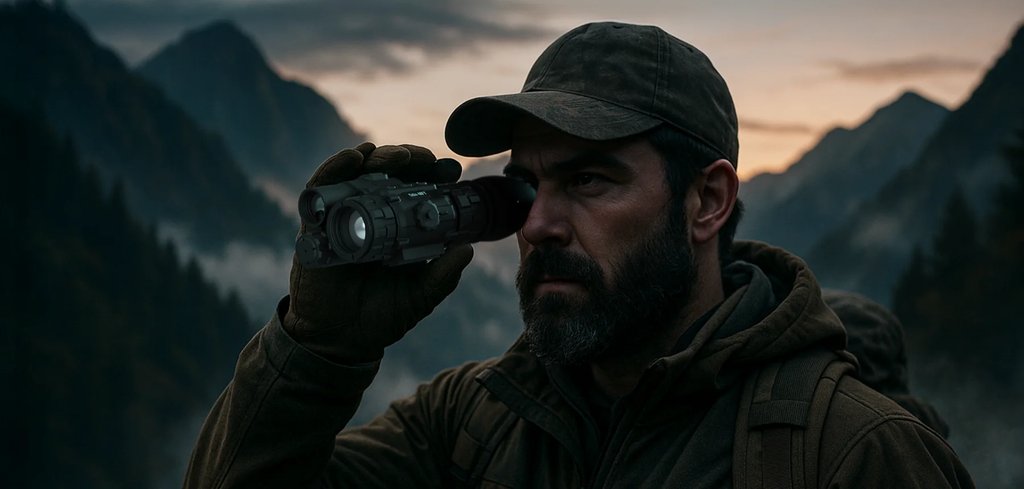
Start the walk-in through a strip of hardwood timber. Sight lines are short and broken by trunks, so you keep the ThOR 6 640x512 2-16x pulled back to its 2x low end, letting the wide field of view catch a hog shifting between stems where a tighter optic would tunnel past it. The timber gives way to a cut cornfield, the ground drops open, and the whole problem changes. Now you thumb the magnification up and let the full 640 sensor and 3100m detection range do the work, glassing the far margin where the field meets brush. Same rifle, same scope, two completely different pieces of ground handled without a compromise between them. That is the terrain argument in a single night: the land keeps changing, and the optic that flexes with it is the one that ends the walk with an animal down rather than a missed chance in the wrong cover.
Reading heat across different ground
Each kind of ground throws a different thermal picture, and the tools that tame it change too. In timber the background is a jumble of warm bark, leaf litter and residual daytime heat, so cycling palettes to lift an animal out of that clutter is what separates a shape from a target. Across an open field the scene is calmer and cold, so the <=15mK NETD earns its keep by holding faint detail on a distant signature. On snow, reflected cold flattens contrast, and here SharpIR's edge cleaning plus a palette switch restore the outline. Learn which combination your terrain wants and the same scope reads three worlds well.
Field of view is a terrain tool
Hunters obsess over top-end zoom, but in cover the low end of the zoom band is the number that matters. A wide field of view lets you sweep a tree line and catch movement between trunks, where a narrow view would slide right past it. That is precisely why the 2-16x suits mixed ground: its open 2x bottom end is a searching tool for tight terrain, and the reach is there for the moment the land opens up in front of you.
A closer look at three landscapes
Timber and thick cover
In woodland you are working a maze of trunks, deadfall and low limbs, and the animal appears and vanishes in a heartbeat. Range is rarely the limiting factor — spotting is. A wide low-end field of view lets you sweep the understorey and catch a hog crossing a shooting lane, and the 640 sensor holds enough detail that you can tell a legal target from a bystander even in the busy heat picture that timber creates. Here the tall zoom of an open-country optic simply gets in your way, narrowing the view when you most need to see wide.
Open fields and cropland
Flat, open ground is the opposite problem. Sight lines run long, cover is thin, and the animal is a small heat signature far out before it is anything you can name. Reach and a tight, detailed high magnification are what matter, so you can identify at the far margin and use the extra distance to plan a line and a rest. Cold, still field air is also the friendliest condition for the <=15mK NETD, which holds faint detail on a distant body when the background is uniformly cool.
Rolling brush and stalks
Broken, brushy country is a walking game. You cover ground on foot, glass short broken sight lines, and swing the rifle constantly, so weight and balance decide how the last hour of the hunt feels. The picture here is cluttered — sun-warmed brush and uneven soil throw heat everywhere — so palette switching and SharpIR do the heavy lifting of separating an animal from its background. The reach you would prize on a field is largely wasted where the next ridge blocks the view.
How each kind of ground shapes your setup
Terrain does not just decide which variant you buy; it decides how you rig and carry it. In deep timber you are often shooting off-hand at close range, so mount the ThOR 6 640x512 2-16x with generous eye relief for quick, awkward positions and keep Picture-in-Picture ready so a zoomed aiming window rides over your wide scanning view. Open country flips the priorities: you can afford a steadier rest, so lean into the high magnification and a tighter aim. Brushy ground that has you on the move rewards a light, balanced build and a scope you can swing without fatigue. The point is that a spec sheet describes a scope in isolation, while your ground describes how it will actually ride on the rifle — set it up for the terrain you spend the most nights in.
Zeroing for the range your ground gives you
There is no single correct zero across mixed terrain — there is a zero that matches your typical shot on the ground you hunt. If most of your timber shots fall inside close range, zero and confirm there; if the fields you hunt stretch the engagement out, set your zero for that distance instead. Zeroing Freeze holds your point of impact steady while you fire the confirming rounds, which makes dialling in for a specific terrain quick and repeatable. Re-check it when you move to a very different piece of ground, because the range that terrain hands you is what your zero should honour.
Weather and season change the ground too
The same field is not the same terrain in July heat and January frost, and thermal reacts to that. On a hot night, ground that soaked up the day's sun radiates back and clutters the picture, so a field that reads clean in winter can look busy in summer — a good moment to switch palettes and lean on SharpIR to lift the animal out of the warm background. Cold, wet nights are kinder to contrast but throw fog and drizzle at you; that is where the <=15mK NETD keeps a distant signature readable when the air turns to soup. Snow flattens everything into a cold, low-contrast sheet, and here Black Hot often separates a warm body from the white ground better than White Hot does. Read the season as part of the terrain and adjust the scope to it, rather than fighting the picture.
One rifle, several kinds of ground
Plenty of hunters cannot dedicate a scope to each landscape, and they do not need to. The 2-16x exists for exactly that hunter: its wide low end handles the cover, its full 640 sensor and 3100m detection handle the open, and the replaceable 18650 cells handle the long walk-ins that link the two. Buy the specialist variants only when your ground is genuinely one-note — nearly all timber, or nearly all open field — because a scope matched to a single terrain will always feel out of place the moment the land underfoot changes.
How we picked these ATN thermal scopes
This is an in-house comparison of ATN's own 640-class thermal scopes organised by terrain, not an independent lab review, so use it to narrow your choice and confirm the specs against the ground you actually hunt. We weighed field of view and magnification band, detection range, sensor resolution, thermal sensitivity (NETD), weight and battery life against timber, open field and brush. Only the current 6th-generation ThOR 6 line was considered. The honest limit: no single scope is perfect everywhere — the open-country pick is overkill in timber, and the brush pick gives up reach you would want on a field. Who it is not for: someone hunting one fixed setup who would rather optimise for range or weight alone.
Frequently Asked Questions
Which 640 thermal scope is best for timber?
The ThOR 6 640x512 2-16x, because its 2x low end opens a wide field of view for spotting movement between trees, while still reaching 3100m when the timber breaks into a field.
Do I need the 3-24x for open-field hunting?
It helps. The 3-24x pushes detection to 3650m and its tighter high magnification identifies a target at distances the field allows, giving you more time to set up the shot.
Is a 384 sensor enough for brushy ground?
Yes. Sight lines in brush are short, so the 384's 2300m detection is ample, and its lighter 790 g body is easier to carry and swing on a stalk.
Does terrain change how thermal performs?
It changes what you need from the optic, not whether it works. Thermal reads heat regardless of cover, but cluttered brush produces a busier picture, which is where the ThOR 6's palettes and SharpIR AI help you separate an animal from background heat.
How long does the battery last across a long walk-in?
About 9 hours per charge, and the 2-16x model takes replaceable 18650 cells so terrain that keeps you out past a single charge is just a battery swap.
Can one 640 scope cover all my terrain?
The 2-16x comes closest, pairing a wide low end for cover with full 640 reach for the open. Pick a specialist only if you almost always hunt one kind of ground.
Ready to match a 640 thermal scope to your ground? Start with the versatile ThOR 6 640x512 2-16x, or compare the full lineup of ATN thermal scopes to find the lens and zoom band your terrain wants. Every model runs SharpIR AI and the Connect 6 app, so whatever ground you hunt, you are set up to read it clearly.
Created: August 5, 2026 · 19:53:40 UTC